
Landing an engineering role across FAANG companies—Meta, Apple, Amazon, Netflix, and Alphabet (Google)—remains one of the most competitive milestones in a developer's career. While thousands of talented engineers apply every day, the majority of rejections do not happen because candidates lack coding ability. Rejections happen because candidates misunderstand how the faang interview process actually evaluates talent.
Big tech hiring operates on a scale unlike any startup or mid-sized business (if you're weighing both paths, explore our breakdown of startup vs enterprise technical interviews). To interview tens of thousands of applicants each quarter across distributed offices and remote hubs, these companies rely on standardized, calibrated pipelines. Individual interviewers rarely have the unilateral authority to hire or reject you; instead, they collect structured evidence to present to independent committees.
In this comprehensive guide, we demystify every phase of the modern big tech hiring gauntlet. From initial recruiter screens and technical filters to full virtual onsite loops, bar raiser assessments, and hiring committee deliberations, here is everything you need to navigate the evaluation pipeline with confidence.
Phase 1: Application, Resume Screening, and Recruiter Calibration
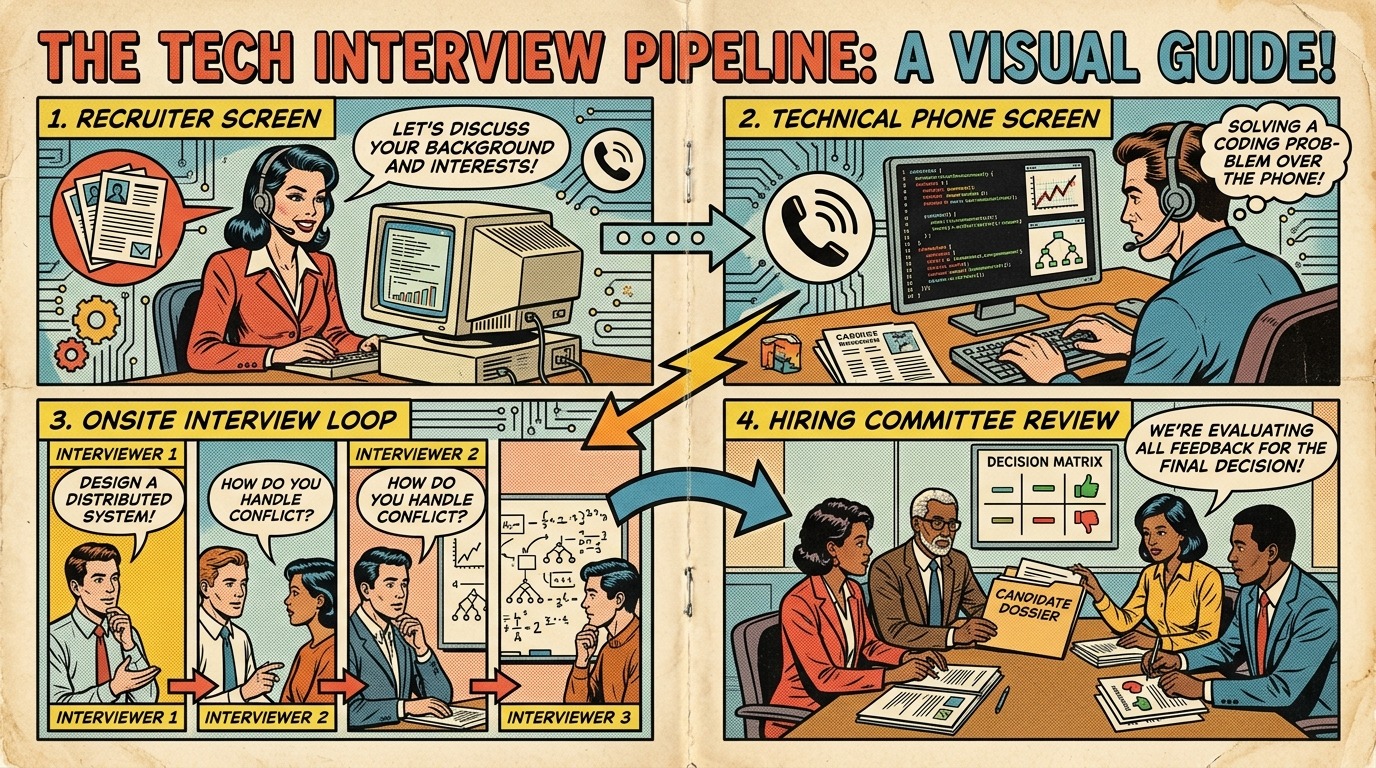
Every FAANG journey starts with initial sourcing. Whether you apply through an internal employee referral, a university recruiting portal, or an inbound outreach message from a technical recruiter, your profile enters an applicant tracking system (ATS) tuned for high-volume calibration.
Candidate Pipeline:
[Referral / Inbound] ➔ [Recruiter Review (30-60s)] ➔ [Initial Screen Call (30 min)]
What Recruiters Screen For
Recruiters spend an average of 30 to 60 seconds reviewing your resume before deciding whether to schedule an introductory call. At this stage, they are looking for clear indicators of scope and impact:
- Quantifiable Engineering Impact: Metrics showing system throughput improvements, latency reductions, revenue enablement, or developer productivity gains.
- Production Complexity: Experience with large-scale distributed architectures, high-concurrency microservices, or complex frontend component systems.
- Relevant Technology Stacks: Core competencies in modern languages such as Python, Java, Go, C++, or TypeScript.
The 30-Minute Recruiter Phone Screen
Once your resume clears the initial filter, you will speak with a dedicated recruiter. This conversation is not a deep technical assessment, but it is an essential calibration step. The recruiter evaluates:
- Role and Level Alignment: Determining whether you match Junior (L3/E3), Mid-Level (L4/E4), Senior (L5/E5), or Staff (L6/E6) requirements based on years of relevant experience and leadership scope.
- Timeline and Compensation Expectations: Assessing your interview readiness, current notice period, and compensation bands.
- Communication and Articulation: Verifying that you can succinctly explain your technical background and past projects without rambling.
If you pass this recruiter screening, your recruiter transitions into your coach. In big tech, recruiters are incentivized to see you succeed; they often provide candidate preparation packets, study guides, and tips on what internal teams prioritize.
Phase 2: The Technical Phone Screen (The Virtual Gatekeeper)
Before committing four to five senior engineers to conduct a full onsite interview, companies evaluate your baseline problem-solving abilities through a remote technical phone screen (follow our targeted remote interview tips for camera setup, audio clarity, and live screen narration).
What to Expect in the Screen
- Duration: Typically 45 to 60 minutes.
- Format: Video conference paired with a shared collaborative text editor (such as CoderPad or internal code-sharing platforms) without syntax auto-completion or code execution.
- Structure:
- 5 minutes: Introductions and brief background overview.
- 35 to 45 minutes: Solving one or two algorithmic coding challenges.
- 5 minutes: Candidate questions for the interviewer.
The goal of this round is to establish a strong technical baseline. The interviewer wants to confirm that you can take an ambiguous problem statement, ask clarifying questions, formulate an optimal algorithmic approach, and write clean, bug-free code.
The Communication Cadence
A common mistake engineers make during the initial technical screen is diving straight into writing code. Silence kills interview momentum. When solving problems over video, top candidates use a structured problem-solving cadence:
- Clarify Constraints: Ask about edge cases (null inputs, empty arrays, integer overflow, scale).
- State Approaches Explicitly: Propose a naive brute-force solution first, state its Big-O time and space complexity, and then introduce an optimized approach.
- Gain Alignment: Confirm that your interviewer agrees with the strategy before typing a single line.
- Dry Run with Test Cases: Step through your written code line-by-line using sample inputs and edge scenarios before announcing that you are finished.
Understanding what interviewers actually look for in tech candidates helps you turn this coding exercise from a nerve-wracking test into a collaborative engineering discussion.
Phase 3: The Virtual Onsite Loop (The Main Gauntlet)
If your phone screen results yield positive feedback, you are invited to the full onsite loop. Historically conducted in person across corporate campuses, nearly all FAANG companies now host these loops virtually.
The onsite consists of 4 to 5 rigorous 45-to-60-minute interviews conducted across a single day or split across two consecutive afternoons.
| Round Type | Typical Count | Target Focus | Key Evaluation Rubric |
|---|---|---|---|
| Data Structures & Algorithms | 2-3 rounds | Array manipulation, Trees, Graphs, DP, Heaps | Algorithmic efficiency, clean syntax, edge case handling |
| System Design & Architecture | 1-2 rounds | Scalability, reliability, data partitioning, trade-offs | Requirements gathering, component design, bottleneck identification |
| Behavioral & Culture Fit | 1 round | Past conflicts, leadership, ownership, teamwork | STAR method responses, self-awareness, alignment with core values |
Algorithmic Coding Rounds
In these sessions, you will tackle medium-to-hard algorithmic problems. Unlike competitive programming, writing obscure one-liners is heavily penalized. Big tech codebases prioritize maintainability, readable variable naming, and modular function design.
If you get stuck on a difficult question or encounter an unfamiliar pattern, review our guide on handling unknown questions gracefully during interviews to discover how proactive communication and hypothesis testing rescue difficult rounds.
System Design Rounds
Required for Mid-level (L4/E4) roles and scrutinized heavily for Senior (L5/E5+) positions, system design interviews evaluate how you architect large-scale distributed systems under real-world constraints.
You will be asked open-ended questions like "Design a real-time notification service," "Architect Twitter's newsfeed," or "Design a distributed key-value storage engine." Success requires leading the conversation:
- Calculating scale (requests per second, daily active users, storage growth).
- Defining API endpoints and database schema trade-offs (SQL vs. NoSQL).
- Addressing fault tolerance, replication strategies, and caching layers.
For a detailed blueprint on navigating these discussions, consult our system design interview preparation guide.
Behavioral Rounds & Cultural Rubrics
Big tech behavioral rounds evaluate whether your working style matches the company's operating principles. Interviewers will press you on specific past experiences using questions like:
- "Tell me about a time you had a major disagreement with a tech lead."
- "Describe a critical production bug you caused and how you remediated it."
- "Give an example of a project where you had to make trade-offs under tight deadlines."
Structuring your stories with the STAR framework (Situation, Task, Action, Result) ensures your answers remain focused and highlight personal ownership. To prepare compelling stories, explore our breakdown of behavioral interview questions for software engineers.
The Hidden Evaluators: Bar Raisers and Hiring Committees
One of the most misunderstood aspects of the big tech hiring pipeline is who makes the final decision. In traditional companies, your hiring manager decides whether or not to give you an offer. In FAANG organizations, hiring managers are deliberately prevented from making unilateral hiring calls.
The Role of the Bar Raiser
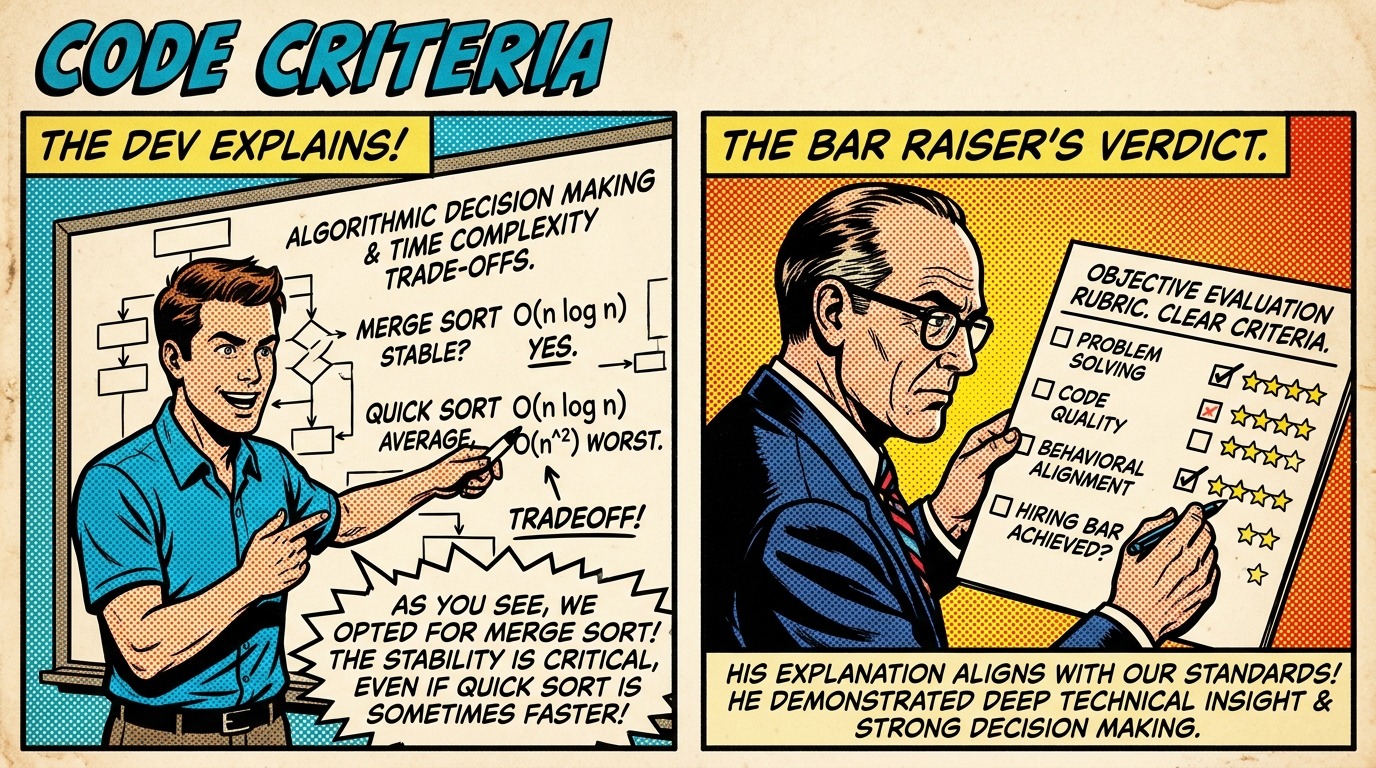
Pioneered by Amazon and adopted in various forms across the industry, the Bar Raiser is an interviewer from an unrelated department or team who holds veto power over hiring decisions.
The Bar Raiser's sole purpose is to ensure that every new hire "raises the bar" relative to the current team's 50th percentile. Because they have no headcount pressure to fill your specific team's opening, they evaluate your candidacy with complete objectivity, preventing managers from compromising on talent standards to meet immediate staffing deadlines.
The Independent Hiring Committee (HC)
At Google and Meta, your complete interview packet—consisting of detailed interview transcripts, your written code, architecture diagrams, and numerical scores—is submitted to an independent Hiring Committee.
The committee reviews the packet blindly:
- They look for consistency across interviewers.
- They identify red flags or conflicting scores.
- They decide whether the evidence justifies an offer and at what exact engineering level.
Because committee members were not in the room with you, your interviewers' written notes are everything. If your code is clear, well-commented, and your explanations are logical, interviewers can capture compelling quotes that advocate for your hire.
How Big Tech Scoring Rubrics Actually Work
Interviewers do not grade candidates on arbitrary gut feelings. Every round is scored against standardized competency rubrics that measure discrete dimensions:
Total Interview Signal:
├── 1. Analytical Problem Solving (Understanding edge cases, decomposing complexity)
├── 2. Technical Craftsmanship (Code cleanliness, correct data structure choices)
├── 3. System Scalability & Architecture (Trade-off evaluation, resilience)
└── 4. Behavioral Competencies (Ownership, collaboration, bias for action)
Each dimension is scored on a standardized four-point or five-point scale, typically ranging from Strong No Hire, No Hire, Leaning Hire, to Strong Hire.
Leveled Expectations
The rubric applied to your packet directly reflects the level you are being calibrated for:
- L3 / E3 (Entry-Level): Focus is on raw algorithmic execution, eagerness to learn, and basic code hygiene. Guidance from the interviewer is expected and acceptable.
- L4 / E4 (Mid-Level): Expected to solve algorithmic problems with minimal prompting, handle complex boundary conditions, and design single-host or small multi-service systems cleanly.
- L5 / E5 (Senior Level): Requires deep ownership, proactive identification of system bottlenecks, broad architectural trade-off mastery, and proven leadership in resolving cross-team conflicts.
- L6 / E6 (Staff Level): Evaluates organizational leverage, multi-year architectural roadmaps, mentorship capacity, and ability to steer strategic technical direction across ambiguity.
If a candidate misses the bar on one round, understanding why candidates miss callbacks after technical screens can help isolate whether the disconnect stemmed from technical depth or behavioral calibration.
Company-by-Company Nuances Across Big Tech
While all FAANG organizations share structural similarities, each enterprise prioritizes distinct cultural and tactical elements:
1. Google (Alphabet)
Google places exceptional emphasis on foundational computer science theory, clean algorithmic efficiency, and "Googleyness" (intellectual humility, collaboration, and comfort with ambiguity). Coding rounds are language-agnostic, and candidates first clear the general hiring committee before entering "team matching."
2. Meta
Meta’s engineering culture is famous for speed and rapid iteration. In technical coding rounds, you are often expected to solve two full algorithmic problems within a single 45-minute interview. System design rounds focus heavily on practical product architecture and handling massive real-time user traffic.
3. Amazon
Amazon’s evaluation framework is anchored by its 16 Leadership Principles (such as Customer Obsession, Ownership, Invent and Simplify, and Dive Deep). In every single interview—including coding rounds—at least 15 to 20 minutes are dedicated to behavioral questions mapped directly to these principles.
4. Apple
Unlike Google or Meta's centralized hiring pools, Apple operates with localized team autonomy. Individual engineering managers hold significant sway, and technical screens frequently test deep language internals (e.g., C++ memory management, Swift concurrency, or low-level OS mechanics) tailored to that specific team's product domain.
5. Netflix
Netflix maintains a renowned high-performance culture centered on stunning colleagues and freedom with responsibility. They historically hire primarily at the Senior (L5+) level, evaluating candidates rigorously against their published Culture Memo and assessing high-level product instincts alongside deep technical depth.
Critical Pitfalls That Disqualify FAANG Candidates
Even experienced engineers frequently stumble over avoidable errors during big tech evaluations:
Common Failure Modes:
[Rushing into Code] ➔ [Missing Hidden Edge Cases] ➔ [Ignoring Interviewer Hints] ➔ [Silent Struggling]
- Jumping Straight into Implementation: Starting to code before clarifying inputs, outputs, and performance constraints signals poor production discipline.
- Ignoring Hints and Redirection: When an interviewer asks, "What happens if this input array is sorted in reverse order?", they are giving you a lifeline. Failing to pivot based on their feedback is an immediate red flag.
- Passive Silence: Sitting silently for minutes leaves the interviewer with zero signal to write in their evaluation rubric. Think out loud constantly.
- Vague Behavioral Stories: Giving generalized answers like "We built an API" rather than detailing your personal contribution ("I designed the rate-limiting middleware using Redis token buckets") prevents the committee from assessing your individual impact.
- Failing to Ask Thoughtful Closing Questions: The final 5 minutes provide a valuable opportunity to demonstrate your engineering maturity. Review these strategic questions to ask your tech interviewer to leave a lasting positive impression.
How to Structure Your 12-Week Preparation Plan
Preparing for the FAANG loop requires disciplined, structured execution rather than haphazard problem solving. Here is an effective 12-week roadmap:
Preparation Timeline:
[Weeks 1-4: Core DSA Patterns] ➔ [Weeks 5-8: System Design & Trade-offs] ➔ [Weeks 9-12: Mock Interviews & Timed Drills]
Weeks 1 to 4: Core Data Structures and Algorithms
- Master pattern recognition: Two Pointers, Sliding Window, Fast & Slow Pointers, DFS/BFS, Topological Sort, and Dynamic Programming.
- Solve 75 to 100 curated problems, prioritizing code cleanliness and verbal explanation over sheer quantity.
- Follow our foundational guide on comprehensive technical interview preparation strategy to organize your daily study schedule.
Weeks 5 to 8: Distributed Systems and Architecture
- Study the building blocks of distributed scale: consistent hashing, message queues (Kafka, RabbitMQ), caching strategies, and database sharding.
- Practice drawing architecture diagrams and calculating back-of-the-envelope estimates under timed conditions.
Weeks 9 to 12: Behavioral Calibration and High-Stakes Mocks
- Assemble 6 to 8 versatile STAR-format career stories that showcase leadership, technical triumphs, and resolved conflicts.
- Conduct simulated interviews to build comfort with real-time pressure.
Using an AI-powered practice environment like totop.app lets you rehearse realistic technical and behavioral rounds with instant, objective feedback tailored to real company rubrics, ensuring you walk into your onsite loop fully prepared.
Conclusion: Turning the Gauntlet into an Opportunity
The FAANG interview process can feel daunting from the outside, but it is fundamentally a systematic, learnable framework. Big tech companies are not looking for perfection; they are looking for clear, collaborative problem solvers who demonstrate structured thinking, strong engineering fundamentals, and the ability to thrive in ambiguous environments.
By mastering the interview cadence, aligning with objective scoring rubrics, and practicing under realistic simulation conditions, you can transform the interview pipeline into your greatest career advantage.
Recommended Next Reads
- What Interviewers Actually Look For in Tech Candidates
- How to Handle Technical Questions You Don't Know the Answer To
- Strategic Questions You Should Ask Your Technical Interviewer
- Comprehensive System Design Interview Preparation Guide
- Behavioral Interview Questions and Winning Frameworks for Software Engineers
Practice Full Stack Engineer Questions Live with AI Mock Interviews
Turn any job description across Engineering, DevOps, Data, Marketing, Sales, Finance, or HR into a personalized test and live voice or text AI mock interview on totop.app, or test your speed right now in the 60-Second Full Stack Engineer Blitz.
Play 60s Full Stack Engineer Blitz (Free, No Login) | Start 14-Day Free Trial | Browse All Interview Guides