Why Traditional Coding Interviews Are Broken
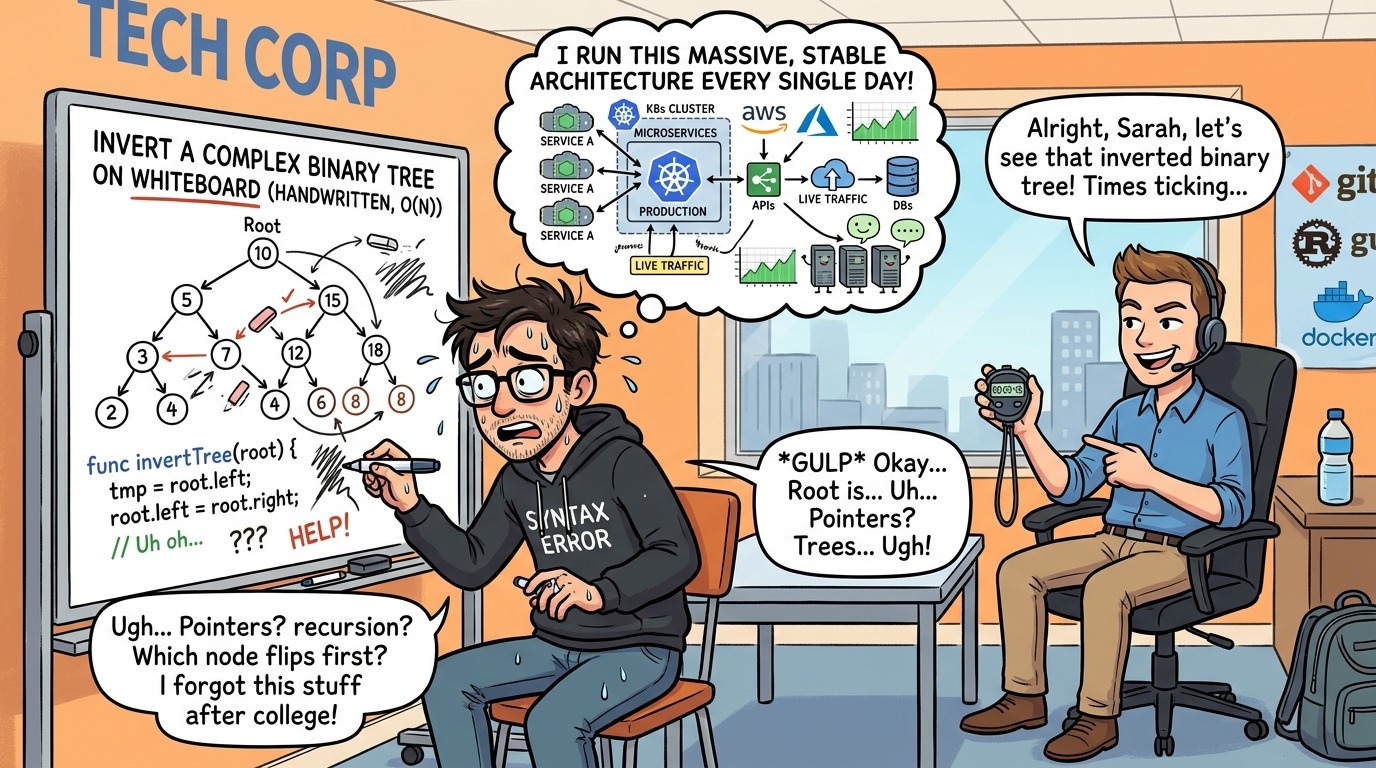
In 2015, Max Howell—the creator of Homebrew, an open-source package manager used by millions of software developers and virtually every engineer at Apple and Google—shared an experience that sent shockwaves across the software industry:
"Google: 90% of our engineers use the software you wrote (Homebrew), but you can't invert a binary tree on a whiteboard so f** off."*
A decade later, despite dramatic advancements in developer tooling, cloud infrastructure, and artificial intelligence, the software engineering hiring pipeline remains largely trapped in the same bizarre time capsule.
Every single day, senior engineers who oversee petabyte-scale distributed systems, maintain mission-critical APIs, and lead cross-functional teams find themselves sitting under an interrogation lamp. Their task? Reverse a singly linked list in fifteen minutes, implement a red-black tree from memory on a dry-erase board, or solve an esoteric dynamic programming riddle involving frogs jumping across lily pads.
If you have ever left a technical interview feeling humiliated, confused, or wondering whether your years of real-world engineering experience were completely worthless, you are not alone. The simple truth is clear to almost everyone who writes code for a living: why traditional coding interviews are broken is no longer a fringe complaint—it is an acknowledged crisis in modern engineering hiring.
The Disconnect: Algorithmic Riddles vs. Real Engineering
The fundamental flaw of the traditional coding interview is an impedance mismatch between the evaluation instrument and the daily reality of the job.
In daily engineering work, software development is an open-book, collaborative, and iterative craft. You spend your hours reading existing codebases, analyzing system telemetry, debating architecture trade-offs with teammates, researching third-party libraries, and writing comprehensive test suites. You use documentation, linters, profilers, and modern AI assistants to write maintainable code that survives in production for years.
In a traditional technical interview, however, the candidate is stripped of all these tools. You are asked to perform an isolated high-wire act with zero external resources, under strict 45-minute countdowns, judged on whether you can conjure an obscure algorithm that was invented in 1974 and already exists in standard language runtimes.
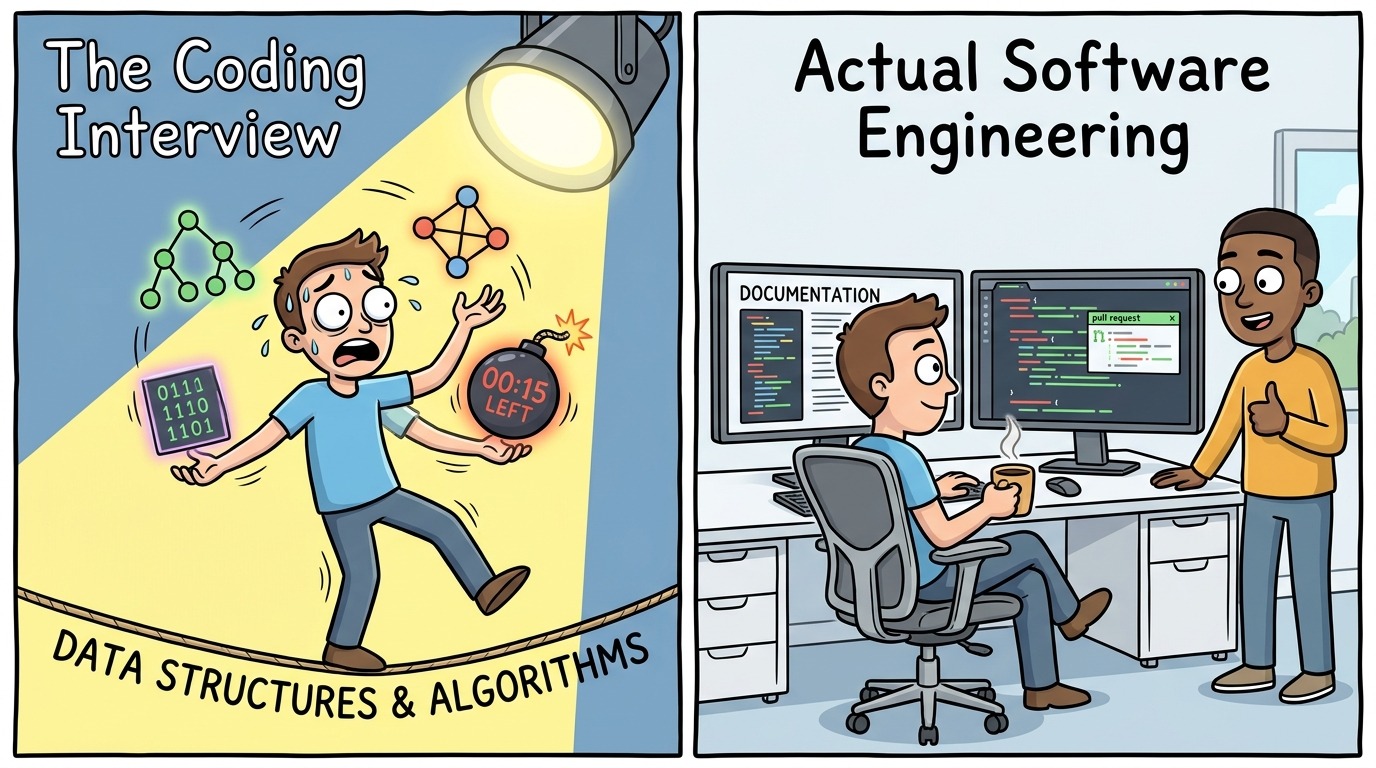
Consider the stark difference between what competitive algorithmic screens reward versus what production software actually requires:
# What competitive algorithmic interviews reward:
# Hyper-compact, obscure bitwise manipulation or memoization with zero safety
def f(a, k):
    m = {}
    return [m[x] for x in a if (k-x in m or m.setdefault(x, len(m)) == -1)]

# What actual engineering teams need in production:
class PaymentTransactionRepository:
    def __init__(self, db_pool: ConnectionPool, logger: StructuredLogger):
        self._db_pool = db_pool
        self._logger = logger

    async def get_reconciled_pairs(
        self,
        transactions: Sequence[Transaction],
        target_delta: Decimal
    ) -> Result[List[TransactionPair], DatabaseError]:
        """
        Identifies offsetting transaction pairs matching target reconciliation delta.
        Includes robust error handling, concurrency control, and audit logging.
        """
        # Explicit variable names, deterministic error handling,
        # observability hooks, and maintainability for the on-call engineer.
        pass
Competitive puzzle solving optimizes for write-once, throwaway code written at breakneck speed. Production engineering optimizes for read-heavy, modular, maintainable systems written to be debugged by someone else at 3:00 AM on a Saturday. By evaluating candidates exclusively on the former, companies systematically misjudge both competence and potential.
The 5 Fatal Flaws of Traditional Technical Screening
To understand why this hiring model causes so much collateral damage, we have to examine the systemic failure points baked into the traditional algorithmic interview format.
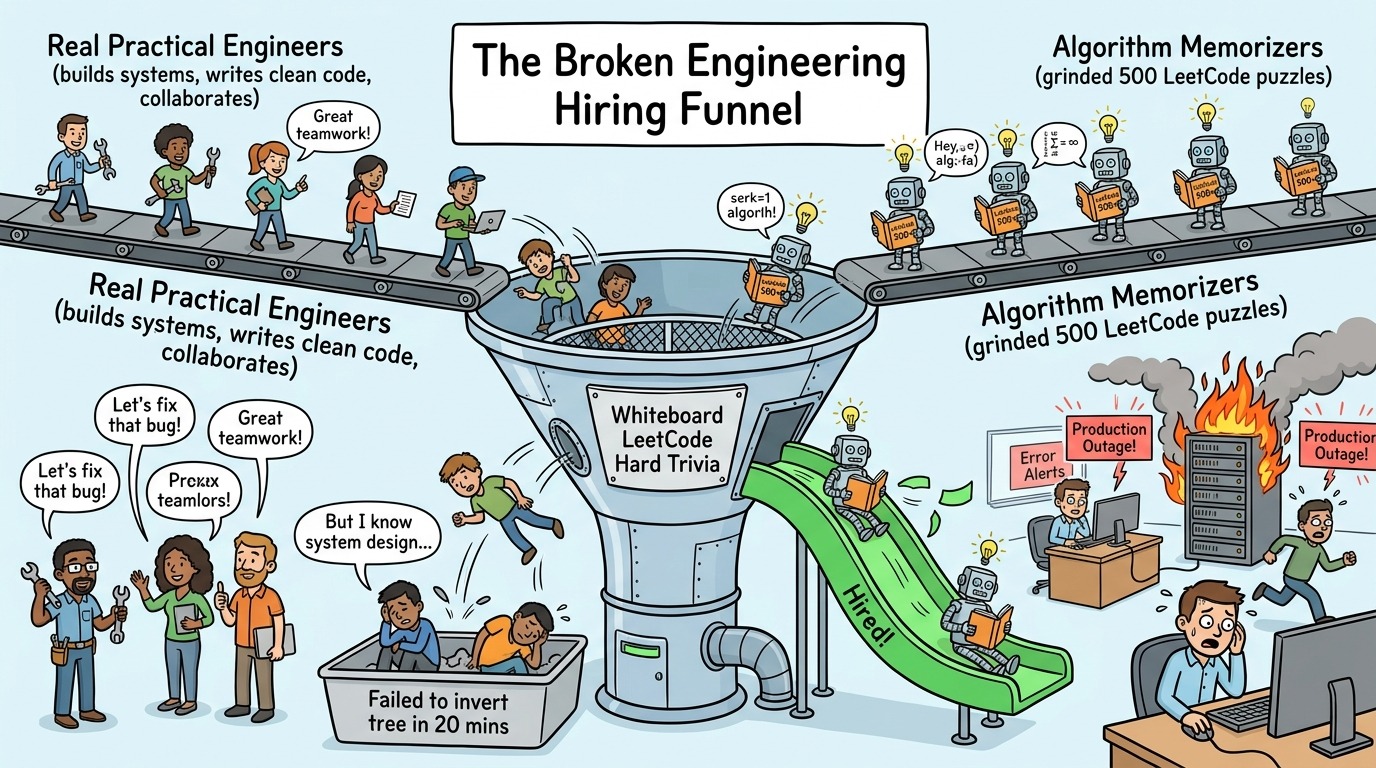
1. Massive False Negatives: Rejecting High-Impact Builders
Traditional whiteboard screens suffer from an astonishingly high false-negative rate. The format filters out exceptional engineers who excel at system design, architectural foresight, API ergonomics, and cross-team execution, simply because they did not spend the preceding six weeks memorizing LeetCode patterns.
Engineering excellence is not a parlor trick. A developer who can build an elastic Kubernetes cluster, debug an asynchronous race condition in PostgreSQL, and mentor junior engineers is infinitely more valuable to a company than someone who memorized Dijkstra's algorithm the night before. Yet the traditional screen treats the latter as superior.
2. High False Positives: Memorization Masks Architectural Incompetence
When a hiring process relies on known puzzle sets, candidates inevitably optimize for the test. An entire cottage industry of bootcamps, flashcards, and algorithm-grinding platforms has trained candidates to recognize archetypal problem signatures and regurgitate optimal solutions in under twenty minutes.
The dangerous consequence for engineering organizations is the false positive: hiring candidates who excel at short-term puzzle memorization but lack basic software hygiene. They struggle when faced with messy legacy codebases, cannot write effective unit tests, fail to structure clean domain models, and have no intuition for how distributed services behave during network partitions.
3. Artificial High-Stress Environments Invalidate Realistic Signal
Placing a candidate under a ticking stopwatch while two senior engineers stare silently at their cursor triggers an acute sympathetic nervous system response: fight-or-flight. Cortisol spikes, working memory contracts, and cognitive bandwidth drops by up to 50%.
Testing someone's cognitive performance under artificial psychological panic does not measure how they will perform on a standard Tuesday afternoon. It measures how well they tolerate stage fright. As we explore in our comprehensive analysis of why 90 percent of candidates fail technical interviews, the primary bottleneck is rarely lack of technical intellect—it is an artificial testing format that paralyzes the candidate's executive function.
4. The "Interviewer Ego" Trap
Interviewing is a skill that few software companies properly train their engineers to perform. In many organizations, engineers are pulled into interviews with little guidance other than: "Find out if they are smart."
Without structured rubrics, interviewers fall into the ego trap. They pick problems that they personally find clever or problems they recently spent days solving in their own project work. The interview ceases to be an objective evaluation of the candidate's capabilities; it becomes an exercise where the interviewer feels intellectually superior because they already know the punchline to the riddle. To counter this dynamic, engineering candidates must understand what interviewers actually look for behind closed doors so they can redirect the conversation toward authentic collaboration.
5. Zero Signal on Teamwork, Code Review, and Humility
Writing software in a modern enterprise is an intensely social endeavor. Success depends on how you deliver constructive feedback in pull requests, how you receive critical reviews of your own code, how you manage technical debt, and whether you can admit when you do not know something.
Whiteboard algorithm exams provide exactly zero data on these qualities. A candidate can be condescending, defensive, and uncollaborative, yet receive a glowing "Strong Hire" recommendation simply because their topological sort completed with $O(V + E)$ complexity. Conversely, a thoughtful, collaborative candidate who asks great questions but gets stuck on a dynamic programming edge case gets rejected.
Traditional Whiteboard vs. Modern Practical Assessment
What should modern technical hiring look like instead? Progressive engineering organizations have begun replacing arbitrary algorithmic interrogations with realistic, practical assessments:
| Evaluation Dimension | Traditional Whiteboard / LeetCode | Modern Practical Assessment |
|---|---|---|
| Primary Skill Evaluated | Memorized algorithmic patterns & puzzle tricks | Practical system building & clean code craftsmanship |
| Working Environment | Whiteboard or locked-down browser pad with no docs | Full IDE with linter, official documentation, and debugger |
| Problem Domain | Abstract math riddles (inverting trees, knight tours) | Real domain tasks (refactoring an API endpoint, fixing a bug) |
| Collaboration Style | One-sided interrogation under a ticking timer | Pair programming simulating real daily teamwork |
| Error Handling & Tests | Ignored in favor of speed and raw time complexity | First-class evaluation criteria with realistic edge cases |
| Predictive Validity | Poor correlation with on-the-job engineering success | High correlation with architectural and team effectiveness |
When companies shift toward practical assessments—such as asking candidates to review a sample pull request, debug an intermittently failing integration test, or walk through realistic trade-offs—the signal-to-noise ratio improves dramatically.
Furthermore, assessing how a candidate behaves when encountering ambiguity is vastly more informative than seeing whether they know a trick formula. When you hit a roadblock during any screen, knowing when you don't know the answer in a technical interview and navigating that moment with transparency and structured reasoning is what distinguishes seasoned engineers from panic-stricken memorizers.
How Candidates Can Navigate the Broken System Today
While the tech industry slowly evolves its hiring methodologies, job seekers still have to live in the reality of today's market. You cannot unilaterally change an employer's interview format, but you can change how you play the game.
Reframe the Interview as a Collaborative Pairing Session
When an interviewer hands you a standard algorithmic problem, do not immediately rush into silent coding panic. Actively dismantle the adversarial dynamic:
- Clarify Constraints Aloud: Treat the prompt as an ambiguous product specification. Ask about input scale, memory constraints, expected data types, and error scenarios.
- State the Naive Solution First: Never be ashamed of a brute-force approach. State it plainly: "A straightforward solution checks every combination in $O(N^2)$ time. Before we optimize, let me verify that this logic holds."
- Think as a Colleague, Not a Test-Taker: Speak your hypotheses out loud. If you are debating between a hash map and a two-pointer approach, voice the trade-offs: "Using a set gives us $O(1)$ lookup at the cost of $O(N)$ auxiliary memory. If memory is constrained on this worker node, we could sort in-place instead."
Build Realistic Muscle Memory with AI Simulation
The greatest hurdle in technical interviews is the cognitive overload caused by performing under observation. When you practice exclusively by typing code silently into an automated judge, you fail to build the verbalization muscles required during live screens.
Platforms like totop.app address this exact gap. Rather than forcing you into endless rounds of disconnected trivia, totop.app provides AI-powered mock interviews tailored to specific job postings and actual company roles. You practice articulating design trade-offs, answering rigorous follow-up questions, and navigating complex technical scenarios in a supportive, realistic simulation. By the time you sit in front of real hiring managers, articulating your technical reasoning feels second nature.
For candidates assembling their end-to-end study timeline, our complete technical interview preparation guide offers a structured roadmap that balances foundational algorithmic competence with practical systems architecture and behavioral storytelling.
The Path Forward: How Engineering Teams Must Evolve
If you are an engineering manager, tech lead, or hiring committee member reading this, the responsibility to fix this broken paradigm rests squarely in your hands:
- Stop Asking Esoteric Brainteasers: Unless your team is literally authoring a new database storage engine or writing low-level compiler passes, stop testing candidates on red-black tree rebalancing.
- Assess Real-World Codebases: Give candidates a realistic, small repo with a failing test and ask them to fix the bug, or present a messy 50-line controller and pair with them to refactor it into clean domain layers.
- Value Communication Over Speed: Grade candidates on how well they explain their thought process, how gracefully they accept feedback, and how rigorously they consider edge cases.
Traditional coding interviews are broken because they measure everything except what actually matters: building reliable software with other human beings. The companies that realize this and modernize their hiring processes will continue to win the battle for top engineering talent—while those that cling to whiteboard trivia will wonder why their production systems keep falling apart. To see how forward-thinking engineering organizations and candidates are navigating this shift, explore our comprehensive guide on how AI is changing the hiring process in tech.