The Future of Technical Interviews: AI and Beyond
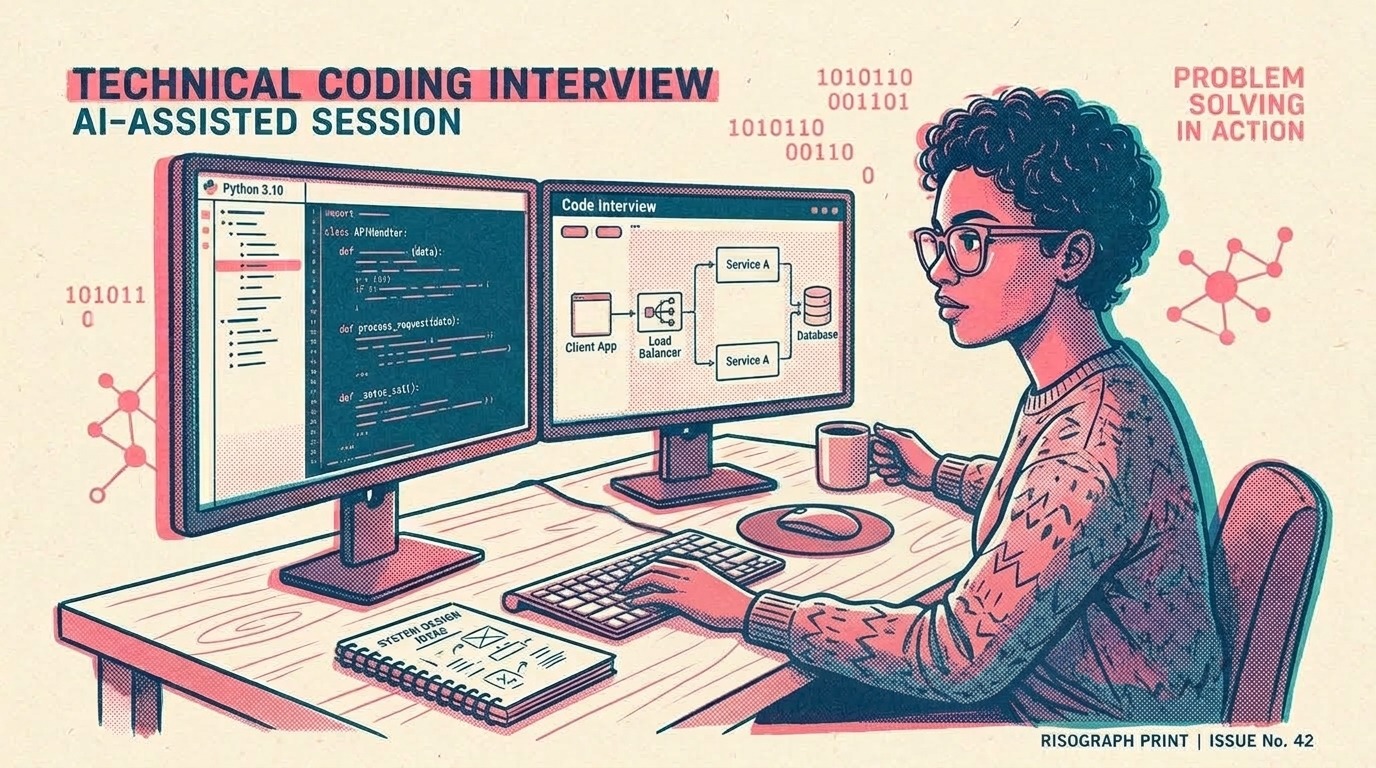
For more than two decades, software engineering hiring revolved around a predictable, highly ritualized rite of passage. Candidates spent months grinding hundreds of algorithmic puzzles, memorized the intricacies of red-black tree rebalancing on dry-erase whiteboards, and rehearsed dynamic programming edge cases in silent dread.
Over the past two years, generative AI coding assistants, autonomous developer agents, and multimodal reasoning engines dismantled that playbook. When an LLM can parse a LeetCode problem, generate idiomatic C++ or Python in three seconds, and explain the time complexity faster than a human can finish typing the problem statement, traditional algorithmic grilling ceases to provide meaningful signal.
Testing whether a candidate can recite Dijkstra’s algorithm from memory measures recall, not engineering capability. The industry stands in the middle of the most consequential paradigm shift in engineering hiring since the web era began. In this deep dive, we examine how the future of technical interviews is changing—from automated screening pipelines and AI pair-programming rounds to the enduring primacy of human architectural judgment.
The Collapse of Whiteboard Trivia and Memorized Riddles
The standard coding screen failed because it measured an artificial proxy for software engineering. In day-to-day product development, developers do not write balance checks for binary search trees from memory without an IDE or documentation. They read existing codebases, compose distributed APIs, handle failure scenarios, inspect race conditions, and navigate messy domain requirements.
When candidates began discretely feeding screen-shared interview questions into background models or voice-to-code pipelines, companies responded initially with aggressive surveillance software: gaze tracking, browser locking, and keystroke recording. However, engineering leaders quickly recognized the fundamental flaw in that arms race: banning the tools developers use every day at work creates an invalid assessment of how they actually build software.
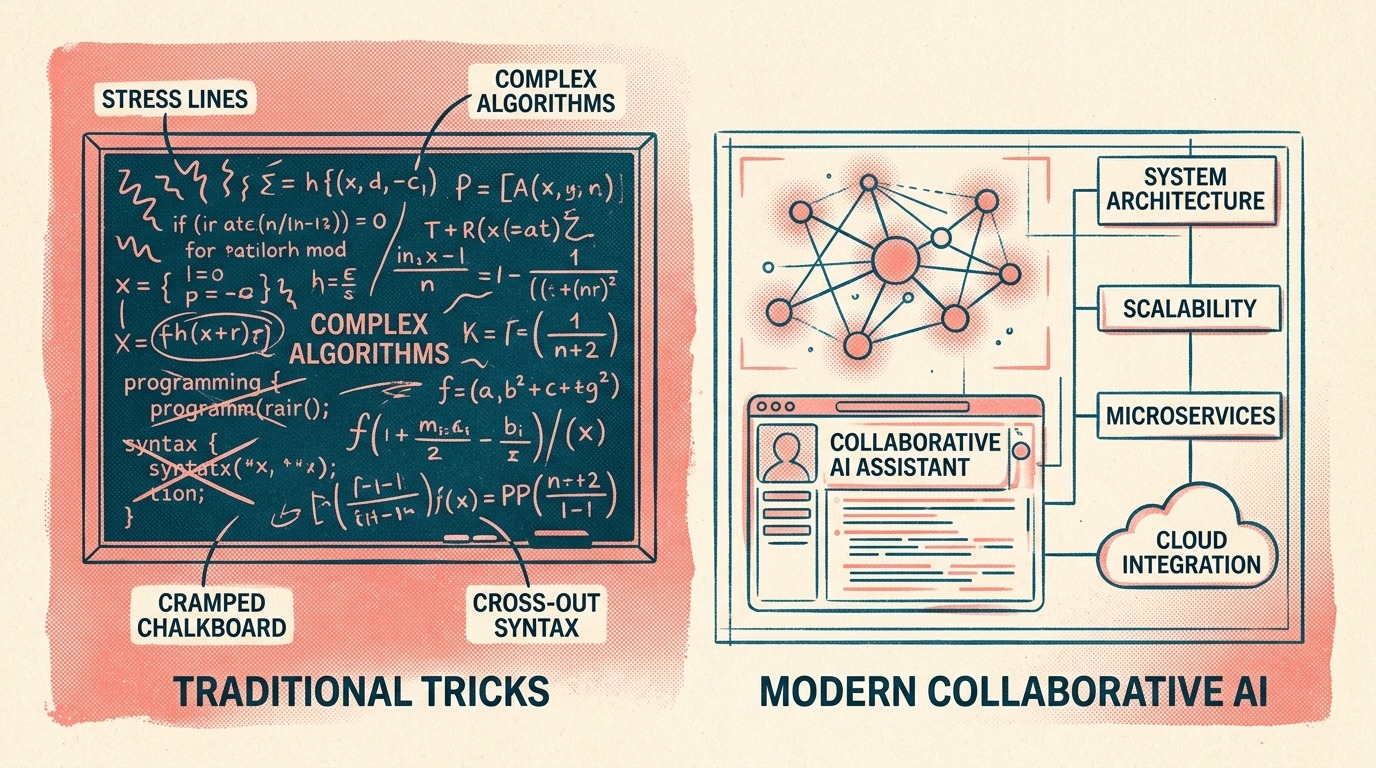
Today, forward-looking engineering organizations are leaving trivia behind and restructuring their interview loops around authentic engineering signals:
| Evaluation Dimension | Traditional Paradigm (2012–2023) | Emerging AI-Native Paradigm (2026+) |
|---|---|---|
| Primary Code Screen | 45-minute LeetCode algorithmic puzzle | Real-world repository debugging or API integration |
| AI Tooling Policy | Strictly prohibited; flagged as cheating | Permitted or explicitly integrated into the session |
| Primary Evaluation Focus | Syntax fluency, manual algorithm implementation | Architectural intent, code review, output verification |
| Interviewer Role | Adversarial proctor watching syntax | Collaborative technical partner probing trade-offs |
| Candidate Signal | Pattern memorization and speed | Systems thinking, debugging rigor, communication |
When you understand this structural transition, you stop preparing for interviews as a memory contest and start preparing as a technical collaborator.
The Three Core Formats Defining AI-Era Technical Interviews
How are engineering teams actually testing candidates today? Rather than eliminating technical evaluations, companies are adopting three robust formats that extract deeper signal in less time.
1. The Collaborative AI Pair-Programming Round
In this format, interviewers do not forbid GitHub Copilot, Cursor, or ChatGPT—they expect you to use them. The candidate receives an ambiguous, multi-file feature prompt or a failing microservice. The goal is not to see if you can write every line of boilerplate by hand; the goal is to evaluate your steering ability and critical verification.
Consider a realistic interview scenario: you are tasked with implementing an asynchronous batch processor for incoming telemetry data in Python. You write a prompt or let your editor's agent suggest a consumer function:
import asyncio
from typing import List, Dict, Any

class TelemetryBatchProcessor:
    def __init__(self, flush_interval: float, batch_size: int):
        self.flush_interval = flush_interval
        self.batch_size = batch_size
        self.queue: asyncio.Queue = asyncio.Queue()
        self._running = False

    async def ingest(self, event: Dict[str, Any]) -> None:
        """Enqueues an incoming event for batch processing."""
        await self.queue.put(event)

    async def start_worker(self) -> None:
        """Processes batches on size threshold or timeout."""
        self._running = True
        batch: List[Dict[str, Any]] = []

        while self._running:
            try:
                # The AI suggests this naive wait logic:
                event = await asyncio.wait_for(self.queue.get(), timeout=self.flush_interval)
                batch.append(event)
                self.queue.task_done()

                if len(batch) >= self.batch_size:
                    await self._flush(batch)
                    batch = []
            except asyncio.TimeoutError:
                if batch:
                    await self._flush(batch)
                    batch = []

    async def _flush(self, batch: List[Dict[str, Any]]) -> None:
        # Simulated database bulk write
        await asyncio.sleep(0.05)
An inexperienced candidate prompts the AI, watches clean code appear, runs the basic happy-path test, and announces that the solution is complete.
A senior engineer treats the generated code with professional skepticism. They immediately walk through the edge cases:
- What happens during a graceful shutdown? If
self._runningbecomesFalsewhile events remain inself.queue, does the service drop telemetry packets? - If
self._flush(batch)raises an unhandled database exception, does the worker crash silently, stalling the entire ingestion pipeline? - Is backpressure maintained if downstream writes slow down, or will unbounded queue growth trigger an out-of-memory crash?
Interviewers evaluate whether you verify edge cases, introduce structured error recovery, and refine generated code into production-grade systems.
2. Live Repository Navigation and Defect Remediation
Instead of writing a 30-line toy algorithm in an empty web sandbox, candidates are dropped into an existing, containerized codebase consisting of 10,000 to 50,000 lines of code.
You are handed an open issue ticket:
"Under high concurrency, order state occasionally transitions to CANCELLED after payment confirmation has already been emitted to the payment webhook."
You have 45 minutes. You must:
- Navigate the repository structure to locate where order transitions and webhook callbacks are synchronized.
- Read test suites, reproduction scripts, and database migration logs.
- Diagnose the underlying race condition (such as missing optimistic locking or unindexed read-modify-write transactions).
- Implement a targeted fix, write automated unit tests, and explain the performance trade-offs to the interviewer.
This format provides unparalleled signal on how you will actually perform on day one.
3. Deep-Dive Systems Architecture and Failure Analysis
Because syntax generation is commoditized, system design interviews have moved from late-stage senior rounds into earlier stages of the hiring funnel across all levels. Interviewers want to know if you can design defensible architectures that scale safely.
Candidates are asked to reason through data partitioning strategies, caching invalidation pitfalls, event-driven ordering guarantees, and multi-region disaster recovery. If you are preparing for these discussions, reviewing our system design interview guide will help you organize your architectural frameworks around concrete latency and durability guarantees.
How Hiring Rubrics Are Shifting: What Evaluators Truly Score
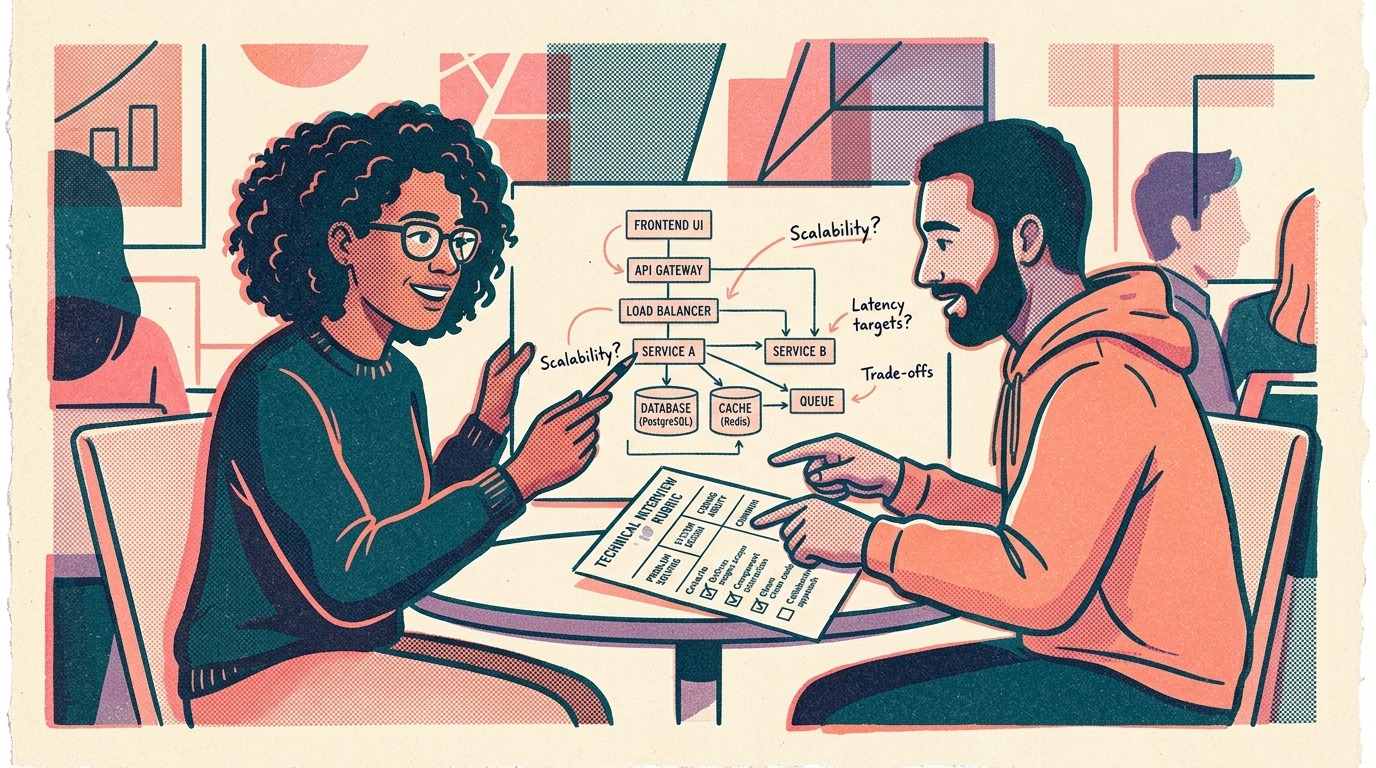
When evaluating candidates in an AI-augmented environment, engineering interviewers no longer score on whether you remember the exact library method signature for binary search. Instead, evaluation matrices focus on four distinct capabilities.
1. Verification Rigor Over Generation Speed
Speed without correctness is negative value in software engineering. When an AI generates a snippet, the interviewer watches your immediate reaction. Do you step through the logic line by line? Do you write boundary tests for negative numbers, null values, or network timeouts? Candidates who demonstrate paranoid verification hygiene consistently receive higher hiring recommendations.
2. Clarity in Problem Framing and Decomposition
Before touching code or typing a prompt into an assistant, you must define the problem boundary. What are the throughput requirements? What consistency model does the business require? In our analysis of what interviewers actually look for, the ability to structure messy ambiguity into clear technical milestones remains the single strongest differentiator between mid-level and senior engineers.
3. Defending Architectural Trade-Offs
Every technical choice carries a trade-off. If you choose an in-memory Redis cache to shield a primary Postgres database, you must explain:
- How you prevent cache stampedes when hot keys expire.
- How you guarantee cache consistency when writes fail midway.
- How memory overhead impacts operational hosting costs.
If an AI tool suggested the pattern, you must still defend it. An answer of "The AI suggested this snippet" results in an immediate downgrade on the rubric.
4. Psychological Composure and Transparent Reasoning
When a production bug occurs or an interviewer introduces a breaking constraint, how do you respond? Candidates who get defensive or freeze up struggle to build confidence with hiring managers. Understanding when you don't know the answer and how to handle it gracefully is an essential behavioral competency: acknowledging knowledge gaps honestly while methodically reasoning toward a solution proves maturity and intellectual integrity.
The Role of AI in Initial Candidate Screening
The transformation of technical interviews is not limited to how candidates write code; it is also redefining how companies screen applicants.
Traditional resume screening filters are notoriously noisy and biased, frequently rejecting qualified self-taught or non-traditional engineers while passing keyword-stuffed resumes. At the same time, take-home assignments have become unmanageable for hiring teams due to rampant plagiarism.
To resolve this, hiring teams are adopting interactive AI mock interview screeners. These systems conduct structured, conversational technical screens where candidates talk through their past projects, solve real-time architecture problems, and answer role-specific technical questions.
Whether interviewing at nimble early-stage startups or massive tech corporations, company priorities diverge significantly. As explored in our breakdown of startup vs enterprise technical interviews, startups use conversational screening to evaluate rapid autonomy and broad versatility, whereas enterprises deploy standardized rubrics to benchmark deep domain knowledge and compliance. Understanding what to expect at each interview round helps candidates calibrate their depth and presentation style for each phase of the hiring funnel.
Practical Blueprint: How to Excel in Modern Technical Interviews
If you are preparing for technical interviews over the coming year, here is an actionable playbook to modernize your preparation:
1. Master AI-Assisted Debugging and Code Review
Stop using AI purely to generate code from scratch. Practice using it as a challenging code reviewer. Ask models to critique your code for subtle concurrency bugs, memory leaks, and performance bottlenecks, then verify whether the critique is valid or a hallucination. Sharpening your ability to spot subtle flaws in generated code is a superpower in modern pair-programming interviews.
2. Anchor Yourself in Foundational Fundamentals
Frameworks, syntax helpers, and UI libraries change constantly, but distributed systems principles, data structures, network protocols, and operating system primitives remain timeless. A candidate who understands TCP handshakes, database indexing internals (B-Trees vs. LSM trees), and memory layouts will always outperform someone who merely copies API snippets. For a comprehensive study timeline, review our complete guide to technical interview prep.
3. Practice Verbalizing Your Mental Model in Real Time
The biggest mistake candidates make during live coding is falling silent while reading code or drafting prompts. Always narrate your thought process:
"I notice this query does a full table scan on the events table. I'm going to add a composite index on
(tenant_id, created_at). Before I do that, let's verify if our write throughput can tolerate the index maintenance overhead."
This turns the interview into an intellectual collaboration rather than an examination.
4. Rehearse with AI-Powered Mock Practice
Waiting for a live, high-stakes interview with your dream company is the worst time to discover that your explanation of microservice failure domains is disjointed or that you fumble when questioned on concurrency. Practicing interactive, job-specific technical rounds on totop.app gives you immediate, objective feedback on your technical clarity, answer structure, and conceptual depth before you speak with a hiring team.
The Path Forward: Engineering Triumphs Over Syntax
The rapid rise of AI is not the end of the software engineering career; it is the liberation of it.
For decades, the hiring industry reduced the magnificent, creative craft of software engineering to a 45-minute memory test on inverted binary trees. Today, that artificial barrier is dissolving. As AI handles routine boilerplate and syntax generation, the future of technical interviews belongs to engineers who can think critically, architect resilient distributed systems, verify code with precision, and communicate complex technical ideas with clarity.
Master those enduring foundations, embrace modern tooling with rigorous skepticism, and you will stand out in any interview room you step into.