What to Expect at Each Interview Round: Typical Process
When embarking on a job hunt in the software industry, few experiences trigger as much stress as facing a multi-stage hiring gauntlet. For most candidates, the anxiety does not stem from writing code itself; it stems from the sheer opacity of the evaluation process. You submit an application, receive an email invitation, and suddenly find yourself scheduled for three, four, or even six distinct conversations spread over several weeks.
Candidates frequently ask: What are interviewers actually looking for at each stage? Why do some rounds focus on trivial resume bullets while others demand hours of distributed systems architecture? And how can a candidate excel in a technical challenge only to receive a rejection email forty-eight hours later?
The reality is that hiring teams do not evaluate you on a single uniform scale. Each stage of the modern hiring pipeline is engineered to test a distinct risk factor and validate specific competencies. A candidate who treats every conversation like an academic exam will fail behavioral evaluations, while a candidate who relies solely on charisma will crumble during live coding.
Understanding what to expect at each interview round demystifies the entire pipeline. When you recognize the exact scorecard and psychological incentives of the person sitting across the screen or desk, you can calibrate your preparation, avoid unforced errors, and present your engineering achievements with poise. In this guide, we break down every stage of the typical interview process, analyze the evaluation rubrics, and share actionable tactics for clearing each hurdle.
The Modern Interview Funnel at a Glance
Before examining each stage in detail, it helps to understand how the broader recruitment funnel functions. Tech hiring is fundamentally a risk-mitigation exercise: companies design stages to progressively eliminate false positives while preserving valuable engineering hours. Early rounds are brief and automated or handled by talent acquisition teams; later rounds involve senior engineers, staff architects, and engineering managers whose time is expensive.
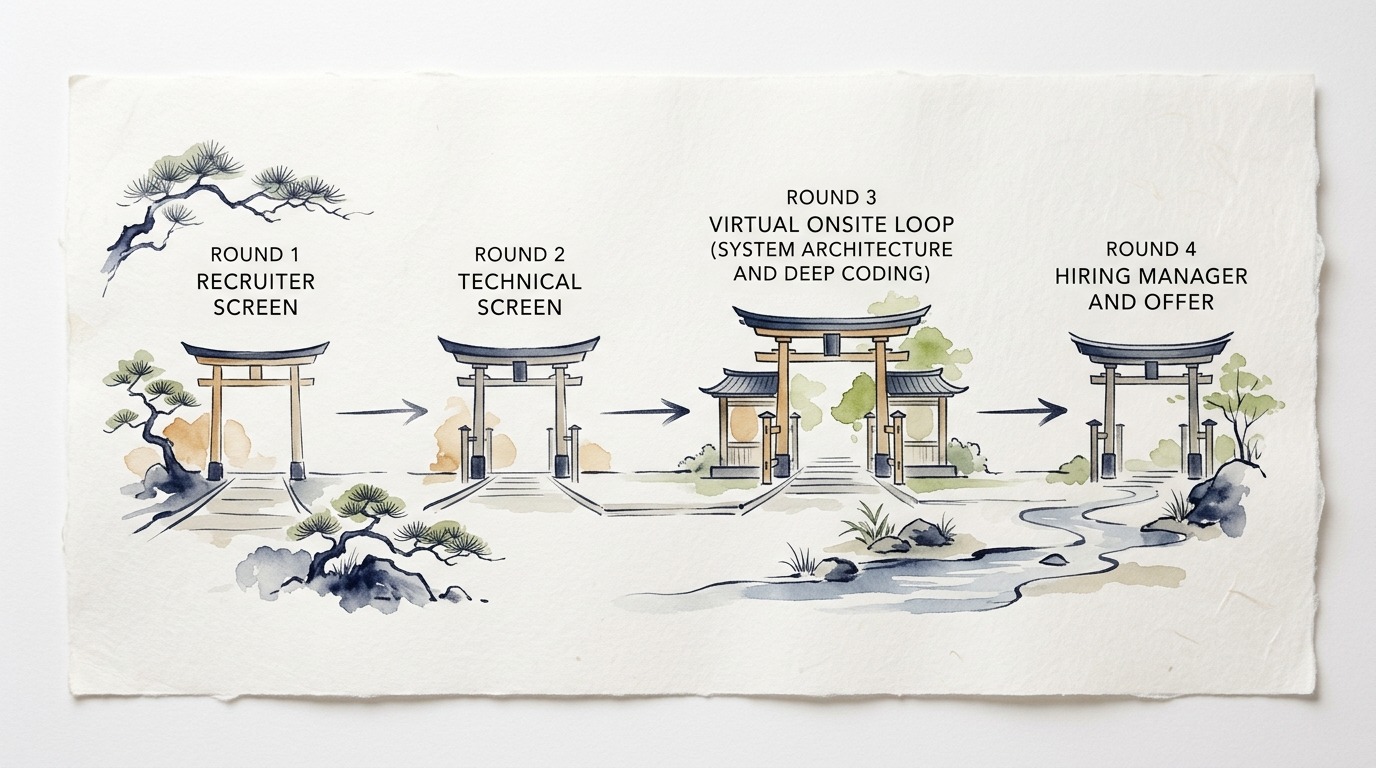
Here is how the stages typically map across a standard tech company:
| Stage | Format & Duration | Primary Evaluator | Core Objective | Typical Pass Rate |
|---|---|---|---|---|
| 1. Recruiter Screen | Phone / Zoom (20–30 min) | Talent Sourcer / Recruiter | Baseline fit, salary alignment, communication | ~40–50% |
| 2. Technical Screen | Live Coding / OA (45–60 min) | Mid/Senior Software Engineer | Foundational data structures, algorithms, syntax fluency | ~25–35% |
| 3. Virtual Onsite Loop | 3–5 Consecutive Rounds (4–5 hrs) | Cross-functional Engineers & Leads | Architecture, deep problem-solving, collaboration | ~20–30% |
| 4. Behavioral / Values | Dedicated Round (45–60 min) | Hiring Manager or Bar Raiser | Ownership, conflict management, communication | ~60–70% |
| 5. Executive & Offer | Video Call (30 min) | Director / VP / Founder | Team vision, role expectations, compensation negotiation | ~90% |
Behind the scenes, independent hiring committees or "Bar Raisers" aggregate the feedback packets from each interviewer. Because interviewers rarely share notes before submitting their individual scores, maintaining consistency across every single conversation is crucial.
Round 1: The Initial Recruiter Screen (20 to 30 Minutes)
The initial recruiter phone screen is the gatekeeper of the hiring process. Many engineers make the mistake of treating this conversation as an informal chit-chat or an administrative afterthought. In practice, talent acquisition specialists review hundreds of candidates weekly and eliminate roughly half of all applicants during this thirty-minute call.
What the Recruiter Is Evaluating
Recruiters are not testing your ability to invert a binary tree or calculate Dijkstra’s shortest path. Instead, they are validating fundamental parameters to ensure neither your time nor the engineering team’s schedule is wasted:
- Resume Authenticity: Can you fluently explain the projects, technologies, and achievements listed on your resume without hesitation?
- Communication Clarity: Can you articulate complex technical projects simply and concisely to someone without a computer science background?
- Logistics & Authorization: Are your work visa requirements, target start date, and geographic or remote preferences compatible with the role?
- Compensation Realism: Do your salary expectations align with the company's approved leveling bands?
- Motivation & Enthusiasm: Did you research the company's core product, or are you indiscriminately blasting applications across the market?
How to Ace the Recruiter Round
- Structure Your Elevator Pitch (The 90-Second Rule): When asked the inevitable opener, "Tell me about yourself," avoid reciting your chronological resume starting from university. Use a three-part structure: Past (foundational background and technologies), Present (recent high-impact project and leadership role), and Future (why this specific company and role represent the logical next step in your career).
- Handle the Salary Question Strategically: If asked about salary expectations upfront, avoid giving a rigid single number that either prices you out or leaves money on the table. Offer a market-researched range and turn the question back to their internal leveling: "Based on market data for Senior Full-Stack roles in our region, I am seeing ranges between 50k and75k base. However, total compensation, equity, and team impact are paramount to me. What is the budgeted band for this level?"
- Ask Informed Questions: Inquire about the team’s current priorities, the planned interview pipeline timeline, and the biggest challenge the hiring manager hopes this hire will solve.
Round 2: The Technical Screen (45 to 60 Minutes)
Once you clear the recruiter screen, you face your first technical hurdle: the technical screen. Depending on the company, this round may be an automated Online Assessment (OA) on platforms like CodeSignal or HackerRank, or a live collaborative coding session over Zoom using CoderPad.
What Interviewers Look For
The engineer evaluating this round has one primary question: Can this person write working, bug-free code under realistic time constraints?
Interviewers evaluate four key vectors:
- Problem Comprehension: Do you rush into writing code blindly, or do you ask clarifying questions, identify edge cases, and define input constraints first?
- Algorithmic Foundations: Do you recognize standard patterns (hash tables, two pointers, sliding window, breadth-first search) and choose the appropriate data structure?
- Code Fluency & Syntax Hygiene: Are your variable names readable? Do you write clean modular code, or do you produce spaghetti logic with unhandled null pointers?
- Complexity Analysis: Can you accurately state the Big-O time and space complexity of your solution without prompting?
Time Allocation for a 45-Minute Live Coding Session
Managing the clock is one of the most under-practiced skills in technical interviews. Adopt this disciplined breakdown:
00:00 - 05:00  Problem Intake & Clarification: Rephrase the prompt, confirm edge cases (empty inputs, negatives, duplicates)
05:00 - 15:00  Solution Design & Trade-Offs: State the brute-force approach, optimize the logic, discuss Big-O, get interviewer buy-in
15:00 - 35:00  Clean Implementation: Write modular, readable code; talk through your implementation choices out loud
35:00 - 40:00  Manual Dry-Run & Edge Case Verification: Walk through sample inputs step-by-step to catch off-by-one errors before executing
40:00 - 45:00  Wrap-Up & Q&A: Explain potential production enhancements, answer interviewer follow-ups, ask your own questions
Navigating Moments When You Get Stuck
If you run into an unfamiliar constraint or draw a blank on an edge case, panic is your worst enemy. Interviewers want to see how you troubleshoot under pressure. If you encounter a roadblock, learning how to handle questions when you do not know the answer is essential for maintaining composure, voicing hypotheses based on first principles, and collaborating with your interviewer rather than freezing up.
Round 3: The Virtual Onsite Loop (3 to 5 Consecutive Rounds)
Clearing the technical screen qualifies you for the main event: the full interview loop. Historically conducted in person at the company's offices, this stage is now predominantly held as a 4- to 5-hour virtual loop. The loop consists of multiple back-to-back 45- to 60-minute sessions designed to stress-test your abilities across multiple dimensions.

Session 3A: Deep-Dive Coding & Algorithmic Problem Solving
Unlike the initial screen, loop coding sessions frequently introduce multi-part questions, dynamic data constraints, or realistic refactoring exercises. You might be asked to design an in-memory caching mechanism with LRU eviction, implement a concurrent rate limiter, or traverse complex graph representations of real-world networks.
To build the speed and structural discipline necessary for these sessions, study our complete guide to technical interview prep, which outlines comprehensive study schedules, pattern clustering techniques, and timed practice regimens.
Session 3B: System Design & Architecture
For mid-level, senior, and staff roles, at least one (and often two) sessions in the loop will be dedicated to open-ended system design. You will be given a vague, large-scale prompt such as "Design a real-time notification service" or "Architect an analytics ingestion pipeline for 50,000 events per second."
In system design, there is no single "correct" answer. Instead, interviewers evaluate your architectural maturity:
- Scope Clarification: Establishing functional vs. non-functional requirements (throughput, latency, availability, consistency).
- High-Level Components: Decomposing systems into API gateways, microservices, relational vs. NoSQL databases, message queues, and distributed caches.
- Deep Dives into Bottlenecks: Addressing failure modes, partition tolerance, database replication lags, and data sharding strategies.
To master the 45-minute architectural pacing required for senior and staff engineering rounds, review our specialized system design interview guide.
Round 4: Behavioral & Culture Alignment (45 to 60 Minutes)
Many highly capable programmers fail the onsite loop because they assume behavioral questions are secondary. In modern tech organizations, a red flag in a behavioral session carries veto power. Even if you write flawless algorithmic code, an assessment that flags arrogance, defensiveness, or poor cross-functional collaboration will result in a swift rejection.
The Behavioral Scorecard
Behavioral interviewers evaluate how you operate within an engineering ecosystem:
- Ownership & Accountability: When an outage occurred or a project deadline slipped, did you take responsibility and drive the postmortem, or did you point fingers at colleagues?
- Constructive Disagreement: How do you handle situations where a senior architect or product manager rejects your technical proposal?
- Mentorship & Multiplier Effect: Do you elevate teammates through thorough code reviews and documentation, or do you hoard domain knowledge?
To align your answers with the formal evaluation rubrics used by senior interviewers, consult our breakdown of what interviewers actually look for.
Formatting Responses with the STAR Method
Never answer behavioral questions with vague abstractions like "I always try to listen to everyone." Ground every response in a specific real-world story using the STAR framework:
S - Situation: Set the scene briefly (company, team size, project constraint)
T - Task: Identify the specific technical or interpersonal challenge you were tasked with solving
A - Action: Detail the exact decisions, code refactors, or conversations YOU personally drove
R - Result: Quantify the outcome with concrete metrics (latency reduced by 40%, bug rates cut in half, deadline met)
Toward the end of the behavioral conversation, you will be invited to ask questions. Taking advantage of this opportunity demonstrates your curiosity and analytical depth. Prepare insightful inquiries in advance using our curated list of questions you should ask your interviewer to evaluate engineering culture and leadership dynamics.
Round 5: Hiring Manager & Executive Alignment (30 to 45 Minutes)
The final conversation in the pipeline is typically conducted by the hiring manager (an Engineering Manager, Director, or VP of Engineering). In seed and early-stage startups, this round may be conducted directly with the CTO or founder.
The Hiring Manager's Mindset
While peer engineers assess your immediate code quality, the hiring manager focuses on long-term team sustainability:
- Role Scoping: Does your career trajectory align with the immediate and future needs of this specific team?
- Growth Potential: Will you be happy in this role for the next 18 to 24 months, or will you burn out or become bored?
- Organizational Fit: How will your personality and communication style blend with the existing team members?
This conversation is also your best opportunity to vet your prospective boss. Ask about team retention, their management philosophy, how performance reviews are conducted, and how the engineering organization balances technical debt remediation against product feature deadlines.
How Interview Formats Vary by Company Scale
While the five rounds outlined above represent the standard industry blueprint, the exact emphasis shifts dramatically depending on the company's size and stage. Understanding these variations helps you tailor your preparation effectively:
Target Company Type:
├── Early-Stage Startup (Seed – Series B)
│   ├── Fast-tracked process (often 2–3 rounds total)
│   ├── Emphasis on practical take-home projects and full-stack pair programming
│   ├── Direct evaluation by founders and technical leads
│   └── Decisions focused on velocity, autonomy, and shipping speed
│
├── Mid-Sized Growth / Unicorn (Series C – Pre-IPO)
│   ├── Balanced 4–5 round pipeline
│   ├── Practical domain challenges paired with moderate algorithmic screening
│   └── High emphasis on architectural scalability and feature ownership
│
└── Enterprise & Big Tech (FAANG / Fortune 500)
│   ├── Rigorous, standardized 5–6 round loop
│   ├── Strict LeetCode-style algorithmic challenges with standardized time limits
│   ├── Independent Bar Raiser and hiring committee consensus
│   └── Calibrated leveling rubrics determining compensation packages
For a comprehensive analysis of the trade-offs between rapid startup interviews and corporate evaluations, explore our guide on startup vs enterprise technical interviews. If you are specifically targeting top-tier tech giants, read our detailed breakdown of the faang interview process to master company-specific leveling committees and rubric scorecards.
Rehearsing Every Round with totop.app
The greatest obstacle in interview preparation is the gap between passive theoretical study and real-time execution. Reading about algorithmic patterns or memorizing STAR stories does not replicate the elevated heart rate, time pressure, and cognitive load of a live interview.
This is where totop.app transforms your interview preparation:
- End-to-End Stage Simulation: Practice each round of the hiring funnel—from initial recruiter screening questions to high-pressure technical screens and behavioral loops.
- Job-Posting Tailored Practice: Paste the exact job description of your target company. The platform’s AI engine analyzes the required tech stack and seniority level to generate customized, role-specific questions.
- Voice-Enabled Realistic Interaction: Speak your thoughts out loud. Practicing verbal articulation helps you eliminate filler words, organize your explanations logically, and get comfortable thinking on your feet.
- Instant Rubric-Based Feedback: Receive detailed scorecards pinpointing your technical precision, code efficiency, communication clarity, and behavioral framing after every response.
By simulating realistic interview pressure in a supportive, automated environment, you turn unfamiliar interview rounds into routine exercises in technical storytelling.
Frequently Asked Questions
How long does the entire interview process take from start to finish?
At most technology companies, the full interview pipeline takes between two to six weeks. Early-stage startups often move quickly, completing all conversations and extending an offer within ten to fourteen days. Large enterprises and Big Tech organizations typically take three to six weeks due to interview scheduling bottlenecks and formal hiring committee reviews.
Can you ask for feedback if you are rejected after an interview round?
Yes, you can always ask, but keep your expectations modest. Due to corporate legal liabilities, most enterprise recruiters cannot share specific interviewer notes and will provide standard canned rejection language. However, in smaller companies or later onsite rounds, recruiters and hiring managers occasionally share high-level themes, such as wanting to see more depth in system design or greater fluency in asynchronous programming.
Is it acceptable to reschedule an interview round if you need more preparation time?
Absolutely. It is far better to request a one-week delay to review foundational concepts than to attend an interview unprepared. Recruiters want candidates to succeed; simply communicate professionally: "I want to ensure I put my best foot forward. Could we schedule the technical screen for next Tuesday instead?" Avoid rescheduling more than once, as frequent delays can signal disorganization.
What should you do if an interviewer cuts a technical round short?
If a 45-minute technical session wraps up in 35 minutes, do not automatically assume you failed. If you solved the problem cleanly, wrote comprehensive test cases, and explained Big-O complexity ahead of schedule, the interviewer may simply have gathered all the positive signal they needed. Use the remaining minutes to ask thoughtful questions about the team’s architecture, deployment pipelines, and engineering roadmap.