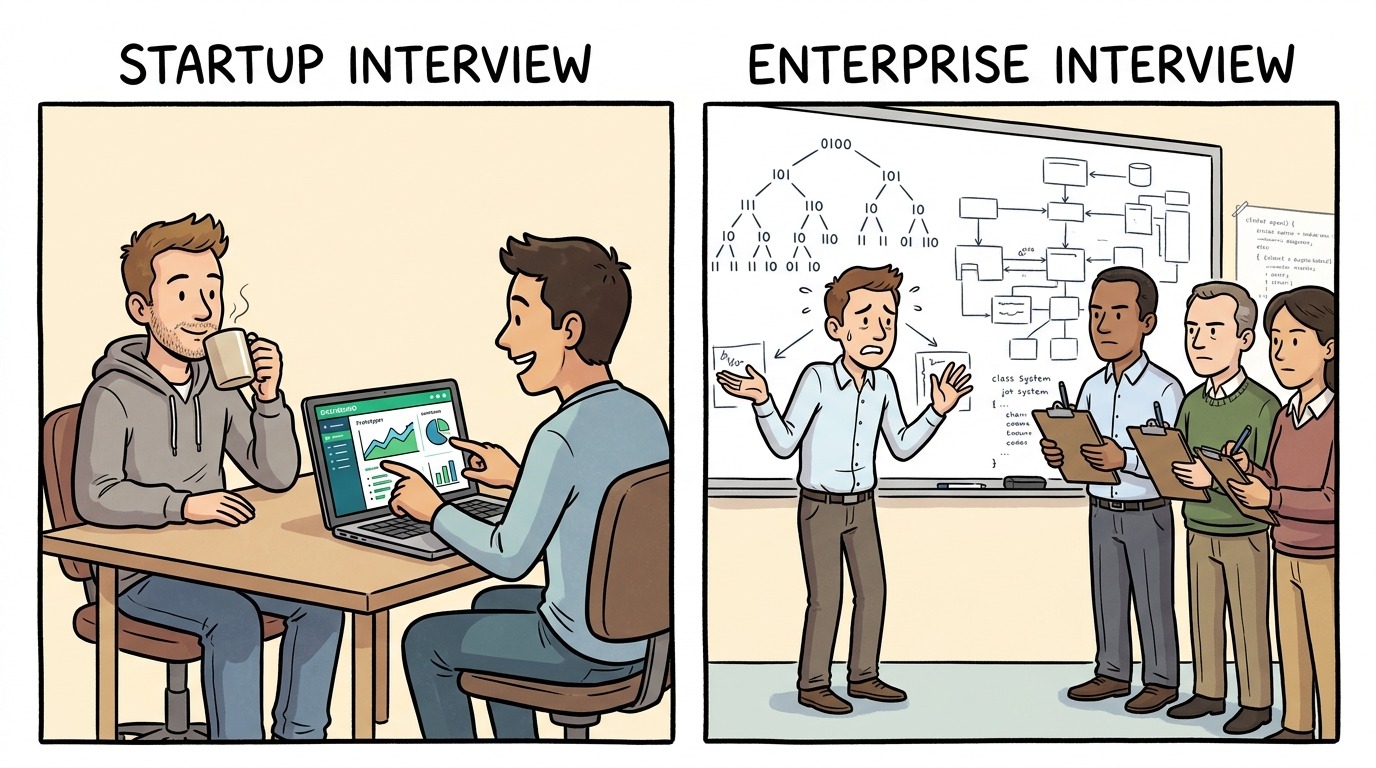
When software engineers gear up for job hunting, they frequently assume that technical evaluation follows a single universal playbook. The conventional wisdom sounds simple: grind hundreds of algorithmic challenges, memorize Big-O complexities, review a few microservice diagrams, and show up.
Yet countless experienced engineers stumble when switching contexts. A candidate who easily clears a rigorous six-stage FAANG gauntlet might completely bomb a Series A startup screen. Conversely, a brilliant full-stack builder who shipped dozens of production features at early-stage companies might fail out of an enterprise screen in the first forty-five minutes.
The reason is simple: startup vs enterprise technical interviews are evaluating two fundamentally different engineering archetypes. Startups hire for velocity, breadth, autonomy, and the ability to turn vague requirements into working software overnight. Enterprises hire for depth, architectural defensibility, standardized rubrics, and the ability to operate safely inside massive distributed codebases.
Understanding these divergent incentives is the difference between an offer letter and a polite rejection email. In this guide, we break down the core philosophical differences, evaluation formats, architecture questions, and behavioral rubrics across both environments—and show you how to calibrate your preparation for each.
The Core Philosophy: Generalist Velocity vs. Calibrated Specialization
Every interview process is a mirror of the company's daily operational pressures.
At an early-stage startup (Seed to Series B), the primary existential risk is running out of runway before finding product-market fit. Teams are lean, backlogs are volatile, and dedicated documentation is nearly nonexistent. A startup cannot afford an engineer who spends three weeks debating the theoretical elegance of an abstraction if the prototype needs to launch this Friday.
At an enterprise or Big Tech firm (Fortune 500, FAANG, late-stage unicorns), the primary existential risk is regressions, outages, regulatory non-compliance, and architectural drift. When a codebase has fifteen million lines of code and supports eighty million daily active users, a single unhandled edge case can cause a multi-million-dollar outage. Consequently, enterprise hiring is calibrated to minimize false positives: they would rather reject five qualified candidates than hire one engineer who introduces systemic instability.
High-Level Comparison Matrix
| Evaluation Dimension | Early-Stage Startup (Seed – Series B) | Enterprise & Big Tech (FAANG / Fortune 500) |
|---|---|---|
| Primary Hiring Goal | Immediate product velocity & pragmatism | System scalability, long-term code quality, risk minimization |
| Evaluation Archetype | T-shaped generalist, autonomous builder | Domain specialist or foundational computer scientist |
| Coding Format | Practical take-home, live pairing, PR review | Timed algorithmic problem solving (LeetCode-style) |
| System Architecture | Practical MVP architecture, managed cloud services | Distributed systems, fault tolerance, multi-region scaling |
| Interviewer Panel | CTO, technical founders, direct peer engineers | Calibrated interview pool, Bar Raisers, independent committees |
| Hiring Decision | Consensus or founder intuition | Standardized rubric scores, leveling committees |
| Feedback Turnaround | Often 24 to 48 hours | Usually 1 to 3 weeks |
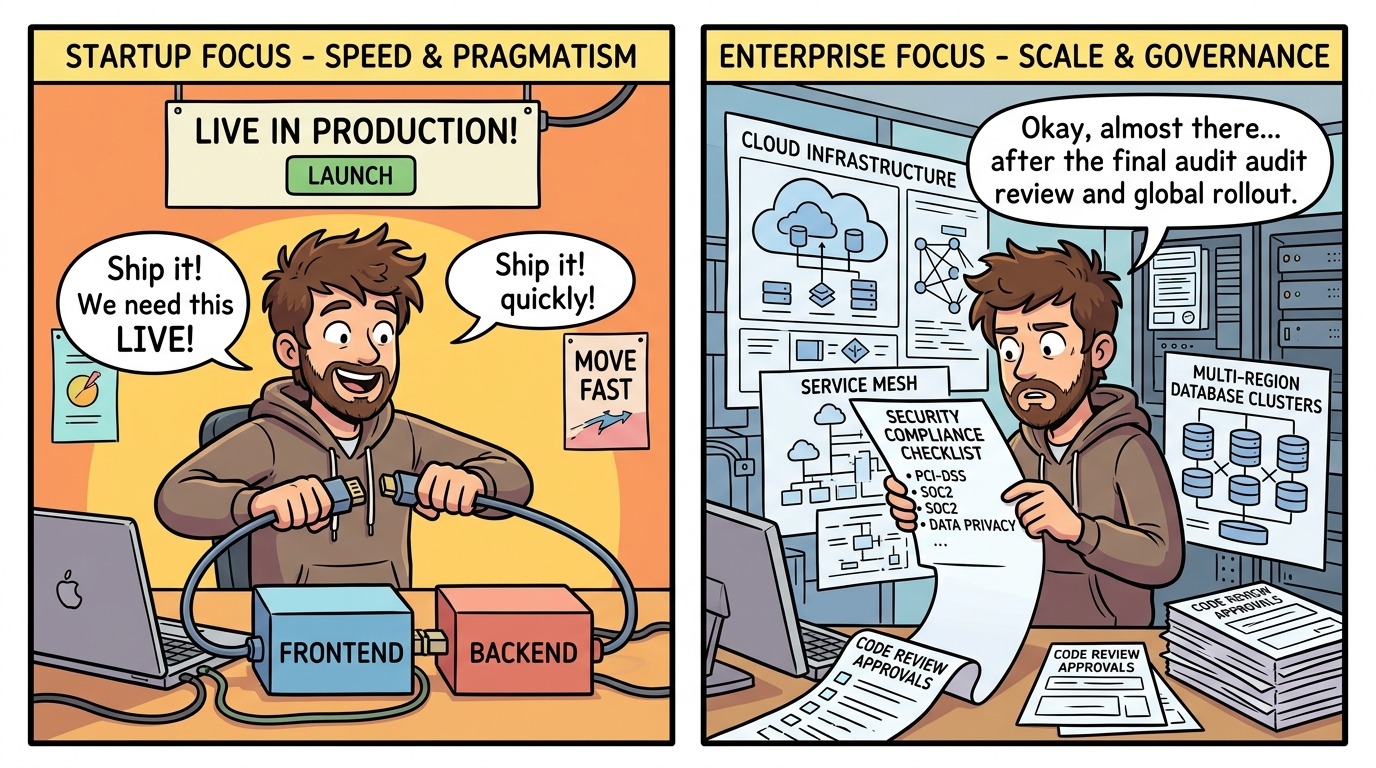
Coding Assessments: Practical Pair Programming vs. Algorithmic Pressure
The format and expectations of technical screens represent the most jarring contrast between both worlds (explore our dedicated remote technical interview tips to optimize your virtual setup, and review what to expect at each interview round for stage-by-stage scoring rubrics).
What Startups Look For: Pragmatic Execution
Startups want to see what your first week on the job will look like. Because team members work closely without layers of project managers, interviewers assess whether you can pick up their existing stack, navigate ambiguous requirements, and ship clean code without hand-holding.
Common startup coding formats include:
- Take-Home Projects: Building a functional full-stack app (e.g., a real-time notification feed, a webhook ingestion service) within a 48-to-72-hour window.
- Repository Debugging & Feature Addition: Pulling down a real open-source or redacted proprietary repository, setting up the local environment, fixing an intentional bug, and writing automated tests.
- Collaborative Pair Programming: Building a UI component or REST endpoint together on Zoom, where the interviewer acts as a teammate rather than a silent proctor.
During these rounds, startup evaluators actively reward:
- Product Intuition: Asking "Who is the end user for this endpoint?" or "Should we debounce this search input so we don't hammer the database?"
- Ecosystem Literacy: Knowing standard libraries, modern framework idioms (e.g., React hooks, Prisma ORM, FastAPI dependency injection), and package ecosystems.
- Speed and Pragmatism: Choosing a sensible, working implementation over an over-engineered pattern.
Consider this typical startup interview scenario: implementing an in-memory rate limiter for an Express API route:
// Startup Interview Focus: Clean, readable, working pragmatic code
import { Request, Response, NextFunction } from 'express';

interface RateLimitStore {
  [ip: string]: { count: number; resetTime: number };
}

const memoryStore: RateLimitStore = {};

export function simpleRateLimiter(limit: number, windowMs: number) {
  return (req: Request, res: Response, next: NextFunction) => {
    const ip = req.ip || req.socket.remoteAddress || 'anonymous';
    const currentTime = Date.now();

    if (!memoryStore[ip] || currentTime > memoryStore[ip].resetTime) {
      memoryStore[ip] = {
        count: 1,
        resetTime: currentTime + windowMs,
      };
      return next();
    }

    memoryStore[ip].count += 1;

    if (memoryStore[ip].count > limit) {
      return res.status(429).json({
        error: 'Too many requests, please try again shortly.',
        retryAfterMs: memoryStore[ip].resetTime - currentTime,
      });
    }

    return next();
  };
}
In a startup screen, writing this functional middleware, explaining its limitations (memory leaks over time, lack of synchronization across multi-instance clusters), and discussing when to swap in Redis demonstrates senior-level pragmatism.
What Enterprises Look For: Algorithmic Rigor & Asymptotic Optimization
Enterprises operate at a scale where standard framework utilities cannot shield you from computational bottlenecks. As explored in our deep dive on the FAANG interview process breakdown, large organizations use algorithmic live-coding rounds to establish an objective, standardized baseline across thousands of worldwide candidates.
Enterprise rounds are strictly timed (typically 45 minutes) and conducted in lightweight environments like CoderPad or on physical whiteboards.
Enterprise 45-Minute Algorithmic Cadence:
[0-5 min: Clarify Constraints] ➔ [5-15 min: State Approaches & Complexity] ➔ [15-35 min: Write Clean Code] ➔ [35-42 min: Dry Run & Trace Edge Cases] ➔ [42-45 min: Candidate Q&A]
In these rounds, interviewers rarely care about your favorite UI library or CSS framework. Instead, they grade you against precise rubric anchors:
- Asymptotic Complexity: Can you derive both the time (
O(N)) and space (O(1)) bounds instantly? - Data Structure Selection: Did you instinctively know that a sliding window, a two-pointer pass, or a monotonic stack was the optimal approach?
- Edge Case Rigor: What happens with empty inputs, duplicate keys, integer overflow, or massive
10^9arrays? - Communication Under Pressure: Can you talk through your trade-offs out loud before writing a single line of code?
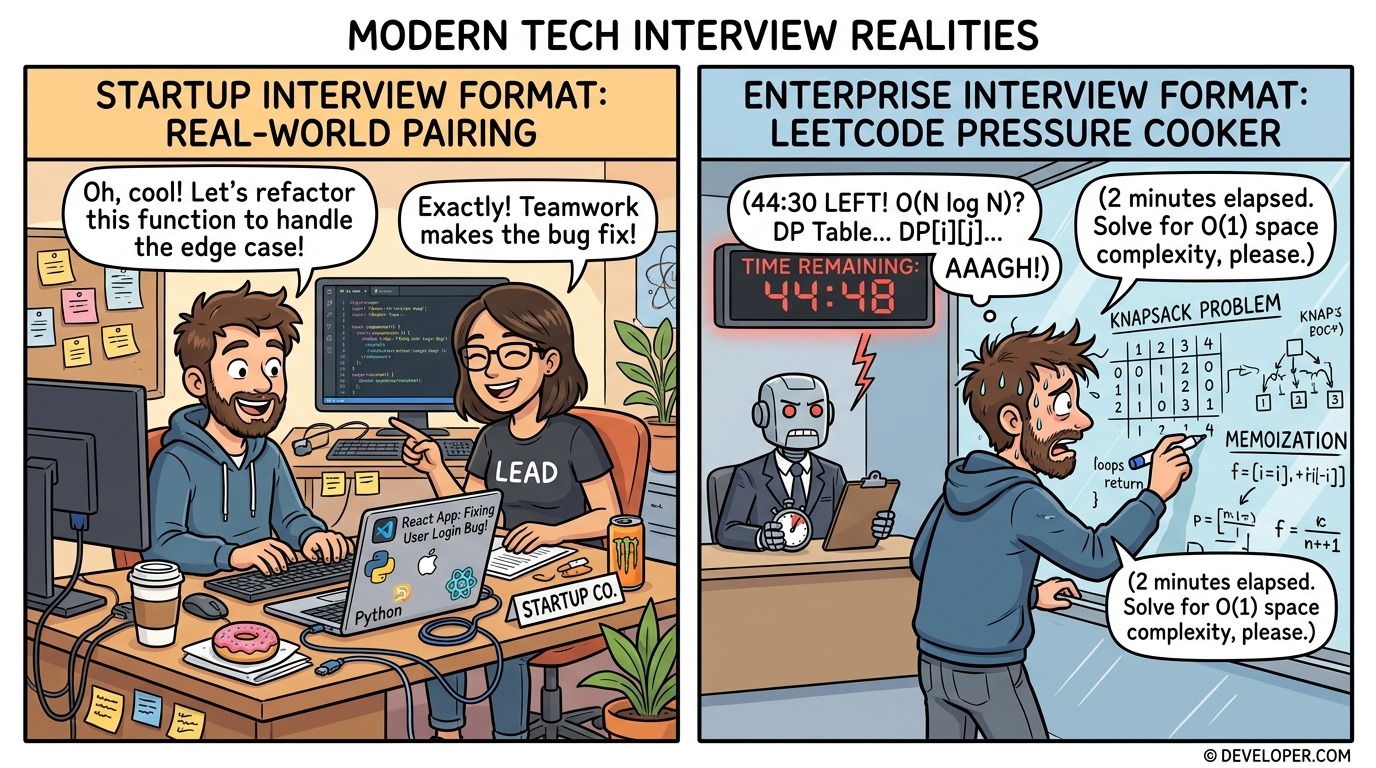
If you struggle during these high-pressure sessions, learning how to handle questions when you do not know the answer is essential for keeping the dialogue collaborative rather than freezing up.
System Design: Shipping an MVP vs. Multi-Region Resilience
System architecture questions showcase another distinct divergence in expectations.
Startup System Design: "How Fast Can We Launch and Validate?"
If a startup interviewer asks you to "Design a URL Shortener" or "Design an Uber for Dog Walkers", they do not want you to immediately partition Cassandra databases across four AWS availability zones. Doing so signals that you do not understand early-stage economics.
Startup interviewers look for:
- Time-to-Market: Leveraging managed services (PostgreSQL via Supabase, Clerk for authentication, Vercel for hosting, Stripe for billing).
- Cost Efficiency: Not burning through seed capital on idle Kafka clusters before having your first hundred paying users.
- Simplicity & Iteration: Starting with a modular monolith and explaining the exact telemetry signals (e.g., DB read replication lag, worker queue depth) that would prompt breaking out a microservice.
Enterprise System Design: "How Does This Handle 100,000 QPS Across Three Continents?"
In an enterprise loop—especially for senior and staff engineering roles—the interviewer assumes your system will immediately face hundreds of thousands of concurrent requests, petabytes of storage, and distributed network partitions. As outlined in our guide to staff engineer system design interviews, enterprise architectural rounds demand systematic rigor:
- Functional and Non-Functional Requirements: Calculating raw throughput, storage projections over five years, read-to-write ratios, and availability SLOs (e.g., 99.99% uptime).
- Distributed Storage & Partitioning: Choosing between SQL vs. NoSQL based on CAP theorem trade-offs, master-follower replication, read replicas, and consistent hashing partitions.
- Resilience & Fault Isolation: Circuit breakers, exponential backoff with jitter, dead-letter queues, idempotent consumer design, and disaster recovery strategies.
- Data Consistency: Handling eventual consistency, distributed transactions, saga patterns, and cache invalidation strategies (write-through vs. cache-aside).
Behavioral & Cultural Rounds: Founder Resonance vs. Calibrated Rubrics
The interpersonal evaluation in technical interviews is where many candidates misread the room.
In Startups: Cultural Alignment and Ownership
In an early-stage company, you will almost certainly interview with the founder or CTO. They are not reading from a standardized HR script. They are assessing:
- Do I want to be in the trenches with this person at 9 PM on a launch day?
- Do they act like an owner or an employee? When something breaks in production, do they step up to fix it, or do they say "That's not my ticket"?
- Are they comfortable with ambiguity? Can they take a two-sentence Slack message from the CEO and turn it into a deployed feature?
When founders ask behavioral questions, they appreciate candidates who exhibit intellectual curiosity about the business itself. Asking thoughtful, high-impact inquiries—like the questions highlighted in our breakdown of questions you should ask your interviewer—proves that you care about user metrics and business viability, not just technology for its own sake.
In Enterprise: Standardized Competencies and Calibrated Scoring
In enterprise loops, behavioral interviews follow rigid corporate frameworks:
- Amazon: 16 Leadership Principles evaluated via strict STAR method (Situation, Task, Action, Result).
- Google: "Googliness" and leadership rubrics assessing intellectual humility, navigating consensus, and blameless postmortems.
- Meta: Driving impact through cross-functional influence and handling organizational conflict.
Enterprise interviewers write detailed notes summarizing your behavioral evidence. Those notes are evaluated by an independent hiring committee that has never met you in person. If your story lacks clear personal ownership ("I resolved the conflict by analyzing data" vs. "We decided to move forward"), you will lose points regardless of how charismatic you were during the call. To master this dimension, study what interviewers actually look for to align your narrative with corporate evaluation scorecards.
Strategic Preparation: How to Tailor Your Approach
To maximize your interview outcomes, do not apply a generic prep regimen. Tailor your prep strategy to the exact profile of the company you are targeting:
Target Company Type:
├── Early-Stage Startup (Seed – Series B)
│   ├── Refine portfolio projects demonstrating full-stack end-to-end execution
│   ├── Practice rapid prototyping with modern frameworks (Next.js, FastAPI, Node)
│   ├── Brush up on database schema modeling, indexing, and SQL queries
│   └── Prepare stories demonstrating extreme ownership, speed, and business impact
│
└── Enterprise & Big Tech (FAANG / Fortune 500)
    ├── Master core data structures & algorithms (Blind 75 / NeetCode 150)
    ├── Drill 45-minute timed whiteboard coding sessions with zero syntax aids
    ├── Deep dive into distributed systems design and high-throughput bottlenecks
    └── Structure 8-10 behavioral stories strictly in STAR format around key leadership principles
Simulating Both Interview Formats with totop.app
Because the mental models required for startup pair programming and enterprise algorithmic interviews are so distinct, context switching without practice is risky.
Using totop.app, you can simulate both interview environments before stepping into live rounds:
- Paste the Specific Job Description: totop.app parses whether the role emphasizes full-stack product velocity or enterprise-scale distributed architecture, instantly tailoring its question bank.
- Custom AI Interview Personas: Practice against a supportive startup founder persona that digs into your product intuition, or switch to a calibrated, high-pressure enterprise interviewer that probes your Big-O edge cases.
- Voice-Enabled Real-Time Feedback: Practice articulating your thoughts out loud under timed conditions, ensuring your technical communication is clear, structured, and confident.
Whether your dream role is helping a five-person startup build the next unicorn or steering high-concurrency systems at a global enterprise, tailoring your preparation to the company's real-world incentives is your greatest competitive advantage.
Frequently Asked Questions
Which interview type is objectively harder: startup or enterprise?
Neither is universally harder; they test different cognitive skills. Enterprise interviews are academically intense, requiring months of algorithmic pattern memorization and high-stakes speed. Startup interviews test practical engineering depth, system debugging, and broad technical fluency. Many senior engineers find startup take-homes more time-consuming, but enterprise coding rounds more psychologically stressful.
Do startups ever ask LeetCode questions?
Some later-stage startups (Series C and beyond) adopt enterprise-style algorithmic filters as their applicant volume increases. However, seed and Series A startups rarely use pure LeetCode questions, preferring practical coding tasks, live debugging, or architectural walk-throughs of your past work.
Can I use startup experience to interview at an enterprise company?
Yes, provided you frame your experience correctly. In enterprise interviews, emphasize how your architectural choices scaled, how you implemented testing and CI/CD pipelines, and how you managed risk. Avoid sounding like a "lone cowboy" who shipped unreviewed code directly to production without tests.
Practice Full Stack Engineer Questions Live with AI Mock Interviews
Turn any job description across Engineering, DevOps, Data, Marketing, Sales, Finance, or HR into a personalized test and live voice or text AI mock interview on totop.app, or test your speed right now in the 60-Second Full Stack Engineer Blitz.
Play 60s Full Stack Engineer Blitz (Free, No Login) | Start 14-Day Free Trial | Browse All Interview Guides