Why You're Not Getting Callbacks After Technical Interviews

You finished the live coding session with five minutes to spare. Your solution passed every visible test case, the compiler threw zero warnings, and the interviewer gave you a polite nod before signing off. You spent the rest of the evening confident that you crushed the round.
Then the email arrives 48 hours later: "While your background is impressive, we have decided to move forward with other candidates."
Getting ghosted or receiving a generic rejection template after an interview that felt successful is one of the most frustrating experiences in a software engineer's career. When your code works, where did things fall apart?
The short answer: working code is merely the entry ticket, not the rubric. Most rejected candidates do not fail because of compilation errors. They fail because of silent communication gaps, unhandled edge cases, rigid problem-solving posture, and missing engineering judgment that never show up in a unit test output.
Understanding what interviewers actually look for requires analyzing how evaluation scorecards work behind closed doors. Here is a forensic breakdown of the hidden reasons behind missed callbacks and a practical system to diagnose your failure points.
1. Silent Assumptions and Skipping Problem Formulation
The single most common reason strong coders get rejected is premature implementation.
When presented with an algorithmic or architectural prompt, an anxious candidate frequently jumps straight into writing code within thirty seconds. In an engineering team, jumping into implementation without clarifying constraints is a massive red flag.
# The common candidate mistake: jumping straight to coding without constraint checks
def find_kth_largest(nums, k):
    # What if nums is empty? What if k > len(nums)?
    # What if nums contains duplicates or negative numbers?
    # What memory constraints exist on large streams?
    nums.sort(reverse=True)
    return nums[k - 1]
When you code before clarifying:
- You assume input data structures fit cleanly in RAM.
- You ignore stream boundaries, duplicates, null values, or concurrency.
- You treat the interviewer as an examiner rather than a collaborative technical partner.
The Diagnostic Check
Ask yourself after every session: Did I spend the first 3 to 5 minutes asking clarifying questions about data scale, mutation limits, and edge conditions? If you started typing code before writing down explicit assumptions, your scorecard likely took a heavy hit in problem formulation.
2. The Difference Between LeetCode Accuracy and Engineering Quality
Passing automated test cases on an online judge only proves that an algorithm produces correct outputs for predefined inputs. In a live interview, engineers evaluate production readiness, readability, and defensive design.
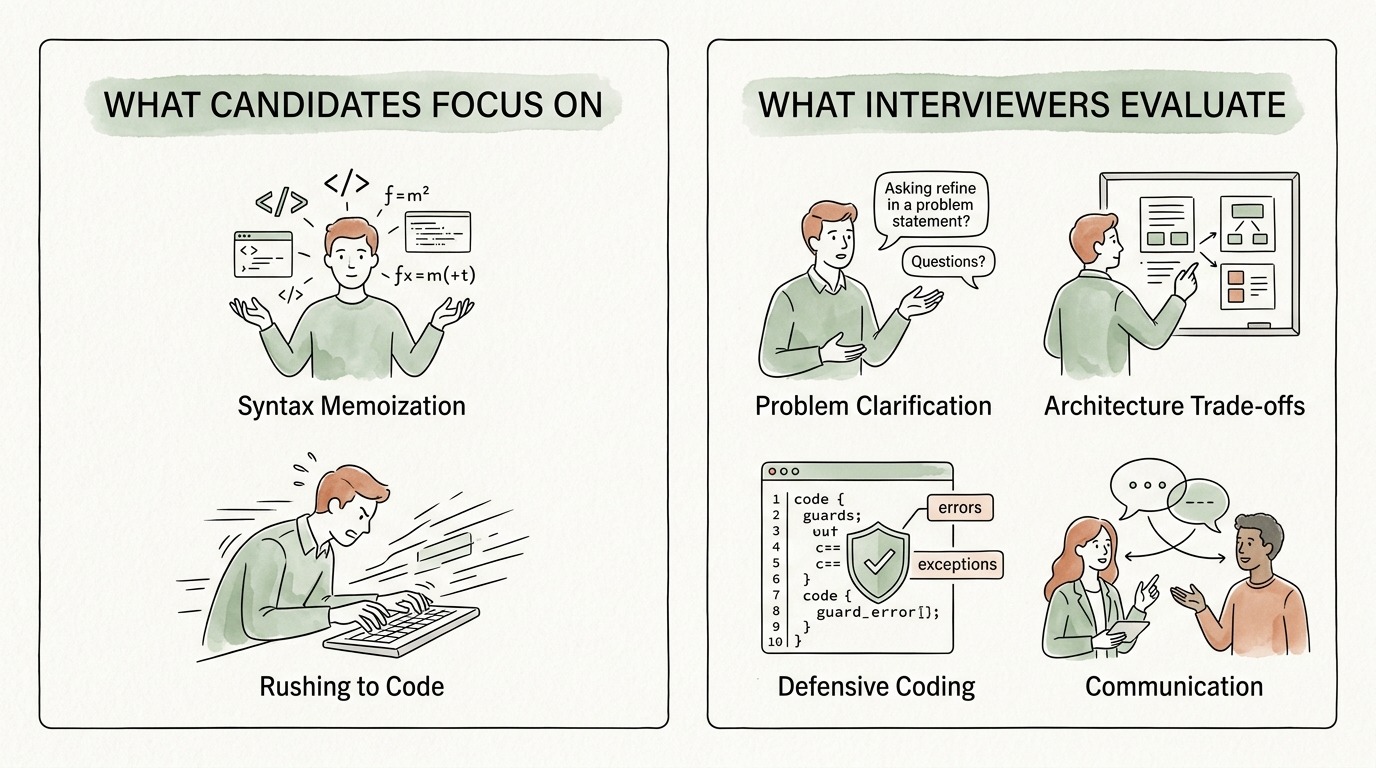
Consider how a candidate structures their code when asked to process structured log payloads:
// Fragile, "scripting" style that costs callbacks
function parseEvents(raw: any[]): Record<string, number> {
  let res: any = {};
  for (let i = 0; i < raw.length; i++) {
    let key = raw[i].type;
    res[key] = (res[key] || 0) + 1;
  }
  return res;
}

// Production-grade engineering structure that secures strong hire signals
interface TelemetryEvent {
  readonly id: string;
  readonly type: string;
  readonly timestamp: number;
}

function aggregateEventFrequencies(
  events: ReadonlyArray<TelemetryEvent>
): Map<string, number> {
  const frequencyMap = new Map<string, number>();

  for (const event of events) {
    if (!event?.type) {
      continue; // Explicit guard against malformed telemetry entries
    }
    const currentCount = frequencyMap.get(event.type) ?? 0;
    frequencyMap.set(event.type, currentCount + 1);
  }

  return frequencyMap;
}
Notice the stark contrast:
- Meaningful Naming and Types: The second snippet uses distinct interfaces, immutable collections (
ReadonlyArray), and typed return values rather than looseanyobjects. - Defensive Guard Clauses: It gracefully handles missing fields and malformed payloads without crashing the runtime.
- Appropriate Data Primitives: It selects
Mapover raw object hash mutations to prevent prototype pollution and key collisions.
When interviewers debrief, they evaluate whether your code would survive code review in production or require immediate refactoring by a teammate.
3. The "Silent Genius" Trap and Missing Thought Broadcast
Many engineers believe that speaking while coding slows them down or makes them appear uncertain. In reality, silence during technical evaluation creates a blind spot for the evaluator.
If you sit silently for 12 minutes and produce a flawless dynamic programming memoization table, the interviewer cannot determine:
- Did you derive this solution systematically through first principles?
- Did you recall a memorized solution from memory without understanding trade-offs?
- If this approach failed, how would you pivot under production pressure?
Technical interviews measure thought trajectory. When you encounter a roadblock, explaining why approach $A$ has an unfavorable $O(N^2)$ space complexity before exploring approach $B$ proves senior-level architectural reasoning.
If you run into an unfamiliar concept or get stuck on an unexpected constraint, knowing handling unknown questions gracefully during interviews allows you to maintain control of the conversation without panicking.
4. The Four-Stage Technical Evaluation Rubric
Every candidate evaluation breaks down across four distinct stages. Failing any individual stage often results in a "No Hire" consensus even if the other stages were adequate.
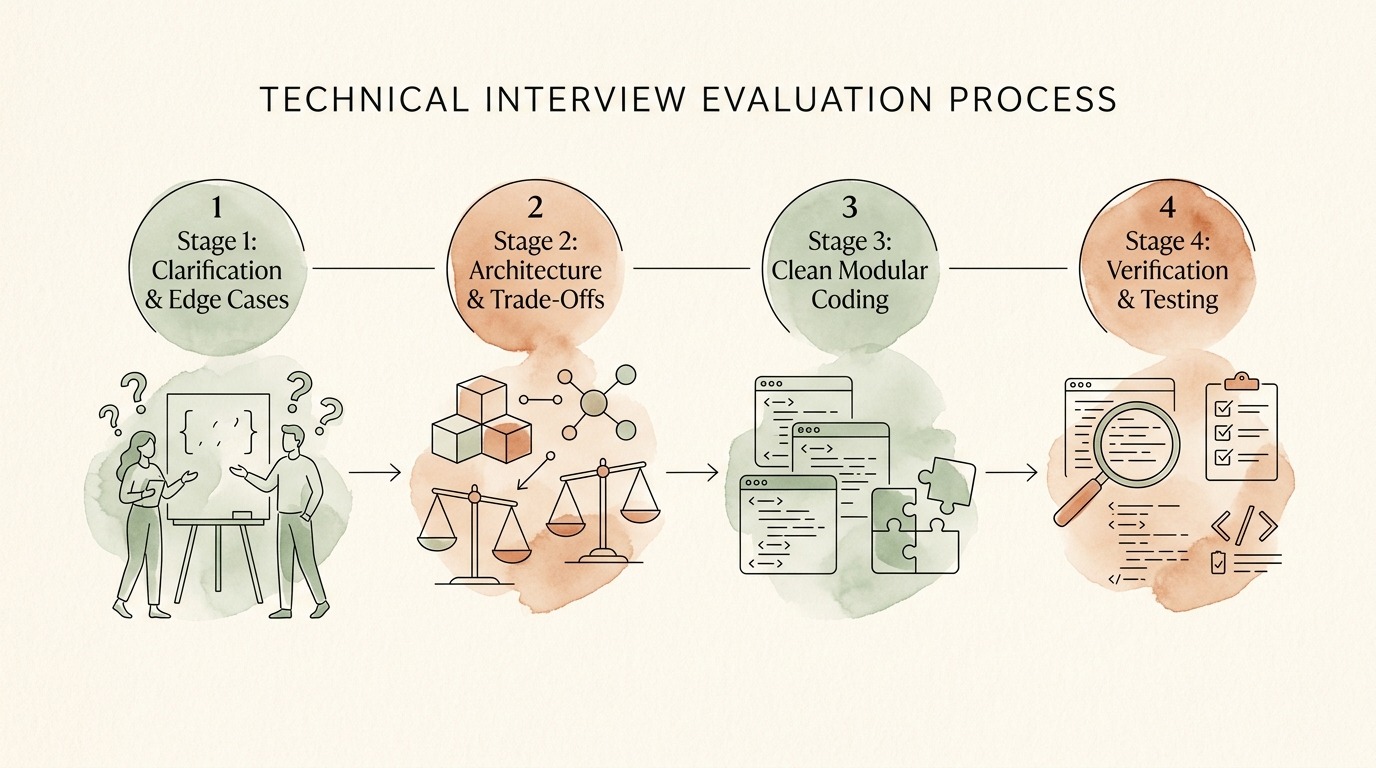
Stage 1: Clarification & Edge Cases
- Evaluation Criteria: Understanding ambiguity, identifying boundary cases (empty collections, overflow, floating-point precision, duplicates).
- Common Failure: Rushing directly into coding without confirming input constraints or throughput scale.
Stage 2: Architectural Design & Trade-Offs
- Evaluation Criteria: Proposing brute-force baseline, evaluating time and space complexities ($O(N)$ vs $O(\log N)$), justifying data structure selection.
- Common Failure: Choosing an overly complex structure without weighing maintenance overhead against runtime speed. Reviewing why 90 percent fail technical interviews highlights how premature optimization leads to incomplete implementations.
Stage 3: Clean Modular Coding
- Evaluation Criteria: Idiomatic syntax, clear function boundaries, separation of concerns, defensive validation.
- Common Failure: Writing monolithic, 80-line nested functions with single-letter variable names (
x,tmp,arr2).
Stage 4: Verification & Manual Dry-Running
- Evaluation Criteria: Step-by-step trace execution with concrete input examples, detecting off-by-one errors before clicking "Run".
- Common Failure: Declaring "I'm done" immediately after writing the last bracket without testing manual walkthrough cases.
5. Inability to Incorporate Interviewer Hints
Interviewers almost never let a candidate drown without tossing a lifeline. They will drop subtle hints:
- "How will this behave if the array contains negative numbers?"
- "Is there a way we can avoid scanning the entire list for every lookup?"
- "What happens to memory consumption when this recursion depth reaches 0^5$?"
Rejected candidates often treat hints as criticism, becoming defensive or ignoring the prompt to double down on their existing approach. In contrast, high-signal candidates pause, acknowledge the observation, and treat it as a collaborative design review:
"Good catch. With negative numbers, our prefix sum monotonic assumption breaks. Let's switch to a hash map to track running remainders instead."
This demonstrates coachability and collaborative maturity—two traits hiring managers prioritize above raw coding speed.
6. How to Run a Post-Interview Autopsy
To stop repeating the same unforced errors across hiring loops, establish a structured debrief routine immediately after finishing each call:
Evaluation Dimension Self-Audit Questions Warning Signs Requirements Discovery Did I ask about scale, edge cases, and nullability before writing line 1? Started typing code within the first 60 seconds. Complexity Analysis Did I calculate time and auxiliary space complexity before coding? Guessed complexity only after finishing the implementation. Verification & Testing Did I manually walk through a sample input trace line-by-line? Asked the interviewer "Does this look right to you?" without testing. Collaborative Engagement Did I ask thoughtful reverse questions at the end of the session? Ran out of questions or asked generic HR policy queries. To make your reverse-interview segment stand out, prepare targeted queries by reviewing questions you should ask your interviewer to evaluate engineering culture and technical debt.
If you have experienced repeated rejections across multiple companies, reading through lessons from failing 15 technical interviews provides perspective on how small, systematic habit shifts compound into offer letters.
7. Fixing Your Blindspots with Simulated Practice
It is impossible to observe your own unconscious communication habits while simultaneously solving complex algorithmic problems. You cannot see that you stop talking when stressed, or that you consistently forget to validate input bounds under time constraints.
This is why structured mock interview simulations are essential. Rather than doing solo problem sets in a code editor, practicing with realistic AI mock interview loops on totop.app allows you to practice answering under realistic time pressure, receive instant diagnostic feedback on your communication structure, and refine your approach across role-specific technical and behavioral rubrics. Combine this with structured behavioral interview frameworks for engineers to ensure your communication score matches your technical execution.
Diagnosing why you missed callbacks is not about second-guessing your technical abilities. It is about treating the interview as an engineering system: calibrate your signals, verify your code defensively, communicate your trade-offs clearly, and the callback rate will take care of itself.