How AI is Changing the Hiring Process in Tech

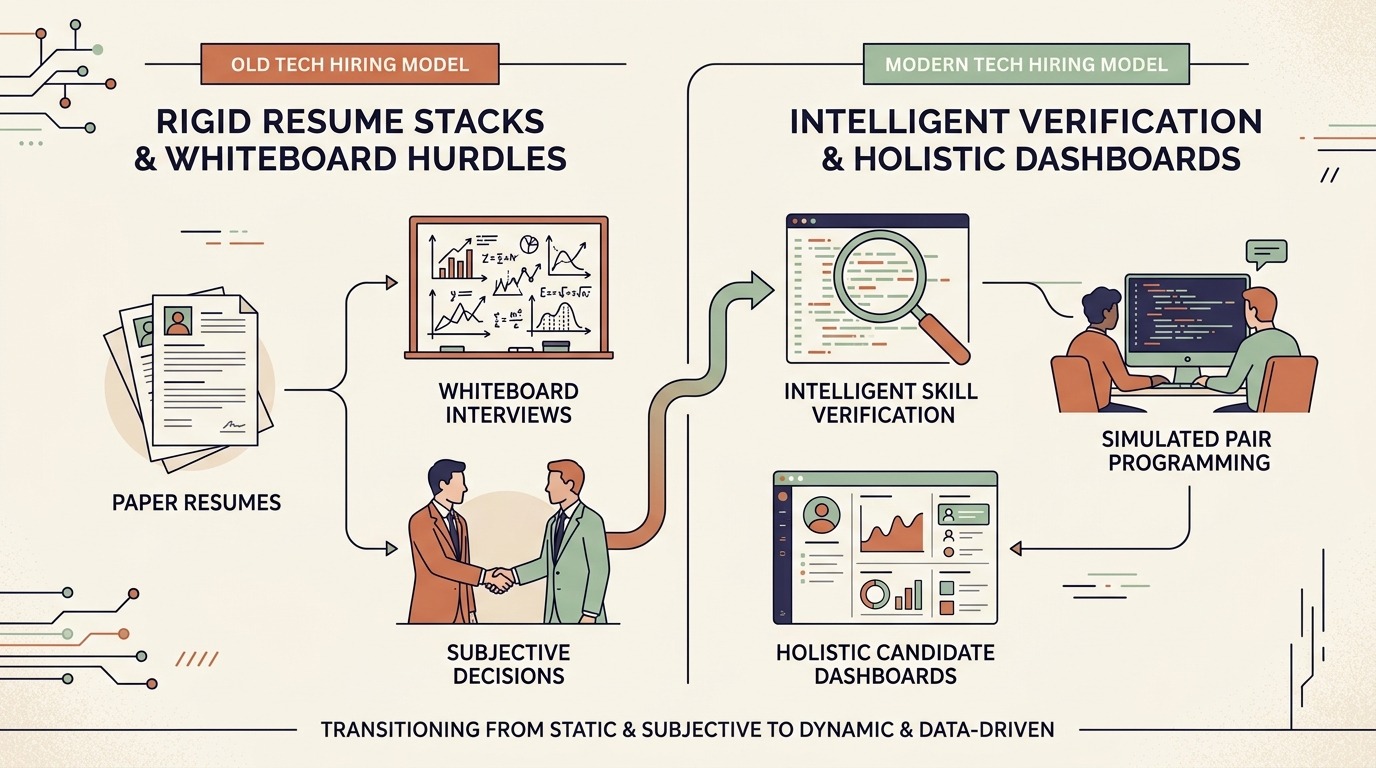
If you applied for a software engineering role five years ago, the hiring playbook was predictable to the point of monotony: submit an unstyled PDF resume stuffed with exact keyword matches, wait for a recruiter to glance at your university name and past company logos for six seconds, tackle a 45-minute LeetCode quiz on an automated testing platform, and spend a grueling on-site day inverting binary trees on dry-erase whiteboards.
Today, that playbook is disintegrating in real time.
Artificial intelligence has entered every phase of the recruitment lifecycle. Engineering organizations are inundated by thousands of automated applications generated by generative AI tools, while hiring teams counter by deploying machine learning algorithms, contextual resume vector search, automated code analysis, and synthetic technical screening assistants. Concurrently, candidates are using AI copilots to prepare, practice, and code faster than ever before.
Understanding how ai is changing tech hiring is no longer just an academic curiosity for talent acquisition teams—it is an existential requirement for developers, engineering managers, and technical leaders navigating the modern job market. The rules of engagement have shifted permanently. Here is an in-depth breakdown of how artificial intelligence is transforming tech hiring, what companies are actually looking for, and how you can position yourself to win.
1. The Resume Avalanche and the Evolution of Candidate Screening
The earliest touchpoint in the engineering funnel—the application—is where artificial intelligence first broke the status quo.
When generative AI tools made it possible for job seekers to customize their resumes, generate bespoke cover letters, and auto-submit hundreds of applications with a single click, engineering job postings suddenly attracted 2,000 to 5,000 applicants within 48 hours. Human recruiters could not physically review that volume, and traditional keyword-based Applicant Tracking Systems (ATS) were easily gamed by prompt-engineered resumes.
In response, modern tech hiring has pivoted from rigid keyword matching to semantic, context-aware AI evaluation.
Traditional ATS Matching:
[Resume Text] ---> Exact String Match ("Kubernetes", "Redis") ---> Pass / Fail
Result: High false positives, easily spoofed by keyword stuffing.

Modern Semantic AI Screening:
[Resume + GitHub + Projects] ---> LLM Vector Embeddings ---> Contextual Analysis
Evaluation: "Did the candidate design fault-tolerant streaming pipelines at scale?"
Result: Evaluates architectural scope, measurable outcomes, and verifiable depth.
From Buzzword Lists to Contextual Proof of Work
Modern hiring platforms use large language models fine-tuned on technical resumes to evaluate the substance of engineering accomplishments rather than the density of acronyms. Instead of flagging whether the word "Docker" appears three times, an AI screening engine evaluates:
- Architectural Scope: Did you build a greenfield service, or did you make minor configuration tweaks to an existing CI/CD pipeline?
- Business Impact & Metrics: Did your caching optimization reduce p99 latency from 850ms to 42ms under 100k requests per second, or is it a vague claim of "improved performance"?
- Verifiable Code Footprints: Algorithms increasingly cross-reference public repositories, pull requests, and technical blog posts to verify genuine authorship and peer review activity.
For candidates, this means that keyword stuffing is dead. The modern resume must read like a curated collection of executive engineering summaries, highlighting trade-offs, constraints, and quantifiable system impact.
2. The Collapse of Algorithmic Trivia and Whiteboard Grinding
For over fifteen years, the technical interview revolved around competitive programming puzzles. Candidates spent months memorizing dynamic programming memoization tables, graph traversals, and bitwise tricks to pass 45-minute timed screens.
Artificial intelligence has demolished the foundation of this evaluation model.
When tools like GitHub Copilot, Claude, and GPT-4 can solve hard LeetCode problems in under four seconds with optimal asymptotic complexity, testing human engineers on rote algorithm puzzles ceases to provide any meaningful signal. If an AI can generate the code instantaneously, testing a human candidate on that exact same output merely measures memorization, not real-world engineering capability. As we examined in our analysis of why traditional coding interviews are broken, companies that continue to rely on artificial algorithmic riddles are selecting for puzzle memorizers rather than pragmatic system builders.
The Rise of Practical, Real-World Technical Screens
Forward-thinking tech organizations are actively replacing isolated coding puzzles with real-world scenarios that mirror the day-to-day work of modern software development:
- Debugging Complex Existing Systems: Instead of writing a function from scratch, candidates are dropped into a Dockerized multi-service repository with broken integration tests, race conditions, or memory leaks, and asked to diagnose the issue using profilers and logs.
- AI-Collaborative Live Coding: Several pioneering companies now require candidates to use AI coding assistants during the interview. The interviewer observes how the candidate prompts the model, whether they critically audit generated code for edge cases and security vulnerabilities, and how quickly they iterate.
- System Architecture and Trade-off Defense: Rather than implementing a red-black tree, candidates design a distributed event ingestion pipeline, defending decisions regarding message brokers (Kafka vs. RabbitMQ), partitioning keys, idempotency guarantees, and failover topologies.
To excel in this environment, understanding what interviewers actually look for requires shifting your focus from syntax recall to holistic system thinking, architectural clarity, and defensive coding practices.
3. Conversational AI and the Democratization of Interview Preparation
While hiring teams are deploying AI to assess candidates, engineers are simultaneously utilizing artificial intelligence to fundamentally transform how they prepare for interviews.
Historically, preparing for technical and behavioral interviews required expensive private coaching, favors from senior mentors, or peer mock interviews that were difficult to schedule and inconsistent in quality. Today, interactive AI interview platforms have transformed interview prep into an on-demand, personalized training simulator.
How AI Mock Interview Simulation Works:
1. Candidate uploads target Job Description & Resume
2. Platform configures an AI Interviewer Persona (e.g., Alex, Staff Architect)
3. Voice-enabled, adaptive technical & behavioral questioning
4. Dynamic follow-ups: "Why did you choose PostgreSQL over MongoDB for that schema?"
5. Instant rubric-based scoring across:
   - Technical accuracy & system design trade-offs
   - Communication clarity and STAR methodology structure
   - Handling of unexpected constraints and ambiguity
Platforms like totop.app enable software engineers to practice realistic, voice-driven mock interviews tailored specifically to the exact job descriptions of the companies they are targeting. Instead of practicing generic questions, an engineer applying for a Staff Backend role at an enterprise fintech company can run simulated interviews that specifically probe distributed transactions, PCI-DSS compliance, and zero-downtime database migrations.
Furthermore, practicing under pressure helps candidates master the psychological side of technical discussions. If you freeze or encounter an unexpected technical hurdle during a live screen, knowing how to handle tough questions gracefully is often the difference between a rejection and an offer. AI simulation gives developers a safe, repeatable sandbox to rehearse those exact recovery tactics until they become second nature.
4. The Interview Room: AI as an Objective Copilot, Not a Replacement Judge
A common fear among engineers is that an autonomous AI algorithm will conduct their interview, evaluate their facial expressions, and issue an unappealable automated rejection. While dystopian one-way video screening tools existed briefly during the early 2020s, industry pushback, candidate boycott, and regulatory scrutiny (such as the EU AI Act and New York City Local Law 144) have largely steered credible tech companies away from fully autonomous hiring bots.
Instead, the prevailing paradigm is Human-in-the-Loop AI Augmentation.

What the Interviewer's Screen Actually Looks Like
During and immediately following a technical interview, modern engineering interviewers are supported by specialized AI copilots that assist with note-taking and objective evaluation:
- Automated Real-Time Transcription: The interviewer no longer has to split their attention between engaging with the candidate and frantically typing verbatim notes. An AI assistant creates an accurate transcript of the discussion.
- Rubric Calibration & Bias Mitigation: The AI cross-references the candidate's responses against standardized departmental scoring rubrics. If an interviewer gives a candidate an unusually low score for a behavioral response, the system prompts the interviewer to cite specific evidence from the transcript, reducing the influence of halo effects or unconscious bias.
- Code Execution Telemetry: Automated sandboxes capture not just whether the candidate's solution passed test cases, but how they structured their commits, how they debugged failing tests, and whether their time complexity matched their verbal explanation.
The human engineering manager remains the sole decision-maker. However, their decision is now supported by structured, audit-ready data rather than fuzzy post-interview impressions. Understanding this dynamic across what to expect at each interview round helps candidates realize that clear verbal reasoning is recorded and evaluated just as rigorously as the code itself.
5. Five Actionable Strategies for Developers in the AI Era
Given that artificial intelligence has permanently transformed the talent pipeline, how should software engineers adjust their preparation and interview execution? Here are five practical, high-impact strategies:
Strategy 1: Prioritize Architectural Reasoning Over Mechanical Syntax
Syntax has been commoditized. Any junior engineer with an LLM can generate a working React hook or a Python Flask route in seconds. What cannot be easily commoditized is the judgment required to know when, why, and how those components should fit together in a resilient distributed system.
In every interview, proactively communicate architectural trade-offs:
- "We could use an in-memory Redis cache here to achieve sub-millisecond read times, but we would need to account for cache invalidation strategies and potential stampedes if the cache node crashes. Alternatively, an indexed read-replica in PostgreSQL gives us immediate consistency at the cost of slightly higher query latency. Given our read-to-write ratio of 20:1, here is why I recommend the read-replica approach first..."
This level of depth demonstrates senior engineering judgment that algorithms cannot mimic. For engineers preparing for comprehensive evaluations, following a structured roadmap like our complete guide to technical interview prep ensures you build balanced depth across algorithms, databases, and distributed architectures.
Strategy 2: Demonstrate "AI Literacy" and Code Auditing Skills
If an interviewer asks you to use Copilot or an LLM assistant during a live coding session, do not simply accept the first code snippet the model produces. Treat the AI like a well-meaning junior engineer who writes fast code but frequently forgets edge cases:
- Verbally review the generated code line by line.
- Check for race conditions, integer overflows, unclosed database connections, and O(N²) hidden loops.
- Write unit tests that deliberately stress-test edge cases (empty inputs, network timeouts, invalid Unicode characters).
Showing that you can effectively orchestrate, audit, and refine AI-generated code is one of the highest-signal skills an engineering candidate can display in 2026.
Strategy 3: Build Verifiable, Living Proof of Work
Because generic resumes are now effortless to generate, hiring managers place disproportionate weight on verifiable evidence of technical skill. Replace passive bullet points with active proof of execution:
- Open Source Contributions: Even small pull requests to reputable open-source projects carry ten times the weight of a bullet point claiming familiarity with a framework.
- Interactive Deployed Projects: Instead of linking to an abandoned GitHub repo with a default README, deploy your application with a live URL, complete API documentation (Swagger/OpenAPI), and an architectural diagram explaining your design choices.
- Technical Writing & Architecture Teardowns: Documenting why a particular database migration failed in production or how you diagnosed a memory leak demonstrates deep analytical capability.
Strategy 4: Master the Art of Collaborative Problem Solving
When interviewers assess engineering candidates, they are fundamentally asking themselves: "Do I want to spend forty hours a week in a Slack channel and in design reviews with this person?"
Artificial intelligence cannot simulate authentic human collaboration, empathy, and constructive debate. During your interview:
- Clarify Ambiguity Early: Never jump straight into code. Ask clarifying questions about expected scale, latency constraints, user personas, and data consistency models.
- Think Out Loud Continuously: Share your thought process as you evaluate multiple approaches. If you realize an earlier assumption was flawed, acknowledge it openly: "Looking at this data structure, our search is going to degrade to linear time. Let me pivot to a balanced search tree or hash index."
- Accept Hints with Agility: If the interviewer offers a suggestion, treat it as a collaborative brainstorm rather than a critique. Incorporate their feedback seamlessly into your design.
Strategy 5: Rehearse with Adaptive AI Simulation Tools
Do not let your first real interview of the year be the place where you discover your communication weaknesses or gaps in system design knowledge.
Leverage adaptive interview platforms like totop.app to conduct realistic mock interviews before sitting in front of real hiring managers. By practicing with an AI interviewer that dynamically challenges your architectural decisions and probes your behavioral examples, you can identify blind spots, eliminate verbal filler, and sharpen your delivery in a low-stakes environment.
Preparation Matrix:
- Monday: Practice 2 job-specific mock interview sessions on totop.app
- Tuesday: Deep-dive into distributed systems concepts (CAP theorem, consensus algorithms)
- Wednesday: Conduct 1 live code refactoring exercise in an IDE with AI copilot enabled
- Thursday: Review transcripts and feedback metrics from totop.app; refine STAR stories
- Friday: Simulate a full 60-minute technical architectural screen under timed pressure
6. The Long-Term Horizon: What the Future Holds
As artificial intelligence continues to mature, we are moving toward an era where the boundary between candidate evaluation and actual on-the-job contribution will blur.
In the near future, technical interviews will likely evolve into paid, micro-contract simulation environments where candidates spend three to four hours working alongside an engineering team's actual codebase, using their everyday tools, IDEs, and AI assistants to solve a realistic ticket. Objective telemetry will measure problem decomposition, code quality, communication, and security awareness—eliminating the artificial friction of high-stakes whiteboard interrogations entirely. As we discuss in our exploration of the future of technical interviews, the ultimate beneficiary of this transformation will be the software engineering discipline itself.
The engineers who flourish in this new landscape will not be those who can memorize the syntax of an obscure binary search variation. They will be the engineers who combine sharp architectural intuition, relentless curiosity, disciplined code verification, and empathetic communication.
By embracing these tools, understanding how companies evaluate talent, and preparing deliberately, you can navigate the modern hiring landscape with supreme confidence and land the technical roles that define your career.