
Behavioral interviews are often the most unpredictable part of the software engineering interview process. While technical rounds test your ability to write code and design systems, the behavioral round evaluates your communication skills, teamwork, and how you handle adversity. As a software engineer, your ability to write clean code is just as important as your ability to collaborate effectively with cross-functional teams.
In this comprehensive guide, we'll explore the most common behavioral interview questions for software engineers, how to structure your answers using the STAR method, and why platforms like totop.app can be your best resource for mastering these soft skills.
Why Do Tech Companies Ask Behavioral Questions?
You might wonder why a company hiring for a deeply technical role cares about your past experiences in non-technical situations. The reality is that modern software engineering is a team sport.
Tech giants and startups alike are looking for engineers who can:
- Navigate Conflict: Can you handle disagreements in code reviews or architectural decisions professionally?
- Demonstrate Ownership: Do you take responsibility for bugs in production, or do you point fingers?
- Communicate Complex Ideas: Can you explain a technical constraint to a non-technical product manager?
- Adapt to Change: How do you react when requirements change midway through a sprint?
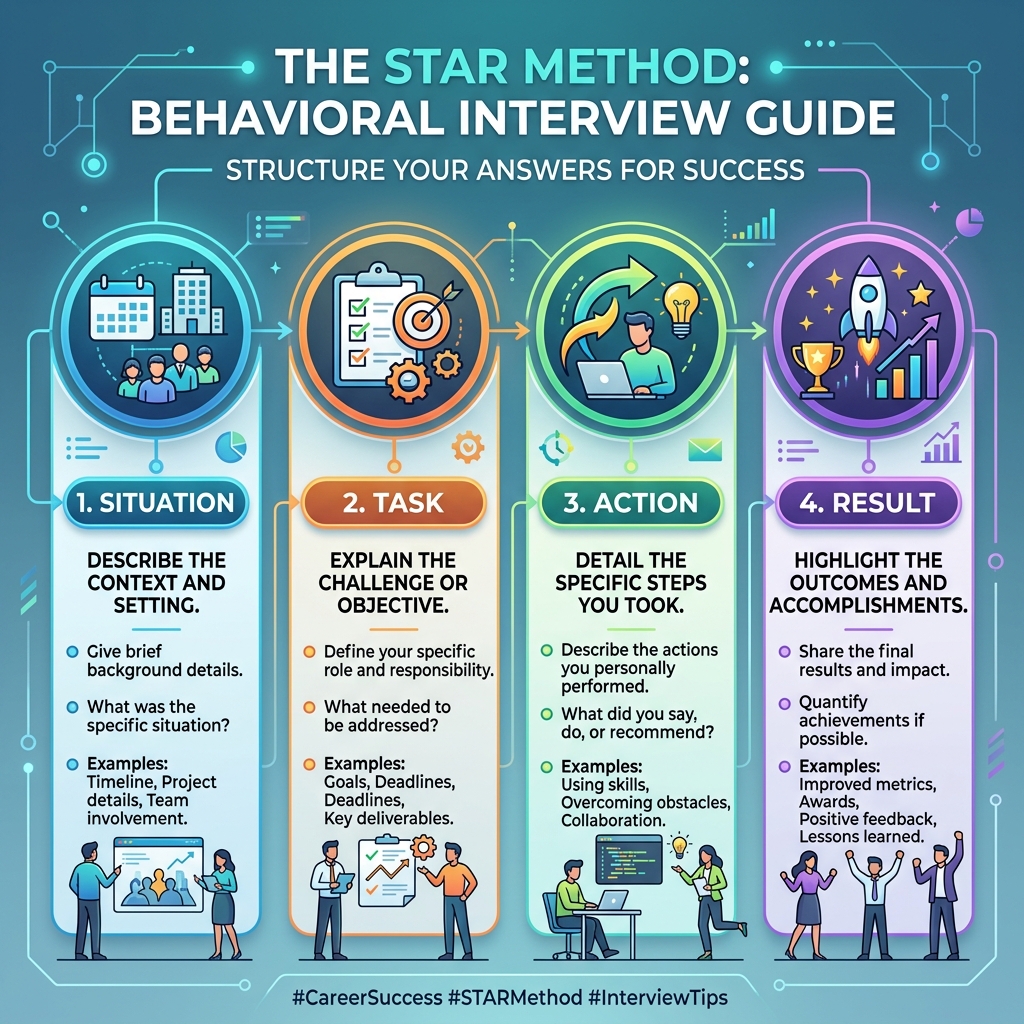
Mastering the STAR Method
The most effective way to answer behavioral questions is by using the STAR method. This structure ensures your answer is concise, impactful, and easy for the interviewer to follow.
- S - Situation: Briefly set the scene. Give the necessary context about the project, team, or challenge.
- T - Task: Describe your specific responsibility in that situation. What was the goal or the problem to solve?
- A - Action: This is the most crucial part. Detail the specific actions you took to address the task. Focus on "I" rather than "we" to highlight your individual contribution.
- R - Result: Share the outcome of your actions. Whenever possible, quantify the results (e.g., "reduced latency by 20%," "delivered the feature two weeks ahead of schedule").
Let's dive into some common categories of behavioral questions and how to tackle them.
Category 1: Conflict Resolution
Disagreements are inevitable in any engineering team. Interviewers want to see that you can handle conflict constructively without letting ego get in the way.
"Tell me about a time you disagreed with a colleague on a technical decision."
What they are looking for: Empathy, logical reasoning, willingness to compromise, and prioritizing the team's success over personal preference.
Example Answer Structure (STAR):
- Situation: "On my previous team, we were deciding between two different database technologies for a new microservice."
- Task: "My colleague advocated for MongoDB because of its flexibility, while I believed PostgreSQL was better suited due to our strict data consistency requirements."
- Action: "Instead of arguing subjectively, I proposed we build a quick proof-of-concept for both. We spent two days prototyping and benchmarking read/write speeds under our expected load. I also scheduled a meeting with a senior architect to get an unbiased perspective."
- Result: "The benchmarks showed PostgreSQL handled our specific query patterns 30% faster. My colleague reviewed the data and agreed. We moved forward with PostgreSQL, and the service has been running smoothly in production for over a year."
Category 2: Dealing with Failure and Mistakes
Everyone makes mistakes, especially in software engineering where complex systems interact in unpredictable ways. The key is how you respond to and learn from those failures.
"Tell me about a time you made a mistake that impacted production."
What they are looking for: Accountability, problem-solving under pressure, and a commitment to continuous improvement (e.g., writing post-mortems, adding tests).
Example Answer Structure (STAR):
- Situation: "Last year, I deployed a new feature that inadvertently caused a memory leak in our main application server."
- Task: "The memory usage spiked, causing the service to crash and affecting about 5% of our active users. I needed to resolve the issue immediately."
- Action: "I first acknowledged the issue in our team's Slack channel and immediately rolled back the deployment to restore stability. Then, I dug into the logs and used a profiler to isolate the leak. I found a missing
close()call on a database connection. I wrote a fix, added a regression test, and pushed the code." - Result: "The service was stabilized within 15 minutes. To prevent this in the future, I led a blameless post-mortem and we updated our CI/CD pipeline to include static analysis checks for unclosed connections. I learned the critical importance of rigorous testing before deployment."
Category 3: Leadership and Initiative
Even if you are applying for a junior or mid-level role, demonstrating leadership qualities can set you apart.
"Tell me about a time you took the initiative to improve a process or tool."
What they are looking for: Proactiveness, identifying pain points, and driving positive change without being explicitly asked.
Example Answer Structure (STAR):
- Situation: "When I joined my previous company, I noticed that our onboarding process for new developers was highly manual and often took over a week."
- Task: "I wanted to reduce this friction so new hires could contribute code faster."
- Action: "During my downtime, I started documenting the setup steps in a central wiki. Then, I wrote a set of shell scripts to automate the installation of dependencies and local environment configuration using Docker. I presented this to my engineering manager and got approval to make it the standard onboarding process."
- Result: "The new automated setup reduced onboarding time from a week to just a few hours. The feedback from the next three new hires was overwhelmingly positive, noting how smooth their first day was."
Category 4: Handling Tight Deadlines and Pressure
Engineering is often about managing trade-offs, especially when time is a constraint.
"Describe a situation where you had to meet a tight deadline."
What they are looking for: Prioritization, communication of risks, scope management, and ability to deliver under stress.
Example Answer Structure (STAR):
- Situation: "We were two weeks away from a major product launch, and the marketing team requested a new integration that wasn't in the original scope."
- Task: "I was tasked with implementing this integration, but the deadline was non-negotiable."
- Action: "I reviewed the requirements and realized building the full feature would take at least three weeks. I met with the product manager and proposed a phased approach. We could deliver the core functionality for the launch by hardcoding some configuration values, and then build the dynamic UI in the following sprint."
- Result: "The PM agreed to the compromise. I focused purely on the critical backend logic. We successfully launched on time with the essential feature in place, and I followed up to complete the UI two weeks later without compromising the initial launch."
Tips for Preparing for Behavioral Interviews
- Prepare Your 'Story Bank': Don't try to memorize answers to specific questions. Instead, prepare 5-7 versatile stories from your past experience that can be adapted to answer various questions (e.g., a story about a difficult bug can answer questions about failure, problem-solving, or tight deadlines).
- Practice Out Loud: Writing down your answers is helpful, but speaking them out loud is crucial. You want to sound natural, not rehearsed.
- Be Honest: Interviewers can usually spot embellishments. If you haven't faced a specific situation, be honest, but explain how you would handle it if it arose.
- Keep it Positive: Even when discussing conflicts or failures, focus on the positive outcome, what you learned, and how it made you a better engineer.
- Use totop.app: Practicing with a peer or a mentor is invaluable. Platforms like totop.app offer incredible AI-driven mock interviews that simulate real-world scenarios, allowing you to practice your behavioral responses and get immediate, actionable feedback on your communication style and content.
STAR Method Examples for Software Engineers (Copy-Ready Cheat Sheet)
Use this structured STAR method cheat sheet to map your own engineering stories across the five most frequently tested behavioral competencies:
| Competency Tested | Situation & Task (20% of Time) | Action — Specific Engineering Steps (60% of Time) | Quantified Result & Learning (20% of Time) |
|---|---|---|---|
| 1. Technical Disagreement / Design Conflict | Team split between adopting a new NoSQL store vs. partitioning our existing PostgreSQL database under a 6-week launch deadline. | Wrote a 2-page Architecture Decision Record (ADR), benchmarked both with a 10M-row synthetic workload, and showed PostgreSQL declarative partitioning met our p99 < 15ms SLA with zero new operational burden. | Shipped 1 week ahead of schedule, saved $4,200/month in managed DB costs, and established ADRs as our org standard. |
| 2. Production Outage / Incident Ownership | Checkout API p99 latency spiked from 120ms to 8s during a flash sale due to connection pool exhaustion. | Took incident command, rolled back the N+1 query release within 6 minutes, added PgBouncer transaction pooling, and built a CI query-count regression gate. | Restored 99.98% availability in 11 minutes and prevented any connection pool incidents over the next 4 quarters. |
| 3. Ambiguous / Changing Requirements | Product requested a real-time analytics export for enterprise tenants with no defined SLA or schema contract. | Interviewed 3 customer success leads, scoped an MVP using asynchronous S3 Parquet exports instead of synchronous REST queries, and iterated in weekly demos. | Delivered the MVP in 10 days, unblocking $180K in enterprise renewals while avoiding main-database read contention. |
| 4. Delivering Constructive Peer Feedback | A junior teammate's large 1,500-line PRs were stalling code review velocity and introducing regressions. | Paired 1-on-1 to introduce stacked PRs (<250 lines) and automated pre-commit unit test hooks rather than leaving critical comments in public channels. | Cut average PR review turnaround time from 3 days to 4 hours and reduced post-merge hotfixes by 60%. |
How to Turn Your Resume into a Printable Behavioral Story Matrix
Before any loop, create a 1-page 5×5 Story Matrix matching your 5 strongest engineering projects (rows) against the 5 universal behavioral prompts (columns: Conflict, Failure/Outage, Tight Deadline, Ambiguity, Mentorship). Having two distinct stories per category guarantees you never repeat the same example twice across a 4-round onsite.
Conclusion
Behavioral interviews don't have to be intimidating. By understanding what interviewers are looking for, structuring your answers with the STAR method, and preparing a robust bank of experiences, you can confidently showcase your soft skills. Remember, companies want to hire engineers who are not only technically proficient but also excellent teammates. Invest time in preparing for this phase of the interview, and you'll significantly increase your chances of landing that dream role.
Practice Full Stack Engineer Questions Live with AI Mock Interviews
Turn any job description across Engineering, DevOps, Data, Marketing, Sales, Finance, or HR into a personalized test and live voice or text AI mock interview on totop.app, or test your speed right now in the 60-Second Full Stack Engineer Blitz.
Play 60s Full Stack Engineer Blitz (Free, No Login) | Start 14-Day Free Trial | Browse All Interview Guides