When You Don't Know the Answer: How to Handle It Gracefully
It happens to every single software engineer eventually.
You're forty minutes into a high-stakes technical interview. You've answered the warm-up questions smoothly, discussed your past architecture wins, and written a clean helper function. Then, the interviewer leans forward and drops a bomb:
"How does Raft handle uncommitted log entries during an asymmetric network partition while an election timeout elapses?"
Or maybe it's simpler, yet equally paralyzing:
"Can you implement a custom memory allocator in C++ with boundary-tag coalescing right now on the whiteboard?"
Your mind goes dead silent. You feel that sharp spike of adrenaline in your throat. You have never touched that specific protocol in production, or you haven't looked at allocator pointer arithmetic since your sophomore year of college.
In that split second, panic whispers three terrible ideas into your ear:
- The Bluff: Pretend you know, string together buzzwords, and pray they don't notice.
- The Freeze: Stare blankly at the screen for two agonizing minutes while your confidence disintegrates.
- The Immediate Surrender: Shrug your shoulders, say "I have no idea," and throw in the towel.
Here is the truth that senior hiring managers and staff engineers know: Not knowing the answer is not what fails candidates. How you handle not knowing is what separates junior coders from hireable senior engineers.

Let's break down why interviewers ask questions you aren't expected to know, the psychology of what they evaluate, and the exact 4-step framework you can use to turn a moment of ignorance into your strongest performance of the day.
1. Why Interviewers Push You to Your Edge
Most candidates view technical interviews as an academic exam: an interviewer asks a question, you retrieve the answer from your mental database, and if you have the file cached, you pass.
Real-world software engineering doesn't work that way. In production, nobody pays you to recite textbook definitions. You get paid to navigate ambiguity, debug systems you didn't write, read documentation under pressure, and solve problems where the answer isn't on Stack Overflow.
When an experienced interviewer asks a question that pushes you past your knowledge boundary, they are usually testing three specific traits:
┌─────────────────────────────────────────────────────────────────┐
│              WHAT INTERVIEWERS ARE ACTUALLY TESTING             │
├───────────────────────────────┬─────────────────────────────────┤
│ 1. Intellectual Honesty       │ Do you admit limits or bluff?   │
│ 2. First-Principles Deduction │ Can you reason from core logic? │
│ 3. Collaborative Composure    │ Are you pleasant to debug with? │
└───────────────────────────────┴─────────────────────────────────┘
- Intellectual Honesty: Can you be trusted in production? An engineer who bluffs in an interview is the same engineer who silently merges untested code or hides an outage out of pride.
- First-Principles Thinking: When your memory fails, can your raw engineering logic take over? Can you break an unfamiliar problem down into fundamental physics, network latency, memory layout, or algorithmic complexity?
- Composure & Communication: When systems break at 2:00 AM, do you panic and shut down, or do you communicate methodically and invite collaboration?
Once you realize that an unknown question is an invitation to demonstrate how you think rather than what you memorized, the fear evaporates.
2. The Fatal Mistakes vs. First-Principles Deduction
Before looking at what to do, let's examine what happens when candidates panic versus when they apply a structured deduction mindset.
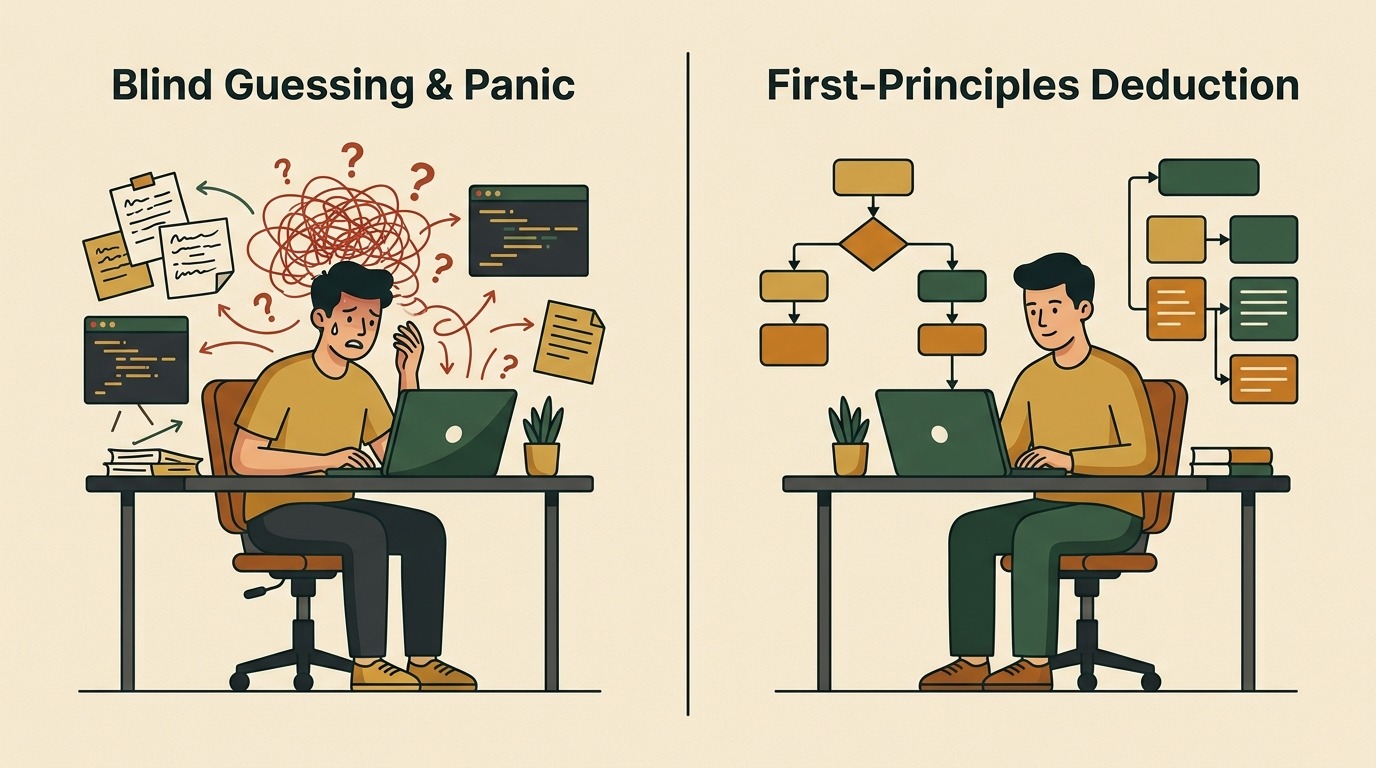
The Anti-Patterns That Sink Candidates
- The Confident Bluff: Trying to guess an API name or pretending to understand an algorithm. Interviewers write these systems daily; they catch bluffs in seconds, and it destroys your credibility instantly.
- The Black Hole Silence: Going completely quiet for three minutes while you panic internally. The interviewer has zero visibility into your brain and assumes you are completely stuck.
- The Defensive Pivot: "Nobody uses that in real life anyway, so why are you asking me this?" (Yes, candidates actually say this when defensive).
- The Instant Wave of the White Flag: Saying "I don't know that" and stopping dead in your tracks without attempting to reason about it.
The Winning Shift: First-Principles Reasoning
Instead of trying to pull a pre-packaged answer from memory, you treat the unknown topic as a system you are designing together in real-time. You state your known constraints, lay out hypotheses, and trace the trade-offs out loud.
3. The 4-Step "Think-Aloud" Rescue Framework
Whenever you hit a wall, deploy this field-tested 4-step framework.
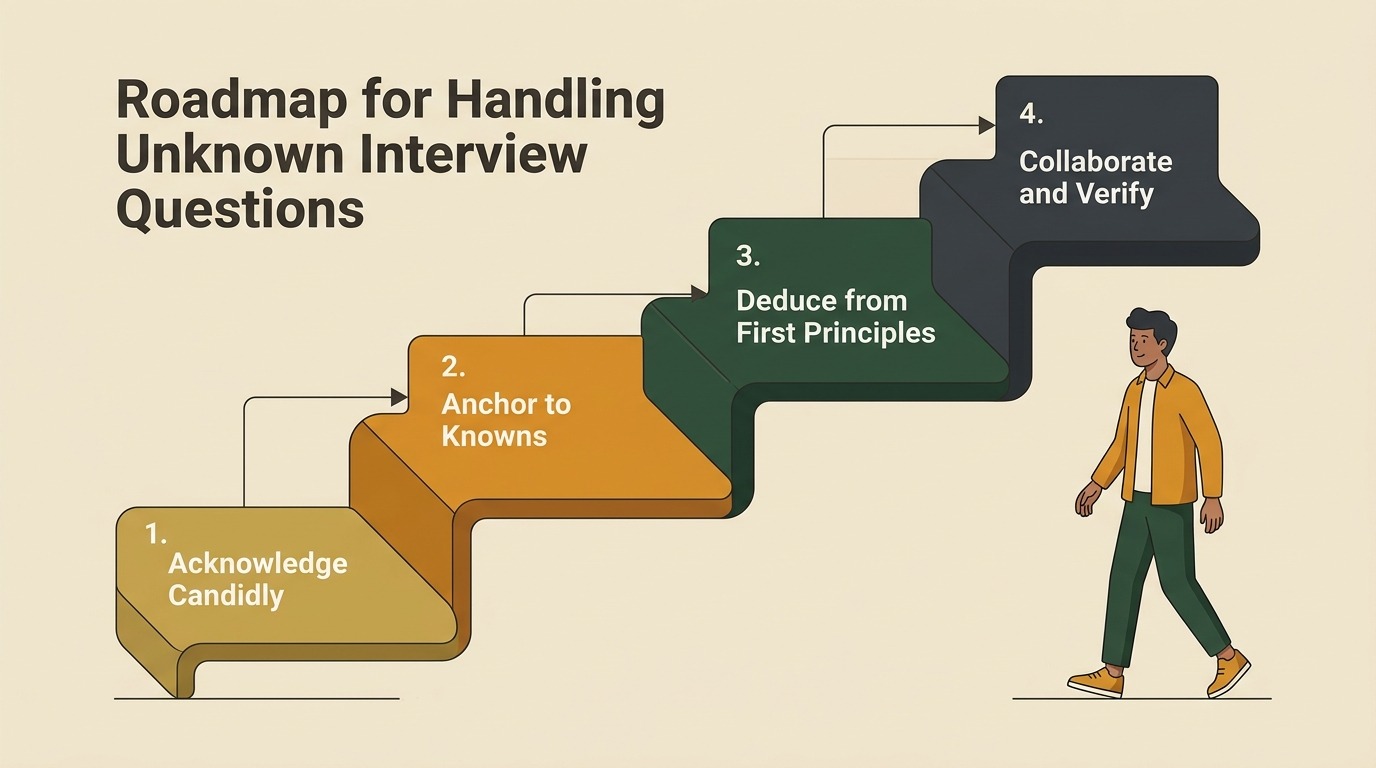
[1. Acknowledge Candidly]
          │
          ▼
  [2. Anchor to Knowns]
          │
          ▼
[3. Deduce from First Principles]
          │
          ▼
 [4. Collaborate and Verify]
Step 1: Acknowledge Candidly (Remove the Pressure)
Disarm the tension immediately. Acknowledge that you haven't worked with this specific tool, API, or algorithm directly, without apologizing or sounding defeated.
Word-for-Word Script: "I haven't worked directly with [X technology/concept] in production yet, but if it's okay with you, I'd love to reason through how it likely works under the hood based on fundamental principles."
Notice what this script does:
- It eliminates the pressure to guess the "one true answer."
- It displays radical honesty.
- It proactively asks permission to solve the problem creatively. 99% of interviewers will enthusiastically say, "Yes, please do!"
Step 2: Anchor to Knowns (Build a Bridge)
You never start from zero. Connect the unfamiliar concept to a related tool, design pattern, or data structure you do understand intimately.
Word-for-Word Script: "While I haven't implemented [X], it reminds me a lot of how [Y] solves concurrency / replication / caching. In [Y], we typically handle this by using [Z]. Let's see if those same constraints apply here."
Example Bridges:
- Don't know Kafka partition rebalancing? Anchor to Consistent Hashing in DynamoDB or Database sharding.
- Don't know Go channels internal lock-free ring buffer? Anchor to classic producer-consumer queues with mutexes and condition variables.
- Don't know an obscure tree rotation algorithm (like Red-Black Trees)? Anchor to standard Binary Search Tree invariant maintenance and balancing heights.
Step 3: Deduce from First Principles (Think Out Loud)
This is where you win the offer. Walk the interviewer step-by-step through your deductive reasoning. Break the unknown system down into its core physical and architectural constraints:
- State the Goal: What is this system or function trying to achieve? (e.g., zero data loss, $O(1)$ lookup, thread safety).
- Identify the Bottlenecks: What makes this hard? (e.g., race conditions, network splits, cache invalidation).
- Propose a Naive Solution: "If I were building this from scratch, the simplest naive approach would be..."
- Stress Test & Iterate: "However, that would fail when two nodes write simultaneously, so we probably need a distributed lock or a monotonic sequence counter."
Step 4: Collaborate and Verify (Turn It Into a Pair-Programming Session)
Check in with the interviewer frequently. Turn the interrogation into a collaborative architecture session between two future teammates.
Word-for-Word Script: "Does that mental model align with how this is structured in your production stack, or is there an edge case I should consider next?"
If your hypothesis was slightly off, a good interviewer will gladly offer a hint: "Well, what if the leader node crashes before the ACK?" Because you invited them in, you can take that hint gracefully and keep building.
4. Real-World Scenarios with Exact Word-for-Word Scripts
Let's see how this framework plays out across different technical interview formats.
Scenario A: System Design / Obscure Distributed Tool
The Question: "How does CockroachDB achieve serializable distributed transactions without central lock managers?"
The Internal Panic: I've only ever used Postgres on a single RDS instance!
The Graceful Response:
1. Acknowledge:
"I haven't operated CockroachDB in a production environment—my primary experience
with high-throughput relational data has been with PostgreSQL and Redis caching layers."

2. Anchor & Deduce:
"However, thinking about serializability across distributed nodes from first principles:
The fundamental challenge is ordering transactions without a single central clock bottleneck.
In distributed systems, physical clocks drift, so standard timestamps cause inconsistencies.
Systems usually solve this with either TrueTime (like Google Spanner with GPS hardware)
or Logical Clocks (like Hybrid Logical Clocks / Lamport timestamps) combined with Multi-Version
Concurrency Control (MVCC)."

3. Hypothesize & Verify:
"If CockroachDB doesn't rely on atomic hardware clocks like Spanner, my deduction is that
they use Hybrid Logical Clocks combined with MVCC write intents. That way, each row maintains
a version history, and conflicting concurrent writes can detect read-write overlaps and abort
the newer transaction. Does that match how CockroachDB approaches consensus?"
Interviewer Reaction: ⭐⭐⭐⭐⭐ Even if you didn't know CockroachDB's exact internal C++ implementation, you demonstrated deep knowledge of distributed clocks, MVCC, and transaction ordering.
Scenario B: Coding / Obscure Data Structure or Tricky Edge Case
The Question: "Find all articulation points (bridges) in this connected network graph."
The Internal Panic: I vaguely remember Tarjan's algorithm from college, but there is zero chance I can write low-link values from memory right now.
The Graceful Response:
1. Acknowledge:
"I know there's a specialized linear-time algorithm for graph bridges (Tarjan's), but I
don't have the exact low-link recursion formula memorized off the top of my head."

2. Anchor & Naive Baseline:
"Rather than trying to guess an algorithm I'm rusty on, let me first build a working,
provably correct baseline so we have functional code, and then we can optimize it together."

3. First-Principles Implementation:
"The core definition of a bridge is an edge whose removal increases the number of connected
components. We can iterate over every edge (u, v), temporarily remove it, run a standard
Breadth-First Search (BFS) or DFS from node 0, and check if all V vertices are still reachable.
That gives us an O(E * (V + E)) baseline."

4. Optimization Reasoning:
"To optimize this, we notice that DFS discovery times form a spanning tree. Any edge that isn't
part of a cycle is a bridge. We could track entry times and back-edges during a single DFS pass.
Would you prefer I implement the clean O(E*(V+E)) baseline first, or should we trace the DFS
cycle detection logic on the board?"
# A clean, working baseline is always 100x better than broken, half-remembered code
def find_bridges_baseline(n: int, edges: list[list[int]]) -> list[list[int]]:
    """
    Baseline O(E * (V + E)) bridge finding using BFS reachability.
    Provably correct, easy to read, and zero bluffing.
    """
    from collections import defaultdict, deque

    adj = defaultdict(list)
    for u, v in edges:
        adj[u].append(v)
        adj[v].append(u)

    def count_reachable(skip_u: int, skip_v: int) -> int:
        visited = set([0])
        queue = deque([0])
        while queue:
            curr = queue.popleft()
            for neighbor in adj[curr]:
                # Skip the temporarily removed edge
                if (curr == skip_u and neighbor == skip_v) or (curr == skip_v and neighbor == skip_u):
                    continue
                if neighbor not in visited:
                    visited.add(neighbor)
                    queue.append(neighbor)
        return len(visited)

    bridges = []
    for u, v in edges:
        if count_reachable(u, v) < n:
            bridges.append([u, v])

    return bridges
Interviewer Reaction: ⭐⭐⭐⭐⭐ You delivered a working, tested solution, explained complexity trade-offs, and showed mature software engineering pragmatism.
Scenario C: Language / Runtime Trivia
The Question: "What happens in Python if you define __del__ on an object participating in a reference cycle in older versions?"
The Graceful Response:
"I haven't encountered that specific reference cycle edge case in my recent Python 3 work.
However, I know Python's garbage collector relies primarily on reference counting, supplemented
by a cyclic garbage collector that periodically traverses object graphs to detect isolated cycles.

If an object in a cycle has a custom __del__ destructor, the collector doesn't know which
destructor to execute first without risking accessing an already-torn-down object. My intuition
is that Python would either mark the cycle as uncollectable (placing it into gc.garbage) or delay
cleanup to prevent memory corruption.

Is that the safety mechanism Python uses here?"
5. Cheat Sheet: Response Templates for Tough Moments
Keep these quick templates in your mental back pocket for your next technical round:
| Situation | Don't Say | Say Instead |
|---|---|---|
| Complete Unknown Tool | "I've never heard of that." | "I haven't had exposure to [Tool] in my previous projects, but based on what it achieves, here is how I'd approach that problem..." |
| Forgot Syntax / API Name | "I forgot how the method is spelled." | "I know the standard library provides a method for this—I'll stub it out as helper_fn() with this signature and focus on the core algorithm." |
| Stuck on an Edge Case | (Complete silence for 3 minutes) | "I'm currently thinking through what happens when input is null or duplicate. Let me trace this with a concrete trace table..." |
| Vague / Open-Ended Prompt | "What do you want me to do?" | "To make sure we're optimizing for the right constraints, should we prioritize read latency or strict consistency for this flow?" |
6. How to Build the Muscle Memory
Reading scripts on a screen is easy; executing them calmly when your heart is pounding is hard.
Handling uncertainty is a physical and psychological reflex. You cannot master it by reading blog posts alone—you have to practice getting stuck in a simulated, low-stakes environment until your default reaction shifts from panic to curiosity.
Here is an effective routine:
- Intentionally Practice Hard Problems Blind: Pick interview questions you have never seen before. Set a 20-minute timer. Forbid yourself from checking hints or solutions. Force yourself to talk out loud to an empty room, explaining your first-principles logic.
- Do AI-Powered Voice Mock Interviews: Using realistic AI interview platforms like totop.app, you can simulate adaptive technical rounds where the AI pushes you with challenging follow-up questions and unfamiliar scenarios. Practicing your vocal tone, pause management, and "think-aloud" scripts against an interactive evaluator builds real-world composure.
- Review Your Pauses: Record your mock sessions. Listen to where you went silent and practice replacing those dead pauses with constructive transition phrases like "Let's examine the memory constraints first."
Conclusion: Poise Under Pressure is Your Superpower
Nobody knows everything in software engineering. Tech stacks change, frameworks deprecate, and distributed systems fail in ways nobody documented.
The next time an interviewer asks you a question that makes your stomach drop, don't shrink back. Smile, take a steady breath, and remember:
You don't need to know every answer. You just need to show them how brilliantly you think when you don't.
Ready to put your interview communication skills into practice? Sharpen your reasoning, speech pacing, and technical depth with personalized AI mock interviews on totop.app.