Your First Technical Interview: What to Really Expect
For most junior engineers and self-taught programmers, walking into their inaugural technical screen feels like stepping onto a high-stakes quiz show. You picture an unsmiling senior engineer waiting to ambush you with obscure dynamic programming algorithms, red-penning your syntax errors while you sweat in front of a whiteboard.
The reality of modern software hiring is fundamentally different. When you know what to expect in your first technical interview, the mysterious black box transforms into a structured, collaborative conversation designed to see how you think, communicate, and solve real-world problems.

Engineering teams rarely hire walking compilers. Instead, they look for junior developers who write clean, testable code, ask insightful clarifying questions, take constructive feedback with humility, and break down ambiguous requirements without spiraling into panic.
Here is an unvarnished breakdown of how technical interviews actually operate, how interviewers score your performance behind closed doors, and what steps you can take to pass.
The Anatomy of the Modern Technical Interview Pipeline
Engineering hiring rarely hinges on a single one-hour meeting. Most engineering organizations run candidates through a phased pipeline to evaluate different dimensions of technical competency, culture fit, and teamwork (for a comprehensive stage-by-stage breakdown, explore our guide on what to expect at each interview round).
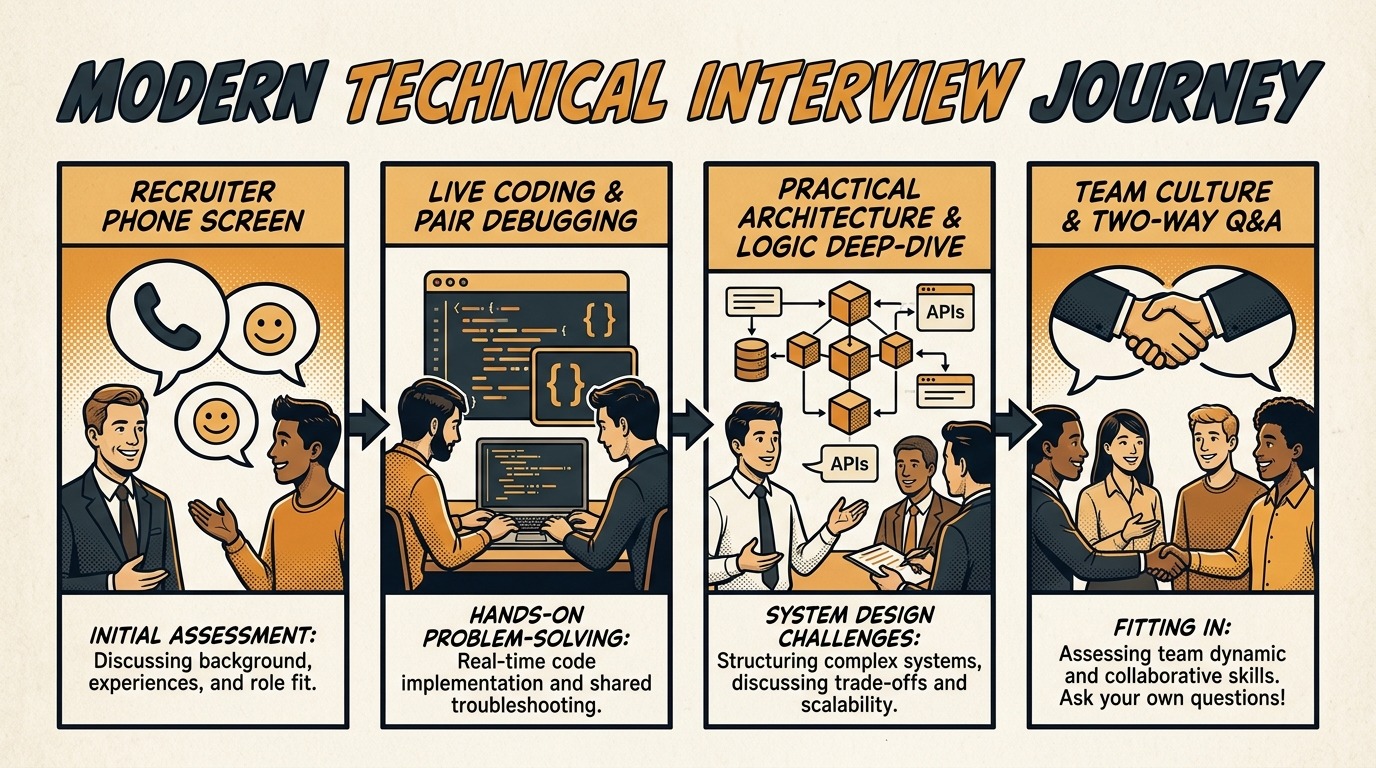
1. The Recruiter Screen (15–30 Minutes)
Your journey starts with a talent partner or technical recruiter. This is an informal phone or video screen to confirm alignment on:
- Baseline background & story: A quick walkthrough of your transition into tech, projects you've built, and languages you specialize in.
- Logistics: Target start dates, salary expectations, work authorization, and remote vs. on-site preferences.
- Surface-level technical sanity check: Confirming that the technologies on your resume reflect your actual day-to-day experience.
Treat recruiters as your biggest internal advocates. When you communicate clearly and show enthusiasm, they will actively coach you on what the technical hiring managers prioritize in subsequent rounds.
2. The Technical Screen or Take-Home (45–60 Minutes)
Depending on company size, this step is either a live coding session via a shared IDE (CoderPad, HackerRank, CodeSignal) or an asynchronous take-home project.
- Live Coding Screen: A senior or mid-level engineer presents a focused algorithmic or data manipulation problem. They want to observe how you structure variables, handle edge cases, and debug errors under pressure.
- Take-Home Project: You are given 24–72 hours to build a lightweight API endpoint, CLI utility, or UI component. Reviewers inspect your git commit hygiene, automated test coverage, and documentation.
3. The Onsite / Virtual Loop (3–4 Hours)
The "onsite" consists of 3 to 5 back-to-back sessions:
- Deep-Dive Live Coding: Practical coding challenges focusing on data structures, string manipulation, or domain-specific logic.
- Architecture & System Flow: For junior candidates, this is not about designing Netflix from scratch. Rather, interviewers ask you to walk through the architecture of a project you built—explaining database schema decisions, API payloads, or authentication flows.
- Behavioral & Culture Fit: Hiring managers evaluate your conflict resolution, curiosity, communication, and response to setbacks.
What Actually Happens in the Live Coding Room
The live coding round is where candidates feel the most anxiety. Demystifying the exact minute-by-minute timeline helps eliminate surprises.
00:00 - 00:05 | Warm-up, introductions, and problem prompt presentation
00:05 - 00:12 | Clarifying edge cases, data types, and defining I/O examples
00:12 - 00:18 | Outlining brute-force vs. optimal approach in pseudocode
00:18 - 00:38 | Active coding and real-time verbalization of thought process
00:38 - 00:45 | Manual dry-running with edge cases, debugging, Big-O analysis
00:45 - 00:50 | Candidate questions about team workflow, engineering culture
The Power of Clarifying Questions
Amateur candidates rush to write code within 30 seconds of seeing a prompt. Senior engineers pause, re-read the prompt, and ask clarifying questions.
Before writing a single line of syntax, clarify the constraints:
- "Can the input array contain negative numbers or null values?"
- "Is the collection guaranteed to fit in memory, or should we optimize for streaming data?"
- "What should the function return if no valid pair exists—an empty array,
null, or throw an error?"
Asking these questions demonstrates that you write defensive code in production and do not build features on unverified assumptions.
// Example: Stating assumptions and typing constraints upfront
interface UserSession {
  id: string;
  durationSeconds: number;
  isActive: boolean;
}

/**
 * Calculates average session length while ignoring inactive sessions.
 * Clarification: Does empty input return 0 or throw an exception?
 */
function getAverageActiveSessionDuration(sessions: UserSession[]): number {
  const activeSessions = sessions.filter(session => session.isActive);
  if (activeSessions.length === 0) {
    return 0; // Confirmed edge case handling with interviewer
  }

  const totalDuration = activeSessions.reduce((sum, current) => sum + current.durationSeconds, 0);
  return totalDuration / activeSessions.length;
}
Thinking Out Loud (Verbalizing Your Logic)
If you solve a problem in total silence, the interviewer cannot grade your thought process. If you get stuck in silence, they have no way to know where you went off track.
Narrate your thought process in conversational sentences:
- "I am thinking of storing visited nodes in a hash set so we can look them up in $O(1)$ time rather than nested loops."
- "I noticed our current pointer might go out of bounds on an empty string, so let me add a boundary guard here."
- "This recursive solution works, but the call stack could grow to $O(n)$. Let's see if we can convert it to an iterative two-pointer approach."
Expectation vs. Reality: Debunking First-Interview Myths
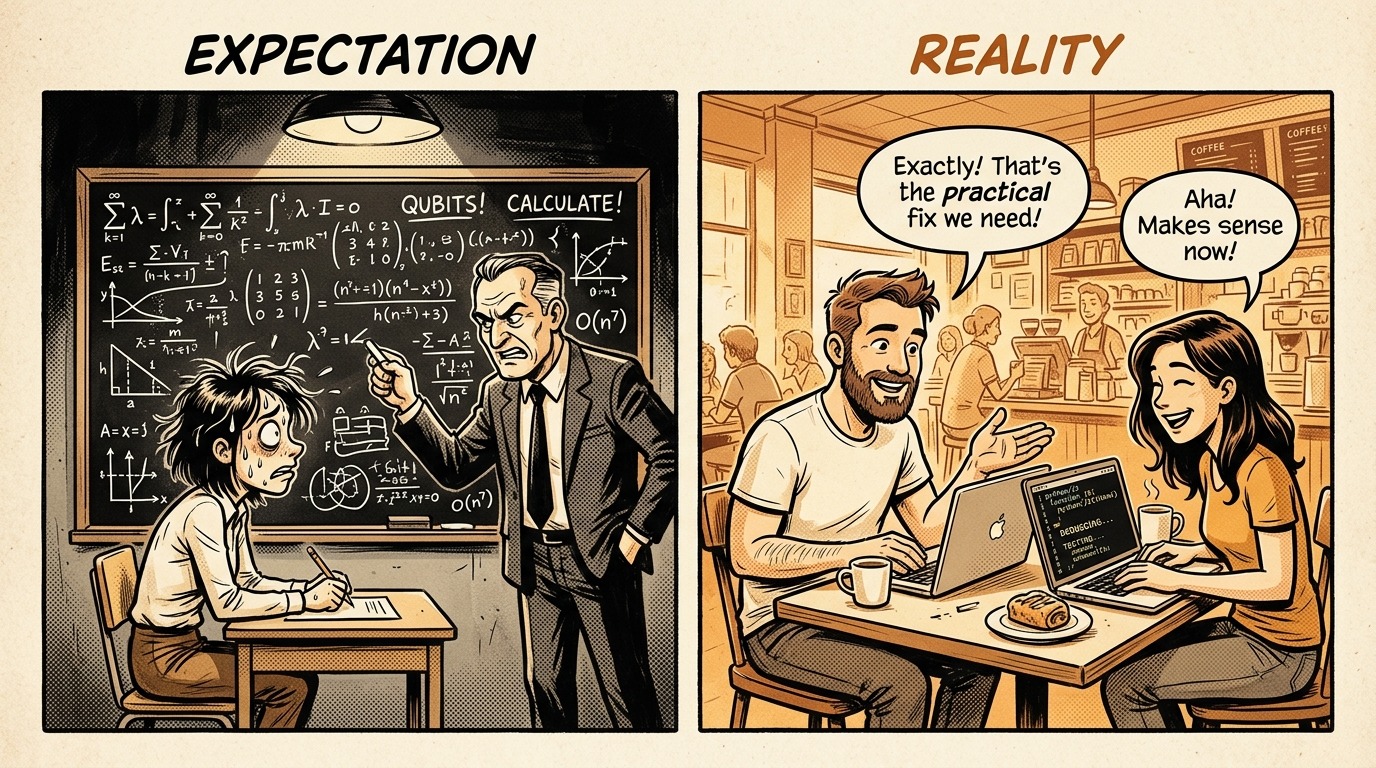
Myth 1: "I must write 100% bug-free code on the first attempt."
Reality: Almost nobody writes flaw-free code on their initial pass without compiling or testing. Interviewers care about how you discover and fix bugs. When a test case fails, don't apologize or panic—methodically trace your variables with a sample input on lines of comments. Finding your own bug with calm precision earns higher marks than blind luck.
Myth 2: "Interviewers are trying to trick me with riddles."
Reality: Modern tech companies have abandoned brainteasers like "why are manhole covers round?" Interviews focus on predictable, applied data structures (arrays, hash maps, binary trees, strings) and API reasoning. Review our comprehensive guide to what interviewers actually look for in candidates to understand how evaluation scorecards work in practice.
Myth 3: "If I don't know something immediately, I've failed."
Reality: When you encounter an unfamiliar library, framework quirk, or edge-case concept, interviewers want to see how you navigate ambiguity. If you hit a roadblock, review the strategies in when you don't know the answer in a technical interview to maintain composure, state what you know, and reason your way forward.
How Interviewers Score You Behind Closed Doors
After the call concludes, interviewers do not simply write "Yes" or "No." They complete a structured scorecard evaluated by a hiring committee.
| Evaluation Dimension | What Gets You a "Strong Hire" | What Gets You a "No Hire" |
|---|---|---|
| Problem Solving | Breaks complex requirements into modular steps; discusses trade-offs before typing. | Jumps straight to brute-force coding without verifying inputs; gets paralyzed by edge cases. |
| Code Quality & Syntax | Meaningful variable names; clean modular functions; idiomatic language constructs. | Cryptic 1-letter variables (a, x1, temp2); messy copy-paste blocks; unhandled null checks. |
| Communication | Explains trade-offs clearly; actively incorporates hints; asks clarifying questions early. | Codes in complete silence; becomes defensive when receiving hints; ignores interviewer guidance. |
| Engineering Rigor | Proactively tests boundaries (empty input, duplicates, large inputs); computes accurate Big-O. | Claims code works without tracing; unable to explain time and space complexity ($O(n)$, $O(\log n)$). |
Understanding these criteria makes it clear why candidates with slightly sub-optimal algorithmic solutions often get hired over arrogant candidates who write optimal code in total silence.
What to Do When You Freeze or Hit a Dead End
Every engineer—from junior bootcamp graduates to principal architects—has frozen during a live interview. Freezing is a physiological stress reaction, not proof of incompetence.
Here is an actionable protocol to reset your momentum:
- Acknowledge the situation calmly:
"I've hit a small snag with this recursive branch. Let me pause for ten seconds to trace my base case." - Step away from code and write down concrete data:
Write a 3-element example in comments right above your function:// Input: [2, 7, 11, 15], target = 9 // Step 1: Map = { 2: 0 } // Step 2: Looking for (9 - 7) = 2. Found at index 0! - Listen intently to interviewer prompts:
If an interviewer says, "What kind of data structure gives us instant lookup?", they are handing you the exact key. Don't brush it off; accept the hint and build on it. - Learn from feedback and diagnostic patterns:
If you aren't advancing past initial screens, inspect the common root causes documented in why you're not getting callbacks after technical interviews to pinpoint whether your issue is coding speed, verbalization, or resume alignment.
The Reverse Interview: Questions You Must Ask
At the end of every interview, you will hear: "We have 5 minutes left. What questions do you have for us?"
Never say "No, I think you covered everything." This is your chance to evaluate whether this engineering team is a healthy, supportive place to grow your career.
Ask questions that reveal real engineering dynamics:
- "How does your team handle code reviews and mentorship for new engineers?"
- "Can you walk me through the lifecycle of a recent bug that reached production and how the post-mortem was conducted?"
- "What does a typical sprint look like, and how is technical debt prioritized alongside feature requests?"
For a deeper repository of high-impact questions organized by role seniority, check out our master list of questions you should ask your interviewer.
Next Steps to Build Real Confidence
Reading about technical interviews builds awareness, but muscle memory comes from speaking out loud under realistic time constraints.
- Structure your preparation plan: Review the complete guide to technical interview prep to organize your study schedule across algorithms, data structures, and system design fundamentals.
- Review real coding patterns: Practice solving and explaining standard junior developer interview questions and real examples across data structures, web architecture, and behavioral rounds.
- Transitioning from non-traditional paths: If you're coming from an intensive coding academy or self-taught background, follow our bootcamp to first dev job interview survival guide for targeted portfolio and interviewing strategies.
- Practice in a live simulation: Use totop.app to run interactive, AI-driven mock interviews tailored specifically to your target job postings. You will receive immediate, actionable scorecard feedback on your communication, code correctness, and algorithmic reasoning before your real interview day.
Your first technical interview is not a test of your worth as a human being—it is simply a learnable, repeatable professional skill. Prepare your fundamentals, talk through your reasoning, and approach each challenge as a collaborative engineering problem.