When you interview for a Senior Software Engineer position, interviewers evaluate whether you can build a reliable service, choose the right database, and scale endpoints under load. When you interview for a Staff, Principal, or Lead Architect role, the rubric changes entirely.
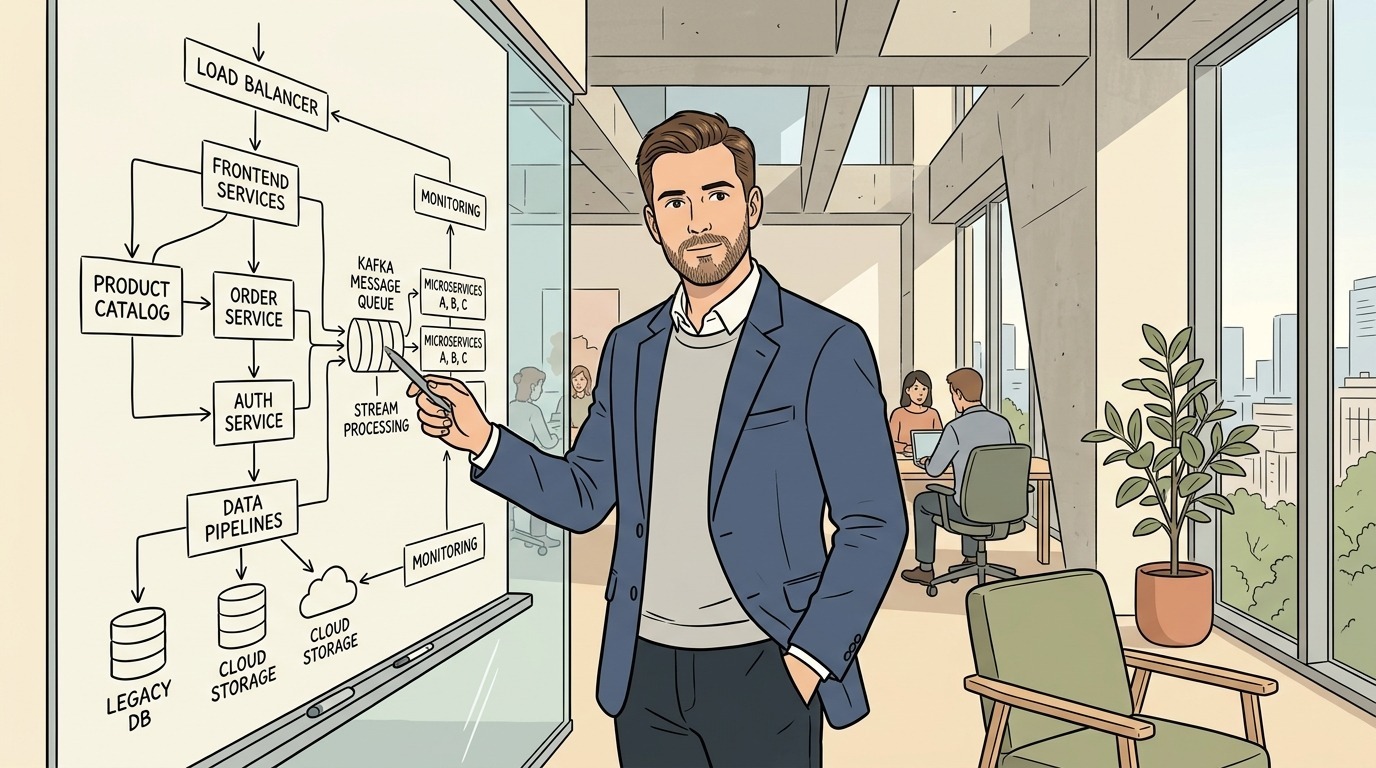
In a staff engineer system design interview, hiring committees rarely care if you can rattle off the definition of consistent hashing or recite Memcached configurations. Instead, they look for architectural maturity: Can you navigate ambiguity? Do you account for organizational team structures, operational blast radiuses, multi-million dollar cloud expenditure budgets, and multi-year technological migration paths?
Staff candidates who fail these sessions almost never fail due to a lack of basic technical knowledge. They fail because they approach the problem like a Senior Engineer—focusing solely on isolated microservice plumbing while completely ignoring systemic resilience, organizational alignment, and business invariants.
Here is the exact playbook to elevate your architectural discussions and pass the staff-level system design interview.
Senior vs. Staff: The Fundamental Paradigm Shift
To command the room during an executive-level or staff-level interview, you must understand what evaluators are tracking behind the scenes.
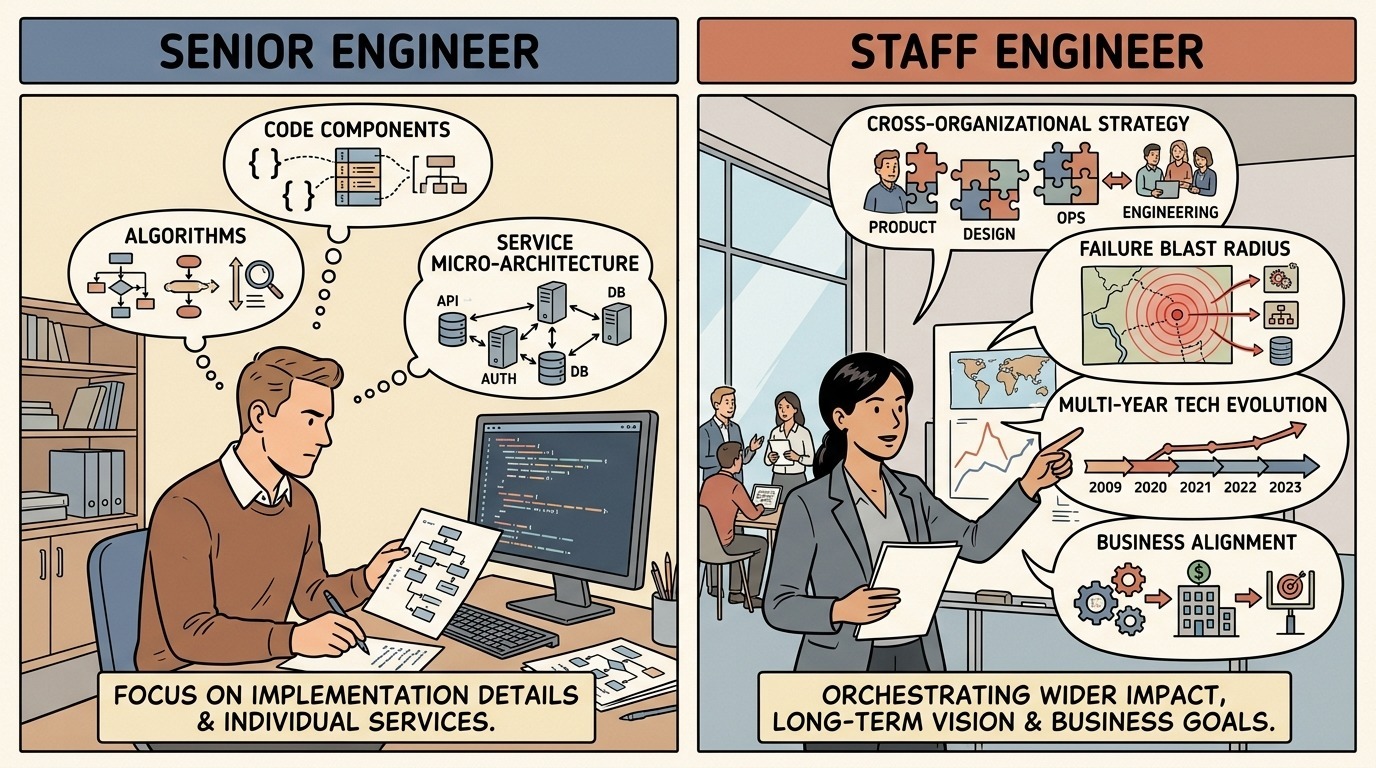
The fundamental difference lies in scope, ownership, and trade-off depth:
| Evaluation Dimension | Senior Engineer (L5 / IC5) | Staff Engineer (L6+ / Principal) |
|---|---|---|
| Problem Framing | Solves the prompt as presented with clear boundaries. | Dissects business requirements, challenges assumptions, and identifies hidden constraints. |
| System Scope | Service micro-architecture, database schemas, and caching layers. | Cross-system ecosystems, cellular boundaries, cross-team interfaces, and Conway's Law. |
| Failure Modes | Retries, fallback caches, and database replication. | Partial network partitions, cascading failures, split-brain resolution, and blast radius containment. |
| Economics & Ops | "We will scale out Kubernetes pods." | TCO (Total Cost of Ownership), network egress expenses, storage tier lifecycles, and operational runbooks. |
| Discussion Control | Waits for interview prompts and follows a standard checklist. | Drives the architectural narrative proactively, anchoring decisions in concrete business trade-offs. |
While a solid grasp of foundational algorithms and system components remains essential—as highlighted in our comprehensive technical interview preparation guide—a staff engineer operates as a technical force multiplier.
The 4 Pillars Evaluated in Staff-Level System Design
When a candidate begins sketching boxes and arrows, staff interviewers listen for four foundational architectural pillars that distinguish seasoned leaders from hands-on coders.
1. Operational Complexity and Blast Radius Containment
Any engineer can design a system that works when network links are stable, dependencies respond within 10 milliseconds, and hardware never faults. Staff engineers design systems that degrade gracefully when the world is burning.
During the interview, proactively address failure isolation:
- Cellular Architecture: Rather than deploying a monolithic shared cluster where an unindexed query can exhaust database thread pools globally, isolate workloads into autonomous "cells" (e.g., partitioned by tenant, geography, or hash ring). A catastrophic failure in Cell 4 never impacts tenants in Cells 1 through 3.
- Shedding Load Over Stalling: Explain how your API gateway implements adaptive capacity limits. When downstream latency spikes, worker queues back up. Rather than accepting all incoming requests and failing every client with timeouts, the system should drop low-priority traffic (e.g., batch reporting) to guarantee 100% throughput for critical transactional flows.
- Circuit Breakers with Jittered Exponential Backoff: Avoid naive retry loops that create thundering herds. Discuss token-bucket rate limiters, client-side backoff with uniform random jitter, and deadline propagation across RPC call chains (using gRPC deadlines or HTTP headers like
Request-Timeout).
2. Architectural Economics and Cost Modeling
At scale, architectures are financial contracts. Designing a streaming pipeline that writes raw uncompressed JSON events directly to multi-region cloud object storage might work functionally, but it could burn through half a million dollars monthly in network egress and IOPS fees.
When proposing a design, do back-of-the-envelope calculations that reflect enterprise reality:
- Egress vs. Ingress Costs: Moving petabytes of data across cloud availability zones or regions incurs significant bandwidth taxation. Explain how co-locating compute and storage or deploying local edge aggregators slashes egress overhead.
- Hot, Warm, and Cold Tiering: Detail data lifecycle policies. For example, audit logs stay in NVMe-backed high-speed search indexes for 14 days, transition to Parquet columnar files in object storage for 90 days, and archive to Glacier/Deep Archive for long-term compliance.
3. Data Governance, Consistency Boundaries, and Distributed State
One of the most revealing moments in any system design interview occurs when the interviewer asks how data flows between distributed boundaries.
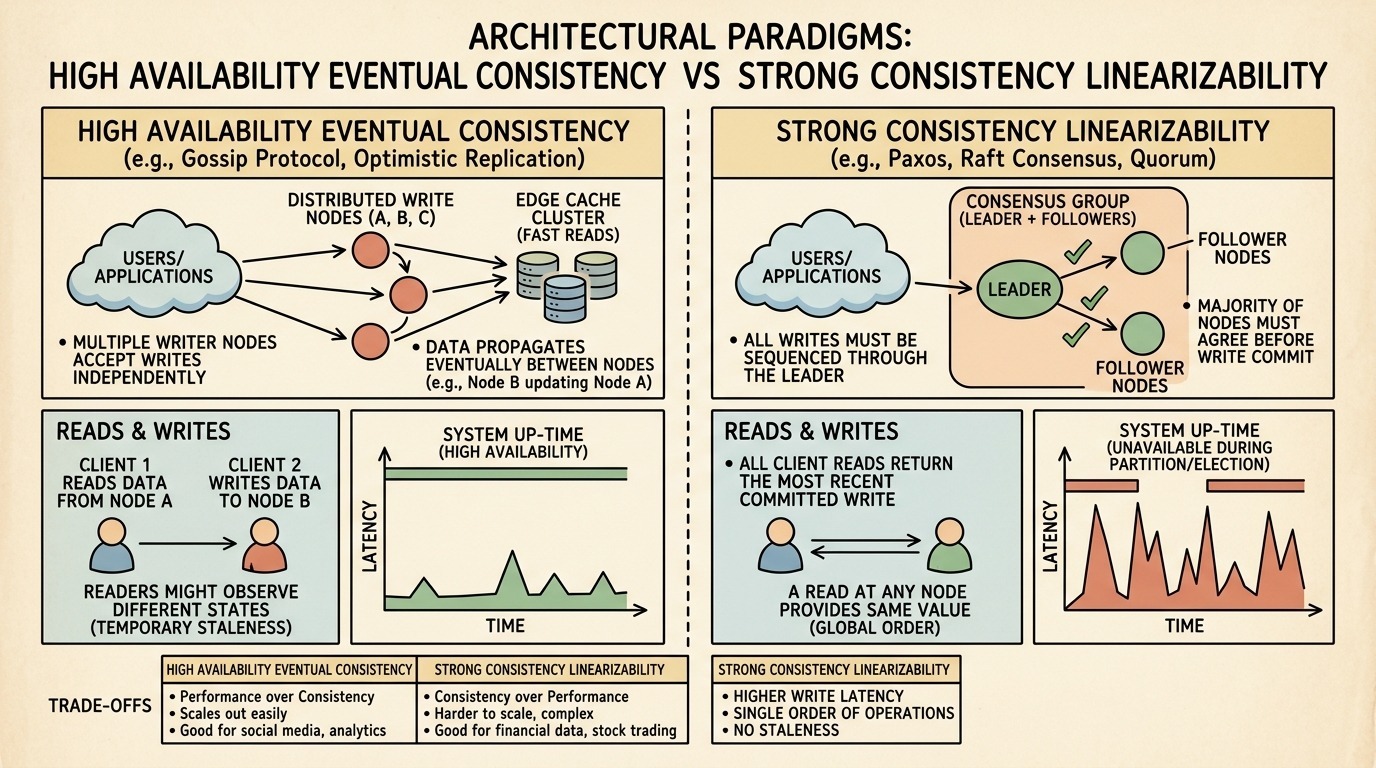
Junior and mid-level candidates often invoke buzzwords like "eventual consistency" without explaining its consequences. A staff candidate explicitly defines where consistency is non-negotiable and where asynchronous reconciliation is permissible:
- Linearizability vs. Sequential Consistency: If you are architecting a ledger or inventory reservation service, eventual consistency is often insufficient without compensating transactions. Clearly articulate when to introduce distributed consensus (Raft, Paxos, Spanner TrueTime) versus when to leverage optimistic concurrency control via version vectors.
- Dual-Write Hazards and the Transactional Outbox: Never promise that a microservice will simultaneously update a PostgreSQL database and publish a message to Apache Kafka inside a standard HTTP handler. If the network drops between the database commit and the message broker write, state becomes corrupted. Explain the Transactional Outbox pattern paired with Debezium change-data-capture (CDC) to guarantee at-least-once delivery.
- Idempotency Keys and Deduplication Windows: Networks retry requests. Explain how distributed idempotency locks in Redis or database unique constraint tables prevent duplicate payment captures or double orders during transient timeouts.
4. Organizational Alignment and Conway's Law
Conway's Law states that organizations design systems that mirror their own communication structures. Staff engineers do not design systems in an organizational vacuum.
If you propose splitting a system into thirty microservices, the interviewer will evaluate how that impacts engineering team velocity:
- Who owns the schema migrations for shared entities?
- What are the contracts between the Platform team, the Core Infrastructure team, and the Product Feature teams?
- How are breaking API changes managed across independent release cadences?
Demonstrating that you consider human workflows alongside service boundaries immediately signals executive technical maturity.
Step-by-Step Walkthrough: A Staff-Level Scenario
To see how these principles come together in real-time whiteboard discussions, let us walk through a common staff-level interview prompt:
"Architect an asynchronous global workflow engine that processes 50,000 multi-step client business automations per second with guaranteed at-least-once execution, strict tenancy isolation, and multi-region active-active disaster recovery."
Step 1: Clarifying Business Invariants and Defining SLAs (Minutes 0–5)
Do not immediately draw an API gateway. First, uncover the non-functional boundaries and business criticality:
- Interviewer Interaction: "Before discussing database tables, I want to clarify our recovery point and recovery time objectives. If an entire cloud region suffers an optical fiber cut, what is our target RTO (Recovery Time Objective) and RPO (Recovery Point Objective)? Are financial transactions included in these workflow steps where duplicate executions cause real-world monetary loss, or can steps be designed to be strictly idempotent?"
- Establishing Workload Profiles:
- Write-to-Read ratio: 50,000 workflow executions/sec, each with an average of 6 dependent steps (300,000 step transitions/sec).
- Latency expectation: P99 step trigger delay < 250ms; end-to-end execution SLA depends on third-party webhook integrations.
- Tenancy model: Enterprise tier requires isolated compute and data residency guarantees (e.g., EU GDPR data cannot leave Frankfurt).
Step 2: High-Level Partitioning & Orchestration Topologies (Minutes 5–15)
Propose the macro architecture, deliberately justifying your high-level architectural patterns:
[Global Anycast DNS / Cloudflare]
               │
               ▼
[Regional Edge API Gateway Cluster]
               │
               ▼
[Tenant Sharded Ingestion Service]
               │
               ├─────────────────────────┐
               ▼                         ▼
    [Persistent Event Log]       [Transactional Outbox DB]
  (Kafka / Redpanda Partition)     (PostgreSQL Tenant Shard)
               │
               ▼
[Worker Execution Engine (Cell-Based)]
   ├── Step Evaluator (State Machine Engine)
   ├── Rate-Limited Egress Dispatcher (Circuit Breakers)
   └── Distributed Timer Wheel (Delayed Execution)
Explain the trade-off between Choreography (services react to decentralized events) versus Orchestration (a centralized state machine coordinator). For complex multi-step business workflows with retries, conditional branches, and rollback logic, a centralized state machine orchestrator (such as Temporal or a custom state engine) provides deterministic observability and auditability that pure event choreography lacks.
Step 3: Proactive Deep Dives on High-Scale Challenges (Minutes 15–35)
This is where you distinguish yourself from senior candidates. Do not wait for the interviewer to probe weaknesses; unpack them yourself.
A. Multi-Tenant Fair Scheduling & "Noisy Neighbor" Mitigation
If a single enterprise tenant triggers a batch run of 20 million workflow steps at 9:00 AM, how do you prevent them from starving all other tenants sharing the cluster?
- Propose a Hierarchical Deficit Weighted Round Robin (DWRR) or Virtual Queueing Model:
- Incoming workflow tasks are placed into tenant-specific virtual queues.
- The dispatch worker pulls tasks proportionally based on purchased tier capacity rather than a single FIFO queue.
- When a tenant exceeds their concurrency limit, their steps are backpressured into durable object storage or lower-priority worker pools without dropping messages.
As explored in our technical breakdown of scaling high-throughput applications to handle 1 million requests per second, managing thread pool exhaustion and asynchronous event queues is what keeps high-concurrency systems operational under sudden traffic spikes.
B. Active-Active Cross-Region Replication Without Distributed Deadlocks
In an active-active setup spanning US-East and EU-Central:
- What happens if a tenant in London modifies workflow state while an automated event in New York triggers a transition on the same workflow instance?
- Solution: Establish Deterministic Single-Leader Ownership per Workflow Instance. While the system runs multi-region globally, each discrete workflow run is pinned to a specific primary region upon initiation using consistent hashing on
WorkflowID. If an event for that workflow arrives in another region, it is forwarded over private cloud interconnects to the owning region. - In the event of an entire regional failure, an automated orchestration failover flips lease ownership via distributed consensus (e.g., etcd or Consul raft groups), triggering safe replay of unacknowledged logs from replica storage.
Step 4: Observability, Debuggability, and Post-Mortem Readiness (Minutes 35–45)
Staff engineers know that systems must be operated by humans at 3:00 AM. Conclude with operational ergonomics:
- Distributed Context Propagation: Every workflow run generates a global
TraceIDthat propagates through every message header, gRPC metadata block, and outbound HTTP request. - Semantic Log Levels & Metric Cardinality: Guard against metric explosion in Prometheus/Datadog by ensuring dynamic UUIDs are never attached as metric tags.
- Audit Trail Immutability: All workflow transitions append to an append-only ledger table, enabling exact replay capabilities for customer support disputes or bug reproductions.
Subtle Traps That Trip Up Senior Developers Aiming for Staff
Reviewing candidate evaluations reveals consistent behavioral and technical patterns where strong Senior engineers miss the Staff bar:
Common Failure Traps:
├── 1. The Resume-Driven Tooling Trap (Defaulting to trendy tech over first principles)
├── 2. The Passive Whiteboarder Trap (Waiting for the interviewer to drive)
├── 3. The Unbounded Complexity Trap (Over-architecting simple components)
└── 4. The Blind Optimism Trap (Assuming networks and third-party APIs never fail)
- Naming Technologies Instead of Architectural Primitives: Saying "I will use DynamoDB" without explaining partitioning keys, secondary indexes, write throttling, and global tables tells the interviewer nothing. Explain the mechanism first: "We need an LSM-tree based wide-column store that supports partition keys with strong local secondary indexing."
- Failing to Manage the Clock: A staff engineer controls the meeting. If you spend 25 minutes detailing the relational database schema of a user table, you will run out of time to discuss distributed coordination, failover, and scaling bottlenecks. Keep your high-level overview crisp so you can dedicate time to deep technical trade-offs.
- Ignoring Organizational and Human Friction: As noted in our guide on interview questions that trip up senior developers, hiring panels assess whether you understand the reality of running systems in production. A technically flawless design that requires twenty teams to coordinate synchronized zero-downtime releases is a failed architecture.
- Neglecting Interviewer Cues: Senior hiring managers and directors evaluate your collaborative leadership style. For a deeper understanding of evaluation scorecards, review what interviewers actually look for in technical rounds, and see how managers navigate leadership alignment in our guide on engineering manager leadership questions.
How to Prepare for Staff-Level System Design Rounds
Reading architecture blogs is passive; succeeding in staff-level interviews requires real-time verbal execution under time pressure.
- Practice Conversational Driving: In senior interviews, the interviewer often guides you with specific follow-up questions. In staff interviews, they deliberately stay quiet to test whether you can structure and lead a 45-minute architectural review autonomously.
- Simulate Realistic Boardroom Pressures: Practice articulating trade-offs aloud. If you want realistic, adaptive mock interview simulations tailored to senior and staff engineering tracks, use totop.app's AI interview platform to get instant, rigorous feedback on your reasoning structure, communication clarity, and technical depth.
- Draft Architectural Decision Records (ADRs): Take common real-world systems (e.g., distributed rate limiters, multi-region notification gateways, global video streaming CDNs) and write two-page ADRs. To master this technique, study our comprehensive breakdown on architecture decision records in system design interviews to learn how to structure your trade-offs and deliver what interviewers want to hear. Force yourself to document the non-functional requirements, the three alternative architectures considered, why two were rejected, and the exact trade-offs accepted.
When you walk into your next staff system design interview, remember: you are not being tested on whether you can design a flawless system. You are being tested on whether you can lead engineering organizations through the inevitable chaos of building and maintaining software at scale.
Practice Staff Backend Engineer Questions Live with AI Mock Interviews
Turn any job description across Engineering, DevOps, Data, Marketing, Sales, Finance, or HR into a personalized test and live voice or text AI mock interview on totop.app, or test your speed right now in the 60-Second Staff Backend Engineer Blitz.
Play 60s Staff Backend Engineer Blitz (Free, No Login) | Start 14-Day Free Trial | Browse All Interview Guides