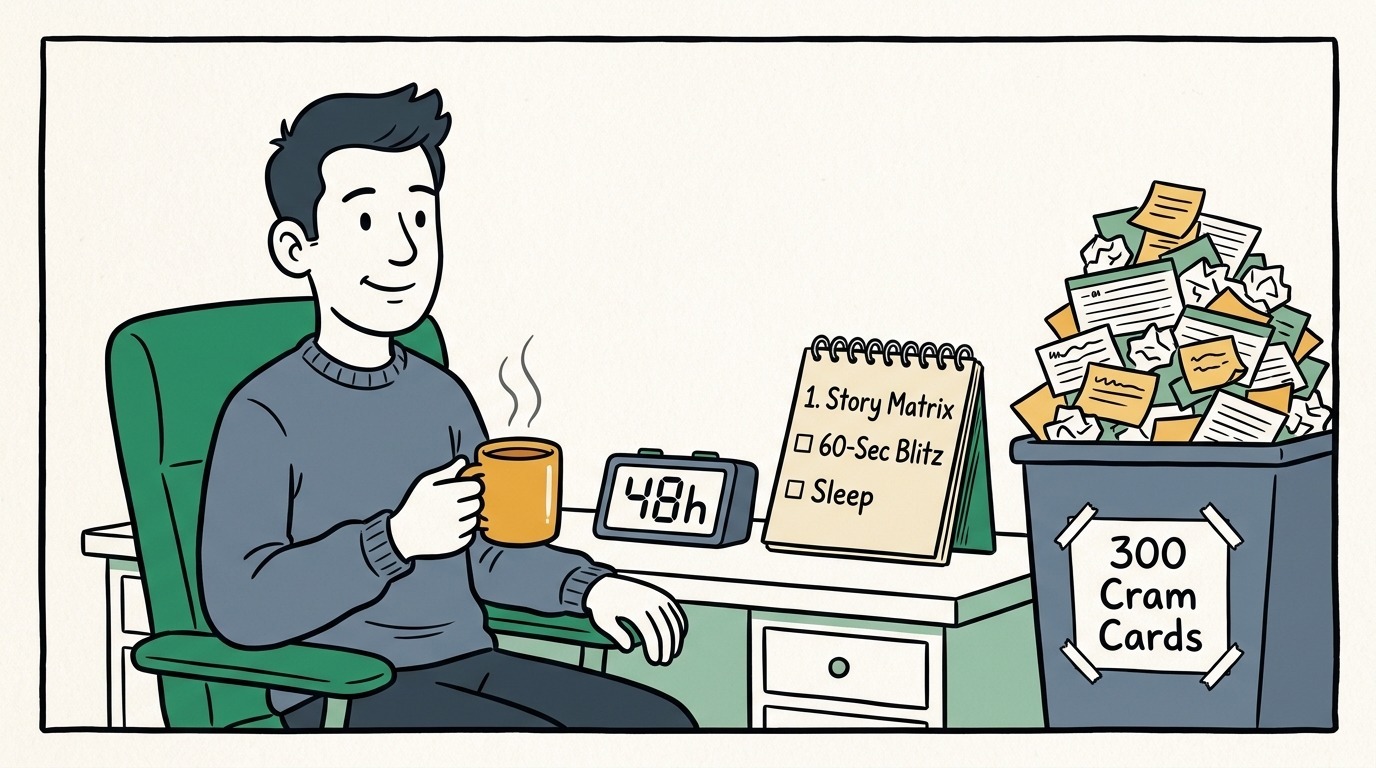
A two-day countdown before an important interview exposes every flaw in traditional preparation advice. Candidates with two weeks or a full month can afford a broad 30-Day Interview Prep Schedule that revisits textbook fundamentals from scratch. When the calendar shows only 48 hours remaining, trying to absorb dozens of unfamiliar concepts produces cognitive overload, fragmented recall, and late-night fatigue that actively lowers live interview scores.
Hiring panels rarely reject well-rested candidates for missing an obscure trivia fact. They reject candidates who ramble through unstructured answers, fail to clarify ambiguous constraints, or lose composure under follow-up questioning. A disciplined last minute 48 hour interview preparation checklist flips the priority from broad memorization to precision triage, verbal calibration, and cognitive recovery.
Whether the upcoming loop targets Software Engineering, Data Analytics, Product Management, Finance, or People Operations, the next 48 hours have enough runway to double answer clarity—provided every hour is allocated strictly to high-leverage drills.
Why Panic Cramming Fails Under 48-Hour Constraints
Before executing the checklist, candidates must discard the instinct to open five textbooks or grind fifty random problems overnight. Working memory holds only a narrow band of active patterns during a high-stakes conversation. Flooding short-term memory with unpracticed algorithms or unfamiliar frameworks creates interference, making even well-known career stories harder to retrieve smoothly.

Evaluating Panic Cramming against a 48-Hour Blueprint clarifies why disciplined scoping outperforms sheer study volume:
| Dimension | Panic Cramming (High Risk) | 48-Hour Blueprint (High Leverage) |
|---|---|---|
| Scope Selection | Attempts to cover every possible topic in the field | Filters strictly to the top 3–4 signals in the job posting |
| Practice Mode | Passive reading, video watching, and silent flashcards | Timed spoken drills, requirement clarification, and Socratic Q&A |
| Behavioral Prep | Writes word-for-word scripts for 20 separate prompts | Builds a 4-story reusable matrix anchored by real metrics |
| Night Before Loop | Studies past midnight; enters interview sleep-deprived | Hard stop at T-12h; light review only; 8 hours of sleep |
| Failure Mode | Freezes when an interviewer changes a constraint | Adapts calmly using structured trade-off rubrics |
For candidates transitioning into their first technical or cross-functional role, pairing this rapid checklist with baseline context from the Bootcamp to Your First Dev Job: Interview Survival Guide helps anchor expectations around how panels actually score junior-to-mid signals.
The 48-Hour Interview Preparation Blueprint
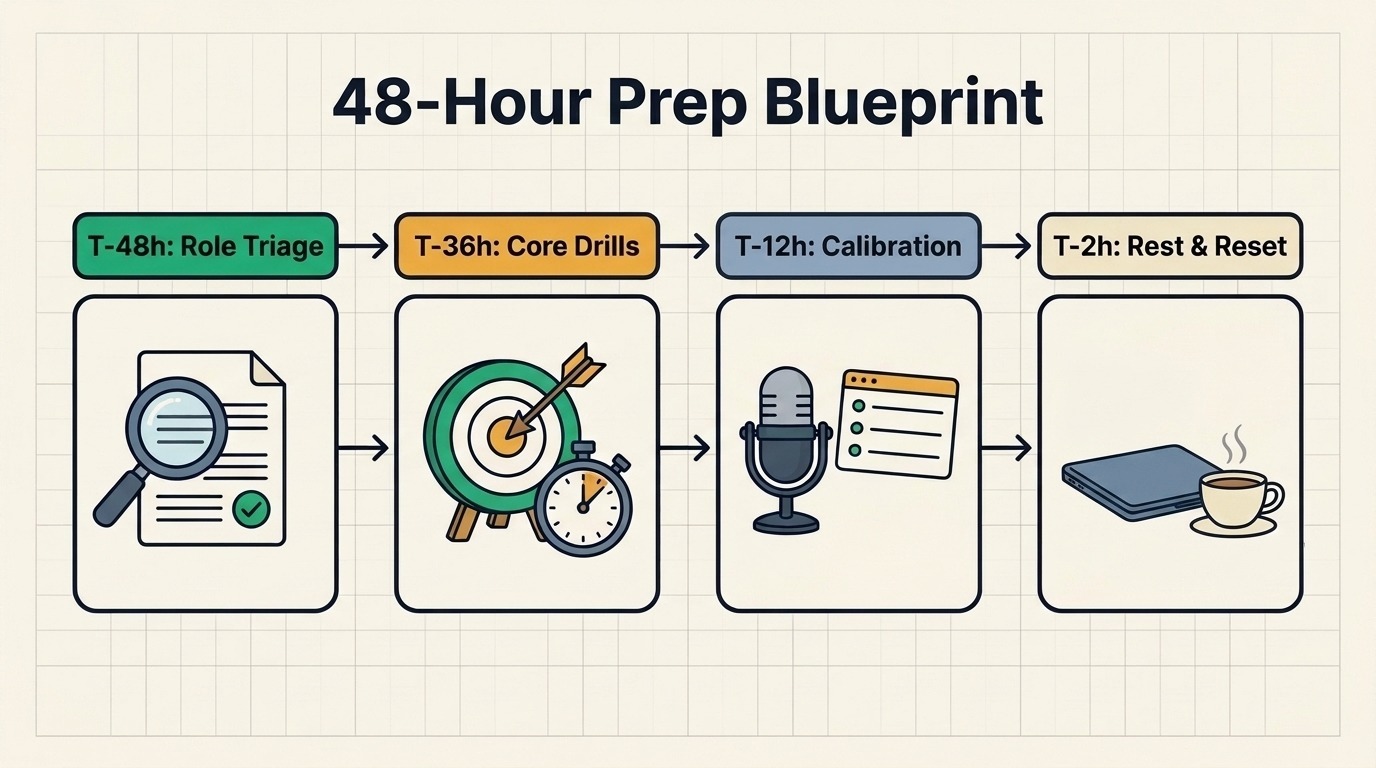
The 48-hour timeline divides cleanly into four operational blocks: T-48h Role Triage, T-36h Core Drills, T-12h Calibration, and T-2h Rest & Reset. Each block has a strict stopping rule so preparation never bleeds into sleep or creates last-minute anxiety.
Step 1: T-48h Role Triage and Rubric Extraction (90 Minutes)
Start by dismantling the exact job description and any recruiter scheduling email. Most interview loops test four to five explicit competencies, yet candidates waste 80% of their time on topics never mentioned in the role specification.
- Highlight the Top Three Repeated Nouns and Verbs: Scan the "Responsibilities" and "Qualifications" sections of the posting. Identify the three core deliverables (for example, distributed API latency, three-statement variance analysis, or stakeholder executive alignment).
- Map the Loop Format: Confirm whether each scheduled session is a 30-minute recruiter screen, a 45-minute technical or case deep dive, or a cross-functional behavioral round. Candidates preparing for HR or talent loops can inspect question patterns in Recruiter Interview Questions & Answers: 2026 Guide and HR Business Partner Interview Questions: 2026 Guide to verify how non-technical panels probe strategic alignment.
- Run a 60-Second Baseline Diagnostic: Before opening any study notes, take a rapid timed benchmark in the 60-Second Job Blitz to expose which domain terminology or framing habits feel rusty under clock pressure.
Deliverable at the end of Hour 46: a single-page Target Rubric listing the 3 core competencies, the interview round formats, and the 2 biggest gaps uncovered during triage.
Step 2: T-36h Role-Specific Core Drills (3 Hours Total)
With the Target Rubric locked, spend two focused 90-minute sprints—separated by a real break—drilling only the highest-probability scenarios for your specific track. Avoid learning brand-new theories; sharpen the patterns you already understand so your delivery sounds crisp and authoritative.
| Role Track | Sprint A (90 Minutes): Technical / Functional Core | Sprint B (90 Minutes): Applied Scenario Walkthrough |
|---|---|---|
| Software & Backend Engineering | Review 4 high-frequency patterns (hash maps, sliding window, BFS/DFS, binary search) and practice narrating time/space complexity aloud | Walk through 2 end-to-end architecture blueprints (caching, rate limiting, database indexing) using a structured capacity checklist |
| Data, Analytics & BI | Drill SQL window functions (ROW_NUMBER, LAG, CTEs), grain-level joins, and query plan bottleneck identification | Practice debugging a sudden 15% drop in a north-star KPI by isolating instrumentation, seasonality, and funnel segmentation |
| Product, Finance & Operations | Review unit economics, variance drivers, or prioritization frameworks (RICE, payback period, capacity trade-offs) | Rehearse 2 structured case prompts aloud: diagnosing an unexpected margin shift or scoping a constrained Q3 roadmap |
| Sales, GTM & People/HR | Calibrate discovery frameworks (pain quantification, stakeholder mapping) or employee-relations triage protocols | Roleplay handling 3 tough objections—budget freeze, executive pushback, or conflicting compliance risk—within 90 seconds each |
Engineers facing a heavy architecture round inside this 48-hour window should borrow the modular scoping habits from the 7-Day System Design Interview Crash Course Schedule and review core fundamentals in System Design Interview: Everything You Need to Know. Rather than memorizing ten architectures, drill one repeatable opening sequence:
5-Minute Architecture & Case Opening Sequence
1. Clarify Scope (60s): Confirm users, core workflow, and out-of-scope features.
2. Quantify Scale (60s): Estimate QPS, data volume, or financial baseline.
3. Propose Baseline (90s): Draw the simplest working design before optimizing.
4. Surface Trade-Offs (90s): Name the primary bottleneck and two mitigations.
This four-step cadence works equally well for a backend whiteboard problem, a data pipeline redesign, or a cross-functional business case because it proves structured thinking before details get complex.
Step 3: T-24h Build a Reusable Four-Story Behavioral Matrix (90 Minutes)
Behavioral rounds often decide final leveling and offer bands, yet candidates frequently fail them because they try to memorize ten rigid answers. Instead of scripting ten stories, extract four versatile career anchors that cover almost every behavioral prompt interviewers ask.
Review the full story-mining methodology in the 14-Day Behavioral and Leadership Interview Study Plan, and compress it into this 4-row matrix for your 48-hour sprint:
- The Ambiguous Ownership Story: A project with unclear requirements where you defined success metrics, aligned stakeholders, and shipped a measurable result.
- The Constructive Disagreement Story: A moment you challenged a peer, manager, or client with data, listened to their constraint, and reached a stronger decision.
- The Production Failure or Missed Target Story: An outage, forecast miss, or launch mistake where you owned the root cause, mitigated impact quickly, and changed the system so it did not recur.
- The Cross-Functional Trade-Off Story: A deadline or resource crunch where you deliberately cut scope or re-sequenced work to protect the most critical outcome.
Write five bullet points per story—Context, Constraint, Action, Trade-Off, and Quantified Metric—never full paragraphs. Reading full paragraphs during an interview makes delivery sound robotic and collapses the moment an interviewer interrupts to ask, "Why did you reject the alternative approach?"
Step 4: T-12h Live Verbal Calibration and Mock Simulation (60 Minutes)
Silent reading creates an illusion of competence. Ideas that look obvious on a notepad frequently come out tangled when spoken aloud under a ticking clock. Dedicate one focused hour the evening before (or morning prior, at least 12 hours before the loop) to out-loud verbal calibration.
Walk through this three-part calibration drill:
- The 90-Second "Tell Me About Yourself" Pitch: Record your opening career summary on your phone or laptop. Check that it links your past scope, your strongest domain impact, and why this specific role is the logical next step—all under 90 seconds.
- Two Timed Deep-Dive Prompts: Answer one role-specific technical or case question and one behavioral prompt from your matrix out loud without notes. Notice where filler words ("basically," "kind of"), defensive phrasing, or skipped numbers appear.
- Three Reverse-Interview Questions: Prepare three sharp questions to ask the panel at the end of each session. Effective prompts ask about the team's hardest bottleneck over the next two quarters, how success is measured at the 90-day mark, or how cross-functional trade-offs get resolved when priorities collide.
Close your study materials at the end of this hour. Studying past T-12h yields negative returns by eroding REM sleep and reaction speed.
Step 5: T-2h Environment Reset and Cognitive Warm-Up (45 Minutes)
On interview day, protect your executive functioning by eliminating logistical friction two hours before the first call:
- Hardware and Workspace Check: Test camera framing, microphone clarity, stable Wi-Fi or wired Ethernet, and browser permissions. Close Slack, email clients, and desktop notifications.
- Physical Desk Reset: Place only three items within reach—a glass of water, a blank notepad with a pen, and your single-page four-story bullet matrix.
- Light 10-Minute Warm-Up: Do not attempt hard problems 30 minutes before the call. Instead, speak your 90-second intro pitch aloud once and complete a quick mental warm-up so your voice feels steady when the first interviewer joins.
Walkthrough: Adapting the 48-Hour Checklist to a Real Scenario
Consider a mid-level candidate invited on Thursday afternoon for a Monday morning final-round loop—leaving roughly 48 focused weekend hours around family or work commitments—for a cross-functional role blending technical architecture and stakeholder execution.
- Thursday Evening (T-48h, 90 min): The candidate extracts three dominant signals from the job description: API reliability under traffic spikes, SQL data investigation, and partnering with product managers on trade-offs. They run a quick diagnostic on the 60-Second Job Blitz and identify that explaining trade-offs concisely is their weakest habit.
- Friday Evening & Saturday Morning (T-36h, 3 hours): They skip unrelated graph theory and drill two targeted areas: 90 minutes on API caching/rate-limiting trade-offs plus SQL aggregation edge cases, and 90 minutes narrating solutions aloud while drawing clean component boxes.
- Saturday Afternoon (T-24h, 90 min): They map four career stories onto bullet cards, ensuring each story includes a hard metric (such as reducing p99 checkout latency by 38% or cutting weekly reconciliation time by 6 hours) and an explicit trade-off they owned.
- Sunday Afternoon (T-12h, 60 min): They run a timed voice mock interview, tighten their opening pitch from 2 minutes 40 seconds down to 82 seconds, write three targeted questions for the hiring manager, and shut the laptop before dinner.
- Monday Morning (T-2h, 45 min): After eight hours of sleep, they test audio, review their four bullet anchors over tea, and walk into the loop calm and adaptable.
Anti-Grind Checklist Summary: What to Cut vs. What to Keep
When time is scarce, knowing what to deliberately ignore matters just as much as what to practice. Keep this triage filter visible throughout your weekend interview prep sprint for busy professionals:
- Cut: Unfamiliar edge-case algorithms, memorizing company trivia, multi-hour passive video playlists, writing full-sentence scripts, and late-night cramming.
- Keep: Job-description signal mapping, out-loud problem framing, the 4-story metric matrix, timed 60-to-90-second verbal drills, and protected sleep.
For candidates who want immediate feedback on pacing, clarity, and follow-up handling before the real panel starts, test your readiness right now with the 60-Second Job Blitz or explore full voice and text roleplay simulations tailored to your exact job posting on totop.app Pricing & Plans. Practicing one calibrated Socratic loop today turns 48 hours of pressure into structured, calm execution on interview day.
Practice Full Stack Engineer Questions Live with AI Mock Interviews
Turn any job description across Engineering, DevOps, Data, Marketing, Sales, Finance, or HR into a personalized test and live voice or text AI mock interview on totop.app, or test your speed right now in the 60-Second Full Stack Engineer Blitz.
Play 60s Full Stack Engineer Blitz (Free, No Login) | Start 14-Day Free Trial | Browse All Interview Guides