How to Pass a Coding Interview Without Doing 500 LeetCode Problems
I remember looking at my LeetCode dashboard a few years ago. I was staring at a number in the high 200s, feeling completely exhausted, and thinking, "If I have to memorize one more obscure graph traversal tweak, I might just give up on tech entirely."
Does this sound familiar? You've probably heard the classic advice: Just grind 500 LeetCode problems until you start seeing the matrix. It's practically a rite of passage at this point.
But what if I told you there’s an anti-grind approach? What if you could pass top-tier technical interviews by deeply understanding just a fraction of those problems?

Let's talk about the strategy that actually works—the one that saves your sanity and makes you a better engineer, not just a better test-taker.
The Problem with "The Grind"
When you focus purely on the number of problems solved, you start playing a dangerous game of memorization. You see a Two Sum problem, you write out the hash map solution from memory, you hit submit, and you feel a hit of dopamine.
But what happens when the interviewer throws a slight twist at you? Maybe they ask you to return all unique pairs, or they constrain your memory usage. If you only memorized the syntax for that one specific optimal solution, a slight breeze will knock your confidence right over.
This chaotic grinding doesn't build a reliable foundation. It just builds a fragile house of cards.
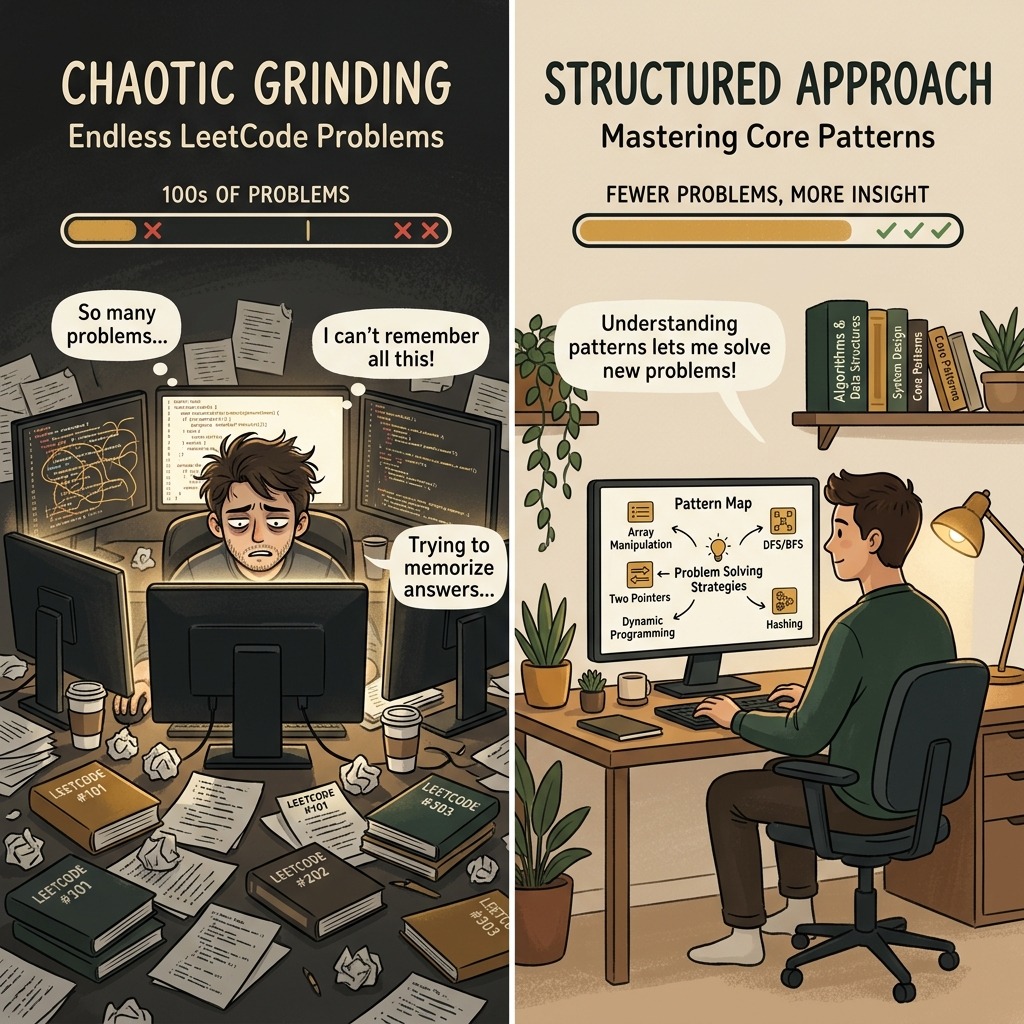
The Anti-Grind: Master the Core Patterns
Instead of trying to collect solved problems like Pokémon, you should be collecting patterns.
Think about it like learning to cook. You don't need to memorize 500 recipes to be a good chef. You need to understand how heat works, how to balance acid and fat, and how to wield a knife. Once you know the fundamentals, you can improvise any dish.
In coding interviews, there are really only about 15-20 core patterns you need to know deeply. These include:
- Sliding Window: Great for contiguous subarrays or substrings.
- Two Pointers: Perfect for sorted arrays or linked lists.
- Fast & Slow Pointers: The ultimate cycle detection tool.
- Breadth-First Search (BFS) / Depth-First Search (DFS): Your bread and butter for tree and graph traversals.
- Top 'K' Elements: Whenever you hear "largest/smallest/most frequent", think heaps.
If you can master these patterns, you instantly unlock the ability to solve hundreds of variations you've never even seen before.
How to Actually Study
So, how do we put this into practice? It's all about quality over quantity.

- Pick one pattern at a time: Don't jump from a dynamic programming problem to a linked list problem. Stick to one pattern until it clicks.
- Solve 5-7 high-quality problems for that pattern: Start with an easy one to grasp the mechanics, then move to medium difficulty to see how it scales.
- Focus on the "Why": After you solve a problem, don't just close the tab. Ask yourself: Why did this pattern work here? What keywords in the problem description hinted at this approach?
- Talk out loud: Interviews are conversations. Practice explaining your thought process out loud to a rubber duck (or your cat) while you code. If you can't explain it simply, you don't understand it well enough yet.
The Secret Weapon: Structured Practice
If you're tired of aimlessly clicking "Random Pick" and hoping for the best, you need a structured environment. That's exactly why we built totop.app.
Instead of throwing you into a massive ocean of isolated problems, totop.app focuses on teaching you the underlying architectures and patterns you need to succeed. It's designed to help you study smarter, not harder—saving you hundreds of hours of frustrating guesswork. You can also pair your practice with our actionable 30-day interview prep schedule to keep your daily study time-boxed and measurable.
You don't need 500 problems to land your dream job. You just need a solid grasp of the fundamentals and the confidence to apply them. Stop grinding, start understanding, and go crush that interview!