From Bootcamp to Your First Dev Job: Interview Survival Guide
The moment you hand in your final capstone project at coding bootcamp, two feelings hit you at once. First, pure euphoria: I actually did it. I built a full-stack web application from scratch. Second, a cold wave of panic: Wait, how on earth do I land an actual software engineering job when 500 other people are applying for the same entry-level role?
If you are feeling overwhelmed right now, take a deep breath. You are far from alone.
Transitioning from a 12-week or 6-month intensive bootcamp into your first paid developer role is one of the most intense career shifts you will ever experience. The job market can feel ruthless, technical interviews often seem designed to expose what you don't know, and rejection emails can quickly erode your confidence.
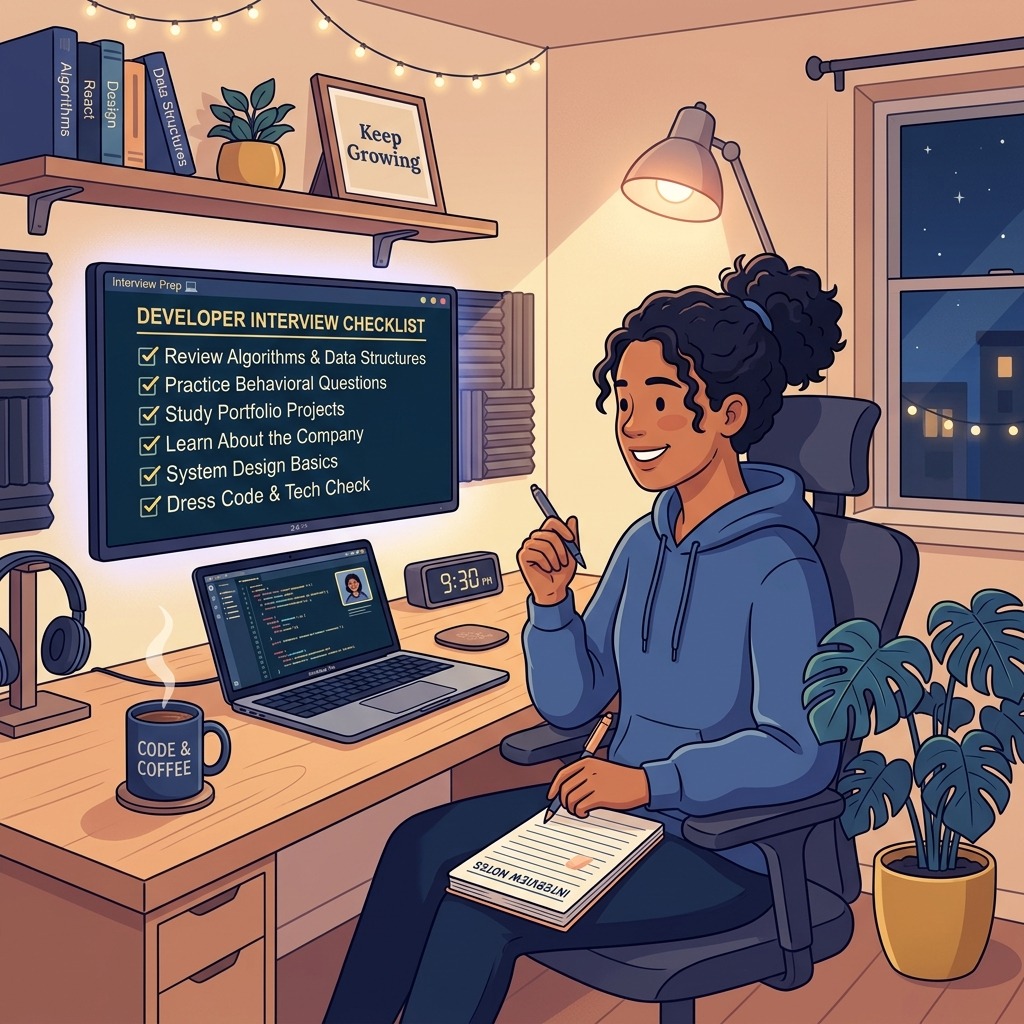
The secret that experienced engineering managers won't always tell you is this: landing your first dev job is less about raw technical brilliance and more about operational strategy, clear communication, and deliberate interview conditioning.
In this survival guide, we will break down the end-to-end journey from graduation day to signing your first offer letter, giving you a field-tested blueprint to out-prepare the competition.
1. The Post-Bootcamp Pipeline: Mapping Your Journey
Most candidates treat job hunting as a brute-force numbers game—spamming 500 Easy-Apply buttons on LinkedIn with the exact same resume. This spray-and-pray tactic rarely works in today's market.
Instead, think of your job search as a structured software pipeline with distinct, measurable stages.
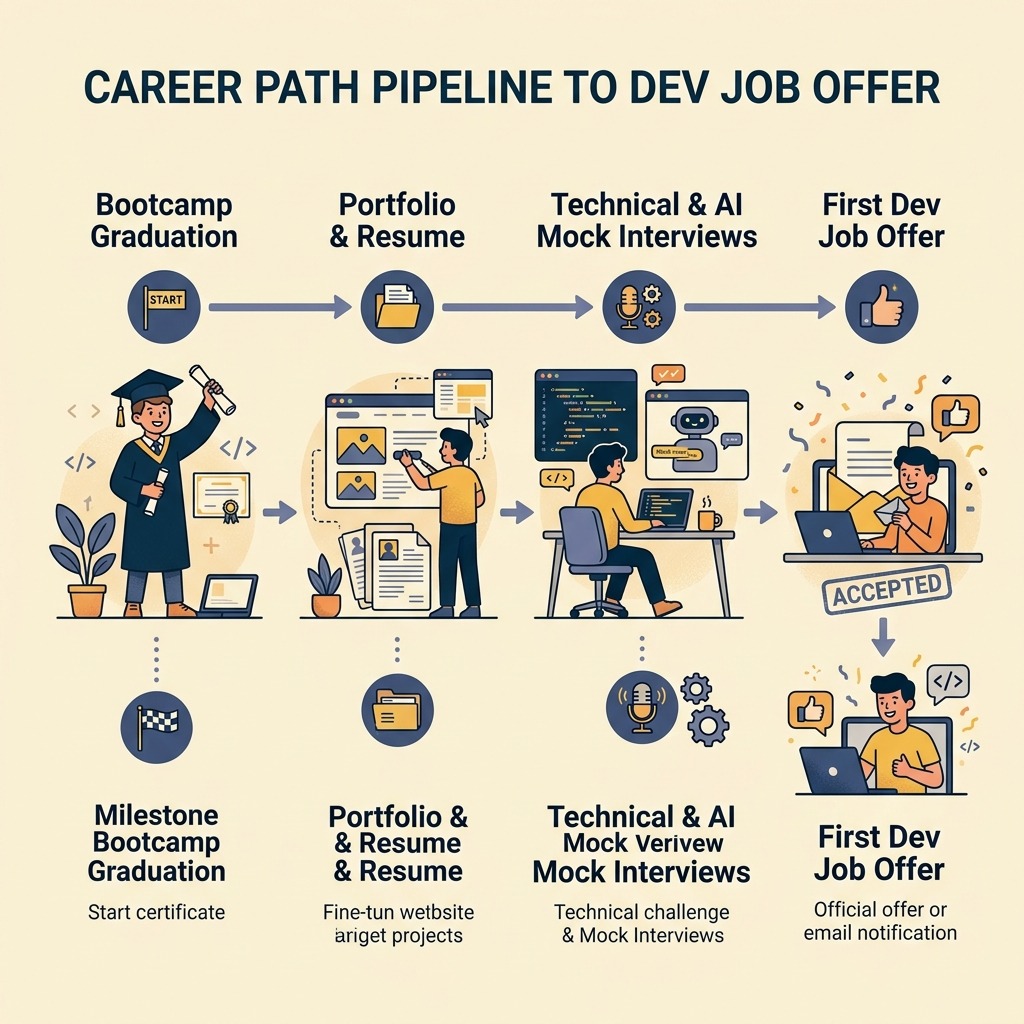
Stage 1: Portfolio & Resume Optimization
Your resume shouldn't just list technologies you touched for two days in week three. Focus on impact and architecture:
- Highlight production-like traits: Mention Docker, CI/CD pipelines, automated testing, API integration, state management, or responsive UI optimizations.
- De-emphasize generic tutorial clones: If your main project is a basic Todo app or Pokedex, replace it or upgrade it. Build a tool that solves a real problem for a real user, and learn how to talk about projects you haven't shipped yet to turn complex in-progress experiments into proof of engineering depth.
- Make your GitHub activity human and clean: Provide clear
README.mdfiles with setup steps, live demo links, architecture diagrams, and brief videos showing key functionality.
Stage 2: Targeted Outreach & Networking
- Warm intros over cold applications: Connect with bootcamp alumni working at companies you admire. Ask for 15-minute coffee chats to learn about their team culture rather than directly asking for a job.
- Showcase build progress in public: Share weekly mini-builds or engineering trade-offs on LinkedIn or X (Twitter). Managers love seeing curiosity and continuous learning.
Stage 3: Technical Screening & Live Coding
Once your resume gets noticed, you will face screening calls, async coding challenges (LeetCode/HackerRank), or live pair-programming sessions. This is where most bootcamp grads get stuck—not because they can't code, but because they freeze under pressure. If you feel anxious competing against computer science majors, learn how to stand out without a CS degree to reframe your alternative background into an engineering asset.
Stage 4: System Design & Cultural Alignment
For mid-size startups and enterprise teams, final rounds assess how well you understand data flow, state management, API design, and how you handle constructive feedback or team conflict.
2. The 4-Pillar Interview Survival Framework
To consistently convert interviews into offers, you need a daily preparation system that balances theoretical concepts, live problem solving, and behavioral readiness.
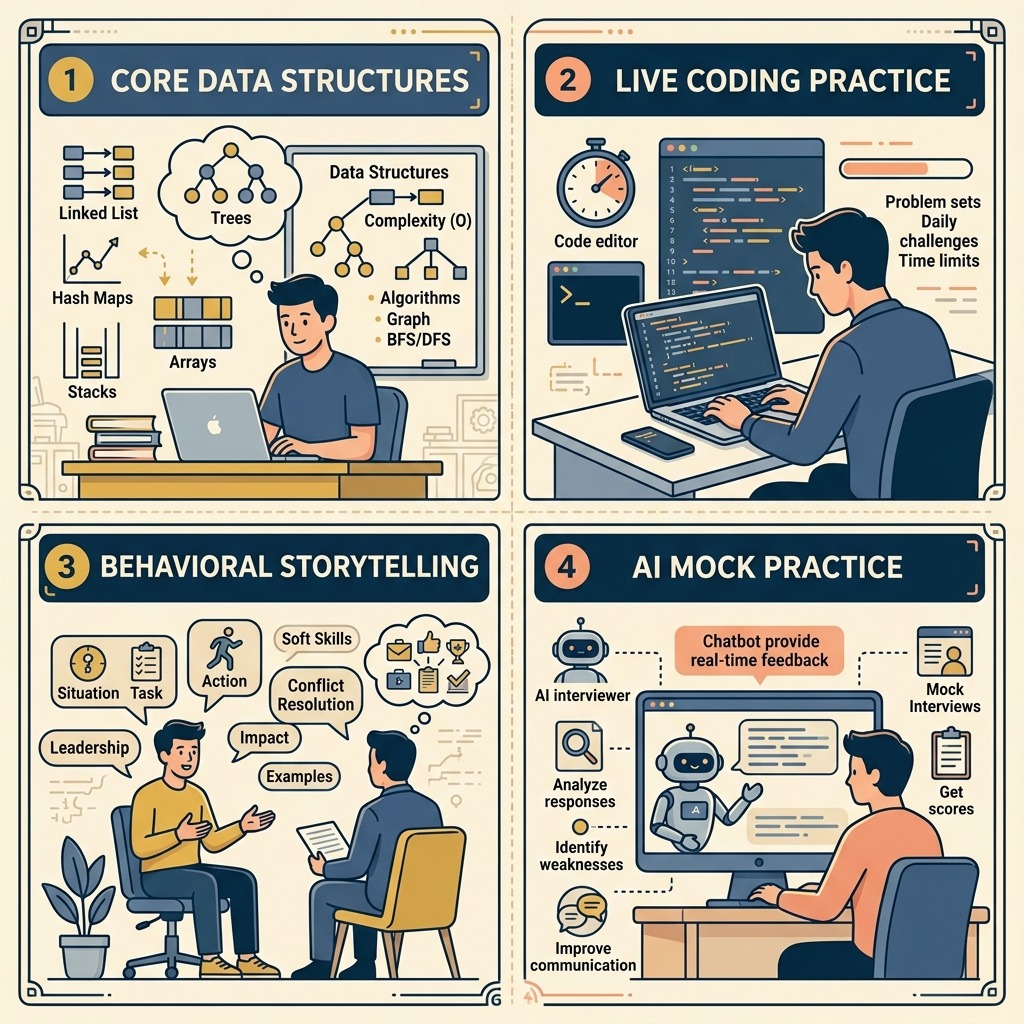
Pillar 1: Core Data Structures & Algorithm Foundations
You don't need to master dynamic programming or complex graph theory on day one, but you must be rock-solid on standard data structures:
- Arrays & Hash Maps: Know when to trade space for speed ($O(1)$ lookup vs. $O(n)$ search).
- Strings & Two Pointers: Master sliding window techniques and string manipulation.
- Linked Lists & Stacks/Queues: Understand memory pointer references and LIFO/FIFO patterns.
- Basic Trees & Traversal: Understand Binary Search Trees (BST), Breadth-First Search (BFS), and Depth-First Search (DFS).
When practicing coding problems, don't just memorize solutions. Explain the time and space complexity out loud using Big-O notation.
Pillar 2: Live Coding & "Thinking Out Loud"
The biggest mistake candidates make during live coding interviews is quiet coding. If you stay silent for 10 minutes typing away in an IDE, the interviewer has zero insight into your thought process.
The 5-Step Live Coding Algorithm:
- Clarify Constraints: Ask about edge cases (e.g., Can inputs be negative or empty? How large is the array?).
- State an Example: Walk through a sample input/output pair by hand.
- Propose a Brute Force Solution First: State the naive approach, analyze its Big-O complexity, and explicitly state why you want to optimize it.
- Think Out Loud Before Typing: Outline your approach in pseudocode or high-level steps.
- Write Clean, Modular Code: Use clear variable names and test your solution with your sample input line-by-line.
// Example: Two Sum optimization using Hash Map in JavaScript
function findTwoSum(nums, target) {
    const seen = new Map(); // Store number -> index mapping for O(1) lookup

    for (let i = 0; i < nums.length; i++) {
        const complement = target - nums[i];

        if (seen.has(complement)) {
            return [seen.get(complement), i];
        }

        seen.set(nums[i], i);
    }

    return []; // Return empty array if no valid pair exists
}
Pillar 3: Behavioral Storytelling (The STAR Method)
Engineering managers hire teammates, not just compilers. Behavioral questions ("Tell me about a time you had a technical disagreement" or "Describe a bug that took you hours to fix") carry huge weight.
Prepare 4 to 5 versatile stories using the STAR Method:
- Situation: Set the context in 2 sentences.
- Task: Explain what you needed to accomplish.
- Action: Highlight your specific technical contributions and decision-making process.
- Result: Quantify the outcome (e.g., Reduced load times by 30%, Delivered the feature 2 days ahead of deadline, Resolved the state synchronization bug).
Pillar 4: AI Mock Interview Practice
One of the most effective ways to build authentic interview muscle memory without wasting real company opportunities is using realistic mock interview environments. Practicing with an interactive voice simulator or structured AI mock platform like totop.app lets you get real-time feedback on your speech pace, technical clarity, and problem-solving depth.
When you practice answering out loud under timed conditions, you eliminate filler words, sharpen your technical explanations, and walk into actual interviews feeling calm, articulate, and prepared.
3. Handling Rejection and Staying Motivated
Let's be completely honest: you will get rejected. Probably multiple times. Rejection in tech hiring is rarely personal—it often comes down to internal budget changes, senior-level hiring shifts, or team headcount adjustments.
How to Maintain momentum:
- Keep a Debug Log for Every Interview: Immediately after an interview ends, open your notes. Write down every question you stumbled on, every algorithm pattern you struggled to articulate, and every system concept you felt shaky about. Study those exact topics that evening.
- Maintain a 70/30 Daily Schedule: Spend 70% of your day applying, practicing mock interviews, and building features. Spend 30% resting, exercising, and stepping away from your desk. Burnout will kill your interview performance faster than a lack of algorithm knowledge.
- Celebrate Micro-Wins: Did you explain Big-O complexity clearly today? Did you complete a technical screen without panicking? Did you get a recruiter response? Those are all milestones moving you closer to your goal.
4. The Checklist: Your Pre-Interview Game Plan
Before your next interview, run through this quick pre-game checklist:
- Tech Check: Test your microphone, camera, lighting, and internet connection 30 minutes early.
- IDE & Workspace: Close extra browser tabs, mute notifications, and open your preferred code editor or scratchpad.
- Company Research: Know the company's core product, business model, engineering blog highlights, and recent news.
- Question Prep: Prepare 3 thoughtful questions for the interviewer about engineering culture, deployment frequency, or mentorship structure.
- Mindset: Remind yourself that an interview is a 2-way conversation between future colleagues, not an interrogation.
Final Thoughts: You Are Ready
Going from bootcamp graduate to hired software engineer requires resilience, focus, and deliberate practice. Every rejection brings you one step closer to the team that will recognize your potential, value your dedication, and hand you your first developer offer.
Stick to the framework, practice explaining your code out loud every single day, and trust the process. Your tech career is just beginning.