Recruiting is the lifeblood of any scaling organization. While product teams ship software and sales executives generate revenue, it is the talent acquisition team that builds the foundation of the entire company. A skilled recruiter does not simply review resumes and send LinkedIn InMails; they serve as a strategic talent advisor, labor market analyst, brand ambassador, and high-stakes negotiator.
Because the macroeconomic hiring environment demands exceptional efficiency and precision, companies no longer hire transactional resume screeners. Hiring leaders look for full-cycle talent partners who can translate high-level business goals into rigorous talent pipelines, calibrate demanding hiring managers, build structured evaluation rubrics, and deliver extraordinary candidate experiences.

Whether you are interviewing for an In-House Corporate Recruiter, Technical Sourcing Specialist, or Lead Talent Acquisition Partner role, this comprehensive recruiter interview guide breaks down the essential recruiter interview questions, proven operational frameworks, and strategic answers required to stand out in today's market.
Part 1: The Modern Full-Cycle Recruiting Architecture
Before stepping into your interview, you must articulate a repeatable, data-informed methodology for managing candidates and stakeholders through the recruitment lifecycle. Top performers operate with structured systems rather than reactive instincts.
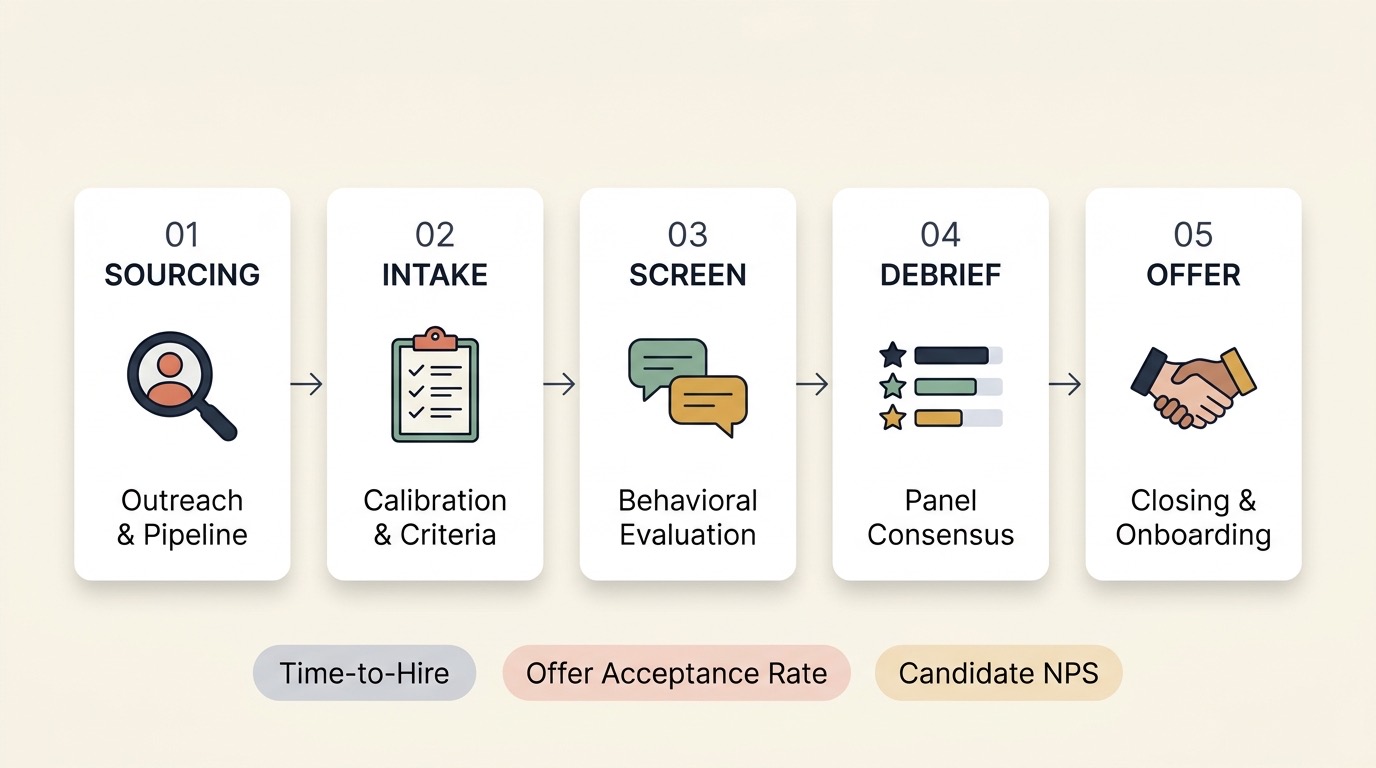
An end-to-end recruitment pipeline rests on five foundational pillars:
1. Intake & Talent Calibration
- Role Scoping: Partnering with hiring managers to unpack the core competencies, non-negotiable technical skills, and behavioral traits necessary for the role.
- Market Reality Checks: Analyzing real-time talent pool supply, compensation benchmarks, and competitor hiring velocity to align expectations before posting the position.
- Scorecard Definition: Establishing objective evaluation criteria and interview panel responsibilities upfront to eliminate subjective bias.
2. Multi-Channel Sourcing & Outreach
- Boolean & X-Ray Search: Crafting precision search strings across professional platforms, GitHub, portfolio communities, and niche forums.
- Personalized Outbound Campaigns: Building multi-touch sequences that emphasize company mission, technical challenges, and career trajectory rather than generic job descriptions.
- Referral & Inbound Nurturing: Activating employee networks and talent communities to build warm talent pipelines.
3. Structured Behavioral Screening
- Competency Mapping: Evaluating relevant hard skills, cross-functional communication, motivation, and career stability.
- Logistical & Compensation Alignment: Transparently verifying salary bands, work authorization, relocation needs, and start timelines early in the funnel.
- Candidate Experience: Treating every applicant with respect, prompt feedback, and clear visibility into the hiring process.
4. Panel Coordination & Scorecard Calibration
- Interview Architecture: Assigning distinct interview competencies to panel members (e.g., technical problem solving, values alignment, system design) to avoid redundant questioning.
- Debrief Facilitation: Guiding consensus discussions and challenging unsubstantiated "gut feel" feedback with structured rubric evidence.
5. Offer Presentation & Closing
- Continuous Pre-Closing: Identifying competing offers, counter-offer likelihood, and personal decision factors throughout the entire process.
- Total Rewards Storytelling: Articulating equity value, benefits packages, bonus structures, and growth trajectory alongside base salary.
Part 2: Core Recruiter Interview Questions & Exemplary Answers
Interviewers evaluate talent partners across three primary axes: stakeholder management, sourcing strategy, and candidate conversion. Below are the most frequent recruiter interview questions paired with structured, high-impact model answers.
Question 1: "How do you partner with a hiring manager who has unrealistic expectations or an overly restrictive wishlist?"
Why Interviewers Ask This
Hiring managers often draft job descriptions describing "purple squirrels"—candidates with 10 years of experience in technologies that have existed for five, willing to work below median compensation. Interviewers want to know if you roll over and waste weeks sourcing non-existent talent, or if you use data and consultative diplomacy to reset the profile.
Strategic Answer Framework
- Validate and Understand: Acknowledge their business goals and why they believe these criteria are vital to the team's success.
- Bring Labor Market Intelligence: Present real-world talent supply data, geographic availability, and compensation percentiles.
- Calibrate with Sample Profiles: Review 5 to 10 distinct candidate profiles together during the initial intake to test trade-offs.
- Agree on "Must-Haves" vs. "Nice-to-Haves": Reframe the requirement matrix around demonstrable learning agility and core competencies.
Sample Exemplary Response
"When a hiring manager presents an overly restrictive profile, I treat the intake meeting as a strategic talent consultation rather than a transactional order-taking session. For example, when hiring a Senior Backend Engineer, the manager insisted on 8+ years of Go experience within fintech, capped at the 50th percentile of market base salary.
Instead of pushing back without proof, I pulled talent supply telemetry showing that fewer than 180 engineers in our target geography matched that exact combination, and their median base compensation was 25% above our budget. I then brought five anonymized profiles to our calibration sync: two who matched the exact Go background, two with deep distributed systems expertise in Java and C++ who had demonstrated rapid language onboarding, and one strong fintech engineer eager to transition to modern tech stacks.
By walking through these profiles together, the manager realized that distributed systems architecture and concurrency fundamentals were the true non-negotiables, while Go was a learnable tool. We expanded our talent pool by 400%, reduced time-to-fill from an anticipated 90 days to 42 days, and hired an exceptional engineer who exceeded performance expectations within three months."
Question 2: "Walk me through your sourcing strategy when outbound response rates on a critical role are below benchmark."
Why Interviewers Ask This
Outbound message fatigue is real. If your response rate drops below 15-20%, sending 100 more templated InMails will not solve the problem. Interviewers want to evaluate your troubleshooting methodology, messaging personalization, and channel diversification.
Strategic Answer Framework
- Friction Diagnosis: Break down whether the issue is deliverability, subject line open rates, pitch resonance, or target profile misalignment.
- Personalized Value Hooks: Highlighting unique technical challenges, direct leadership visibility, or specific projects from the candidate's public footprint.
- Multi-Touch Omnichannel Approach: Combining thoughtful InMails, email outreach, GitHub or portfolio engagement, and warm peer introductions.
Sample Exemplary Response
"When outbound reply rates drop below my target benchmark of 25%, I conduct a pipeline autopsy across three diagnostic checkpoints: audience targeting, messaging value proposition, and channel selection.
First, I review my Boolean search syntax and criteria. If I am targeting senior engineers who receive dozens of recruiter messages weekly, generic company intros get ignored. Second, I overhaul my outreach copy. I discard templated job bullet points and structure a concise three-paragraph sequence: (1) why their specific background caught my attention, such as an open-source contribution or a talk they gave; (2) the exact architectural challenge our team is solving; and (3) a zero-pressure invitation to chat.
Third, I leverage our engineering team. Candidates respond at triple the rate when an engineering manager or staff engineer sends the introductory note. I draft the message and coordinate with the hiring manager to send the initial touchpoint. When we deployed this collaborative sourcing model for a stubborn platform engineering search, our outbound reply rate surged from 12% to 38%, leading to two hires within five weeks."
Question 3: "How do you conduct an initial behavioral phone screen to evaluate candidate qualifications objectively while minimizing unconscious bias?"
Why Interviewers Ask This
Unstructured phone screens lead to inconsistent data, subjective "culture fit" judgements, and poor downstream passthrough rates. Interviewers want to see that you use structured rubrics, standardized question sets, and behavioral evaluation techniques like the STAR method (Situation, Task, Action, Result).
Strategic Answer Framework
- Standardized Question Matrix: Asking every candidate for the role the same foundational competency questions.
- Behavior-Based Inquiry: Probing past demonstrated actions rather than hypothetical intentions.
- Calibrated Scoring Rubrics: Scoring answers against predefined rating scales (1 to 4) anchored in specific behavioral indicators.
Sample Exemplary Response
"I structure my 30-minute phone screens into four intentional chapters: 3 minutes setting the agenda and establishing psychological safety, 18 minutes on standardized competency questions, 5 minutes selling the opportunity and answering their questions, and 4 minutes on operational logistics.
To eliminate unconscious bias, I build a calibrated interview scorecard before speaking with any applicants. Every candidate answers the same behavioral questions mapped directly to the core competencies agreed upon in intake. For example, to evaluate cross-functional stakeholder alignment, I ask: 'Describe a situation where a product or engineering counterpart pushed back on your timeline. How did you resolve the impasse?'
I listen specifically for concrete actions and measurable outcomes using the STAR framework. If an answer remains vague, I dig deeper with follow-ups like 'What specific decision did you make?' rather than assuming capability. This structured approach maintains our candidate-to-onsite conversion rate above 75% and ensures our evaluation is rooted in demonstrable skill rather than rapport or affinity bias."
Question 4: "Tell me about a time a top candidate was on the verge of rejecting an offer or accepting a counter-offer. How did you close them?"
Why Interviewers Ask This
Great recruiters win candidates at the offer stage because they started closing during the very first screen. If an offer rejection comes as a complete surprise, the recruiter failed to uncover motivations and objections along the way. Interviewers test your negotiation acumen, candidate advocacy, and closing instincts.
Strategic Answer Framework
- Early Discovery: Uncovering true career drivers (e.g., mentorship, autonomy, project scope) and personal anchors early.
- Pre-Closing Verification: Confirming acceptance parameters before generating the official offer letter.
- Counter-Offer Anticipation: Roleplaying their resignation conversation before they speak with their current manager.
Sample Exemplary Response
"Closing never happens at the offer stage; it begins during the initial screen. In my opening conversation, I always uncover the candidate's core reason for exploring opportunities—what I call their 'catalyst for change'—as well as their target compensation package and current promotion timeline.
On a critical Staff DevOps search, our finalist received a competitive retention counter-offer from their current employer that matched our base salary. Because I had established deep trust, the candidate called me immediately to share their dilemma. Rather than engaging in a pure bidding war, I grounded our conversation in the original reasons they wanted to leave: their current company was sunsetting their cloud modernization initiative, whereas our platform was scaling multicloud infrastructure from scratch.
I arranged an immediate 20-minute conversation with our VP of Infrastructure to map out the candidate's 12-month engineering roadmap and accelerated equity vesting milestones. I also reminded them that counter-offers rarely resolve underlying cultural or organizational stagnation. The candidate signed our offer that afternoon, and they remain one of our highest-performing team leads."
Question 5: "Which recruiting metrics and analytics do you rely on to manage your workload and diagnose pipeline leaks?"
Why Interviewers Ask This
Modern talent leaders expect operational rigor. You must be able to speak fluently about recruiting funnels, identifying exactly where candidates are dropping off and what corrective actions to take.
Strategic Answer Framework
- Funnel Conversion Rates: Application-to-screen, screen-to-hiring-manager-review, review-to-onsite, onsite-to-offer.
- Efficiency Metrics: Time-to-Fill, Time-in-Stage, Sourcing Channel Effectiveness.
- Outcome Metrics: Offer Acceptance Rate (target ≥ 80%), Quality of Hire at 6 and 12 months, Candidate Net Promoter Score (cNPS).
Key Pipeline Metrics Table
| Metric | Healthy Benchmark | Diagnostic Signal if Off-Target |
|---|---|---|
| Phone Screen to Onsite Rate | 60% – 75% | If below 50%, recruiter screening criteria and hiring manager expectations are misaligned. |
| Onsite to Offer Rate | 25% – 35% | If below 20%, onsite interview panels are testing miscalibrated competencies or bar-raising is inconsistent. |
| Offer Acceptance Rate (OAR) | 80% – 90% | If below 75%, compensation is uncompetitive, pre-closing was missed, or candidate experience was poor. |
| Time-to-Fill (TTF) | 35 – 50 days | If expanding, review bottleneck stages such as feedback latency or sluggish interview scheduling. |
| Candidate NPS (cNPS) | +50 or higher | If declining, communication cadence, interview transparency, or rejection feedback requires immediate overhaul. |
Part 3: Behavioral Questions Recruiters Face
In addition to operational questions, interview panels will probe your emotional intelligence, resilience, and adaptability through situational scenarios.
Navigating Difficult Stakeholder Dynamics
When working with cross-functional partners, conflicts are inevitable. Be prepared to discuss how you handle demanding executive teams, shifting headcount budgets, and sudden hiring freezes. Practicing handling tough interview moments helps you maintain poise and professional composure when interviewers push back during behavioral case studies.
Diversity, Equity, and Inclusion (DEI) in Pipeline Building
Modern recruiters must demonstrate proactive sourcing across underrepresented groups. Explain how you craft gender-neutral job descriptions, partner with specialized professional associations, audit talent pipelines for demographic drop-offs, and enforce diverse interview slates before panel interviews commence.
Collaboration with HR and People Operations
Recruiters do not work in isolation. You will frequently collaborate with teammates across people operations interview questions, talent acquisition interview questions, and HR business partner interview questions to ensure smooth transitions from signed offer letter to 90-day employee onboarding.
Part 4: Advanced Interview Scenarios: Technical vs. Business Recruiting
Recruiting requirements vary drastically depending on whether you are supporting engineering departments or go-to-market teams. Tailor your interview anecdotes to the specific focus of the hiring team:
- Technical Recruiting: Demonstrate your fluency with tech stacks, modern frameworks, system architecture terminology, and platforms like GitHub and Stack Overflow. Understanding the core themes of behavioral interview questions for engineers demonstrates that you can evaluate technical candidates intelligently.
- Remote & Hybrid Talent Acquisition: Show how you manage time-zone distributed interview panels and screen for self-direction using best practices for handling remote interview dynamics.
- Go-To-Market & Executive Recruiting: Emphasize quota achievement validation, commission plan structures, and confidential executive headhunting tactics.
Part 5: Proven Framework to Prepare for Your Recruiter Interview
To convert recruiter interviews into top-tier offers, follow this 4-step preparation roadmap:
1. Build Your Metric Portfolio
Gather concrete data from your past 12 to 24 months of recruiting:
- Total hires completed across quarters.
- Average Time-to-Fill and Offer Acceptance Rate.
- Percentage of hires sourced through outbound versus inbound.
- Cost-per-hire reductions or agency spend savings you achieved.
2. Prepare 5 Signature STAR Case Studies
Structure concise 2-minute stories covering:
- Sourcing a critical, niche individual contributor or leadership role.
- Managing a high-friction disagreement with a hiring manager.
- Overhauling a broken recruitment process or candidate experience bottleneck.
- Turning an imminent offer rejection into an accepted hire.
- Launching an employer branding or diversity recruiting initiative.
3. Ask Strategic Reverse Questions
At the end of your interview, ask questions that position you as an operational partner:
- "What is the current interview-to-offer ratio across your highest-priority departments, and where is the primary pipeline bottleneck today?"
- "How is the talent team currently partnering with finance and hiring leaders during annual headcount planning?"
- "What applicant tracking system (ATS) and sourcing tech stack is the team leveraging, and what gaps are you looking for this hire to solve?"
4. Practice Real-Time Delivery with AI Mock Interviews
Knowledge of recruiting theory is not enough; your verbal delivery, executive presence, and concise storytelling under pressure determine whether you receive an offer. Using totop.app allows you to simulate high-pressure recruiter interviews with an interactive AI interviewer. You can test your responses against real hiring manager objections, refine your STAR storytelling cadence, and receive real-time feedback on your answers before walking into the interview room.
By mastering the full recruitment lifecycle, backing your answers with hard pipeline metrics, and practicing structured behavioral communication, you will demonstrate the strategic leadership required to excel in any talent acquisition interview.
Practice Talent Acquisition Specialist Questions Live with AI Mock Interviews
Turn any job description across Engineering, DevOps, Data, Marketing, Sales, Finance, or HR into a personalized test and live voice or text AI mock interview on totop.app, or test your speed right now in the 60-Second Talent Acquisition Specialist Blitz.
Play 60s Talent Acquisition Specialist Blitz (Free, No Login) | Start 14-Day Free Trial | Browse All Interview Guides