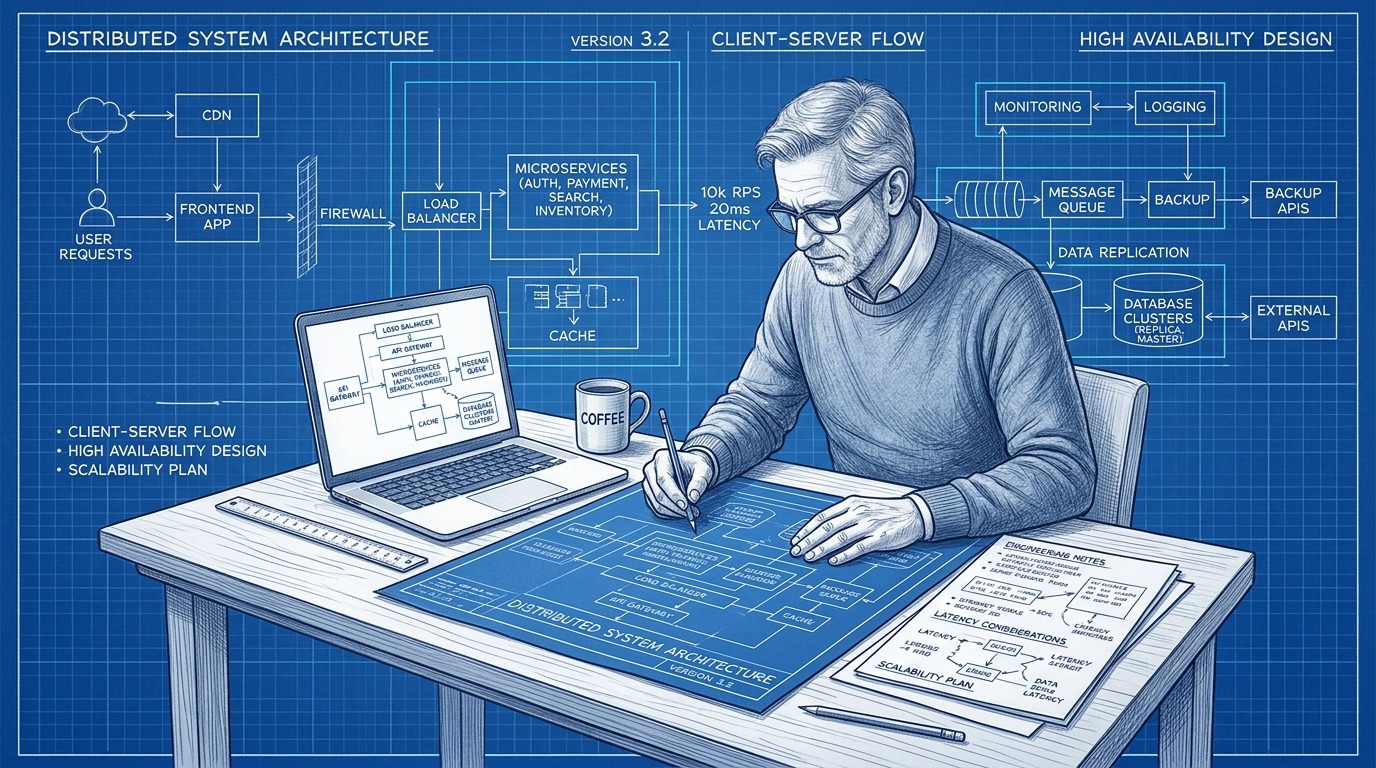
Engineering candidates often approach system design interviews with a flawed assumption: that success requires memorizing hundreds of pages of distributed systems literature or watching dozens of disconnected architectural videos. When faced with an upcoming on-site interview in one week, this encyclopedic approach leads directly to burnout, cognitive overload, and fragmented answers.
In reality, technical interview loops at top technology companies do not evaluate trivia recall. Interviewers evaluate communication discipline, requirement scoping, quantitative capacity estimation, and the ability to articulate trade-offs under architectural constraints. Candidates who structure their thought process methodically routinely outperform those who recite complex buzzwords without justification.
This 7 day system design interview crash course schedule provides an intensive, anti-grind roadmap designed for engineers balancing preparation with full-time workloads. By dedicating 90 to 120 focused minutes each day to specific foundational architectural layers, candidates transform passive knowledge into active interview execution. For those transitioning from non-traditional backgrounds, reviewing foundational prep context in the Bootcamp to First Dev Job Interview Survival Guide provides an excellent complementary baseline.
The Anti-Grind Preparation Philosophy
Traditional interview preparation encourages passive consumption—reading blog posts and watching whiteboarding sessions without actively structuring solutions. In high-pressure 45-minute technical rounds, passive familiarity collapses when an interviewer introduces unexpected latency bottlenecks or network partitions.
The anti-grind methodology focuses on three operational principles:
- Modular Architectural Blocks: Master reusable system patterns (caching tiers, message buses, partition schemes) rather than memorizing bespoke end-to-end architectures.
- Quantitative Reflexes: Practice back-of-the-envelope calculations until calculating queries per second (QPS), read/write ratios, and storage growth takes under three minutes.
- Socratic Defense: Anticipate interviewer counter-proposals by actively verbalizing trade-offs between consistency, availability, latency, and operational complexity.
For engineers with severe weekday constraints, this framework also functions as a condensed weekend interview prep sprint for busy professionals by combining Days 1–3 into Saturday's agenda and Days 4–6 into Sunday's deep dive.
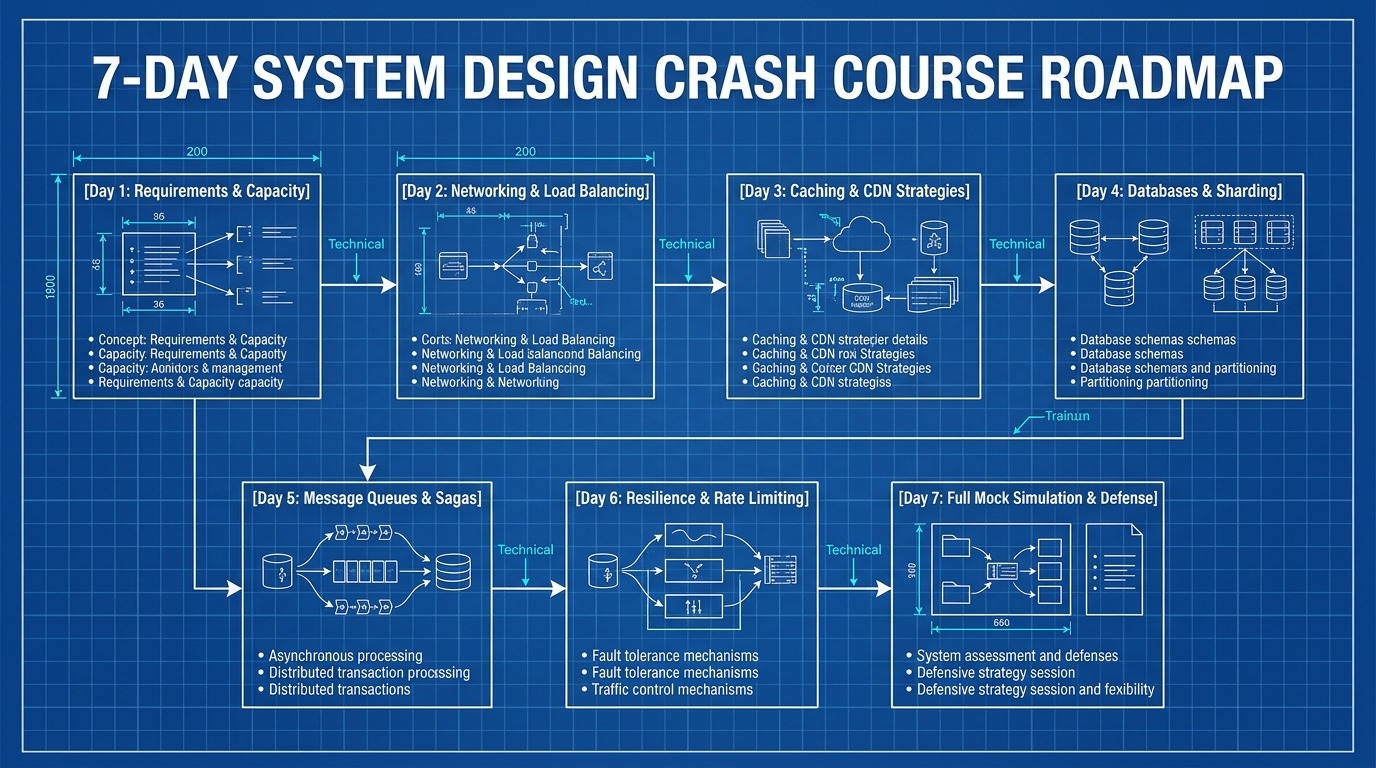
Day 1: Requirements Clarification, Scoping & Capacity Estimation
The first 5 to 7 minutes dictate the trajectory of a system design interview. Candidates who rush into drawing boxes without clarifying scope frequently solve the wrong problem.
Functional vs. Non-Functional Scoping
Begin every prompt by categorizing constraints:
- Functional Requirements: Exactly 2 to 3 core user journeys (e.g., "users can upload 10MB video clips", "users can follow creators and view a chronological feed"). Explicitly state out-of-scope capabilities (e.g., live streaming, real-time analytics) to preserve interview time.
- Non-Functional Requirements: High availability (99.99%), low read latency (< 50ms p95), eventual vs. strong consistency, data durability guarantees, and geographic redundancy.
The Standard Capacity Estimation Template
Interviewers look for realistic assumptions grounded in standard powers-of-two approximations:
Traffic Assumptions:
- Daily Active Users (DAU): 50,000,000 (50M)
- Reads per user per day: 20
- Writes per user per day: 1
- Read/Write Ratio: 20:1

QPS Calculations:
- Daily Writes = 50M * 1 = 50M writes / 86,400 sec ≈ 580 writes/sec
- Peak Write QPS (2x buffer) ≈ 1,160 writes/sec
- Daily Reads = 50M * 20 = 1,000,000,000 reads / 86,400 sec ≈ 11,574 reads/sec
- Peak Read QPS (2x buffer) ≈ 23,150 reads/sec

Storage Estimation (5-Year Horizon):
- Average payload size: 500 bytes metadata + 100 KB media pointer
- Daily Storage = 50M writes * 100 KB = 5,000,000 KB = 5 TB/day
- 5-Year Storage = 5 TB/day * 365 days * 5 years ≈ 9,125 TB ≈ 9.1 PB
Documenting these estimates establishes clear engineering justification for downstream caching tiers and database partitioning decisions.
Day 2: Networking, API Protocols & Load Balancing
Day 2 focuses on ingress traffic management and client-server communication boundaries.
Layer 4 vs. Layer 7 Load Balancing
Managing ingress traffic effectively prevents cascading network bottlenecks:
- Layer 4 (Transport): Operates at the TCP/UDP level without inspecting application payloads. Tools like AWS NLB or HAProxy route packets with microsecond latency, making them ideal for high-throughput edge ingress.
- Layer 7 (Application): Inspects HTTP headers, cookies, and URLs. Tools like Envoy, NGINX, and AWS ALB enable path-based routing, SSL termination, and rate limiting at the cost of higher CPU and memory overhead.
Protocol Trade-Offs
Select client-to-service protocols based on data access patterns:
- REST over HTTP/2 or HTTP/3: Default standard for CRUD interfaces, benefiting from browser caching and universal client tooling.
- gRPC (Protobuf over HTTP/2): Low serialization overhead, compact binary payloads, and multiplexed bidirectional streaming. Optimal for internal microservice communication.
- WebSockets vs. SSE: WebSockets provide persistent full-duplex TCP channels for bidirectional chat and gaming. Server-Sent Events (SSE) offer lightweight unidirectional streaming for live dashboards and notifications.
For a comprehensive review of architectural foundations, explore the complete System Design Interview Guide.
Day 3: Caching Architectures, Invalidation & Cache Stampede Defense
Caching separates systems that collapse under viral traffic from systems that maintain sub-100ms response times. Day 3 covers caching topologies and failure mitigation.
Cache Placement Strategies
Implement caching across multiple infrastructural tiers:
- Client / Browser Cache: Cache-Control headers, ETags, and Service Workers reduce round-trips for immutable assets.
- Content Delivery Network (CDN): Edge caching for static media and geodistributed API responses via Cloudflare or CloudFront.
- Application Memory Cache: In-process caches (Guava, Caffeine) for hot read configuration, though subject to memory pressure and cache drift across instances.
- Distributed Cache Tier: External Redis or Memcached clusters shared across stateless application servers.
Invalidation Patterns & Stampede Protection
Selecting an invalidation pattern directly impacts consistency and database load:
- Cache-Aside (Lazy Loading): Application reads from cache; on miss, queries the database and populates cache. Simple, but vulnerable to initial read latency and stampedes.
- Write-Through: Application writes to cache; cache synchronously writes to the database. Ensures freshness at the expense of write latency.
- Write-Behind (Write-Back): Writes are acknowledged in cache and asynchronously flushed to disk in batches. High write throughput, but risks data loss during unexpected crashes.
# Production Defense: Probabilistic Early Expiration (XFetch Algorithm)
import math
import random
import time

def should_refresh(key_ttl_remaining, beta=1.0, computation_time=0.05):
    """
    Prevents cache stampede (thundering herd) by probabilistically refreshing
    hot keys before their hard TTL expires.
    """
    if key_ttl_remaining <= 0:
        return True

    # Random delta based on logarithm of uniform random distribution
    delta = computation_time * beta * math.log(random.random())
    return (key_ttl_remaining - delta) <= 0
Deploying distributed mutexes (such as Redis SETNX) or probabilistic early expiration protects underlying relational databases when top-tier keys expire.
Day 4: Data Layer Architecture: SQL, NoSQL, Sharding & Replication
On Day 4, candidates focus on data persistence models, consistency guarantees, and horizontal scaling strategies.
Database Selection Decision Matrix
Never declare a database type without articulating the read/write workload characteristics:
- Relational Databases (PostgreSQL, MySQL): ACID compliance, structured schemas, relational joins, complex indexing (B-Tree, GIN). Use when transactional integrity is paramount (financial ledgers, order checkouts).
- Document Stores (MongoDB, DynamoDB): Flexible schemas, JSON document storage, horizontal scale-out. Ideal for user profiles, product catalogs, and variable schemas.
- Wide-Column Stores (Cassandra, ScyllaDB): Append-only LSM trees, high write throughput, linear horizontal scalability across regions. Ideal for time-series metrics, telemetry, and activity logs.
Horizontal Sharding Strategies
When database size exceeds single-node storage or write throughput limits, horizontal sharding is required:
- Range-Based Sharding: Partitions data by value ranges (e.g., User IDs 1–1,000,000 on Shard A). Simple to implement, but vulnerable to hot spots if new entries cluster in the latest range.
- Directory-Based Sharding: A central lookup service maps entities to shard locations. Flexible and simplifies shard rebalancing, but introduces an additional network hop and a single point of failure if un-replicated.
- Consistent Hashing: Hashes shard keys onto a virtual ring with virtual nodes. Minimizes data movement when expanding from
Nto $N+1$ nodes to approximately $1/N$ of keys, balancing load evenly.
Candidates should explicitly state how they resolve cross-shard queries by aggregating results in the application tier or denormalizing query-specific read views.
Day 5: Asynchronous Processing, Message Queues & Event-Driven Sagas
Modern high-scale architectures decouple synchronous request-response loops using asynchronous messaging. Day 5 covers message brokers and distributed transaction boundaries.
Message Broker Topologies
Differentiate between message queue semantics and event stream logs:
- Message Queues (RabbitMQ, AWS SQS): Ephemeral messages dispatched to competing consumers. Once acknowledged, the message is deleted from the queue. Excellent for discrete task execution, worker pools, and transactional notifications.
- Append-Only Distributed Logs (Apache Kafka, AWS Kinesis): Immutable partitioned commit logs where messages persist for a configurable retention window. Multiple independent consumer groups read offsets at their own pace, enabling high-throughput stream processing and event replay.
Review the structural trade-offs in our deep-dive on Kafka vs RabbitMQ System Design Interview.
Distributed Transactions: The Saga Pattern
When distributed services span independent databases, two-phase commit (2PC) creates blocking dependencies and poor availability. The Saga pattern coordinates multi-step transactions via compensating actions:
sequenceDiagram
    autonumber
    actor Customer
    participant OrderService as Order Service
    participant PaymentService as Payment Service
    participant InventoryService as Inventory Service
    participant Broker as Event Broker (Kafka)

    Customer->>OrderService: POST /orders (Create Order)
    OrderService->>Broker: Publish: OrderCreatedEvent
    Broker->>PaymentService: Consume: OrderCreatedEvent
    PaymentService->>PaymentService: Authorize Credit Card ($150)
    alt Payment Succeeded
        PaymentService->>Broker: Publish: PaymentAuthorizedEvent
        Broker->>InventoryService: Consume: PaymentAuthorizedEvent
        InventoryService->>InventoryService: Reserve Warehouse Stock
        InventoryService->>Broker: Publish: StockReservedEvent
        Broker->>OrderService: Consume: StockReservedEvent (Mark Completed)
    else Payment Declined
        PaymentService->>Broker: Publish: PaymentFailedEvent
        Broker->>OrderService: Consume: PaymentFailedEvent (Cancel Order)
    end
In choreography-based sagas, services listen to events and react autonomously. In orchestration-based sagas, a centralized workflow coordinator directs task dispatch and compensation logic, simplifying auditability at the expense of central coupling.
Day 6: Resilience Engineering, Rate Limiting & Consensus
Day 6 addresses what happens when components fail. Senior engineering loops heavily emphasize failure isolation and high-availability design.
Rate Limiting Algorithms
Protect downstream infrastructure from abusive clients or cascade failures using proven rate limiting patterns:
- Token Bucket: Tokens fill a bucket at a steady rate up to capacity; each request consumes a token. Allows bursts while enforcing average throughput.
- Leaky Bucket: Requests enter a queue processed at a constant leak rate. Eliminates bursts and smooths outbound traffic.
- Sliding Window Counter: Calculates request velocity across overlapping historical time slices, preventing boundary burst exploits.
Examine complete implementation details in our analysis of Rate Limiting Algorithms in System Design Interviews.
High Availability & Fault Tolerance Patterns
To prevent catastrophic outages, incorporate standard resilience patterns:
- Circuit Breakers (Netflix Hystrix, Resilience4j): Detect downstream failure thresholds (e.g., 50% errors over 10 seconds), immediately tripping open to fail fast without exhausting thread pools.
- Idempotency Keys: Use client-generated UUIDs stored in Redis or database unique constraints to ensure duplicate payment submissions do not double-bill customers.
- Consensus Protocols (Raft, Paxos): Understand leader election, log replication, and quorum majorities (
N/2 + 1) powering distributed coordination systems like etcd, ZooKeeper, and Consul.
Day 7: Full 45-Minute Mock Interview Simulation & Socratic Defense
The final day transitions preparation from theoretical knowledge to live communication mastery. Candidates should simulate a complete 45-minute technical screen under realistic conditions.
The 45-Minute Whiteboard Timing Breakdown
Manage the interview clock using a structured four-phase cadence:
00:00 - 05:00: Requirements & Constraints Scoping
- Establish 2 core use cases, clarify scale (DAU, QPS), latency, and availability SLAs.

05:00 - 15:00: High-Level Architecture
- Draw end-to-end data flow: Client -> CDN / DNS -> Load Balancer -> API Gateway -> Services -> Databases.

15:00 - 35:00: Deep Dive into Critical Bottlenecks
- Address primary technical challenges (e.g., feed generation fan-out, sharding key selection, cache invalidation).

35:00 - 45:00: Bottleneck Analysis & Trade-Off Defense
- Review failure scenarios, single points of failure (SPOF), monitoring metrics, and evolutionary scale.
Milestone Comparison & Preparation Rubric
Use this comprehensive rubric to evaluate mastery across each architectural domain before your live interview loop:
| Day | Core Architectural Focus | Key Concepts & Patterns | Common Interview Pitfalls | Self-Assessment Benchmark |
|---|---|---|---|---|
| Day 1 | Scoping & Estimation | DAU, QPS, Storage Math, SLA | Skipping math, jumping into DB schema | Complete capacity math in < 3 minutes |
| Day 2 | Ingress & Networking | L4 vs L7, gRPC, WebSockets, CDN | Confusing proxy layers, ignoring SSL overhead | Articulate L4/L7 trade-offs clearly |
| Day 3 | Caching Architecture | Cache-Aside, Write-Through, Stampede | Forgetting invalidation, no eviction strategy | Implement stampede protection logic |
| Day 4 | Data Layer & Sharding | SQL vs NoSQL, Consistent Hashing | Choosing NoSQL without justifying workload | Design consistent hashing partition ring |
| Day 5 | Async & Event Sagas | Kafka vs RabbitMQ, Sagas | Using 2PC for microservices, ignoring ordering | Diagram compensation logic for failed steps |
| Day 6 | Resilience & Reliability | Rate limiting, Circuit breakers, Raft | No rate limiting, single points of failure | Explain token bucket vs sliding window |
| Day 7 | Full Live Simulation | 45-min pacing, Trade-off defense | Rambling, failing to check in with interviewer | Deliver end-to-end design in 40 minutes |
Candidates preparing over longer timelines can compare this 7-day sprint against our comprehensive 30-Day Interview Prep Schedule. Furthermore, those balancing algorithmic prep with system design can reference our guide on How to Pass Coding Interview Without LeetCode to streamline technical practice.
Anti-Patterns That Disqualify Senior Candidates
Interviewers evaluate seniority based on how candidates handle ambiguity and constraints. Avoid these four fatal mistakes:
- Premature Optimization & Buzzword Overload: Introducing Kubernetes, Kafka, Redis, and Cassandra into a system designed for 500 daily requests demonstrates poor engineering judgment. Always start with the simplest viable architecture and scale components only when justified by bottlenecks.
- Ignoring Single Points of Failure: Leaving a single load balancer, primary database node without hot standby, or un-replicated cache cluster exposes a candidate's lack of production operational experience.
- Passive Monologues: Talking continuously for 15 minutes without validating assumptions with the interviewer alienates the evaluator. Treat the interview as a collaborative architectural working session.
- Vague Scaling Claims: Stating "I will just add more servers" without addressing stateful data replication, connection pooling limits, or database lock contention signals shallow systems understanding.
Actionable Next Steps: Put Your Preparation into Practice
Memorizing templates is only the first step; technical instincts must be battle-tested out loud under timed pressure.
Test your baseline technical readiness in under one minute with the free, interactive 60-Second Job Blitz to identify knowledge gaps across system design and architectural trade-offs.
When you are ready to simulate full, unscripted technical loops with real-time feedback on your architecture, pacing, and trade-off defense, explore totop.app Pricing & Plans. Practice with voice-enabled AI personas tailored to your target company's engineering bar, ensuring you walk into your next system design round with complete confidence.
Practice Staff Backend Engineer Questions Live with AI Mock Interviews
Turn any job description across Engineering, DevOps, Data, Marketing, Sales, Finance, or HR into a personalized test and live voice or text AI mock interview on totop.app, or test your speed right now in the 60-Second Staff Backend Engineer Blitz.
Play 60s Staff Backend Engineer Blitz (Free, No Login) | Start 14-Day Free Trial | Browse All Interview Guides