HR Business Partner Interview Questions: 2026 Guide

The role of the Human Resources Business Partner (HRBP) has shifted dramatically from policy enforcer to core business driver. Companies no longer seek HR professionals who merely administer benefits, process onboarding paperwork, and manage routine compliance checklists. Modern executive committees look for commercial operators who understand unit economics, organizational design, talent retention dynamics, and how people architecture directly impacts company profitability.
During senior HRBP and People Operations interviews, hiring leaders test whether you think like a business executive who specializes in human capital or like a traditional administrative operator. They will challenge you on complex restructuring scenarios, executive coaching dilemmas, retention modeling, and workforce forecasting.
Whether you are interviewing for an HRBP, Senior HRBP, Director of People Partnering, or Chief People Officer track, this comprehensive guide explores the essential hr business partner interview questions, field-tested advisory frameworks, and practical behavioral answers you need to stand out.
The Strategic Shift: Operational HR vs. Strategic Business Partnering
Before stepping into your interview, it is vital to internalize how top-tier organizations distinguish between basic HR operations and high-impact business partnering.
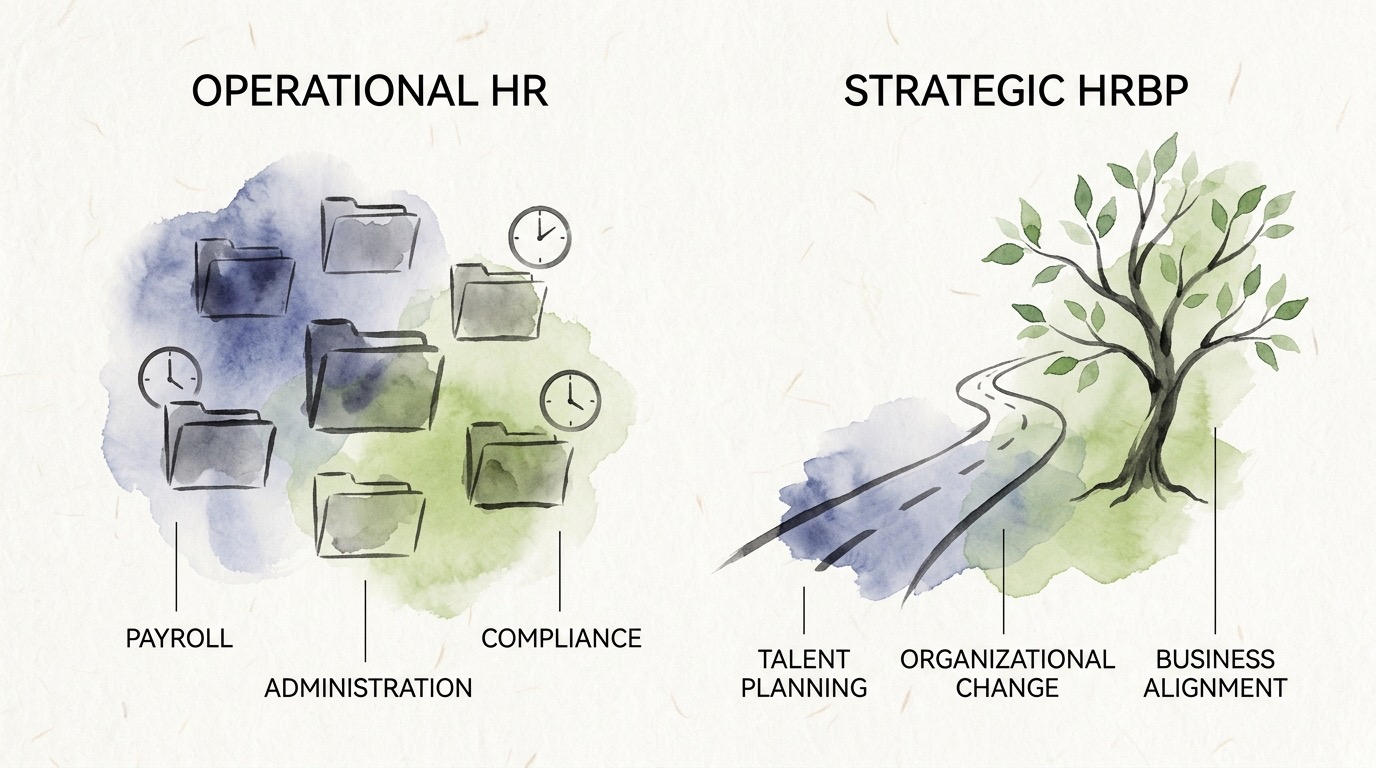
As visualized above, operational HR concentrates on baseline compliance, administrative recordkeeping, and day-to-day transactional support. In contrast, strategic business partnering focuses on long-range talent architecture, organizational agility, executive trust, and aligning people strategies directly with business goals.
Interviewers frame their questions to evaluate four core pillars:
- Commercial & Business Acumen: Your ability to read a profit and loss statement, understand market pressures, and translate corporate objectives into headcount models.
- Organizational Design & Workforce Planning: Structuring teams for scalability, defining career ladders, and managing spans and layers of control.
- Change Management & Restructuring: Guiding executive teams through mergers, rapid hiring blitzes, cost reductions, or leadership reorganizations.
- Executive Coaching & Conflict Resolution: Influencing VP- and C-level leaders, challenging flawed decisions constructively, and resolving sensitive employee relations matters.
1. Commercial Acumen & Strategic Workforce Planning Questions
Question 1: "How do you align human resources strategies with departmental financial targets?"
What the Interviewer Is Really Asking: Can you speak the language of business leaders, or do you view HR initiatives in an isolated vacuum? The interviewer wants to know if your talent initiatives support concrete revenue, efficiency, and delivery targets.
Key Concepts to Demonstrate:
- Business Discovery: Partnering with business leaders during annual budgeting cycles to understand revenue forecasts, product delivery milestones, and operational bottlenecks.
- Competency Gap Analysis: Mapping required future capabilities against existing bench strength to decide whether to build internally (upskilling), buy externally through targeted talent acquisition interview questions and sourcing pipelines, or borrow (contract talent).
- Productivity & Efficiency Ratios: Connecting headcount investments to metrics such as revenue per employee, engineering velocity, or customer acquisition efficiency.
Sample Answer:
"I begin by analyzing the business unit's quarterly and annual targets before proposing any people initiative. For example, when partnering with an engineering and product organization aiming to accelerate a new product line launch, I examined their delivery capacity rather than simply asking how many heads they wanted to hire. We audited current team bandwidth, attrition rates, and engineering velocity. By identifying that their critical bottleneck was senior systems architecture rather than junior development, we reallocated hiring budget from four generalist roles into two principal architects and instituted targeted retention incentives for key domain leads. This kept the team on budget while accelerating our launch by two months."
Question 2: "Which people analytics metrics do you monitor regularly, and how do you use them to drive proactive decisions?"
What the Interviewer Is Really Asking: Do you rely on intuition and gut feeling, or do you leverage quantitative data to anticipate attrition, engagement drops, and productivity bottlenecks?
Tactical Approach:
- Differentiate Leading vs. Lagging Indicators: Voluntary turnover and exit interview notes are lagging indicators—by the time you see them, the damage is already done. Leading indicators include offer acceptance trends, internal mobility velocity, pulse survey sentiment shifts, and high-performer promotion velocity.
- Span of Control & Organizational Depth: Monitoring managerial spans (typically 6 to 8 direct reports) to prevent management bottlenecks or disengaged micro-teams.
- Bench Strength & Succession Readiness: Identifying critical single points of failure across key departments.
Sample Answer:
"I track both leading and lagging indicators through a dedicated people dashboard. While voluntary turnover and employee net promoter scores (eNPS) provide helpful historical context, I focus heavily on leading signals: promotion velocity of top performers, time-to-productivity for new hires, and 90-day sentiment trajectories. In my previous role, I noticed that team-level pulse survey confidence dropped sharply in one product division following a fast management reshuffle. Rather than waiting for turnover spikes six months down the line, I partnered with the division VP to run focused listening forums, uncover workload distribution gaps, and realign managerial expectations. We reversed the sentiment decline and preserved a 94% retention rate among core contributors."
Similar to how cross-functional leaders track metrics in our guide on marketing manager interview questions and frameworks, strategic HR partners must connect data directly to executive decision-making.
2. Organizational Change, Design & Restructuring Questions
Question 3: "Walk me through how you planned and executed a complex organizational restructuring or workforce reduction."
What the Interviewer Is Really Asking: Restructuring and reduction-in-force (RIF) scenarios test an HRBP's legal precision, operational discipline, and empathy under intense pressure. Interviewers want to verify that you balance business necessity with compassionate, dignified treatment of employees.
Framework to Apply (The 4-Stage Restructuring Protocol):
| Phase | Core Objective | Key Deliverables |
|---|---|---|
| 1. Business Case & Modeling | Define the commercial rationale | Spans and layers audit, cost impact model, functional redundancy analysis |
| 2. Selection & Objective Criteria | Ensure legal compliance & objectivity | Objective skills criteria, adverse impact testing, manager calibration |
| 3. Operational Logistics | Coordinate communication & resources | Severance packages, day-of-event runbooks, notification scripts, IT access coordination |
| 4. Day-2 Retention & Morale | Stabilize remaining team members | Retention bonuses for critical roles, town hall messaging, roadmap clarity |
Sample Answer:
"When our company needed to consolidate two overlapping product organizations, I led the people strategy alongside our VP of Technology. First, we established objective, documented competency criteria based on ongoing technical roadmap needs rather than subjective manager preferences, and completed adverse impact analyses to ensure complete fairness. Second, I coached people managers through realistic role-play rehearsals to deliver difficult messages with clarity, transparency, and dignity. On the day of communication, we provided comprehensive severance, extended healthcare, and professional outplacement services. Immediately following the transition, we launched focused roadmap sessions for the continuing team to clarify team charters, address survivor uncertainty, and stabilize delivery."
Question 4: "How do you handle a department executive who demands to fire an underperforming employee immediately without documentation?"
What the Interviewer Is Really Asking: Can you protect the company from legal exposure and reputational damage while remaining an empathetic, collaborative partner to a frustrated executive?
Key Strategy:
- Acknowledge the Leader's Frustration: Validate their urgency so they feel heard rather than blocked by HR red tape.
- Assess the Facts: Review the history of feedback, previous performance evaluations, and whether clear goals were communicated in writing.
- Outline the Risks: Calmly articulate the legal liabilities, wrongful termination risks, and potential damage to team morale.
- Offer a Defensible Path Forward: Propose either an accelerated, objective Performance Improvement Plan (PIP) with clear 30-day deliverables or an equitable, mutual separation agreement with appropriate legal releases.
When handling intense disagreements where the path forward is nuanced, techniques highlighted in our advice on handling difficult interview questions gracefully can help you articulate calm, structured options.
3. High-Stakes Leadership Coaching & Influence
Question 5: "Describe a time you strongly disagreed with a senior VP or CEO on a people decision. How did you handle it?"
What the Interviewer Is Really Asking: Are you an executive 'yes-person' who avoids conflict, or do you have the courage and commercial credibility to push back constructively when leadership decisions could harm the business?
Core Competencies to Highlight:
- Evidence-Based Persuasion: Bringing concrete data, retention risk assessments, and cultural impact projections rather than personal opinions.
- Private Executive Alignment: Having difficult conversations behind closed doors rather than openly challenging leaders in public forums.
- Focusing on Shared Objectives: Framing your disagreement around the executive's own long-term business goals.
Sample Answer:
"Our Chief Revenue Officer wanted to mandate an immediate, sudden five-day office return for all global sales representatives, despite their sustained performance across distributed territories. I knew an abrupt mandate would trigger severe attrition among our top enterprise Account Executives, especially since several competitors were actively recruiting for remote roles. Rather than opposing the CRO in an executive meeting, I scheduled a private one-on-one session. I shared data on competitive compensation and talent mobility in enterprise sales, modeled the cost of replacing even three quota-carrying senior reps, and proposed a structured hybrid framework with monthly high-impact customer strategy intensives instead. The CRO appreciated the risk analysis and adopted the phased framework, preserving 100% of our enterprise sales leadership while meeting executive collaboration goals."
This proactive, stakeholder-focused mindset mirrors the enterprise relationship strategies seen in our deep dive into customer success manager interview questions and scenarios.
Behavioral Storytelling Framework for Senior HR Leaders
When responding to open-ended behavioral questions, senior HR candidates often make the mistake of speaking in broad theoretical principles instead of grounding their answers in concrete past actions.
To ensure your stories resonate with hiring panels, adopt the STAR-E Framework:
- Situation: Define the business environment, market challenge, or departmental friction with specific context.
- Task: Articulate your distinct strategic responsibility as the HR Business Partner.
- Action: Outline the exact interventions you designed, stakeholder conversations you facilitated, and policies you implemented.
- Result: Quantify the business impact—retention rates preserved, employee engagement increases, time-to-fill improvements, or operational savings.
- Evaluation: Reflect on what the organization learned and how the framework evolved for future scale.
If you are structuring a comprehensive multi-week interview preparation plan, following a disciplined schedule such as our 30-day interview prep roadmap ensures you allocate structured time to behavioral rehearsal and executive scenario analysis.
Summary Checklist: Preparing for Your HRBP Interview Round
Before walking into your final interview stages, review this preparation checklist:
- Master the Company's Business Model: Understand their revenue streams, target market, major competitors, and current growth stage.
- Prepare Three Deep Case Studies: Have detailed examples ready covering organizational restructuring, high-stakes executive coaching, and talent retention.
- Know Your People Metrics: Be prepared to discuss formulas and strategies for eNPS, involuntary turnover, voluntary attrition, and time-to-productivity.
- Formulate Strategic Questions for the Panel: Ask about their current spans and layers, talent development philosophies, and where executive leadership feels the biggest organizational growing pains.
Practice Dynamic Executive Scenarios with AI
The most challenging component of any HRBP interview is navigating ambiguous, high-pressure leadership scenarios on the spot—such as calming a frustrated department lead, negotiating restructuring parameters, or articulating people strategy to a demanding board member.
With totop.app, you can engage in realistic, interactive mock interviews tailored to HR and leadership roles. Experience lifelike executive role-play scenarios, test your framing under pressure, and receive immediate, actionable feedback on your composure, commercial clarity, and strategic depth before you face your real hiring committee.