In modern hiring across engineering, technology, and business, behavioral and leadership evaluations carry immense weight. While coding screens and systems architecture rounds confirm baseline technical ability, behavioral loops frequently determine leveling, compensation bands, and final hiring committee approval. A senior candidate can solve complex problems yet receive a down-level offer if their answers signal defensiveness, ambiguous ownership, or an inability to navigate cross-functional trade-offs.
Many candidates approach behavioral preparation through inefficient extremes. Some defer preparation until forty-eight hours before their final round, trying to fabricate complex project narratives on the fly. Others exhaust themselves memorizing rigid scripts, only to stumble when interviewers interrupt with probing follow-ups.
The anti-grind alternative is a structured system. This 14 day behavioral and leadership interview study plan delivers a step-by-step blueprint to mine authentic career experiences, organize them into versatile story archetypes, and rehearse delivery under strict time constraints. Whether preparing for a senior promotion, staff panel, or team lead role, this plan ensures you project executive presence without burning out.
Core Philosophy: Story Mining vs. Script Memorization
Hiring managers and bar raisers evaluate authentic decision-making, interpersonal maturity, and strategic altitude rather than recited monologues. Memorized scripts break down when interviewers ask probing follow-up questions like "Who disagreed with your proposal and what was their exact objection?"
A resilient alternative is the Story Matrix Method. Candidates identify six to eight foundational projects documented with factual anchors: metrics, constraints, friction points, and lessons learned. A single well-architected story answers questions about technical conflict, production outages, scope creep, or leading through ambiguity.
How Interviewers Evaluate Behavioral Seniority
Interviewers score responses against explicit seniority rubrics. Understanding how expectations shift across levels enables candidates to emphasize the exact signals their target role demands.
| Competency | Mid-Level Signal (IC3/IC4) | Senior Signal (IC5) | Staff & Engineering Manager Signal (IC6+) |
|---|---|---|---|
| Technical Ownership | Completes assigned tasks; fixes bugs; escalates blockers. | Drives end-to-end design; anticipates risks; refactors services. | Identifies systemic risks; sets multi-quarter technical roadmaps. |
| Conflict & Disagreement | Voices concerns politely; defers when consensus stalls. | Uses data and prototypes to persuade; disagrees and commits. | Facilitates cross-org alignment; depersonalizes debate; aligns incentives. |
| Failure & Recovery | Follows runbooks; assists during outages; avoids repeat bugs. | Leads blameless post-mortems; adds regression guards. | Transforms isolated failures into platform-wide resilience investments. |
| Cross-Functional Influence | Collaborates cleanly with product and QA peers. | Translates business goals to specs; pushes back on unviable scope. | Partners with executives; balances revenue against technical debt. |
Candidates building a comprehensive preparation roadmap should also review our bootcamp-to-first-dev-job-interview-survival-guide for foundational hiring expectations and our behavioral-interview-questions-software-engineers guide for detailed question banks.
The 14-Day Roadmap at a Glance
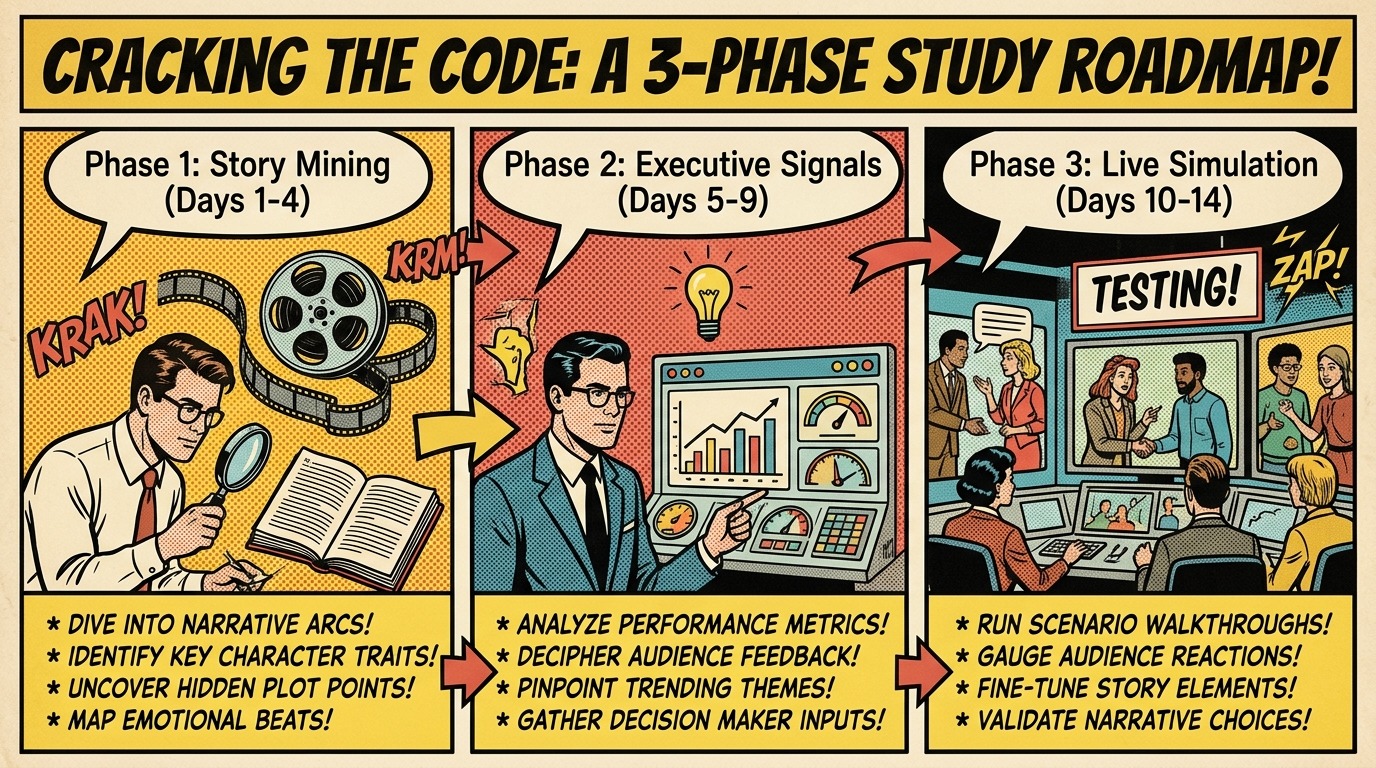
The study plan divides into three focused phases:
- Phase 1: Story Mining and Behavioral Archetypes (Days 1–4): Audit past projects, identify core narratives, map metrics, and categorize stories across essential competencies.
- Phase 2: Mastering the STAR-V Architecture (Days 5–9): Structure narratives using the Situation, Task, Action, Result, and Vision (STAR-V) framework; eliminate ambiguous language; prepare failure and conflict narratives.
- Phase 3: High-Fidelity Simulation, Voice Practice & Calibration (Days 10–14): Practice out loud under strict two-minute timers; conduct mock voice sessions; refine executive questions; calibrate cognitive rest.
| Day | Focus Area | Daily Deliverable | Target Time |
|---|---|---|---|
| Day 1 | Career Backlog Audit | Catalog 8–10 pivotal projects | 45 min |
| Day 2 | Competency Matrix | Map 6 primary stories | 45 min |
| Day 3 | Failure & Conflict Cases | Draft 2 failure and 2 conflict cases | 45 min |
| Day 4 | Business Impact | Attach verified operational metrics | 45 min |
| Day 5 | STAR-V Framing | Outline stories in STAR-V format | 45 min |
| Day 6 | Deep Action Framing | Refactor with active first-person verbs | 45 min |
| Day 7 | Vision & Reflection | Draft forward-looking takeaways | 45 min |
| Day 8 | Leadership Scenarios | Prepare trade-off negotiation cases | 45 min |
| Day 9 | Adversarial Probes | Draft 3 follow-up answers per story | 45 min |
| Day 10 | Two-Minute Constraint | Record audio under 120 seconds | 60 min |
| Day 11 | Weekend Calibration | Audit recordings for filler words | 60 min |
| Day 12 | Reverse-Interviewing | Craft 5 executive reverse questions | 45 min |
| Day 13 | AI Mock Simulation | Execute simulated behavioral loops | 60 min |
| Day 14 | Repertoire Review | Review notes and verify setup | 30 min |
Phase 1: Story Mining and Behavioral Archetypes (Days 1–4)
Effective interview prep begins with discovery rather than memorizing stock answers. On Day 1, audit pull requests, design documents, post-mortem reports, and performance reviews from the past three years. Identify eight to ten moments involving operational or interpersonal stakes: a missed release deadline, a production outage, an architectural disagreement, or a legacy refactor executed under tight business constraints.
On Day 2, filter your catalog down to six foundational stories and map each across core behavioral pillars:
- Technical Leadership: Mobilizing an unprompted solution to an unaddressed systemic defect.
- Navigating Ambiguity: Delivering high-quality systems despite shifting requirements.
- Overcoming Failure: Owning an architectural miscalculation and introducing permanent safeguards.
- Constructive Conflict: Resolving divergent technical opinions through objective data.
- Business Empathy: Balancing developer ergonomics against business deadlines.
- Mentorship & Elevation: Leveling up teammates and establishing engineering standards.
For candidates transitioning from individual contributor roles to engineering management, cross-reference our guide on leadership-questions-in-engineering-manager-interviews.
On Day 3, draft failure and conflict narratives. Avoid the "humblebrag" trap ("I cared too much about code quality"). A credible failure narrative requires genuine operational stakes, unequivocal personal ownership, and structural safeguards introduced to prevent recurrence. On Day 4, attach verified metrics to every story: cite latency drops (e.g., 850ms to 120ms), infrastructure savings, onboarding velocity gains, or customer churn mitigation.
Phase 2: Mastering the STAR-V Architecture (Days 5–9)
Traditional STAR frameworks often leave candidates stranded in lengthy situational backstories. On Day 5, adopt the modernized STAR-V Model with strict time budgeting:
- Situation & Task (20% / ~25 seconds): Concise context, operational scale, and the immediate blocker.
- Actions Taken (60% / ~70 seconds): Concrete individual decisions, trade-offs, and interpersonal navigation.
- Results & Vision (20% / ~25 seconds): Quantified metrics, team outcomes, and lasting institutional impact.
On Day 6, eliminate the passive pronoun "we" from your action sections. Replace "we migrated the cluster" with "I authored the architecture decision record, evaluated throughput, and wrote the Go consumer pool that peers used as an implementation template."
On Day 7, craft the Vision dimension for each narrative. Senior engineers resolve an immediate bottleneck; staff engineers ensure the organization permanently levels up. Highlight how the project produced shared runbooks, automated regression tests in CI, or improved architecture review standards.
On Day 8, prepare high-stakes scenarios: handling a stakeholder who insists on launching an unverified feature, coaching an underperforming peer, or prioritizing technical debt over feature velocity. If you are balancing multi-track preparation, synchronize your schedule with our 30-day-interview-prep-schedule and our 7-day-system-design-interview-crash-course-schedule. On Day 9, draft three adversarial follow-up probes for each narrative, detailing alternative designs considered and how you resolved friction with skeptics.
Phase 3: High-Fidelity Simulation, Voice Practice & Calibration (Days 10–14)
On Day 10, enforce the two-minute constraint. Record your six foundational stories using a smartphone or laptop microphone. Delivering answers aloud forces you to trim superfluous historical context. Re-record each answer until it consistently fits between 90 and 115 seconds.
On Day 11, conduct a weekend interview prep sprint for busy professionals. Dedicate a two-hour weekend block to audit your audio recordings. Weed out vocal hedging ("I kind of led..."), eliminate filler words ("um," "like"), and ensure vocal energy conveys calm executive presence. For candidates preparing for recruiter and talent screens, review our comprehensive 100-hr-interview-questions-and-answers guide.
On Day 12, draft strategic reverse-interview questions for engineering directors:
- "What is the most critical technical debt challenge currently threatening the quarterly roadmap?"
- "How does leadership balance speed-to-market against maintainability when deadlines compress?"
- "Where has the architecture experienced the greatest friction when scaling concurrent traffic tenfold?"
- "Can you describe an instance where engineering pushed back on a product requirement, and how alignment was achieved?"
- "How does this organization evaluate senior individual contributors who wish to maximize architectural leverage without entering management?"
For first-time virtual candidates, our how-to-prepare-for-your-first-technical-interview provides additional environmental checklists.
On Day 13, execute a simulated behavioral loop out loud using interactive voice tools to practice spontaneous recall under pressure. On Day 14, taper your preparation. Review your one-page Story Matrix notes, verify your technical setup, rest well, and enter your interview loop with poised confidence.
Concrete Scenario Walkthrough: Production Crisis & Conflict
Examine how two candidates answer: "Tell me about a time you managed a severe production failure."
Weak, Unstructured Response (Junior / Low-Ownership)
"Our payment service went down on a Friday afternoon because someone merged a pull request without testing it. Alerts showed 500 errors. We jumped on Zoom, saw the connection pool was exhausted, and rolled back the deployment. The rollback took forty minutes because our pipeline was slow. After that, we told product it was fixed and agreed developers should be more careful before merging code on Fridays."
Why It Fails: Shifts blame to unnamed teammates, overuses passive "we," lacks quantifiable metrics, and offers a superficial takeaway ("be more careful").
Polished STAR-V Response (Senior / Staff Signal)
[Situation & Task - 20%]
"In Q3 of last year, our payment microservice suffered an outage during our annual flash sale, dropping transaction authorization rates by 35% over twenty-five minutes. Because our tier handled over 4,000 transactions per minute, immediate stabilization was vital to prevent six-figure revenue leakage."[Action - 60%]
"As on-call lead, I initiated incident protocol, opened a triage channel, and assigned an engineer to support comms. In Datadog APM traces, I found an unindexed query in that morning's promotional release was exhausting our RDS connection pool.Rather than executing a risky full rollback disrupting active shoppers, I used feature flags to disable the coupon query immediately, restoring pool capacity within three minutes. Following stabilization, I led a blameless post-mortem with backend and database leads."
[Result & Vision - 20%]
"We recovered checkout availability in twenty-eight minutes with zero lost transaction data. To prevent recurrence, I implemented an automated explain-plan validator in CI that flags unindexed queries, and authored a connection-pooling runbook now used across twelve backend services."
Elevating Your Preparation with totop.app
Navigating behavioral and leadership rounds requires active conversational practice. Speaking your answers aloud under time pressure transforms structural knowledge into natural interview presence.
With totop.app, you can practice real-world behavioral loops tailored to your target company and seniority:
- Test situational instincts with our free 60-Second Job Blitz—evaluating decision-making, ownership, and conflict resolution in fast drills.
- Experience interactive AI mock interviews featuring realistic voice interviewer personas who probe for trade-offs and deliver instant rubric scoring.
- Explore flexible membership options on our pricing plans to unlock unlimited text and voice mock interview sessions before your upcoming loop.
Frequently Asked Questions
How to prepare for behavioral interviews if I have limited leadership experience?
Focus on informal technical leadership: mentoring an intern, writing documentation for legacy repositories, refactoring an unstable CI test suite, or proposing automated linters. Proactive problem-solving and peer enablement signal leadership regardless of formal title.
Can I use the same project story for multiple behavioral questions?
Yes. A multifaceted project involves system architecture, technical trade-offs, deadlines, and interpersonal friction. You can pivot one foundational project across multiple behavioral questions by highlighting the specific phase relevant to the interviewer's prompt.
What should I do if an interviewer asks about a scenario I have never experienced?
Never fabricate an experience. Acknowledge the constraint directly, then bridge to related principles: "While I have not managed a distributed multi-region failover outage directly, when our primary database connection pool degraded, I applied similar isolation and triage techniques..." Explain how you would systematically approach the challenge using sound engineering logic.
How many stories should I prepare for a standard final-round interview loop?
Six to eight well-structured stories mapped across the core competency matrix provide complete coverage for a standard four-to-five round on-site or virtual loop. This library ensures fresh examples for each interviewer without repeating narratives across rounds.
Practice Product & Engineering Lead Questions Live with AI Mock Interviews
Turn any job description across Engineering, DevOps, Data, Marketing, Sales, Finance, or HR into a personalized test and live voice or text AI mock interview on totop.app, or test your speed right now in the 60-Second Product & Engineering Lead Blitz.
Play 60s Product & Engineering Lead Blitz (Free, No Login) | Start 14-Day Free Trial | Browse All Interview Guides