30-Day Interview Prep Schedule (Free Template)
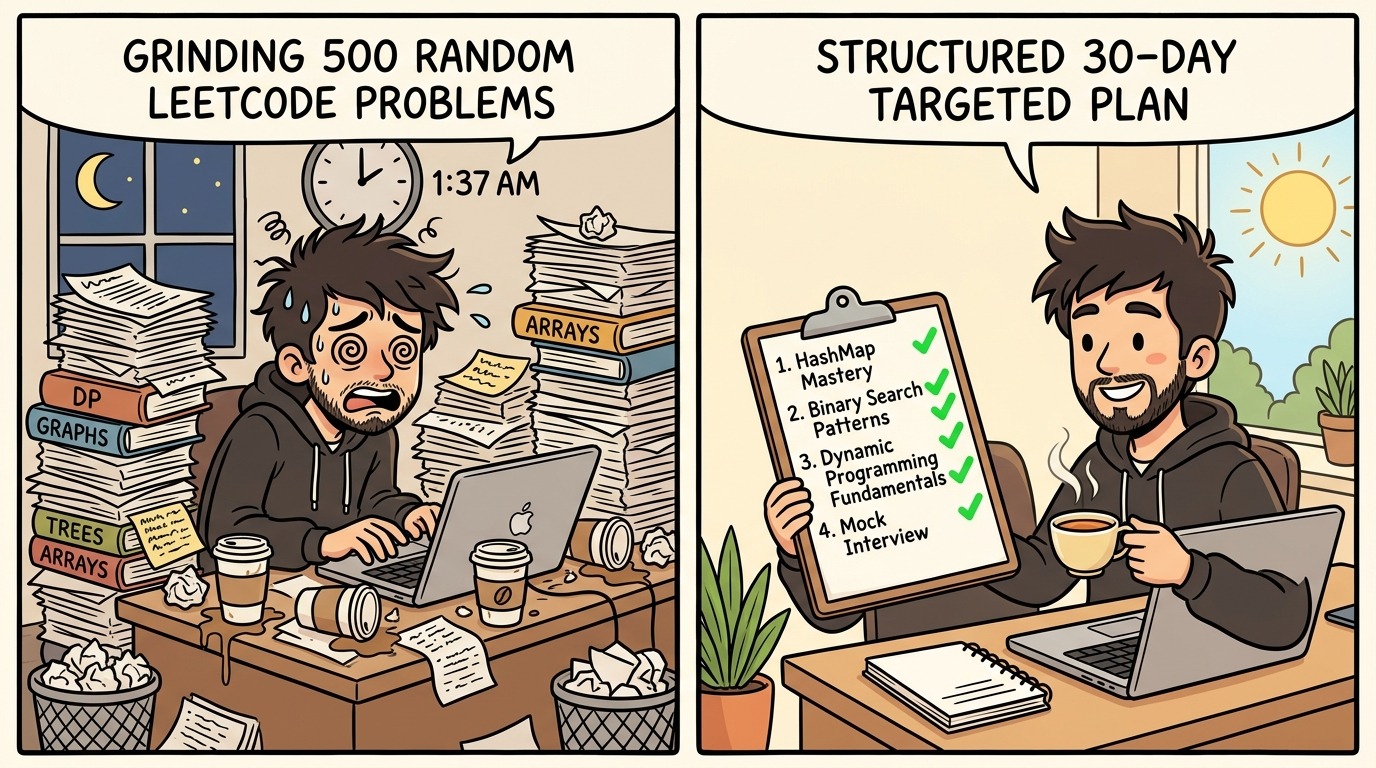
Most software engineers approach interview preparation like an endurance sport: open a problem repository, sort by frequency, and attempt to grind through 500 questions until burnout sets in. Three weeks later, they stare at a medium-difficulty tree problem during a live screen and freeze because they memorized solutions rather than mastering underlying patterns.
Preparing for modern technical loops does not require three months of full-time isolation. What it requires is a disciplined, pattern-focused routine that balances algorithmic problem solving, system architecture fundamentals, and verbal articulation.
Whether you just received an unexpected recruiter reach-out or set a deadline to enter the job market, this 30-day interview prep schedule gives you a daily, time-boxed roadmap designed for working professionals. It compresses high-yield preparation into 90 to 120 minutes per day, pairing conceptual reinforcement with interactive mock interview practice so you walk into your onsite confident and prepared.
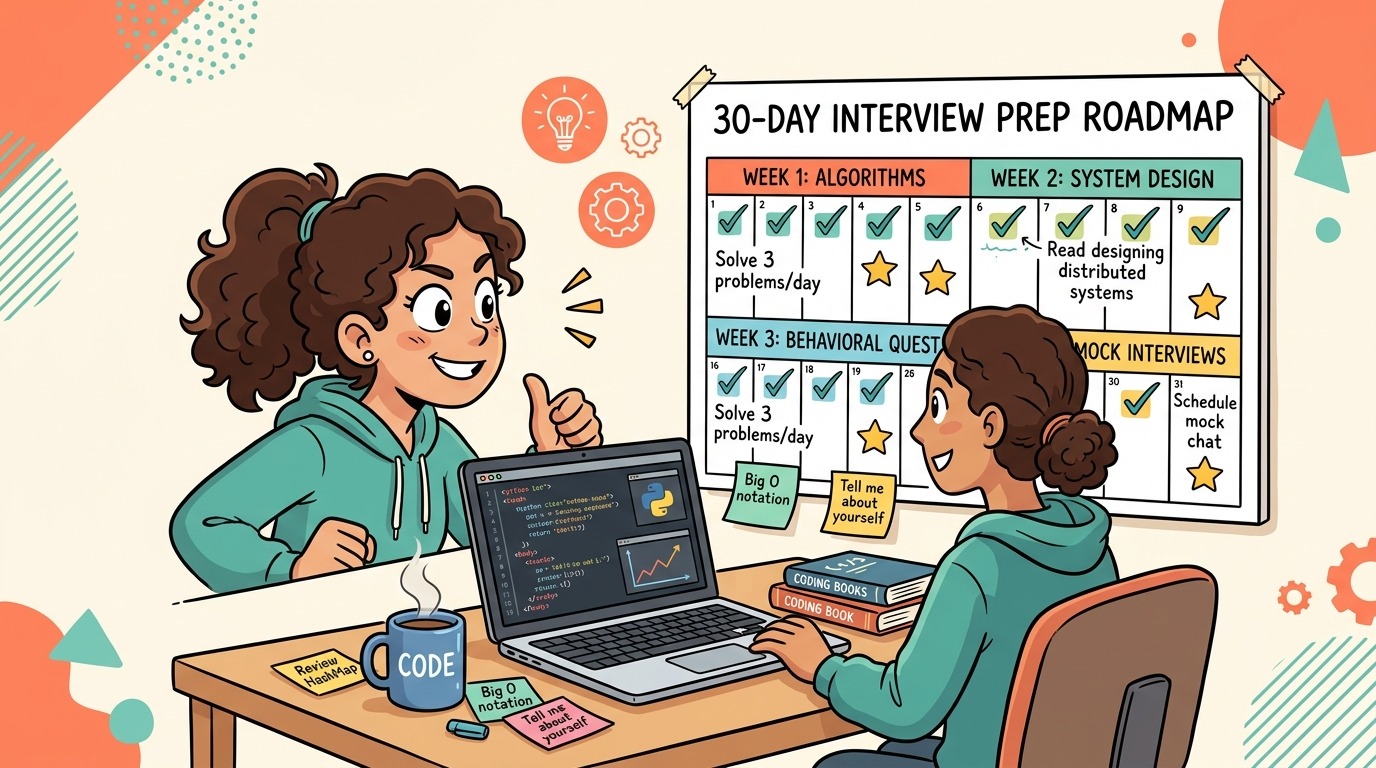
The 30-Day Preparation Philosophy
A compressed timeline requires ruthless prioritization. When you have four weeks to prepare, your competitive advantage comes from pattern recognition, clear communication, and deliberate time-boxing.
1. Pattern Recognition Over Problem Volume
Solving 75 carefully curated problems across 14 canonical patterns yields far better interview outcomes than solving 400 random questions. When an interviewer introduces a problem with unique domain wording, a candidate who memorized solutions searches their memory for an exact match. A candidate trained in pattern recognition immediately identifies the underlying mechanics: "This is a sliding window problem with a dynamic boundary condition."
2. The 90-Minute Daily Time-Box
Do not pull late-night study marathons that leave you exhausted during your workday. Consistency outperforms intensity:
- 10 Minutes: Warm-Up & Concept Review. Quick mental review of data structure operations, Big-O trade-offs, or syntax quirks.
- 50 Minutes: Timed Problem Solving. One medium problem solved under strict interview constraints (no debugger, pen and paper first, verbalizing assumptions).
- 20 Minutes: Solution Dissection & Pattern Logging. Analyzing optimal solutions, edge cases, space complexity, and logging key takeaways in your personal cheat sheet.
- 10 Minutes: Behavioral Story Refinement. Crafting or polishing one STAR story bullet point.
3. Deliberate Communication
The number one failure mode in senior and mid-level screens is the silent coder. Interviewers evaluate your thought process, how you navigate ambiguity, and how you receive hints. Starting in Week 1, you must solve problems out loud.
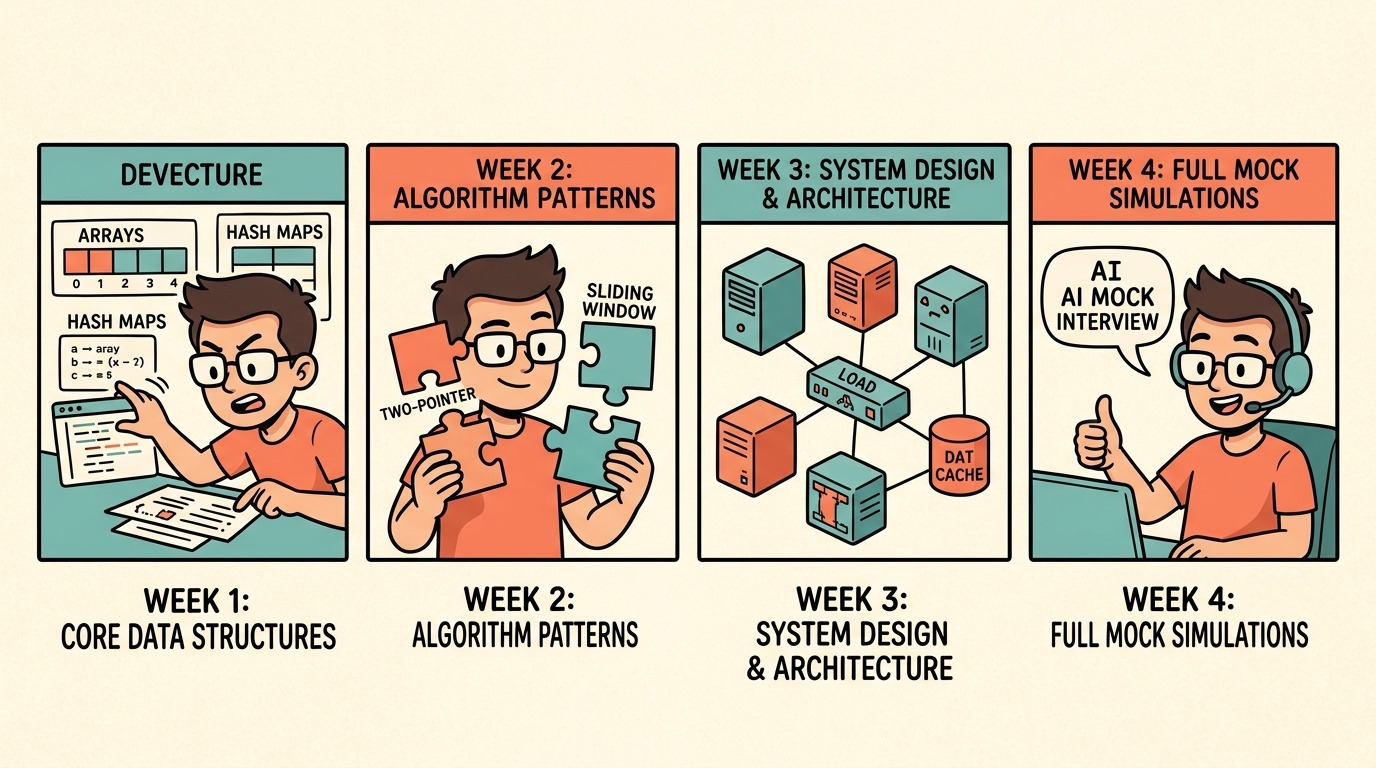
4-Week Roadmap Overview
The 30-day cycle is structured into four distinct phases, transitioning progressively from foundational data structures to complex algorithms, architecture, and live interview simulations.
Week 1: Foundations & Core Data Structures (Days 1–7)
The first week establishes algorithmic fluency and rebuilds your speed with core data structures. Focus on memory layouts, lookups, and basic traversals.
Daily Breakdown
| Day | Focus Area | Core Concepts & Patterns | Daily Practice Targets |
|---|---|---|---|
| Day 1 | Big-O & Complexity Grounding | Time vs. space complexity, auxiliary allocations, amortized analysis | Review our Big-O notation quick reference for interviews; analyze 3 nested loop variants |
| Day 2 | Arrays & Strings (Two Pointers) | Contiguous memory, in-place swaps, opposite-direction pointers | Two Sum II (Sorted Array), Valid Palindrome, Reverse String |
| Day 3 | Arrays & Strings (Sliding Window) | Fixed-size vs. dynamic windows, substring frequency hashing | Maximum Average Subarray, Minimum Size Subarray Sum |
| Day 4 | Hash Maps & Hash Sets | Collision handling, hash keys, frequency counting, trade-offs | Longest Consecutive Sequence, Group Anagrams, Subarray Sum Equals K |
| Day 5 | Linked Lists Fundamentals | Node manipulation, pointer reversal, dummy head technique | Reverse Linked List, Merge Two Sorted Lists, Remove Nth Node From End |
| Day 6 | Fast & Slow Pointers (Floyd's Cycle) | Cycle detection, midpoint discovery, distance equations | Linked List Cycle I & II, Middle of the Linked List |
| Day 7 | Stacks & Queues | LIFO/FIFO mechanics, monotonic stack basics | Valid Parentheses, Daily Temperatures, Implement Queue using Stacks |
Week 1 Milestone Checklist
- Confidently articulate time and space complexities without hesitating.
- Implement Two Pointers and Sliding Window patterns without off-by-one errors.
- Handle singly linked list edge cases (empty list, single node, cycles) cleanly using sentinel dummy nodes.
Week 2: Advanced Structures & Algorithmic Patterns (Days 8–14)
Week 2 tackles non-linear structures—trees, graphs, heaps—and the foundational patterns that comprise the majority of technical screen questions.
Daily Breakdown
| Day | Focus Area | Core Concepts & Patterns | Daily Practice Targets |
|---|---|---|---|
| Day 8 | Binary Trees (DFS Traversals) | Pre-order, in-order, post-order recursion, call stack frames | Maximum Depth of Binary Tree, Invert Binary Tree, Diameter of Binary Tree |
| Day 9 | Binary Trees (BFS & Level Order) | Queue-based level exploration, boundary condition tracking | Binary Tree Level Order Traversal, Binary Tree Right Side View |
| Day 10 | Binary Search Trees (BST) | BST properties, range search, validation | Validate Binary Search Tree, Lowest Common Ancestor of a BST |
| Day 11 | Binary Search & Variants | Modified binary search, rotated arrays, searching search spaces | Search in Rotated Sorted Array, Find Minimum in Rotated Sorted Array, Koko Eating Bananas |
| Day 12 | Heaps & Priority Queues | Min-heap vs. max-heap, Top-K elements, stream processing | Kth Largest Element in an Array, Top K Frequent Elements |
| Day 13 | Graphs (BFS / DFS & Adjacency) | Graph representations, visited sets, connected components | Number of Islands, Clone Graph, Max Area of Island |
| Day 14 | Graphs (Topological Sort & Cycles) | Directed Acyclic Graphs (DAG), Kahn's algorithm, cycle checks | Course Schedule I & II, Pacific Atlantic Water Flow |
Week 2 Milestone Checklist
- Write bug-free recursive DFS and iterative BFS tree traversals in under 15 minutes.
- Identify when a problem requires a heap ($O(n \log k)$) versus full sorting ($O(n \log n)$).
- Understand how to read and execute our guide on how to prepare for your first technical interview to calibrate your pace.
Week 3: Dynamic Programming, System Design & Behavioral (Days 15–21)
Senior and mid-level interviews demand broader competence than pure algorithms. Week 3 bridges recursion, state optimization, high-level architecture, and communication tactics.
Daily Breakdown
| Day | Focus Area | Core Concepts & Patterns | Daily Practice Targets |
|---|---|---|---|
| Day 15 | Dynamic Programming (1D Memoization) | Overlapping subproblems, state definition, transition formulas | Climbing Stairs, House Robber, Coin Change |
| Day 16 | Dynamic Programming (2D & Strings) | Grid paths, string alignments, bottom-up tabulation | Unique Paths, Longest Common Subsequence |
| Day 17 | Backtracking & Combinations | State space trees, pruning branches, recursion backtracking | Subsets, Permutations, Combination Sum |
| Day 18 | System Design: Core Primitives | Horizontal scaling, load balancers, caching layers, CDNs | Read architecture blueprints; study cache invalidation strategies (Write-through vs. Cache-aside) |
| Day 19 | System Design: Databases & Storage | SQL vs. NoSQL, indexing, replication, sharding, ACID vs. BASE | Design a URL Shortener (TinyURL) end-to-end with schema definition |
| Day 20 | Behavioral Prep: STAR Stories | Constructing 5 modular stories for leadership, conflict, failure | Draft STAR bullets: Technical Disagreement, Critical Outage, Mentorship |
| Day 21 | Behavioral Prep: Resume Deep-Dive | Architecture walkthrough of recent projects, business impact | Practice articulating your biggest technical achievement in 3 minutes |
Week 3 Milestone Checklist
- Formulate DP recurrence relations on paper before writing a line of code.
- Diagram a reliable distributed system architecture starting from API endpoints down to database storage.
- Prepare 5 versatile behavioral stories that map to common culture and leadership inquiries.
Week 4: Full Simulations, Whiteboarding & Execution (Days 22–30)
The final nine days shift from learning new concepts to high-stress execution, timing, and composure.
Daily Breakdown
| Day | Focus Area | Core Concepts & Patterns | Daily Practice Targets |
|---|---|---|---|
| Day 22 | Timed Coding Screen 1 | 45-minute timed test with 2 unseen medium questions | Simulate real pressure; no Google searches, no IDE autocomplete |
| Day 23 | System Design Simulation 1 | 45-minute architectural whiteboard session | Design a Distributed Rate Limiter or Notification Service |
| Day 24 | Targeted Weak-Spot Remediation | Reviewing mistake log, revisiting failed problems | Redo 3 problems you struggled with in Weeks 1 and 2 |
| Day 25 | AI Mock Interview: Coding Round | Realistic voice-driven problem solving with follow-ups | Complete a full coding simulation session on totop.app |
| Day 26 | Timed Coding Screen 2 | Hard problem decompensation or mixed medium round | Word Break, Merge Intervals, Lowest Common Ancestor in Binary Tree |
| Day 27 | AI Mock Interview: Behavioral Round | Rapid-fire behavioral pressure testing | Complete a leadership and behavioral mock loop on totop.app |
| Day 28 | System Design Simulation 2 | Scalability and data consistency deep-dive | Design an E-Commerce Checkout System or Social Media News Feed |
| Day 29 | Interview Tactics & Curveballs | Handling unexpected questions, clarifying requirements | Review our guide on when you don't know the answer how to handle it gracefully |
| Day 30 | Rest, Logistics & Mental Reset | Environment check, audio/camera test, sleep hygiene | Light 30-minute review of your personal cheat sheet; zero heavy coding |
Week 4 Milestone Checklist
- Consistently solve and communicate medium algorithm problems in under 30 minutes.
- Drive system design conversations proactively, asking clarifying questions on scale, latency, and read/write ratios.
- Completed at least two full-length AI mock interviews to calibrate pacing, tone, and poise.
The Complete Printable 30-Day Template
Copy this markdown template directly into your personal note-taking tool (Obsidian, Notion, or Markdown file) to track your daily progress:
# 30-Day Technical Interview Prep Tracker

## Week 1: Core Data Structures
- [ ] Day 01: Big-O Complexity & Memory Layout Analysis (Target: 90 mins)
- [ ] Day 02: Two Pointers: Two Sum II & Valid Palindrome (Target: 90 mins)
- [ ] Day 03: Sliding Window: Subarray Sum & Longest Substring (Target: 90 mins)
- [ ] Day 04: Hash Maps & Sets: Group Anagrams & Subarray Sum K (Target: 90 mins)
- [ ] Day 05: Linked Lists: Reverse List & Merge Sorted (Target: 90 mins)
- [ ] Day 06: Fast & Slow Pointers: Cycle Detection & Midpoint (Target: 90 mins)
- [ ] Day 07: Stacks & Queues: Valid Parentheses & Daily Temperatures (Target: 90 mins)

## Week 2: Trees, Heaps & Graphs
- [ ] Day 08: Binary Trees DFS: Depth, Invert, Diameter (Target: 90 mins)
- [ ] Day 09: Binary Trees BFS: Level Order & Right Side View (Target: 90 mins)
- [ ] Day 10: Binary Search Trees: Validation & LCA (Target: 90 mins)
- [ ] Day 11: Binary Search Variants: Rotated Array & Search Space (Target: 90 mins)
- [ ] Day 12: Heaps & Priority Queues: Top-K & Median Stream (Target: 90 mins)
- [ ] Day 13: Graph Traversals: Number of Islands & Clone Graph (Target: 90 mins)
- [ ] Day 14: Topological Sort: Course Schedule I & II (Target: 90 mins)

## Week 3: Dynamic Programming, Architecture & STAR Stories
- [ ] Day 15: 1D Dynamic Programming: Climbing Stairs & Coin Change (Target: 90 mins)
- [ ] Day 16: 2D Dynamic Programming: Unique Paths & LCS (Target: 90 mins)
- [ ] Day 17: Backtracking: Subsets & Combinations (Target: 90 mins)
- [ ] Day 18: System Design: Scalability, Load Balancers & Caching (Target: 90 mins)
- [ ] Day 19: System Design: Database Sharding & URL Shortener (Target: 90 mins)
- [ ] Day 20: Behavioral: 5 Core STAR Stories Drafted (Target: 90 mins)
- [ ] Day 21: Behavioral: Technical Walkthrough of Recent Project (Target: 90 mins)

## Week 4: Timed Simulations & Live Polish
- [ ] Day 22: Timed Mock Coding Screen 1 (45 mins timed)
- [ ] Day 23: System Design Simulation 1: Rate Limiter (45 mins timed)
- [ ] Day 24: Weak-Spot Remediation: Revisit 3 Failed Problems (Target: 90 mins)
- [ ] Day 25: AI Mock Interview (Coding): totop.app Simulation (Target: 60 mins)
- [ ] Day 26: Timed Mock Coding Screen 2: Intervals & String DP (Target: 90 mins)
- [ ] Day 27: AI Mock Interview (Behavioral): totop.app Simulation (Target: 60 mins)
- [ ] Day 28: System Design Simulation 2: Distributed Feed (Target: 90 mins)
- [ ] Day 29: Interview Tactics Review & Question Arsenal (Target: 60 mins)
- [ ] Day 30: Rest, Logistics, Audio/Video Setup & Mental Recharge (Target: 30 mins)
5 Critical Mistakes That Derail a 30-Day Sprint
Even with a detailed schedule, candidates often fall into traps that undermine their hard work. Keep these guardrails in mind:
1. The Passive Solution Trap
Reading a solution after 5 minutes of struggling produces an illusion of competence. If you get stuck, give yourself at least 20 minutes to brainstorm approaches. If you must look at a hint, read only the conceptual hint, then close the tab and write the code yourself. Re-solve the same problem from memory two days later. For alternate study strategies that sidestep endless question banks, explore how to pass coding interview without leetcode.
2. Skipping Space Complexity Analysis
Modern interviewers care deeply about memory efficiency. Always declare both the time complexity and the auxiliary space complexity (including the implicit memory overhead of the recursion call stack) before writing code.
3. Ignoring the First 5 Minutes
Rushing into code without asking clarifying questions is a red flag. Always confirm inputs:
- "Can the input array contain negative numbers or duplicate values?"
- "What are the bounds on $N$? Can the input be empty?"
- "Can we modify the original data structure in place, or do we need an immutable copy?"
4. Neglecting Behavioral Preparation
Technical skill gets you through the screen; behavioral fitness determines your level, offer, and team placement. Dedicating 15% of your study budget to STAR formatting ensures you do not stumble when asked about conflicts, system outages, or project compromises.
5. Practicing in Silence
In a live interview, silence makes interviewers nervous. If you practice silently in your bedroom for 29 days, speaking while coding on Day 30 will feel unnatural. Verbalize your thought process during every practice session.
How to Accelerate Your Prep with AI Mock Interviews
Self-study teaches you problem-solving patterns, but it cannot replicate the dynamic back-and-forth of an experienced interviewer probing your edge cases.
This is where totop.app provides an unfair advantage. Instead of generic question prompts, the platform's AI interview agent tailors technical screens and behavioral questions specifically to the job description and role level you are targeting:
- Realistic Pressure: Practice answering live questions with voice interaction, just like a real video screen.
- Instant Technical Feedback: Receive instant evaluations on code correctness, algorithmic efficiency, communication clarity, and composure.
- Targeted Weak-Spot Identification: Uncover recurring blind spots before your actual interview date so you can adjust your 30-day roadmap dynamically.
For a comprehensive breakdown of technical interview strategies and round-by-round expectations across the entire industry, review our complete guide to technical interview prep.
Print out your 30-day template, commit to your daily 90-minute time-box, and start Day 1 today.