
If you are navigating the technical hiring landscape without a formal computer science degree or a bootcamp brand name stamped on your resume, you already know the emotional roller coaster. You spent months—perhaps years—waking up at 5:30 AM before your day job, debugging JavaScript syntax errors in isolation, wrestling with SQL joins at midnight, and piecing together documentation from across the open web.
Yet, when you step into the interview arena, a creeping wave of self-doubt often strikes: Will they immediately realize I don't know formal compiler theory? Am I going to freeze when they ask me to invert a binary tree on a shared screen? How do I compete with university graduates who spent four straight years immersed in academic algorithms?
Here is the unvarnished reality: self-taught developer interview prep requires a fundamentally different playbook than academic interview prep.
You cannot afford to merely mimic the college student who grinds 400 LeetCode problems in a dorm room. Instead, you must leverage the distinct advantage that every great self-taught programmer possesses: pragmatic engineering craftsmanship, relentless resourcefulness, and real-world execution.
In this comprehensive guide, we will break down exactly what hiring committees evaluate, how to eliminate the "credibility deficit," and how to master the technical and behavioral hurdles between you and your first engineering offer.
The Asymmetry of the Self-Taught Job Search
To ace your interviews, you must first understand the psychology of the engineering manager and tech lead sitting across from you.
When hiring managers evaluate candidates from non-traditional paths, they operate under an asymmetric set of assumptions:
- The Skepticism (The Credibility Deficit): Interviewers worry you only know surface-level framework syntax (like copying a React tutorial) without understanding runtime complexity, memory mechanics, HTTP protocols, or foundational data structures.
- The Opportunity (The Craftsmanship Surplus): Traditional CS graduates frequently enter the workforce lacking practical engineering skills. Many cannot configure a Dockerfile, write a clean database migration, configure an authentication flow, or write meaningful integration tests. As a self-taught builder, you have likely built entire working applications from the ground up.
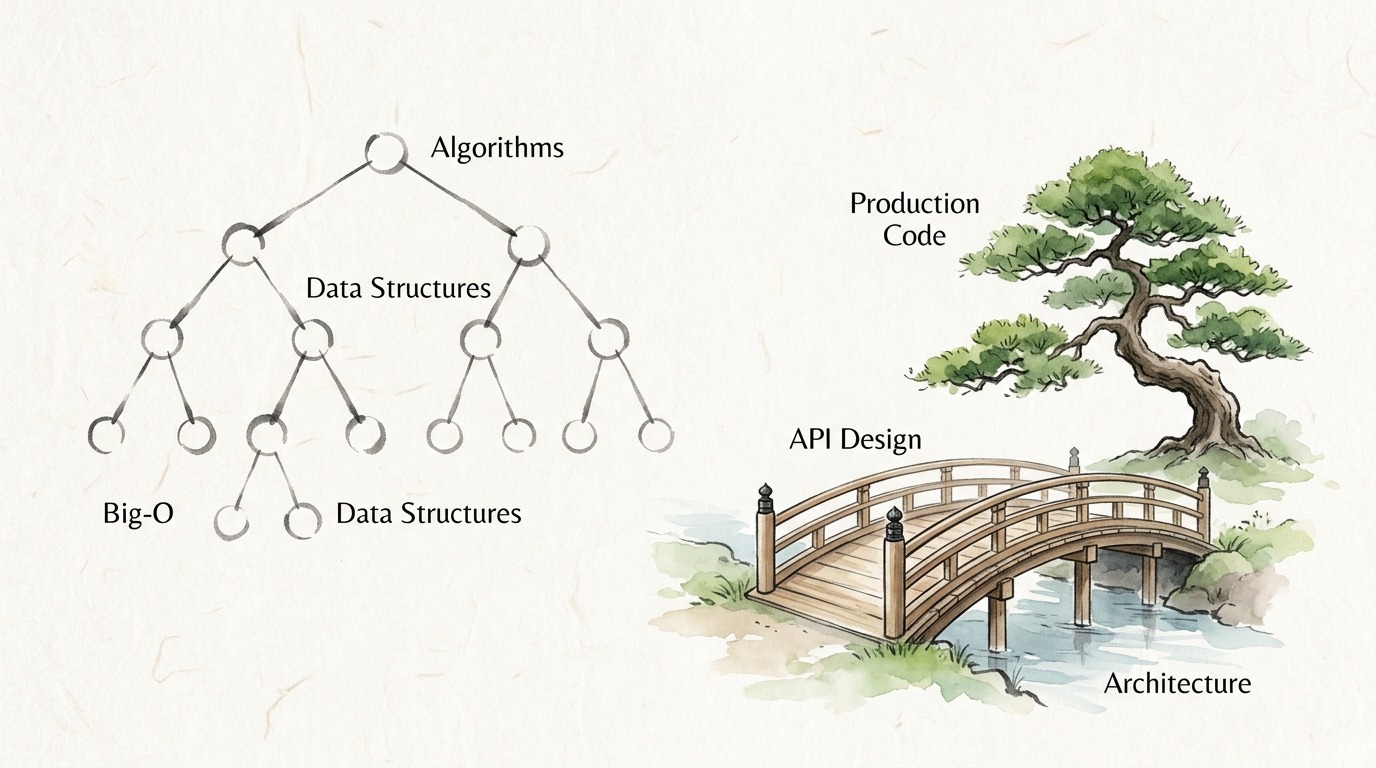
Your objective during interview prep is straightforward: neutralize the skepticism on foundational theory while putting your craftsmanship surplus on full display.
As explored in our guide on how to stand out without a CS degree, tech leads do not hire degrees; they hire problem solvers who reduce their team's backlog. Let's look at how to build that readiness methodically.
The 4-Pillar Interview Readiness Framework
Navigating non-traditional interview preparation requires steady, disciplined steps across four interconnected domains. Think of them as stepping stones across a river: miss one stone, and your balance falters under pressure.
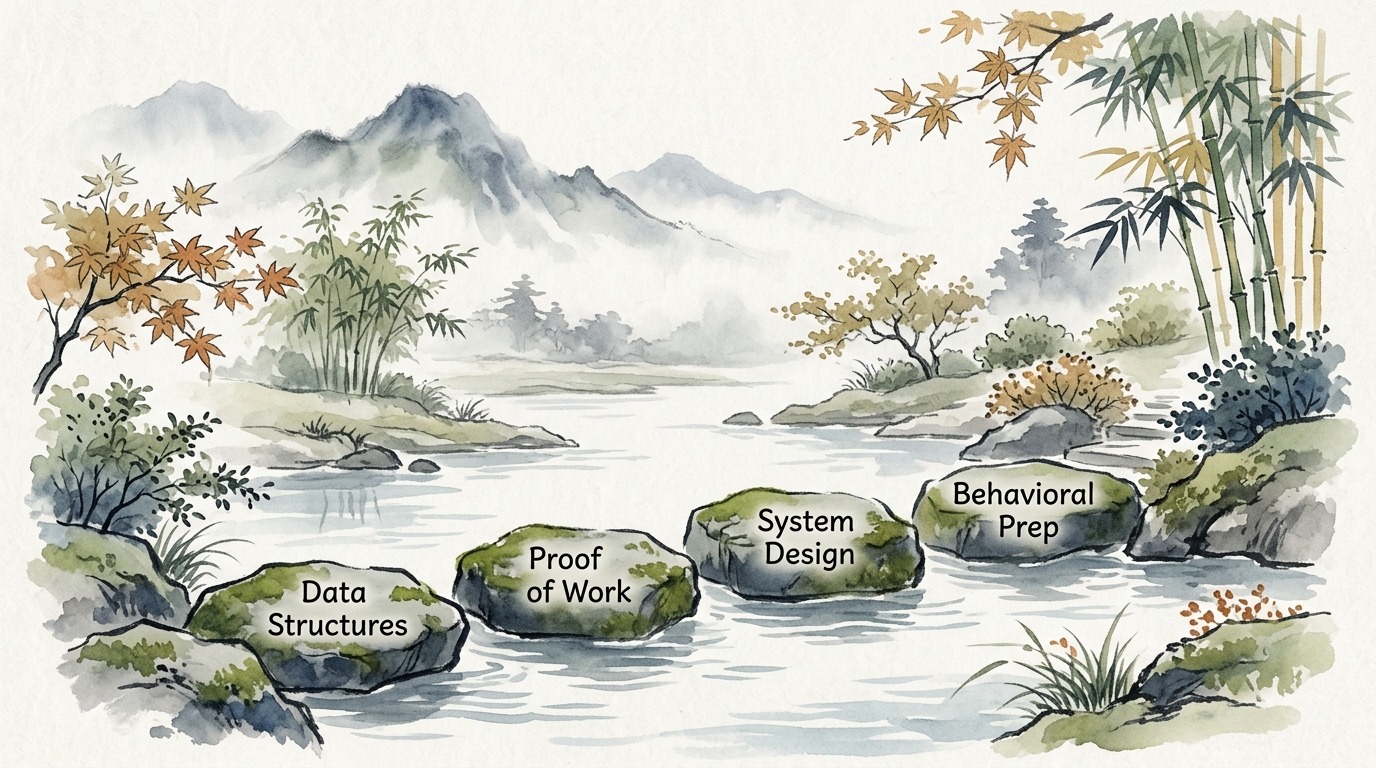
Pillar 1: Targeted Computer Science Fundamentals
Many self-taught developers make the mistake of either ignoring data structures entirely or trying to swallow an entire four-year university curriculum in six weeks. Both approaches lead to burnout and interview failure.
You do not need to implement Red-Black Tree rebalancing from scratch or memorize Dijkstra's mathematical proofs. However, you must master the core structures that make up 90% of real-world live coding screens:
- Contiguous vs. Node-based storage: Arrays, Strings, Singly & Doubly Linked Lists.
- Constant-time lookups: Hash Maps (Objects/Dictionaries) and Hash Sets.
- Hierarchical data: Binary Search Trees, Depth-First Search (DFS), and Breadth-First Search (BFS).
- Linear queues and stacks: LIFO and FIFO execution mechanics.
- Algorithmic Complexity: Understanding time and space complexity using our Big-O notation cheat sheet and algorithmic complexity guide.
A Concrete Example: Moving from Brute Force to Optimal Lookup
Consider a classic interview challenge: verifying whether a list contains two numbers that sum to a specific target. A candidate relying solely on nested iteration writes an O(n^2) solution:
// Suboptimal: O(n^2) Time Complexity, O(1) Space Complexity
function hasTargetSumBruteForce(numbers: number[], target: number): boolean {
  for (let i = 0; i < numbers.length; i++) {
    for (let j = i + 1; j < numbers.length; j++) {
      if (numbers[i] + numbers[j] === target) {
        return true;
      }
    }
  }
  return false;
}
An interviewer will immediately ask: "Can you optimize the runtime if our input array contains 500,000 integers?"
By demonstrating your command of hash-based lookups, you showcase your ability to trade space for time:
// Optimal: O(n) Time Complexity, O(n) Space Complexity
function hasTargetSumOptimal(numbers: number[], target: number): boolean {
  const seenComplements = new Set<number>();

  for (const num of numbers) {
    const complement = target - num;
    if (seenComplements.has(complement)) {
      return true;
    }
    seenComplements.add(num);
  }

  return false;
}
Notice what this demonstrates to an interviewer: you understand how memory allocation works, how set membership lookups operate in O(1) amortized time, and how to write clean, idiomatic code without nested loops.
Pillar 2: Verifiable Proof-of-Work Over Tutorial Clones
If your GitHub profile consists of a weather widget, a Netflix clone, and a basic to-do list, interviewers will instantly recognize that you followed along with a video tutorial.
To stand out in competitive screening rounds, your portfolio must demonstrate real architectural autonomy. You need proof-of-work systems that solve non-trivial problems. As detailed in our roadmap on building a portfolio that gets you interviews, a single production-grade application beats twenty half-baked tutorial repositories.
A strong self-taught project exhibits:
- End-to-end deployment: A custom domain with valid SSL, hosted on reliable cloud infrastructure (AWS, Fly.io, Railway, or Vercel).
- Robust data storage: A relational or document database featuring clean schema migrations, indexes on foreign keys, and relational constraints.
- Resilience & edge cases: Input validation, rate limiting, centralized error handling, and unit test coverage.
- Authentic utility: Even a small utility that serves real users—similar to our experience when shipping a micro-SaaS in 7 days—proves you know how to operate beyond a local
localhost:3000playground.
When an interviewer asks, "Tell me about a technical challenge you solved," you won't describe a simulated homework assignment. You will describe debugging database connection pool exhaustion or implementing webhook idempotency in production.
Pillar 3: Practical System Architecture Intuition
In mid-level and even entry-level tech interviews, interviewers love probing your understanding of how systems interact. They will ask questions such as:
- "What happens when a user clicks 'Submit' on our checkout form?"
- "How do you prevent a user from accidentally submitting a payment twice?"
- "When would you choose PostgreSQL over MongoDB for a new service?"
Self-taught engineers frequently have an intuitive edge here because they have had to connect frontend interfaces to backend servers, configure environment variables, and manage API keys themselves.
To ace these questions, prepare a clear architectural checklist:
- Client-Server Contract: RESTful conventions, status codes (
200 OK,201 Created,400 Bad Request,401 Unauthorized,429 Too Many Requests). - Database Trade-offs: ACID compliance, indexing trade-offs (faster queries vs. slower writes), and normalization.
- Caching & Latency: When and where to introduce Redis or CDN edge caches to reduce database strain.
- Asynchronous Processing: Why heavy operations (sending emails, image processing, report generation) belong in background message queues rather than blocking synchronous HTTP request threads.
Pillar 4: Articulate Engineering Communication & Behavioral Storytelling
Technical skill alone will not win you the offer if you cannot explain your thought process clearly. In fact, many non-traditional candidates fail not because their code was buggy, but because they coded in dead silence for forty minutes.
Interviewers are assessing what it will be like to pair-program with you eight hours a day. They want a colleague who communicates intent, solicits feedback, and accepts constructive criticism gracefully.
When faced with behavioral questions or scenarios outside your current knowledge, use the techniques outlined in our guide on how to handle questions when you don't know the answer. Be transparent about what you know, hypothesize based on first principles, and demonstrate curiosity rather than defensive guessing.
The Live Coding Battle: The 5-Step Verbal Framework
When you are given a coding problem in an interview, do not immediately start typing code. Resist that urge completely. Instead, follow this structured five-step verbal ritual:
[1. Clarify Requirements] ──▶ [2. Walk Through Test Cases] ──▶ [3. State Brute Force]
                                                                        │
[5. Code, Test & Optimize] ◀──────────────── [4. Propose Optimal Strategy]
Step 1: Clarify Requirements & Constraints
Ask intentional questions about input boundaries:
- "Can the input array be empty or contain negative numbers?"
- "How large can
Nbe in production? Are we optimizing for memory or raw throughput?" - "Should we return an empty array or throw an error if no valid pair exists?"
Step 2: Establish Concrete Examples
Write down two or three quick test cases directly in the code editor comments:
- Normal case:
[2, 7, 11, 15], target = 9 -> true - Edge case:
[], target = 5 -> false - Duplicates case:
[3, 3], target = 6 -> true
Step 3: State the Brute Force Approach First
Always articulate the obvious baseline solution before attempting clever optimizations:
"The straightforward way to solve this is checking every pair using a nested loop in
O(n^2)time. It usesO(1)space, but as the array scales to tens of thousands of elements, that quadratic time will degrade performance."
Step 4: Propose the Optimal Strategy and Verify
Explain the intuition behind your preferred approach:
"We can reduce runtime from quadratic
O(n^2)down to linearO(n)by utilizing a Hash Set to track the complements we've already visited. Does that approach make sense before I begin coding?"
Step 5: Implement Cleanly and Dry-Run Edge Cases
Write readable variable names. Avoid single-letter variables other than standard indices. When finished, trace your code manually using your edge cases before telling the interviewer you are done.
Closing the Loop with AI Mock Interview Simulations
The biggest mistake self-taught developers make is treating interview prep like a silent reading assignment.
You can read five books on algorithms and watch sixty hours of YouTube system design tutorials, but until you practice verbalizing technical solutions under simulated time pressure, your brain will freeze during the real interview.
An interview is an interactive performance. You must coordinate typing, thinking, speaking, and reading the room simultaneously.
This is where practicing with totop.app transforms your preparation. Instead of hoping you explained a data structure clearly, you can run realistic, job-tailored AI mock interviews that ask dynamic follow-up questions, evaluate your technical explanations, and test your ability to handle curveballs.
Reviewing your performance in a safe, simulated environment allows you to diagnose speech habits, fill algorithmic knowledge gaps, and build the muscle memory required for high-stakes screening rounds. For additional transition strategies, explore our bootcamp and career transition interview survival guide.
Your 8-Week Self-Taught Interview Action Plan
To keep your preparation focused and measurable, structure your schedule over an eight-week timeline:
| Week | Primary Focus | Concrete Deliverables |
|---|---|---|
| Weeks 1–2 | Core Data Structures & Big-O | Arrays, Strings, Hash Maps, Sets, Two-Pointer patterns. Solve 20 fundamental problems. |
| Weeks 3–4 | Trees, Recursion & Linked Lists | Binary Search Trees, BFS/DFS tree traversals. Implement iterative and recursive solutions. |
| Weeks 5–6 | Portfolio Deep-Dive & System Basics | Audit your best project. Add database indexing, Docker containerization, and unit tests. |
| Week 7 | Behavioral Stories & Architecture | Craft 5 STAR-format stories (challenges, trade-offs, bugs). Practice system design fundamentals. |
| Week 8 | Mock Interviews & Live Simulation | Run daily timed simulations on totop.app. Practice thinking aloud and refining verbal explanations. |
Final Thoughts: Embrace Your Non-Traditional Edge
Being a self-taught software developer is not a handicap; it is proof of your intellectual curiosity and grit.
You did not write code because a professor assigned it for a grade. You wrote code because you were driven to build things that work. When you combine that builder's instinct with disciplined computer science fundamentals, clear verbal communication, and rigorous mock interview practice, you become the kind of engineer every high-performing team wants to hire.
Prepare with intention, trust your craftsmanship, and step into your next technical interview ready to demonstrate what you know.
Practice Full Stack Engineer Questions Live with AI Mock Interviews
Turn any job description across Engineering, DevOps, Data, Marketing, Sales, Finance, or HR into a personalized test and live voice or text AI mock interview on totop.app, or test your speed right now in the 60-Second Full Stack Engineer Blitz.
Play 60s Full Stack Engineer Blitz (Free, No Login) | Start 14-Day Free Trial | Browse All Interview Guides