How to Stand Out Without a CS Degree in Tech Interviews
Almost every self-taught software engineer and coding bootcamp graduate remembers the sinking feeling of scanning an exciting job posting, nodding along to the technical requirements, and then slamming into the dreaded bullet point near the bottom: "B.S. or M.S. in Computer Science, Software Engineering, or equivalent practical experience."
In that split second, imposter syndrome takes the wheel. A persistent inner critic whispers: You didn’t spend four years writing compilers in C. You never took Discrete Mathematics or Operating Systems 401. As soon as an interviewer asks you about memory paging or balanced AVL trees, you will be exposed as a fake.

Here is the truth that experienced engineering managers and tech leads know: in modern software engineering, academic credentials only open the initial screening door, but practical craftsmanship, clear problem solving, and production readiness win the job.
If you want to stand out without a cs degree, you do not need to spend four years re-studying abstract academic theory. Instead, you must learn how to reframe your non-traditional journey as a competitive advantage, bridge essential data structure fundamentals, and demonstrate the tangible engineering impact that academic programs rarely teach.
1. Dismantling Developer Imposter Syndrome
Imposter syndrome in tech is not an irrational personal flaw; it is an occupational hazard caused by comparing your behind-the-scenes struggles to everyone else's curated highlight reel.
When non-traditional candidates walk into technical interviews, they usually suffer from two distinct psychological traps:
- The Credential Trap: Believing that because you lack a formal university parchment, your engineering ability is inherently inferior to candidates from prestigious computer science programs.
- The Gap Paranoia: Constant anxiety that the interviewer will deliberately hunt for the exact mathematical or theoretical topics you skipped during your self-directed learning.
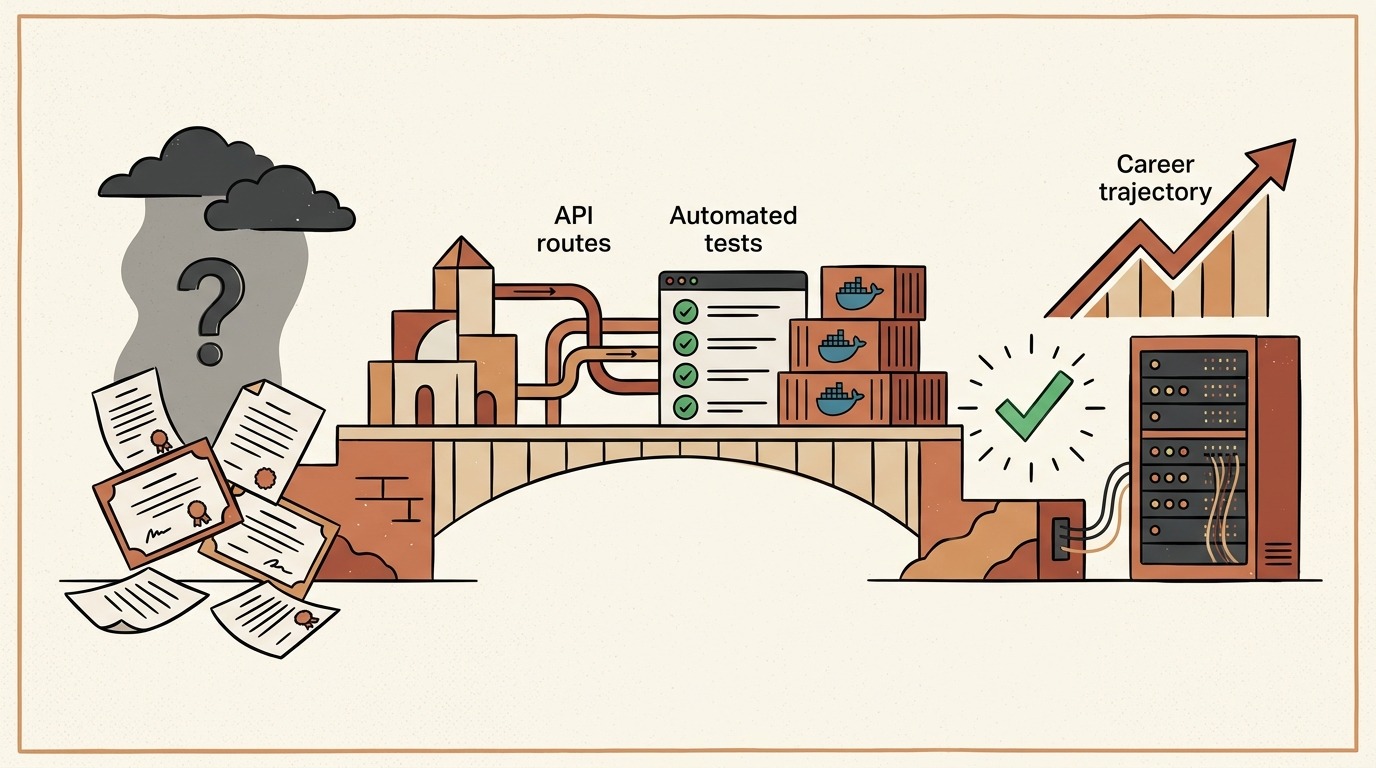
Shifting from Imposter to Pragmatic Builder
To break free from this mental spiral, you must recognize what hiring managers are actually evaluating during a technical loop. Engineering teams are not hiring walking encyclopedias to write academic proofs on whiteboards. They are hiring colleagues who can:
- Read and navigate messy, existing codebases without getting paralyzed.
- Debug confusing production incidents methodically using structured logs and metrics.
- Translate ambiguous product specifications into reliable APIs and databases.
- Communicate trade-offs clearly when working under tight deadlines.
When you feel nervous before an interview, grounding yourself in physical and mental routines is critical. Reviewing techniques for dealing with interview anxiety will help you keep your nervous system calm, preventing stress from hijacking your working memory during live problem solving.
2. The Non-Traditional Builder Advantage
Many self-taught developers and bootcamp graduates view their non-traditional background as a liability they need to disguise. In reality, having an alternative background gives you unique strengths that traditional graduates often take years to develop.
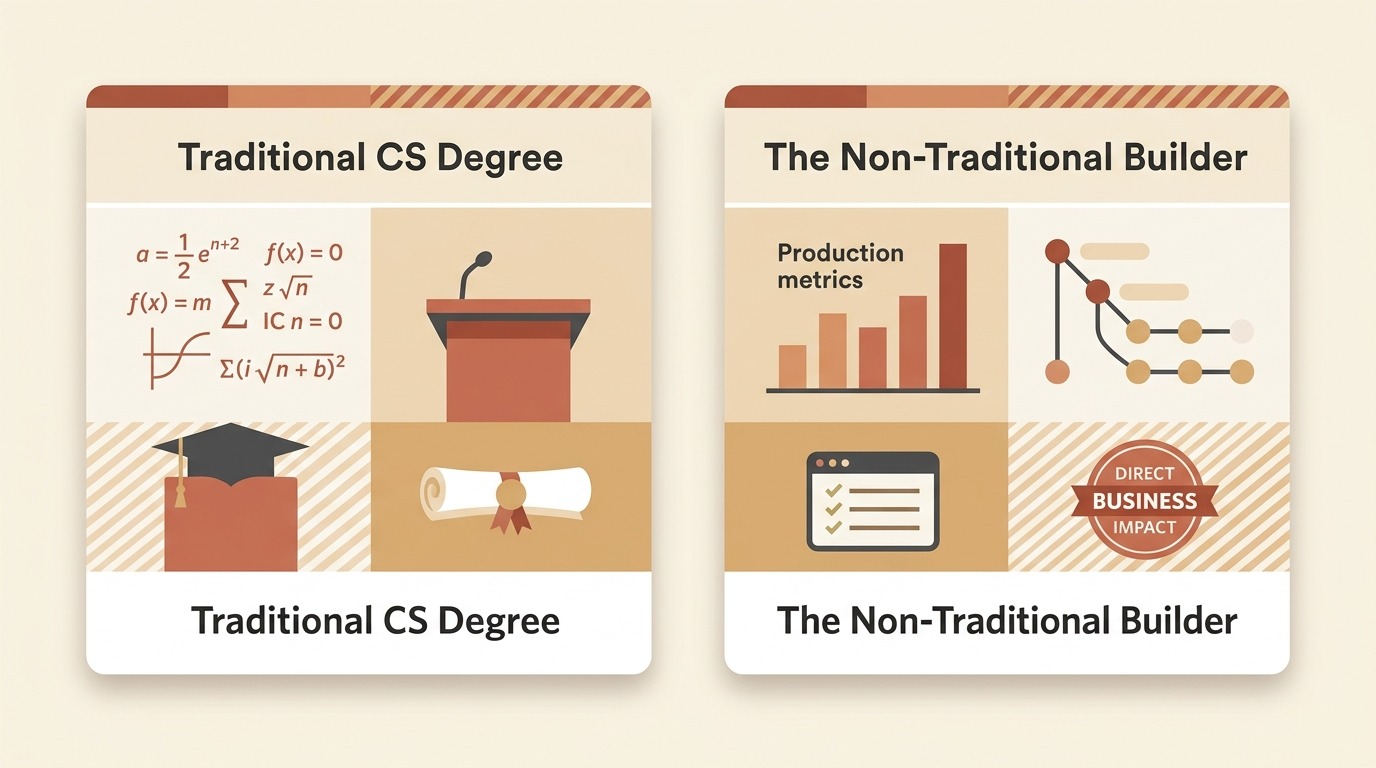
Theory vs. Real-World Engineering
Consider the practical differences between an academic curriculum and real-world software delivery:
| Assessment Factor | Traditional Academic Focus | Non-Traditional Builder Strength |
|---|---|---|
| Code Lifespan | Ephemeral homework scripts discarded at semester's end | Maintainable software built to run continuously in production |
| Tooling & Ecosystem | Command-line compilers, synthetic terminal inputs | Modern Git workflows, Docker, CI/CD, cloud deployments |
| Problem Context | Perfectly constrained problems with known single answers | Ambiguous requirements, real user feedback, third-party API limits |
| Domain Empathy | Theoretical algorithmic efficiency ($O(n \log n)$ proofs) | Business impact, user conversion, accessibility, product resilience |
When you enter an interview room, you are not a second-class engineer trying to imitate an academic researcher. You are a builder who understands how software solves real business problems.
3. The 4 Pillars to Out-Perform in Technical Interviews
To consistently win offers against candidates with formal degrees, focus your preparation on four tactical pillars.
Pillar 1: Bridge Core Computer Science Foundations
While you do not need an entire degree, you cannot ignore algorithmic fundamentals. Most technical screenings use algorithmic coding challenges as an initial filter.
You do not need to memorize every obscure tree balancing algorithm, but you must master the high-frequency patterns:
- Hash Maps and Sets: Converting slow $O(n^2)$ lookups into lightning-fast $O(1)$ amortized operations.
- Arrays and Two Pointers: Sliding windows, frequency counters, and in-place transformations.
- Recursion and Basic Trees: Traversing binary trees using Depth-First Search (DFS) and Breadth-First Search (BFS).
- Time and Space Complexity: Explaining Big-O notation fluently before writing a single line of code.
Here is a classic example of demonstrating algorithmic maturity in JavaScript by replacing a nested loop with a hash table:
/**
 * Finding two numbers that add up to a target sum.
 * Naive nested loops: O(n^2) Time, O(1) Space.
 * Optimized Hash Map: O(n) Time, O(n) Space.
 */
function findTargetPair(numbers, target) {
  // Use a Map to store previously visited numbers and their indices
  const visited = new Map();

  for (let i = 0; i < numbers.length; i++) {
    const currentNumber = numbers[i];
    const complement = target - currentNumber;

    // Check if the required pair value was already seen
    if (visited.has(complement)) {
      return [visited.get(complement), i];
    }

    // Record the current value and index for subsequent elements
    visited.set(currentNumber, i);
  }

  return [];
}
Notice the narrative: instead of jumping straight into code, explain the trade-off out loud: "We can solve this naively by checking every pair in $O(n^2)$ time, or we can trade a small amount of memory—$O(n)$ space—by storing visited complements in a hash map to achieve optimal $O(n)$ linear runtime." This instantly signals senior engineering judgment.
Pillar 2: Build Production Systems, Not Tutorial Clones
The quickest way to get filtered out by recruiters is having a GitHub profile filled with clone tutorials: a generic Todo application, a weather widget, or a basic calculator.
Instead, build one or two deeply considered projects that demonstrate production readiness:
- Automated Testing: Include unit tests and integration tests with Jest, Pytest, or Vitest.
- Containerization: Provide a
Dockerfileanddocker-compose.ymlso anyone can spin up your app with a single command. - Observability: Integrate structured JSON logging, error tracking (such as Sentry), and health check endpoints (
/healthz). - Resilience: Handle network drops, rate limits, and database connection timeouts gracefully.
For instance, seeing how developers architect real apps like building a microsaas tech stack showcases full ownership: database schemas, payment webhook idempotency, and cloud monitoring. Even if a project is still ongoing, knowing how to talk about projects you haven't shipped yet demonstrates authentic problem-solving curiosity.
Pillar 3: Master the "Think Out Loud" Communication Protocol
In live coding interviews, silence is your greatest enemy. Interviewers do not expect immediate, flawless code; they want to see how you collaborate, ask clarifying questions, and reason under ambiguity.
Follow the field-tested strategies detailed in the bootcamp to first dev job interview survival guide to structure your live interview execution:
- Clarify Constraints: Ask about inputs, data sizes, duplicates, and edge cases before touching the keyboard.
- Walk Through Examples: Trace sample inputs by hand to confirm your mental model.
- Draft High-Level Pseudocode: Validate the approach with your interviewer first so they can steer you if you head in the wrong direction.
- Implement Cleanly: Write self-documenting code with meaningful variable names.
- Manually Dry Run: Step through your code with a sample case before declaring you are finished.
Demonstrating this level of communication directly reflects what interviewers actually look for when choosing candidates they want to mentor and collaborate with every day.
Pillar 4: Speak the Language of Architecture and Trade-offs
Academic programs focus heavily on mathematical correctness. Industry teams focus on trade-offs.
Whenever you answer technical questions, adopt the language of engineering trade-offs:
- "We could store this in PostgreSQL for strict ACID guarantees, or use Redis if we need sub-millisecond cache lookups for frequently accessed sessions."
- "A synchronous REST call is straightforward here, but if traffic spikes, placing tasks into an async message queue prevents server bottlenecks."
When you frame problems in terms of latency, throughput, consistency, and maintenance costs, you sound like an experienced engineer rather than an entry-level applicant reciting textbook definitions.
4. Accelerate Readiness with AI Mock Interviews
Reading blog posts and reviewing syntax flashcards only builds passive recognition. Under the hot lights of a real interview, anxiety can freeze your thoughts unless you have developed strong muscle memory.
This is where deliberate practice transforms your outcomes. Instead of waiting for high-stakes company interviews to discover where your explanations stumble, you can pressure-test your skills in realistic simulations.
On totop.app, you can paste your target job description and practice live with AI interviewers tailored to that specific company and role. You will face unexpected follow-up questions, receive instant feedback on the clarity and depth of your answers, and learn how to articulate complex trade-offs effortlessly. By turning interview preparation into a repeatable simulation, you replace nervousness with calm, conditioned confidence.
5. Your 30-Day Game Plan to Stand Out
Here is a practical 4-week roadmap to build your confidence and prepare to win offers:
Week 1: Audit Your Narrative & Reframe Imposter Mindset
- Write down your origin story: why you transitioned into software, what projects you have built, and how your past career strengthens your engineering perspective.
- Identify your 2 or 3 recurring imposter syndrome triggers and write down factual counter-evidence for each.
Week 2: Solidify Core Data Structures
- Spend 60 minutes daily practicing high-frequency data structures (hash maps, sliding windows, two pointers).
- Practice vocalizing Big-O time and space complexity out loud as you solve each problem.
Week 3: Upgrade One Capstone Project to Production Quality
- Pick your strongest portfolio project and add comprehensive unit tests, Docker configurations, and structured error handling.
- Record a 2-minute Loom walkthrough demonstrating architecture, trade-offs, and live functionality.
Week 4: Daily Mock Interview Conditioning
- Run mock interview sessions on totop.app targeting real job listings.
- Practice answering behavioral questions using the STAR framework (Situation, Task, Action, Result) to highlight ownership and grit.
Final Thoughts: Ownership Over Pedigree
The software industry is one of the rare fields where working code speaks louder than academic pedigree. When production systems fail at 2 AM, servers do not care where you went to school or what degree is hanging on your wall; they care whether you can diagnose root causes, deploy clean fixes, and keep users happy.
Embrace your non-traditional journey. Ground yourself in core fundamentals, build software that solves real problems, communicate your thought process clearly, and let your craftsmanship stand for itself.