People Operations Interview Questions: 2026 Guide

The transition from traditional, reactive Human Resources to modern People Operations (People Ops) represents one of the most significant shifts in organizational design over the past decade. Where legacy HR focused heavily on administrative compliance, paperwork, and risk mitigation, People Operations approaches employees as internal customers. High-performing People Ops leaders treat culture, team velocity, retention, and engagement as core operational systems requiring thoughtful engineering, measurable data, and human empathy.
In 2026, tech startups, scale-ups, and modern enterprises hold People Operations Managers and Directors to rigorous business standards. Executive hiring panels do not evaluate candidates on surface-level enthusiasm or generic team-building ideas. They assess whether you can design automated onboarding systems, implement transparent compensation bands, diagnose cultural friction, and link people metrics directly to company profitability.
Whether you are interviewing for a People Operations Coordinator, Senior People Ops Specialist, People Operations Manager, or Head of People, this comprehensive guide delivers the most common people operations interview questions, tactical answering frameworks, core metrics formulas, and strategic model answers.
The 4 Pillars of Strategic People Operations
Before stepping into an interview loop, anchor your mindset to the structural framework of People Operations. Interviewers want to verify that you understand how disparate HR disciplines interconnect into a cohesive employee lifecycle.
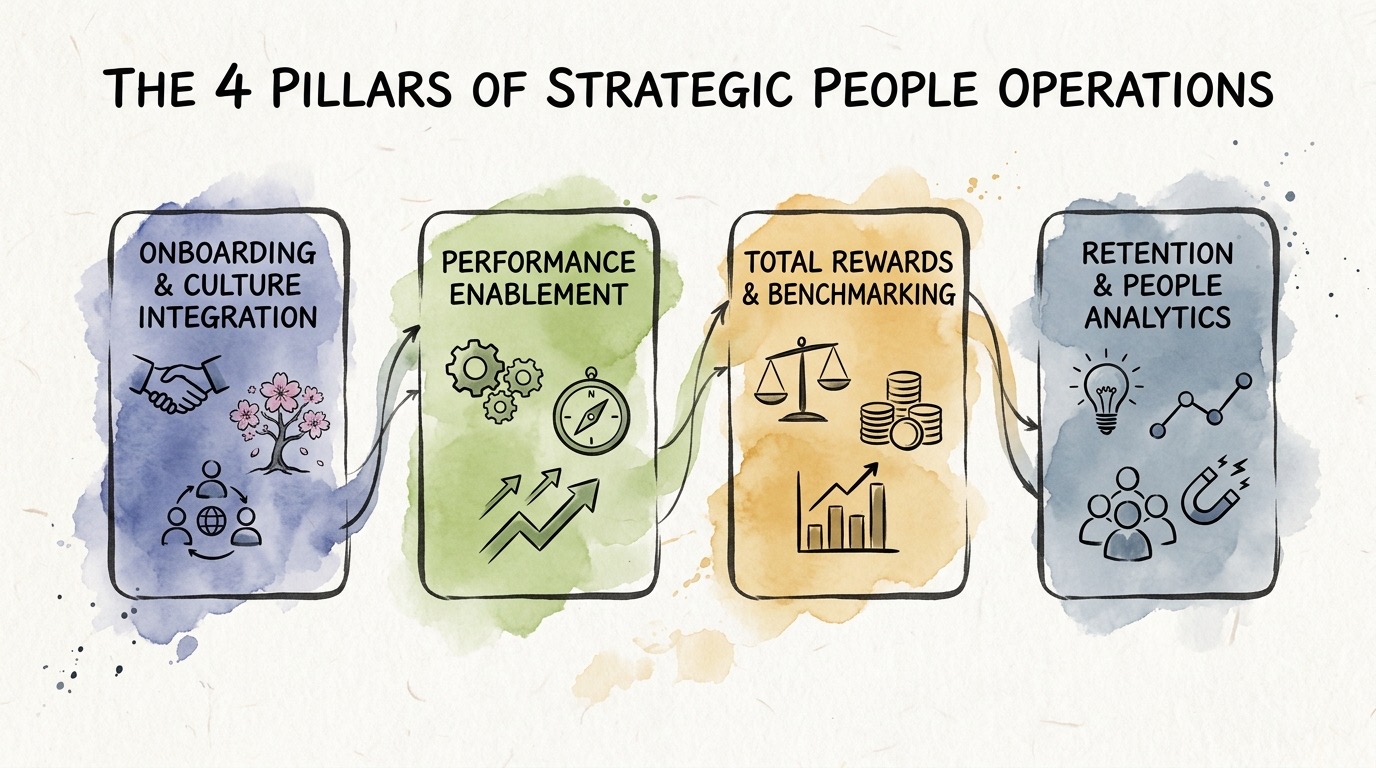
As visualized in the framework above, strategic People Operations rests upon four core pillars:
- Onboarding & Culture Integration: Designing friction-free entry experiences that shorten time-to-productivity, automate hardware/software provisioning, and socialize new hires into organizational norms.
- Performance Enablement & Career Architecture: Moving past archaic annual reviews into continuous goal tracking (OKRs), transparent career ladders, and growth-oriented manager coaching.
- Total Rewards & Market Benchmarking: Creating equitable, data-driven compensation formulas, pay equity governance, and compelling benefits structures that attract and retain top talent.
- Retention Analytics & Employee Engagement: Measuring eNPS (employee Net Promoter Score), attrition signals, and survey telemetry to proactively resolve burnout before turnover spikes.
When answering behavioral and scenario questions, referencing these four pillars demonstrates that your interventions are systematic rather than ad-hoc.
1. Onboarding, Scaling & System Architecture Questions
Question 1: "How do you design a remote or hybrid onboarding program that minimizes time-to-productivity while fostering cultural connection?"
What the Interviewer Is Really Asking: Can you coordinate complex logistics (IT, payroll, department managers) while ensuring the human side of joining a new company isn't lost behind screens?
Key Concepts to Demonstrate:
- Pre-boarding Orchestration: Sending equipment, welcome packets, and initial setup guides 7-10 days prior to Day 1 to eliminate first-day technical paralysis.
- The 30-60-90 Day Milestone Blueprint: Providing clear deliverables calibrated with the hiring manager so new hires know exactly what success looks like.
- Social Scaffolding: Pairing new hires with cross-functional "onboarding buddies" and scheduling targeted asynchronous cohort coffee chats.
- Feedback Loops: Deploying pulse surveys at Day 7, Day 30, and Day 90 to track onboarding satisfaction and operational bottlenecks.
Strong Sample Answer:
"I structure onboarding into three concurrent tracks: technical readiness, role enablement, and cultural integration. Before Day 1, our automated HRIS triggers provisioning with IT and sends an asynchronous welcome portal so new hires enter their first morning with working access, clear calendar invites, and their buddy assigned.
During the first 30 days, we focus on cultural immersion and foundation: meeting cross-functional partners, shadowing customer calls, and understanding team norms. By Day 60, the employee transitions from shadowing to executing scoped starter projects. By Day 90, they are operating autonomously with defined quarterly OKRs.
In my previous role, implementing this structured 30-60-90 day milestone system coupled with automated Day-14 and Day-45 sentiment surveys reduced our engineering time-to-first-commit by 32% and boosted 90-day retention to 96%."
Question 2: "When an organization grows from 50 to 250 employees in a year, how do you prevent culture dilution and administrative chaos?"
What the Interviewer Is Really Asking: Have you scaled people systems before? Do you understand how communication breaks down as team topologies expand?
Key Concepts to Demonstrate:
- Codifying Core Values into Rubrics: Turning abstract company slogans into concrete behavioral examples for hiring scorecards and performance assessments.
- Manager Enablement: Building manager toolkits, 1-on-1 agendas, and leadership training cohorts to maintain consistency across squads.
- Internal Knowledge Architecture: Maintaining transparent, searchable internal wikis (Notion, Confluence) so information does not live trapped in private Slack channels.
- Cross-Functional Alignment: Partnering closely with recruiting teams similar to tactics used in talent acquisition interview questions to protect quality bars as hiring speed accelerates.
2. Performance Management & Career Development Questions
Question 3: "How do you handle the transition away from dreaded annual performance reviews to a continuous feedback model?"
What the Interviewer Is Really Asking: Do you understand change management? How do you motivate busy department heads to adopt new HR processes without feeling bogged down by paperwork?
Key Concepts to Demonstrate:
- Agile Check-Ins vs. Retrospective Audits: Replacing massive year-end evaluations with lightweight monthly pulse check-ins and quarterly development conversations.
- Unlinking Development from Compensation: Separating forward-looking growth coaching conversations from backwards-looking salary adjustment discussions to encourage honest self-reflection.
- Manager Accountability: Equipping team leads with simple conversation prompts and tracking completion rates in the HRIS.
Strong Sample Answer:
"Annual reviews fail because they turn performance evaluation into an anxiety-ridden post-mortem six months after the work happened. When rolling out continuous feedback, I start by consulting leadership across engineering, sales, and product to identify their pain points.
I propose a quarterly rhythm: two lightweight check-ins focused purely on skill development, blockers, and OKR trajectory, and two biannual compensation and leveling reviews. I provide managers with 3-question templates rather than 20-page forms: 'What went exceptionally well?', 'Where can we accelerate impact?', and 'What support do you need from me?'.
When leadership sees that lightweight cadences eliminate surprise underperformance and keep top performers engaged, adoption rates skyrocket. In our last rollout, manager compliance reached 94% within two quarters."
Question 4: "Walk me through how you manage an underperforming employee and the Performance Improvement Plan (PIP) process."
What the Interviewer Is Really Asking: Can you balance empathy and legal compliance? Do you use PIPs as a genuine rescue mechanism or a predetermined firing paper trail?
Key Concepts to Demonstrate:
- Pre-PIP Documentation & Clarification: Ensuring the manager provided clear, documented feedback and expectations before initiating a formal PIP.
- SMART Milestone Goals: Writing unambiguous, objective performance metrics with clear timelines (30, 60, or 90 days).
- Weekly Check-Ins & HR Stewardship: Participating in weekly progress touchpoints to verify that the employee receives necessary resources and impartial feedback.
- Compassionate Exits: If improvement is not achieved, handling offboarding with respect, severance clarity, and professional dignity.
3. Total Rewards & People Analytics Questions
Question 5: "What essential people analytics metrics do you monitor on your executive dashboard, and why?"
What the Interviewer Is Really Asking: Are you truly data-driven, or do you rely on anecdotal impressions? Can you interpret what metrics signal about company health?
Key Concepts to Demonstrate:
- Quality of Hire & Early Attrition: Measuring 90-day voluntary turnover to spot misalignment between recruiting promises and role realities.
- eNPS & Pulse Sentiment: Tracking overall employee satisfaction trends segmented by department and tenure.
- Internal Mobility Rate: Measuring the percentage of open roles filled by internal promotions versus external hiring.
- Regrettable Attrition Rate: Distinguishing between bottom-quartile turnover and the departure of high-impact key personnel.
Essential People Operations Metrics Cheat Sheet
To impress senior interviewers, know the precise formulas and strategic implications of core People Ops metrics:
| Metric Name | Formula / Calculation | Healthy Benchmark | Strategic People Ops Insight |
|---|---|---|---|
| eNPS (Employee Net Promoter Score) | % Promoters (9-10) - % Detractors (0-6) | +20 to +50 | Primary gauge of organizational sentiment; drops predict upcoming turnover waves. |
| Early Attrition Rate | (Departures within 90 days / Total New Hires) * 100 | < 5% | High early attrition indicates flawed job descriptions or poor onboarding handoffs. |
| Regrettable Attrition | (Top-Performer Departures / Total Top Performers) * 100 | < 8% annually | Pinpoints compensation gaps, lack of career progression, or toxic management. |
| Internal Mobility Ratio | (Internal Promotions + Lateral Moves) / Total Hires * 100 | 20% - 35% | Proves viable career pathways; lowers external hiring costs and boosts retention. |
| Offer Acceptance Rate (OAR) | (Accepted Offers / Total Extended Offers) * 100 | > 85% | Reflects market competitiveness of compensation bands and brand reputation. |
| Time to Full Productivity | Days from Day 1 to reaching standard role velocity | 30 - 90 Days (role-dependent) | Directly measures the efficiency of your onboarding architecture and tool access. |
4. Conflict Resolution, Stakeholder Alignment & Crisis Leadership
Question 6: "How do you partner with technical leaders who view HR policies as administrative red tape?"
What the Interviewer Is Really Asking: Can you earn respect from skeptical engineering managers, SRE directors, and data leads who prioritize shipping features over completing HR tasks?
Key Concepts to Demonstrate:
- Speaking the Language of Engineering: Framing people initiatives in terms of velocity, reduction in technical debt, and sprint predictability. Just as infrastructure engineers monitor system reliability in site reliability engineer SRE interview questions, People Ops monitors organizational reliability.
- Reducing Friction in Tools: Integrating HR approvals into Slack, Jira, or GitHub workflows rather than forcing engineers into clunky legacy portals.
- Co-Designing Frameworks: Inviting engineering leads to sit on career ladder committees to create dual IC (Individual Contributor) and Management tracks that reflect real technical milestones.
Question 7: "Describe a scenario where leadership decided on an unpopular policy (e.g., return to office, budget freeze). How did you navigate rollout and team sentiment?"
What the Interviewer Is Really Asking: How resilient are you under pressure? Can you stand by executive decisions while genuinely listening to employee concerns?
Key Concepts to Demonstrate:
- Transparent 'Why' Communication: Explaining the business context, market shifts, and trade-offs rather than disguising bad news behind corporate platitudes.
- Manager Briefings Before All-Hands: Equipping frontline leads with FAQs and talking points so they can support their teams immediately after announcements.
- Active Listening Channels: Hosting structured AMAs (Ask Me Anything) and monitoring anonymous sentiment forms to identify specific friction points that can be mitigated.
- Poise Under Fire: Knowing how to remain composed during heated meetings, similar to techniques discussed in handling unexpected interview scenarios gracefully.
Strategic Answering Framework: The STAR-O Method
When responding to behavioral people operations interview questions, generic answers fail to differentiate your candidacy. Utilize the STAR-O framework (Situation, Task, Action, Result, Organizational System) to demonstrate long-term impact:
- Situation: Briefly establish the business context, company size, and specific people problem (e.g., 22% attrition in sales, chaotic onboarding).
- Task: Define the objective and your direct responsibility as the People Ops owner.
- Action: Detail the data analysis, stakeholder interviews, and system design you implemented (e.g., redesigned career ladders, automated provisioning).
- Result: Share quantified business outcomes (e.g., turnover dropped 9%, eNPS increased by 28 points).
- Organizational System: Explain how you codified the solution into documentation, playbooks, or automated workflows so it remains permanent long after you step away.
This final step—showing that you build scalable systems rather than one-off interventions—is what separates senior People Ops leaders from junior administrators.
Level Up Your People Ops Interview Preparation
Interviewing for modern People Operations roles requires high-level communication polish, immediate recall of metrics, and emotional composure under pressure. You will be evaluated not just on what you know, but on how effectively you listen, calibrate tone, and defend strategic decisions.
If you are preparing for upcoming interviews, complement your studying with role-tailored resources:
- Review our detailed guide on HR business partner interview questions to master strategic alignment with C-suite executives.
- Practice verbal articulation using AI-powered mock interviews on totop.app, where you can simulate behavioral scenarios, receive real-time feedback on delivery, and refine your leadership presence before speaking to executive panels.
By mastering the 4 pillars of People Ops, grounding your answers in concrete metrics, and demonstrating a track record of building automated, humane systems, you will position yourself as an indispensable strategic leader ready to elevate any organization's culture and performance.