Transitioning from a Staff or Senior Software Engineer into engineering management—or stepping into an executive Engineering Manager (EM) role at a premier technology company—demands an entirely different mental model during hiring rounds. While technical rounds assess your capacity to build distributed systems, leadership rounds evaluate how you build, nurture, and unblock the human systems that build software.
When answering engineering manager leadership questions, the single most pervasive failure mode among candidates is falling back into technical architecture problem-solving. When an interviewer asks how you handled an aggressive deadline or mediated an intractable technical dispute, they are not evaluating whether you chose gRPC or GraphQL. They are evaluating your organizational empathy, strategic communication, conflict mediation tactics, operational accountability, and long-term people development skills.
In this deep-dive guide, we break down the core leadership evaluation dimensions, explore the definitive behavioral categories, provide battle-tested sample answers, and deliver a strategic blueprint to master your next EM leadership loop.
The Four Pillars of the Engineering Manager Leadership Interview
Every top-tier engineering organization—from fast-growing Series B scale-ups to Tier-1 cloud enterprises—structures their EM behavioral assessments across four core leadership pillars.
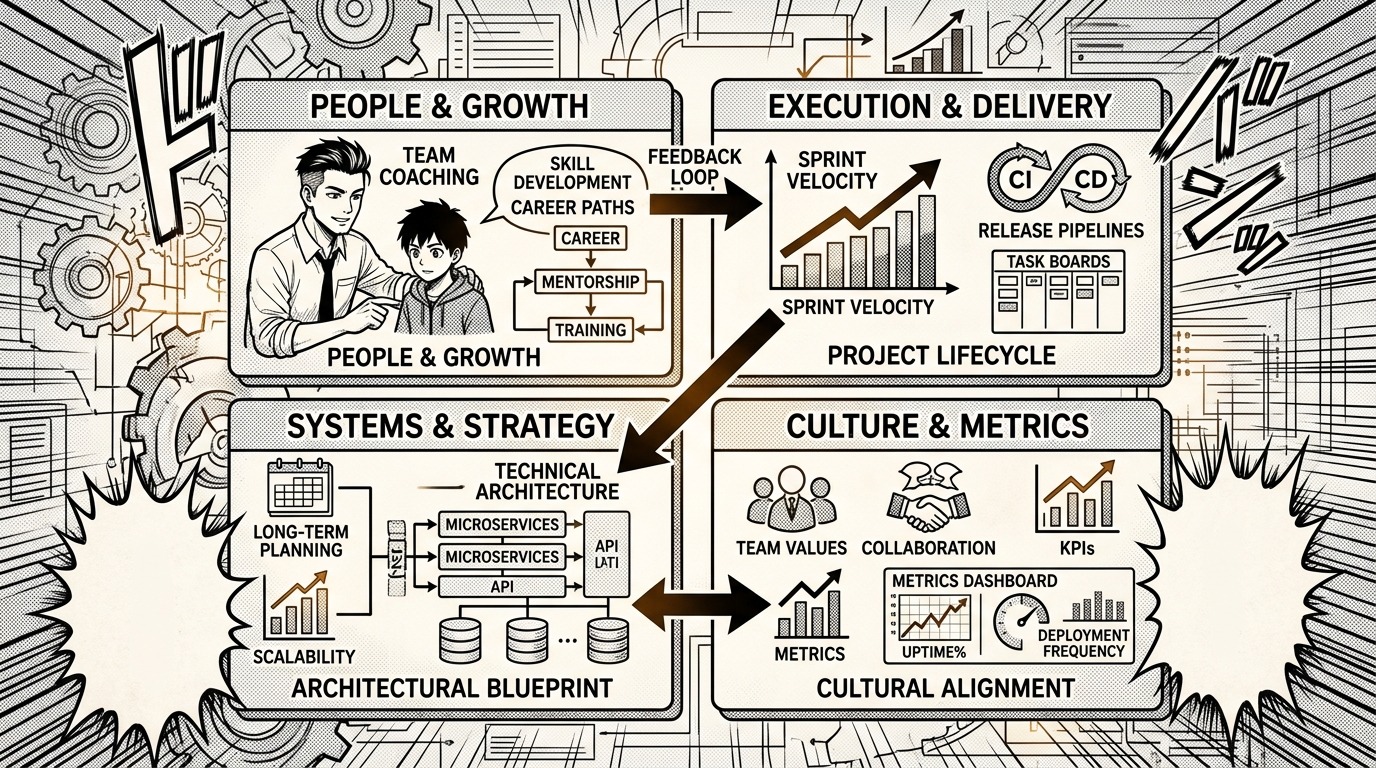
Understanding these four dimensions ensures you never give a one-dimensional answer:
- People & Growth (The Multiplier Engine): Your philosophy on 1-on-1s, mentorship, performance management, retention, career growth ladders, and addressing underperformance.
- Execution & Delivery (The Operational Engine): How you manage agile sprint cycles, trade off technical debt against product roadmaps, manage unforeseen delivery delays, and maintain predictability.
- Systems & Technical Strategy (The Alignment Engine): How you partner with Staff Engineers and Principal Architects, influence technical vision, evaluate risk, and avoid micro-managing technical details.
- Culture & Team Dynamics (The Foundation): How you cultivate psychological safety, mediate high-stakes interpersonal friction, champion diversity and inclusion, and maintain composure through organizational restructuring or severe production crises.
The "I" vs. "We" Balancing Act: The Silent EM Disqualifier
Before diving into specific questions, you must master the fundamental linguistic trap of the EM interview: the tension between collective credit and personal agency.
Junior or hesitant management candidates often overuse "we":
"We decided to migrate the pipeline, and we held daily check-ins to make sure we delivered on time."
Interviewers hearing this cannot discern whether you led the initiative, observed it passively, or actively hindered it. Conversely, dictatorial candidates overuse "I":
"I redesigned the database schema, I told the engineers what tasks to take, and I completed the sprint on time."
This signals an autocratic micro-manager who has failed to delegate.
The winning pattern is the Leader-Initiator Synthesis:
- Use "I" to describe your personal diagnosis, managerial decisions, coaching actions, and organizational interventions.
- Use "We" or "The team" to celebrate collective technical delivery, architectural brainstorming, and team milestones.
+-------------------------------------------------------------------------------+
|                      The EM Communication Balance                             |
+------------------------------------+------------------------------------------+
|  Overusing "We" (Passive)          |  Leader-Initiator Synthesis (Target)     |
+------------------------------------+------------------------------------------+
| "We decided to put the engineer on | "I noticed the engineer missing two      |
| a PIP, and we saw improvements."   | consecutive sprint milestones. I audited |
|                                    | their PR cycle time, initiated a weekly  |
|                                    | coaching plan, and partnered with HR to  |
|                                    | establish unambiguous measurable goals." |
+------------------------------------+------------------------------------------+
Category 1: People Management & Coaching Questions
People management forms 40% to 50% of any engineering management evaluation rubric. Hiring directors look for managers who treat coaching as an active daily discipline rather than an annual review ritual.
1. "How do you handle a consistently underperforming software engineer?"
What Interviewers Are Really Looking For
Interviewers want to see whether you distinguish between skill deficits, motivational issues, and external blockers. They look for early detection, radical candor paired with psychological safety, structured documentation, and fair accountability.
Key Traps to Avoid
- Waiting until quarterly performance reviews to bring up issues.
- Immediately escalating to Human Resources or placing someone on a Performance Improvement Plan (PIP) without prior informal coaching.
- Blaming the individual without examining internal onboarding friction or unclear task requirements.
Battle-Tested Sample Answer Outline
Situation: At my previous company, a Mid-Level Full-Stack Engineer who had historically performed well experienced a sharp 40% drop in pull request velocity and began missing sprint commitments over a 6-week window.
Task: As their manager, I needed to identify the root cause, establish clear expectations, and help them either regain baseline performance or execute a formal performance path without disrupting team morale.
Action: Rather than waiting for the bi-annual review, I brought the issue up directly during our next weekly 1-on-1. I grounded the conversation in objective observations: "I noticed your PR review turnaround time has doubled from 18 hours to 44 hours, and two critical feature branches missed their target release dates. What challenges are you experiencing right now?"
The engineer initially expressed frustration with ambiguous requirements from our product partner, but deeper active listening revealed they felt overwhelmed by sudden family health issues and felt isolated working remotely on our new microservice codebase.
I took a three-pronged corrective approach:
- Immediate Workload Calibration: I temporarily adjusted their on-call rotation schedule and paired them with a Senior Engineer on a well-scoped refactor to reduce cognitive load and isolation.
- Clear 30-Day Recovery Plan: I documented 3 specific, measurable weekly objectives: breaking work into sub-300-line PRs, attending daily standup async updates, and completing tickets within estimated story points.
- Weekly Progress Checkpoints: We reviewed objective dashboard metrics every Monday morning to maintain transparent alignment.
Result: Within 4 weeks, the engineer's PR cycle time decreased by 55%, and they successfully delivered a key customer-facing export service ahead of schedule. More importantly, it re-established mutual trust. Had performance not improved, I had already established clear, documented evidence to collaborate with HR on a formal PIP, ensuring fairness for both the individual and the team.
When managing newer teammates who struggle during their first career steps, adapting your managerial cadence is essential. Review our insights on junior developer interview questions and coaching strategies to understand how to structure early career mentorship loops.
2. "How do you manage a high-performing engineer with a toxic or dismissive attitude?"
What Interviewers Are Really Looking For
Can you hold the line on team culture when someone delivers strong technical output? Organizations know that a single "brilliant jerk" demoralizes five other engineers and triggers turnover.
High-Impact Tactics to Emphasize
- Acknowledge their technical strengths without giving them a pass on interpersonal behavior.
- Clearly define performance as
Performance = Technical Output × Team Citizenship. If citizenship is zero, overall contribution is zero. - Tie code review etiquette, inclusive meeting behavior, and collaborative design reviews directly to compensation and promotion rubrics.
Category 2: Navigating High-Stakes Conflict & Architectural Stalemate
Technical disagreements are healthy in engineering teams. Toxic deadlocks and passive-aggressive silences are not. In an em leadership interview, interviewers probe how you turn ideological disputes into productive architectural consensus.
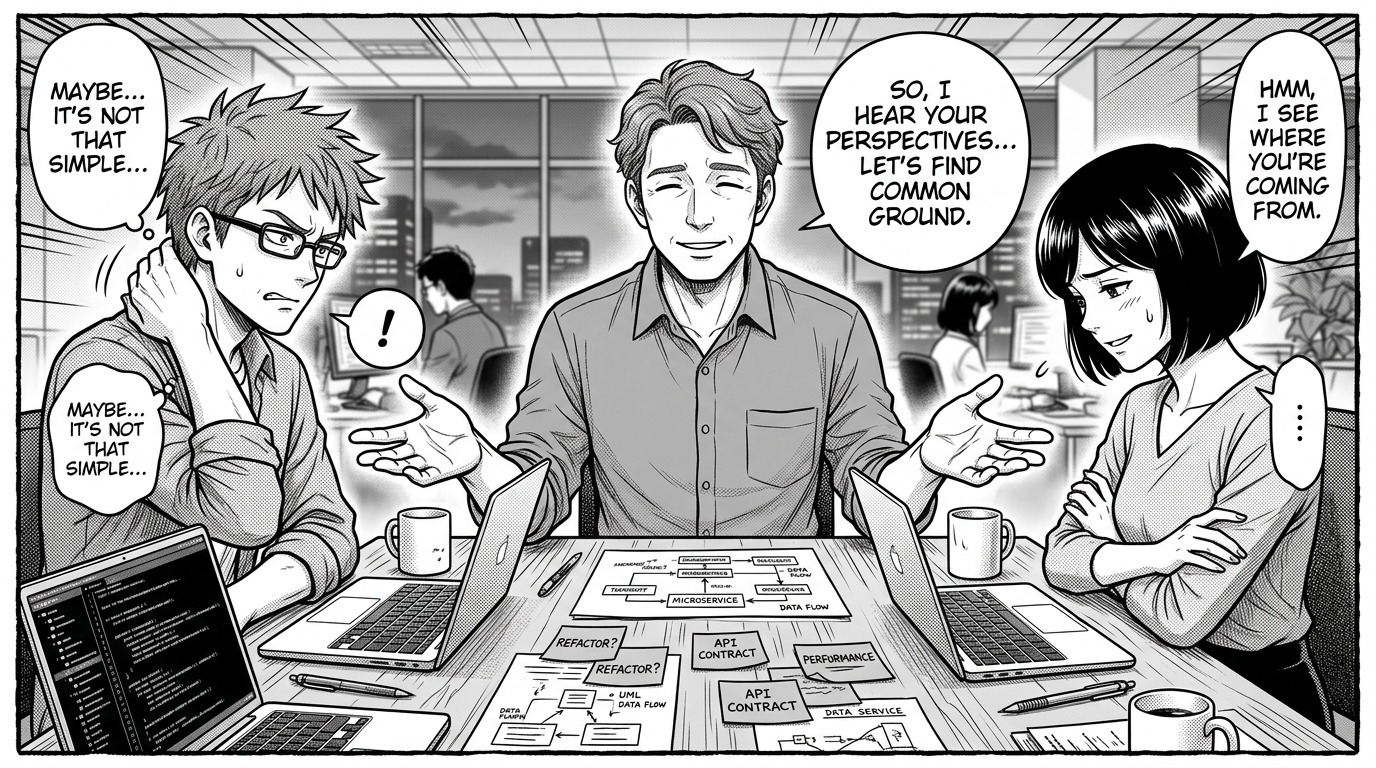
3. "Tell me about a time two senior engineers vehemently disagreed on technical direction. How did you resolve it?"
What Interviewers Are Really Looking For
Do you step in as the authoritarian decider and write the architecture yourself? Or do you create an objective decision framework that empowers engineers while preserving team cohesion?
Framework: The RFC & Decision Matrix Protocol
When senior team members clash over technologies—such as event-driven messaging vs. synchronous gRPC calls—effective engineering managers institute an objective evaluation protocol:
- Decouple the Ego from the Idea: Move debates from Slack or meetings into an asynchronous Request for Comments (RFC) document.
- Define Shared Evaluation Criteria: Agree on explicit scoring criteria (operational overhead, latency SLA, developer onboarding curve, cloud infrastructure cost, rollback complexity) before evaluating solutions.
- One-Way vs. Two-Way Door Classification: Determine if the decision is easily reversible (two-way door) or irreversible with heavy capital expenditure (one-way door).
- Disagree and Commit: If consensus cannot be reached, the manager makes the final call based on the matrix, ensuring all parties publicly commit to the chosen path.
When discussing interactions with high-level individual contributors, demonstrating an understanding of staff-level scope is vital. Review our comprehensive guide on staff engineer system design interview approaches to articulate how EMs and Staff Architects divide strategic responsibilities.
Category 3: Execution, Deadlines, and Technical Debt
Engineering managers are held accountable for delivery predictability. Questions in this track evaluate how you handle real-world turbulence when estimates fail, scope creeps, or legacy code breaks.
4. "What do you do when a high-visibility project is 3 weeks behind schedule?"
The Iron Triangle of Engineering Management
When delivery timelines slip, an inexperienced manager attempts to push the team harder through weekend overtime. Seasoned managers rely on the project management triangle: Scope, Time, and Resources.
                   [ TIME / DEADLINE ]
                           /\
                          /  \
                         /    \
                        /      \
                       /        \
                      /          \
   [ QUALITY / SLA ] /____________\ [ SCOPE / FEATURES ]
Step-by-Step Response Strategy
- Never Compromise Quality/Testing: Cutting unit tests or skipping automated staging deployments always creates production incidents that slow future velocity.
- Perform Root-Cause Work breakdown: Audit the remaining work. Is the delay due to unexpected technical complexity, third-party API dependencies, or scope creep?
- De-Scope to a Minimum Viable Release (MVR): Collaborate with your Product Manager to identify the 20% of features that deliver 80% of customer value. Push nice-to-have items to Phase 1.1.
- Proactive, Early Stakeholder Communication: Notify leadership and dependent teams the moment a date is at risk. Never hide a delay until the eve of launch.
5. "How do you justify technical debt refactoring to business stakeholders who only care about feature velocity?"
Hiring executives love this question because it tests whether you speak the language of business. If you argue that "the code is ugly and needs a clean rewrite," you will lose.
Instead, frame technical debt in commercial financial terms:
- Velocity Drag: "Our current monolithic billing module requires 4 days of manual regression testing per release cycle. Refactoring this module saves 32 engineering hours every sprint, equating to an additional $120,000 in saved engineering capacity annually."
- Reliability & Churn Risk: Frame unpatched dependencies or database query deadlocks around uptime SLAs and customer retention risks.
- The 80/20 Maintenance Rule: Institutionalize dedicating 15% to 20% of every sprint's capacity to stability, reliability, and developer tooling so that massive, multi-quarter rewrite projects never become necessary.
When unexpected blockers happen in production or during interviews, maintaining your composure is essential. See our field manual on handling situations when you don't know the answer to handle unpredictable interview twists with executive presence.
Category 4: Hiring, Team Topologies, and Culture
A core responsibility of an engineering manager is scaling the organization sustainably. Interviewers want to understand your philosophy on talent acquisition and organizational design.
6. "How do you design a technical interview process that evaluates competence without introducing bias?"
Hiring pipelines frequently suffer from cargo-culting: asking esoteric brainteasers or niche trivia questions that bear no resemblance to daily engineering reality.
Strong EM candidates emphasize:
- Role-Calibrated Rubrics: Clear grading rubrics with concrete behavioral and technical anchors for Junior, Mid, Senior, and Staff levels.
- Practical, Domain-Relevant Assessments: Replacing artificial whiteboard puzzles with realistic code reviews, API design sessions, or system architecture debugging.
- Interviewer Training & Shadowing: Requiring engineers to reverse-shadow experienced interviewers before conducting independent evaluations to ensure consistent candidate calibration.
- Candidate Experience Focus: Treating candidates as potential brand ambassadors, ensuring timely feedback and respectful dialogue.
Comparing managerial interview standards across business units also broadens your perspective; see how functional leaders approach talent acquisition in our breakdown of marketing manager interview frameworks.
The STARR-L Response Structure for Engineering Leadership
Standard STAR (Situation, Task, Action, Result) is designed for individual contributors. For engineering managers, you must upgrade your narrative arc to STARR-L:
+-------------------------------------------------------------------------------+
|                      The EM STARR-L Architecture                              |
+-------------------------------------------------------------------------------+
| S - Situation   | Set context concisely: team size, tech stack, business stake.|
| T - Task        | Define the organizational or technical challenge clearly.   |
| A - Action      | Focus 60% on your specific managerial decisions & coaching. |
| R - Result      | Provide quantifiable metrics: velocity, latency, retention. |
| R - Reflection  | What went well? What unexpected friction occurred?          |
| L - Learnings   | What permanent process or team norm did you institute?      |
+-------------------------------------------------------------------------------+
Why Reflection and Learnings Win Offers
Executive interviewers know that real leadership is messy. If your behavioral stories always depict a smooth triumph where everyone happily agreed and the project launched flawlessly, interviewers suspect you are either exaggerating or oblivious to team friction.
Adding a thoughtful reflection demonstrates organizational humility:
"Looking back, while we met the Q3 deadline, I realized that communicating the architectural shift via Slack caused unnecessary anxiety among the junior engineers. Following that milestone, I instituted monthly architectural open-office hours so the team can voice concerns in a live, low-pressure forum."
Integrating behavioral storytelling into your broader prep curriculum is critical; review our complete roadmap in the complete guide to technical interview prep for comprehensive timeline planning.
Engineering Manager Leadership Competency Matrix
Before your interview loop, audit your behavioral repertoire across this 10-point competency matrix to ensure you have at least two distinct, verified stories for every area:
| Competency Area | Core Question Example | What Interviewers Evaluate |
|---|---|---|
| Coaching & Retention | "Tell me about an engineer you mentored from Mid to Senior." | Growth frameworks, intentional sponsorship, retention. |
| Performance Management | "Walk me through a difficult termination or PIP process." | Compassion, clear documentation, legal compliance, team protection. |
| Delivery Predictability | "How do you calculate sprint velocity and avoid burn-out?" | Capacity planning, scope trimming, sustainable engineering pace. |
| Cross-Functional Alignment | "Tell me about a disagreement you had with a Product Director." | Empathy for business metrics, constructive negotiation, compromise. |
| Crisis Management | "How did you lead your team through a Sev-0 production incident?" | Composure under fire, blameless postmortems, systemic root cause fixes. |
| Hiring & Calibration | "How do you calibrate interviewers who grade too strictly or too leniently?" | Process governance, objective scoring rubrics, hiring culture. |
| Technical Strategy | "When should an EM veto an architectural choice made by the team?" | Delegation vs. oversight, business risk assessment, tech governance. |
| Culture & Diversity | "How do you foster psychological safety on a distributed team?" | Inclusive meeting norms, async practices, psychological safety. |
| Change Management | "How did you lead your engineers through a major company pivot or re-org?" | Resiliency, transparent communication, context sharing. |
| Resource Allocation | "How do you balance tech debt, customer bugs, and net-new features?" | Strategic prioritization, executive communication, capacity modeling. |
Transforming Preparation into Performance: Realistic Simulation
The most frequent mistake management candidates make is preparing in silence: writing bullet points in a document and assuming their managerial presence will naturally translate into high-stakes interviews.
In reality, engineering management behavioral interviews are dynamic dialogues filled with challenging follow-up probes:
- "Why didn't you step in earlier?"
- "What would you have done if the VP of Product refused your de-scoping request?"
- "How did the other engineers on the team react when you reassigned that feature?"
Without active simulation, candidates stumble under pressure, revert to technical jargon, or fail to substantiate their results with clear metrics.
Practice Dynamic EM Scenarios with AI
To build genuine fluency and executive presence, leverage the AI-powered mock interview engine at totop.app. With job-tailored interview personas, you can:
- Engage in Adaptive Behavioral Drills: Experience realistic managerial interview rounds with intelligent follow-up questions tailored to your specific engineering management background.
- Receive Instant Feedback on Leadership Rubrics: Get scored on your communication balance (the "I" vs. "We" ratio), empathy, decision-making clarity, and conflict resolution maturity.
- Refine Your Executive Presence: Practice articulating complex architectural trade-offs and team interventions in real-time, eliminating verbal filler and structuring crisp STARR-L narratives.
Final Checklist: What to Review Before Your EM Interview Loop
Before stepping into your management rounds, verify your readiness with this tactical pre-interview checklist:
- Quantified Achievements: Do you have exact metrics memorized for your key stories? (e.g., "reduced incident MTTR by 35%," "scaled team from 4 to 12 with 0% regrettable attrition," "shipped microservice processing 40M daily events").
- Two Vulnerable Stories: Have you prepared genuine stories of past projects that failed, deadlines that slipped, or mistakes you made as a manager, accompanied by deep lessons learned?
- Staff / Principal Partnership: Can you articulate your exact relationship with your Staff+ engineers, demonstrating that you lead people and roadmap alignment while empowering them to own deep system design?
- Questions for Your Interviewers: Have you prepared thoughtful questions that evaluate their engineering culture? (e.g., "How does your executive leadership team balance quarterly product commitments against foundational platform investments?").
Mastering the engineering manager leadership questions is not about presenting a flawless persona. It is about demonstrating that you are a thoughtful, empathetic, and accountable organizational leader who builds resilient systems, empowers people to do their best work, and delivers business value consistently.
Practice Product & Engineering Lead Questions Live with AI Mock Interviews
Turn any job description across Engineering, DevOps, Data, Marketing, Sales, Finance, or HR into a personalized test and live voice or text AI mock interview on totop.app, or test your speed right now in the 60-Second Product & Engineering Lead Blitz.
Play 60s Product & Engineering Lead Blitz (Free, No Login) | Start 14-Day Free Trial | Browse All Interview Guides