Sales Interview Questions: The Ultimate Prep Guide

If you are preparing for a sales interview, let's get one thing straight: the era of the fast-talking, slick-backed recruiter pitch is officially over.
I remember my very first sales interview. I walked in with my suit freshly pressed, a memory full of generic closing techniques, and a massive amount of unearned confidence. Ten minutes in, the hiring manager cut off my rehearsed elevator pitch and asked a simple question: "What is the difference between a client who has a budget problem and a client who has a priority problem?"
I froze. I had no idea. I tried to talk my way out of it with some buzzwords about "creating value," but he saw right through it.
That was the day I learned that modern sales isn't about having the loudest voice in the room or the quickest tongue. It is about discovery, diagnosis, and business acumen. Whether you are applying for an entry-level Sales Development Representative (SDR) position or preparing for Account Executive interview questions, hiring managers are looking for structured thinkers who treat sales like a science, not a gamble.
In this guide, we will break down the exact sales interview questions you will face, the psychology behind what interviewers are actually looking for, and how to structure your answers so you leave no doubt that you can hit your quota.
The Core Blueprint: Selling the Funnel
Before you answer any individual question, you need to show the interviewer that you understand the mechanics of a modern sales pipeline. Every question they ask is designed to test your competence at a specific stage of the sales funnel.
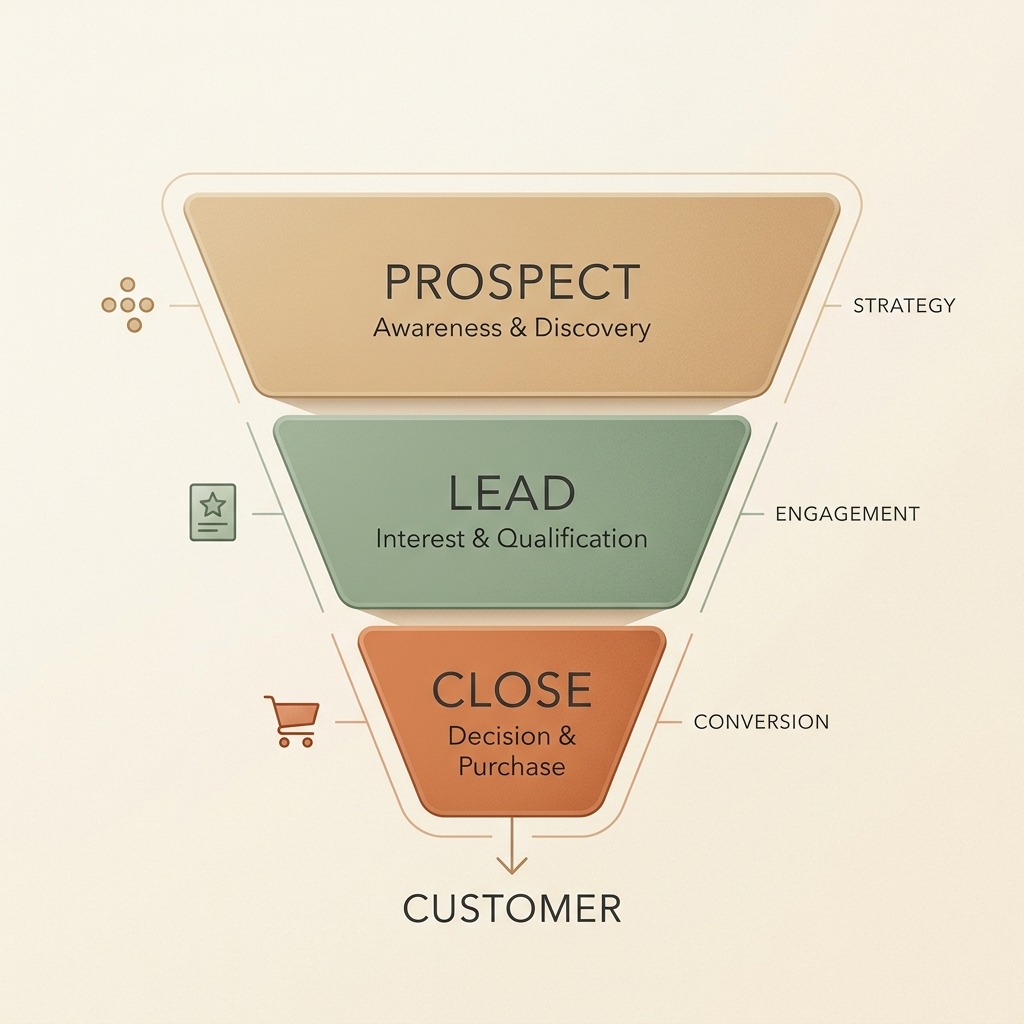
- Top of the Funnel (Prospecting & Discovery): Can you identify the right buyers, get them on the phone, and diagnose their actual business pain points?
- Middle of the Funnel (Engagement & Pitching): Can you tie your product's features directly to the problems you uncovered in discovery, or do you just give generic feature presentations?
- Bottom of the Funnel (Objection Handling & Closing): Can you navigate complex buying committees, handle budget objections, and guide a prospect across the finish line without dropping your price?
If you frame your answers around these three stages, you show that you don't just "sell"—you manage a business pipeline.
1. The Discovery and Diagnosis Questions
In modern sales, discovery is 90% of the game. If you get discovery right, the pitch writes itself. Interviewers want to see how you dig for pain.
Question: "How do you prepare for a discovery call with a high-value prospect?"
What they are really asking: Do you actually do research, or do you just show up and wing it?
How to answer: Walk through your structured research routine. Mention the specific tools you use (LinkedIn, company financial reports, recent press releases) and the specific triggers you look for (new executive hires, product launches, or funding rounds).
Sample Answer:
"I never go into a discovery call cold. First, I spend 15 minutes researching the prospect's LinkedIn profile to find any shared connections, past companies, or recent posts they've shared to find a warm angle.
Next, I look at the company's website and recent press releases. I want to know: Did they just raise a round? Are they expanding into a new territory?
Finally, I prepare three highly tailored, open-ended questions designed to uncover their current friction points. For example, if I see they are hiring heavily in customer support, my question might be: 'I noticed you're scaling your support team. How are you maintaining resolution times during this growth spike?' This shows the prospect I actually understand their business before we even start talking."
2. Nailing the Pitch and Objecting-Handling
This is where most candidates fall apart. They get an objection, panic, and immediately offer a discount or start arguing.

Question: "A prospect tells you, 'Your product looks great, but we just don't have the budget for this right now.' What do you do?"
What they are really asking: Do you crumble under pressure, or do you know how to isolate and handle objections?
How to answer: Never argue. Instead, validate the concern, isolate the objection to ensure budget is the only blocker, and then pivot to value or timeline.
Sample Answer:
"I start by validating their situation. I'll say: 'I completely understand. Budget is always a top priority, especially this quarter.'
Then, I isolate the objection. I need to know if it's truly a money issue or if they just don't see the value. I'll ask: 'Hypothetically, if budget weren't an issue, is this a solution you believe would solve your team's tracking problem?'
If they say yes, then we have a priority problem, not a budget problem. I'll pivot back to the cost of inaction: 'If we don't address the tracking issues now, how much is that manual leak costing you in engineering hours over the next six months?' By showing that doing nothing actually costs more than the software, the budget objection usually resolves itself."
3. The Classic Test: "Sell Me This Pen"
Almost every sales interview features some variation of this role-play.
The biggest mistake: Immediately describing the pen. "This is an amazing pen. It has blue ink, writes smoothly, and looks very professional." Congratulations, you just failed the test. You're pitching before you know if the buyer even needs a pen.
The winning strategy: Start by asking questions. Turn the table and run a mini-discovery session.
Sample Answer:
"Instead of telling you how great the pen is, I'll turn it around:
'How long have you been looking for a new writing instrument?' 'What do you typically use a pen for—signing contracts, jotting down quick notes, or sketching ideas?' 'What is the most frustrating thing about the pens you currently use? Do they bleed, run out of ink, or feel uncomfortable?'
Once you tell me that you sign high-value contracts and hate when ink smudges on important documents, I have my angle. Now, I pitch: 'Since you're signing six-figure deals and need a reliable, smudge-proof signature every single time, this is the exact pen you need. It uses fast-drying archive-grade ink designed specifically for legal contracts. Shall we get this set up for you?'"
How to Prepare for Behavioral Questions (The STAR Method)
Hiring managers love asking: "Tell me about a time you missed your quota" or "Describe a deal you lost and what you learned."
When answering these, use the STAR method (Situation, Task, Action, Result) but add a sales-specific spin: Metrics. Always talk in numbers.
- Situation: Set the scene (e.g., "Last Q3, my target was 20k ARR, but we lost a major champion mid-deal").
- Task: Explain the challenge you had to overcome.
- Action: Describe the specific, proactive steps you took to salvage the quarter.
- Result: Share the final outcome and the data to back it up (e.g., "I closed three smaller deals to hit 104% of quota").
Elevating Your Sales Interview Prep
Practice makes perfect. Rehearsing in front of a mirror or reading blog posts can only get you so far. You need interactive, real-time feedback to handle objections smoothly and build muscle memory.
That is where totop.app comes in. You can generate custom mock interview scenarios for any sales role—from SaaS Account Executives to Enterprise Relationship Managers. Our AI interview agent behaves like a real, demanding prospect or hiring manager, giving you the realistic practice you need to handle high-pressure questions with confidence.
Give it a spin before your next round, and go close that offer.