Talent Acquisition Interview Questions: 2026 Guide

The landscape of corporate recruiting has evolved far beyond traditional keyword searches, posting job ads on generic boards, and sending repetitive cold emails. In 2026, high-performing Talent Acquisition (TA) Specialists, Lead Recruiters, and Sourcing Managers act as strategic business advisors. Organizations rely on talent teams to analyze labor market dynamics, structure bias-free candidate evaluations, partner closely with demanding hiring leaders, and safeguard employer brand reputation across every candidate touchpoint.
When interviewing for a talent acquisition or recruiting role today, executive panels assess whether you can operate as a data-driven talent consultant. Hiring directors want to know how you diagnose stalled hiring funnels, push back on unrealistic candidate profiles, leverage artificial intelligence ethically, and close top-tier talent in competitive markets.
Whether you are preparing for a Corporate Recruiter, Senior Talent Acquisition Specialist, Technical Recruiter, or Talent Acquisition Manager interview, this comprehensive guide covers the most critical talent acquisition interview questions, tactical answering frameworks, and data-backed sample responses.
The Modern Talent Acquisition Lifecycle
Before analyzing specific interview questions, it is critical to frame your responses around the end-to-end recruitment lifecycle. Top hiring teams do not evaluate recruiters solely on raw headcount numbers; they measure process rigor, candidate experience, and long-term retention quality.
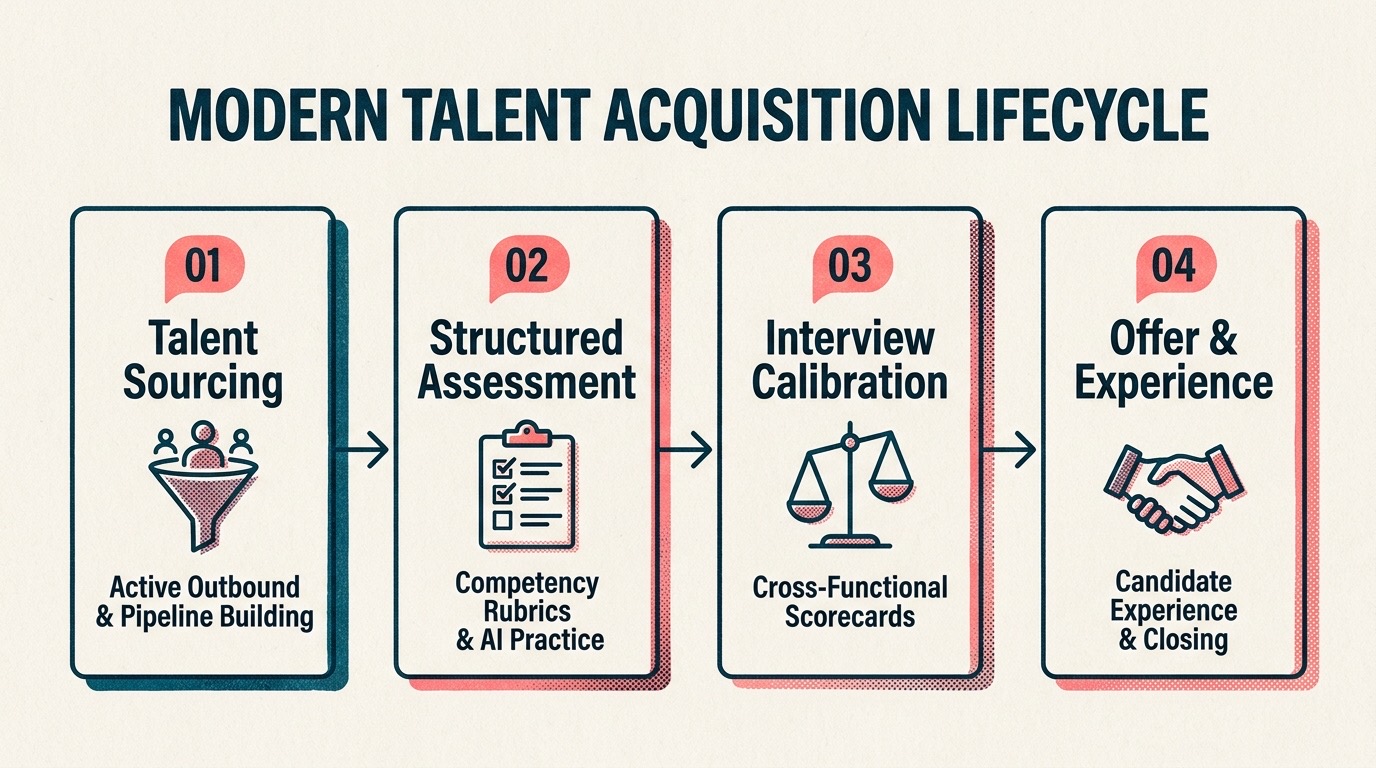
As shown in the framework above, modern talent acquisition comprises four tightly integrated phases:
- Strategic Sourcing & Talent Mapping: Identifying passive talent pools, analyzing competitor compensation benchmarks, and building proactive nurture pipelines before requisitions open.
- Structured Competency Assessment: Replacing vague "culture fit" impressions with objective scorecards, standardized rubric-driven screens, and skills calibration.
- Stakeholder Alignment & Interview Loops: Training interview panels, establishing clear focus areas for each interviewer round, and running decisive debrief sessions.
- Candidate Experience & Closing: Maintaining transparent communication, pre-closing candidates on compensation and role scope, and navigating counteroffers effectively.
When you answer questions throughout your interview, anchor your responses to these four phases to demonstrate strategic maturity rather than transactional coordination.
1. Sourcing, Pipeline Architecture & Market Mapping Questions
Question 1: "How do you build a predictable outbound pipeline for highly competitive or niche roles?"
What the Interviewer Is Really Asking: Can you generate your own pipeline when inbound applicant flow is low, or do you rely entirely on job board applications? The panel wants to understand your sourcing methodologies, boolean search sophistication, and talent engagement tactics.
Key Concepts to Demonstrate:
- Market Mapping: Analyzing talent density across target companies, geographies, and relevant technology stacks.
- Multi-Touch Outreach Sequences: Crafting personalized, value-oriented messaging across multiple channels (email, professional networks, industry communities) rather than generic templates.
- Talent Communities: Nurturing silver-medalist candidates and keeping warm leads engaged over six- to twelve-month horizons.
Sample High-Impact Response:
"When kicking off a search for a niche role—such as a distributed systems architect or enterprise sales executive—I never rely solely on inbound applicants. I start with an intake calibration session with the hiring manager to define non-negotiable core competencies versus nice-to-have qualifications.
Next, I build a market map of peer organizations, growth-stage competitors, and adjacent talent pools. I construct targeted boolean and semantic search strings to identify candidates with demonstrated experience in those environments. For outreach, I craft personalized three-touch messaging sequences that highlight concrete organizational impact, specific engineering challenges, and growth trajectory rather than copying bullet points from the job description.
By tracking response rates and conversion milestones weekly, I maintain an outbound funnel that reliably delivers three to four qualified candidates to the first interview stage every week, ensuring the hiring team never stalls."
Question 2: "When inbound applicant volume is overwhelming but largely unqualified, what immediate tactical adjustments do you make?"
What the Interviewer Is Really Asking: How efficiently do you protect your time and prevent recruiting bottlenecks? Can you optimize screening workflows without alienating job seekers?
Key Concepts to Demonstrate:
- Intake & Job Description Refinement: Clarifying specific prerequisites and must-have credentials on the public job posting.
- Pre-Screening Criteria: Introducing clear qualifying questions in the application form to filter for core requirements.
- Workflow Automation: Leveraging automated candidate routing and polite rejection notifications so applicants receive timely updates.
Sample High-Impact Response:
"High applicant volume paired with low relevance indicates a mismatch between the job posting signals and market interpretation. My first step is reviewing the public job description to ensure minimum qualifications, compensation parameters, and core prerequisites are prominently stated at the very top.
Simultaneously, I introduce three to four targeted qualifying screening questions in the Applicant Tracking System (ATS)—such as authorization status, mandatory tooling proficiency, or required domain experience. This immediately filters out out-of-scope applications.
For candidates who do not meet baseline thresholds, I ensure an automated, courteous communication is triggered within 48 hours to preserve our employer brand. I then shift my active focus to proactive outbound sourcing and calibrated candidate reviews."
2. Structured Assessment & Behavioral Evaluation Questions
Question 3: "How do you design structured competency interviews to mitigate unconscious hiring bias?"
What the Interviewer Is Really Asking: Do you evaluate talent through objective, repeatable frameworks, or do you rely on subjective intuition? In modern organizations, structured interviewing is the gold standard for diversity, equity, and hiring accuracy.
Key Concepts to Demonstrate:
- Rubric-Driven Scorecards: Defining behavioral anchor scales (e.g., 1 to 5) with concrete behavioral examples for each rating level.
- Standardized Question Banks: Asking every candidate the same core competency questions in the same sequence.
- STAR / CAR Probing: Guiding candidates to share Situation, Task, Action, and Result to evaluate real-world past performance.
Sample High-Impact Response:
"Mitigating unconscious bias requires eliminating ambiguity before the first candidate interview takes place. I work with the hiring team to isolate three to five core competencies essential for success in the role—for instance, problem-solving under ambiguity, stakeholder influence, and cross-functional execution.
For each competency, we draft standardized behavioral questions and construct an evaluation rubric with explicit anchors: what does a novice, competent, and advanced answer look like? During the interview, every candidate is asked the same core questions in the same order.
I also train interviewers to take verbatim notes during the conversation and postpone rating candidates until after the interview concludes. When debriefing, we review evidence-based notes against the rubric rather than debating vague impressions or cultural fit."
Question 4: "Tell me about a time a hiring manager wanted to reject a qualified candidate based on a 'gut feeling'. How did you handle it?"
What the Interviewer Is Really Asking: Can you advocate for candidates and challenge leadership constructively using objective data? This behavioral question assesses your diplomatic influence and commitment to fair hiring practices.
Key Concepts to Demonstrate:
- Curiosity Over Confrontation: Asking clarifying questions to understand what prompted the manager's hesitation.
- Focus on Evidence: Anchoring the conversation back to the agreed-upon competency rubric.
- Collaborative Problem-Solving: Suggesting focused follow-ups or reference checks if genuine uncertainty remains.
Sample High-Impact Response:
"In a previous role, an engineering director wanted to reject a senior candidate after a final loop, citing that the candidate 'didn't feel assertive enough for our culture.' The candidate had scored exceptionally high on technical architecture, system design, and coding execution.
Rather than disagreeing directly, I referenced our initial kickoff rubric and asked the manager to walk me through the specific questions where assertiveness was tested. We examined the candidate's interview notes, which showed clear examples of successfully leading complex migrations and managing technical conflict across distributed teams. The candidate simply had a thoughtful, calm communication style rather than a loud one.
I pointed out that confusing extroversion with leadership capability would exclude strong technical leaders. The director acknowledged the bias, agreed to review the candidate's scorecard objectively, and we moved forward with an offer. That hire went on to become one of the team's highest-performing technical leads."
For deeper insights into navigating delicate conversations when evaluations feel uncertain, review our guide on when you don't know the answer and how to handle it gracefully.
3. Stakeholder Management & Hiring Manager Partnership Questions
Question 5: "How do you partner with a hiring manager who has unrealistic expectations—the proverbial 'purple squirrel' search?"
What the Interviewer Is Really Asking: Are you an order-taker who blindly accepts impossible job requirements, or do you act as a consultative partner who coaches hiring managers toward realistic market solutions?
Key Concepts to Demonstrate:
- Talent Intelligence & Market Data: Presenting compensation distributions, talent availability numbers, and candidate supply curves.
- Trade-Off Matrix: Helping managers prioritize non-negotiable capabilities versus skills that can be developed on the job.
- Calibration Candidates: Reviewing real anonymized profiles early in the search to align on realistic talent profiles.
Sample High-Impact Response:
"When a hiring manager presents a wish list that doesn't exist in the open market—such as eight years of production experience in a technology that has only existed for four, alongside below-market compensation—I approach the conversation as an advisor armed with talent intelligence.
Within the first 72 hours of the intake call, I source five to eight anonymized calibration profiles across a spectrum: Profile A has the exact domain background but requires higher compensation; Profile B has strong adjacent skills and proven learning velocity within budget; Profile C has the technical depth but less leadership tenure.
We review these profiles together to establish a trade-off matrix. I show them live market data on candidate supply and median compensation benchmarks. This helps the hiring manager realize what the market actually looks like and allows us to recalibrate the job profile toward realistic hiring criteria before wasting weeks on an impossible search."
If you frequently collaborate with leadership on executive searches, our breakdown of leadership questions in engineering manager interviews offers valuable context on how senior leaders evaluate management competency.
Question 6: "How do you orchestrate interview loops to eliminate repetitive questions and keep interviewers aligned?"
What the Interviewer Is Really Asking: Do your candidate loops run smoothly, or do candidates experience five consecutive rounds of identical introductory chats? Interview orchestration directly affects candidate satisfaction and evaluation completeness.
Key Concepts to Demonstrate:
- Role & Competency Division: Assigning distinct focus areas to each interviewer on the panel.
- Pre-Loop Briefings: Ensuring all interviewers understand their specific evaluation criteria before meeting the candidate.
- Structured Debriefs: Moderating post-interview meetings where feedback is gathered systematically without peer influence.
Sample High-Impact Response:
"Unorganized interview loops frustrate candidates and result in shallow, redundant data. To prevent this, I build an interview matrix during requisition setup where each interviewer is assigned an exclusive focus area.
For example, in an enterprise sales search, Interviewer 1 evaluates prospecting and discovery mechanics; Interviewer 2 assesses deal qualification and pipeline management; Interviewer 3 evaluates executive presentation and negotiation; and the executive round focuses on strategic alignment and cultural values.
I host a brief five-minute alignment sync before the loop begins to confirm everyone knows their focus competency. After all rounds conclude, I require independent scorecards to be submitted in the ATS before opening the joint debrief. This guarantees comprehensive evaluation coverage and prevents interviewers from anchoring to each other's opinions."
4. Recruiting Metrics & Funnel Health Questions
Question 7: "What key recruiting metrics do you monitor weekly, and how do they inform your decisions?"
What the Interviewer Is Really Asking: Do you understand recruiting operations from an analytical perspective? Can you translate funnel conversion rates into business outcomes?
Key Concepts to Demonstrate:
- Pass-Through Rates: Conversion efficiency between each consecutive stage of the recruiting pipeline.
- Time-to-Fill vs. Time-to-Hire: Measuring total requisition open days versus active candidate velocity through the pipeline.
- Offer Acceptance Rate (OAR): Gauging competitive positioning, compensation alignment, and candidate engagement.
- Candidate Net Promoter Score (cNPS): Measuring applicant and candidate satisfaction across all stages.
| Recruiting Metric | Target Benchmark | Diagnostic Signal if Underperforming |
|---|---|---|
| Recruiter Screen to Manager Screen | 75% – 85% | Recruiter and hiring manager intake alignment is disconnected. |
| Manager Screen to Onsite/Final Loop | 50% – 65% | First-round technical or domain screening lacks depth. |
| Final Loop to Offer Stage | 30% – 50% | Interview panel lacks shared evaluation standards or clear rubrics. |
| Offer Acceptance Rate (OAR) | ≥ 85% | Compensation misalignment, slow offer turnaround, or poor pre-closing. |
| Candidate NPS (cNPS) | +50 or higher | Lack of communication, ghosting, or disorganized interview loops. |
Sample High-Impact Response:
"I manage my requisitions like a sales pipeline, tracking five core conversion metrics weekly: stage pass-through rates, time-to-hire velocity, sourcing channel return on investment, offer acceptance rate, and candidate NPS.
Rather than looking only at lagging indicators like time-to-fill, I focus heavily on stage conversion ratios. For instance, if my recruiter-to-hiring-manager screen pass rate drops below 70%, it immediately signals that my intake calibration was flawed or the manager's expectations shifted without my knowledge.
If our offer acceptance rate drops below 85%, I immediately examine our compensation benchmarks and review whether we pre-closed candidate salary expectations thoroughly during earlier stages. Data allows me to diagnose problems proactively before requisition timelines slip."
Question 8: "If a hiring funnel shows a severe bottleneck at the hiring manager review stage, how do you resolve it?"
What the Interviewer Is Really Asking: How do you manage accountability with busy hiring managers who delay resume reviews or schedule updates, putting candidate momentum at risk?
Key Concepts to Demonstrate:
- Service Level Agreements (SLAs): Establishing agreed-upon turnaround windows (e.g., 48 hours for profile reviews).
- Batch Review Sessions: Scheduling dedicated working sessions to unblock stuck pipelines.
- Pipeline Data Visibility: Sharing weekly funnel health dashboards with department heads to highlight operational bottlenecks.
Sample High-Impact Response:
"When candidates sit in review stages for more than 48 hours, candidate momentum drops and drop-off rates spike. When I notice a backlog forming, I don't just send email reminders. I book a 15-minute 'live calibration sync' on the manager's calendar.
During that session, we review five to ten pending profiles live on screen. This serves a dual purpose: it clears the queue immediately, and it lets me listen to their real-time reactions to identify why certain profiles were hesitations.
To prevent future bottlenecks, I institute a 48-hour review SLA during kickoff. If a manager consistently misses review deadlines, I share the funnel data with their department leadership to demonstrate how delays directly impact time-to-hire and cost the company top candidates."
5. Offer Negotiation, Closing & Candidate Experience Questions
Question 9: "Walk me through your candidate closing process from the first conversation to an accepted offer."
What the Interviewer Is Really Asking: Do you wait until the end of the hiring process to discuss compensation, location, and counteroffers, or do you manage the closing process iteratively throughout the candidate journey?
Key Concepts to Demonstrate:
- Continuous Pre-Closing: Validating compensation expectations, competing offers, and decision criteria at every stage.
- Handling Counteroffers: Proactively discussing potential counteroffers from current employers before an offer is made.
- The Verbal Offer Call: Presenting the full total compensation package dynamically before sending written paperwork.
Sample High-Impact Response:
"In my experience, closing never happens at the offer stage—it begins during the initial recruiter phone screen. In that first conversation, I establish transparency around our compensation structure, equity, benefits, and remote flexibility. I ask the candidate what factors beyond salary will guide their final career decision.
At every subsequent stage, I check in on competing interviews, timeline changes, and current employer retention efforts. When the team decides to extend an offer, I schedule a verbal offer consultation before generating formal documents.
During that call, I walk through the full compensation model, benefits, and career progression path. I ask directly: 'If we put these exact terms into writing today, are you in a position to sign and accept?' This surfaces any hidden reservations immediately, allowing us to address questions collaboratively and maintain a 90%+ offer acceptance rate."
To see how peer roles manage strategic candidate and employee interactions, review our detailed guide on HR business partner interview questions.
Question 10: "How do you protect candidate experience and company reputation when you must reject the vast majority of applicants?"
What the Interviewer Is Really Asking: Do you treat rejected candidates with dignity, or do you contribute to the industry-wide problem of recruiter ghosting? Candidate experience directly affects consumer trust and future talent attraction.
Key Concepts to Demonstrate:
- Timely & Respectful Feedback: Notifying candidates promptly rather than leaving applications pending indefinitely.
- Constructive Communication: Providing actionable, high-level feedback to candidates who reached final onsite loops when appropriate.
- Talent Community Re-Engagement: Keeping runner-up candidates engaged for future openings.
Sample High-Impact Response:
"Every candidate who applies to our company is a potential future hire, brand advocate, or customer. Ghosting candidates damages employer reputation and causes candidate NPS to plummet.
For candidates who do not advance past the initial application review, I ensure an empathetic, clear automated rejection email is sent within two business days so they aren't left waiting. For candidates who completed an interview round with our team, I personally send a thoughtful email update or schedule a brief phone call.
When runner-up candidates perform well but narrowly miss out on an offer, I schedule a closing touchpoint to thank them, explain how close the decision was, and ask permission to keep them in our priority talent community. Several of my best hires in past companies were previous silver medalists re-engaged six months later."
6. How AI and Automation Are Transforming Talent Acquisition in 2026
Artificial intelligence has fundamentally reshaped recruiting workflows in 2026. Top talent acquisition professionals use automation not to replace human relationships, but to eliminate administrative drudgery so they can spend more time advising hiring managers and engaging candidates.
+-----------------------------------------------------------------------------------+
|               THE 2026 AI-AUGMENTED RECRUITING WORKFLOW                          |
+-----------------------------------------------------------------------------------+
| 1. SOURCING & DISCOVERY    -> AI Semantic Talent Search & Market Intelligence    |
| 2. SCREENING & LOGISTICS   -> Automated Scheduling, ATS Data Hygiene & Routing   |
| 3. CANDIDATE READINESS     -> AI Mock Interviews & Practice Simulations          |
| 4. STRATEGIC EVALUATION    -> Human-Led Competency Interviews & Calibration      |
| 5. CLOSING & ONBOARDING    -> High-Touch Relationship Building & Offer Strategy  |
+-----------------------------------------------------------------------------------+
High-Impact AI Applications in Modern TA:
- Intelligent Sourcing Algorithms: Surfacing passive candidates across diverse platforms by matching semantic project portfolios rather than simple keyword tags.
- Automated Scheduling Assistants: Eliminating multi-day email scheduling delays and reducing recruiter administrative overhead by up to 35%.
- Objective Candidate Preparation: Progressive hiring teams encourage candidates to use AI interview platforms like totop.app to practice mock questions tailored specifically to the job posting. When candidates prepare thoroughly, interview conversations are richer, more substantive, and deliver higher evaluation signal.
To understand broader hiring dynamics across modern technology teams, read our analysis on how AI is changing the hiring process in tech and best practices for remote interview tips and virtual screens.
7. Strategic Questions to Ask Your Interviewer at the End of the TA Interview
At the end of your interview, the questions you ask the panel reflect your strategic perspective as a talent partner. Stand out by asking high-level operational questions rather than basic administrative inquiries:
- "What is the current ratio of inbound applications to outbound sourcing hires across your critical engineering and go-to-market teams?"
- "How are hiring manager interview SLAs tracked here, and how supportive is executive leadership in holding teams accountable to evaluation timelines?"
- "Which stage of your current recruiting funnel exhibits the highest candidate drop-off rate, and what hypotheses does the talent team have regarding the root cause?"
- "How are competencies and scorecards calibrated across interview loops to prevent subjective 'culture fit' hiring bias?"
- "What talent intelligence or recruitment tooling investments is the organization planning to make over the next 12 to 18 months?"
For more strategic closing inquiries across varied seniority levels, explore our curated list of questions you should ask your interviewer.
Practical Preparation Checklist for Your TA Interview
To perform at your best during your upcoming talent acquisition interview, use this structured preparation checklist:
- Quantify Your Historical Impact: Prepare specific metrics on requisitions filled, average time-to-hire, offer acceptance rate, and diversity pipeline growth across your past two years.
- Master Behavioral Answering Structures: Format your stories using Situation, Task, Action, and Result (STAR), focusing on what you specifically executed.
- Prepare One Difficult Stakeholder Story: Be ready to discuss a scenario where you pushed back on a senior executive or resolved a challenging hiring conflict.
- Practice Role-Playing Sourcing Scenarios: Practice articulating your boolean strings, market mapping strategies, and multi-touch outbound messaging workflows out loud.
- Simulate Live Interviews with totop.app: Run realistic AI mock interviews on totop.app tailored to specific job postings to refine your communication clarity, pacing, and behavioral storytelling before your actual interview.
Talent acquisition is one of the most vital strategic functions in any growing enterprise. By demonstrating data-driven funnel management, structured interviewing rigor, and genuine empathy for the candidate experience, you will position yourself as an indispensable talent leader in 2026.