Product Marketing Manager Interview Questions: The Ultimate GTM Playbook
The Product Marketing Manager (PMM) sits at the high-stakes intersection of product management, sales, customer success, and executive leadership. While software engineers build the product and account executives close the pipeline, it is the PMM who defines who the product is for, why it matters, and how the company wins in the market.
Because product marketing is inherently cross-functional, hiring managers evaluate candidates with extraordinary scrutiny. They do not just ask whether you have launched a feature; they test whether you can synthesize raw customer qualitative research, architect defensible positioning against entrenched competitors, enable quota-carrying sales reps, and analyze post-launch telemetry to accelerate expansion revenue.
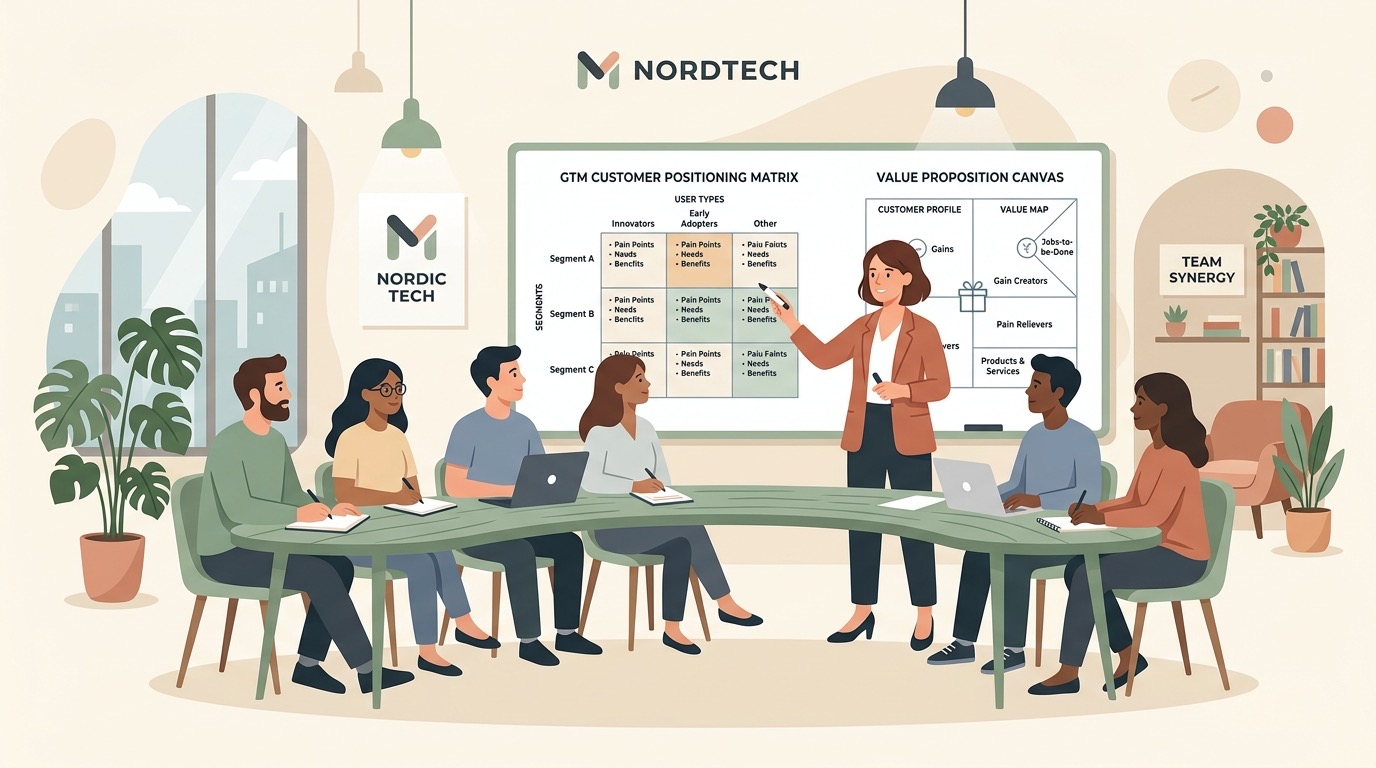
Whether you are interviewing for an Associate PMM, Senior PMM, or Director of Product Marketing role, this comprehensive guide explores the core product marketing manager interview questions, quantitative frameworks, and executive-level answers you need to land top offers.
Part 1: The Modern Go-To-Market (GTM) Lifecycle
Before facing specific interview questions, you must demonstrate a structured methodology for launching and scaling products. Elite PMMs do not rely on ad-hoc launch checklists; they run an iterative, four-phase Go-To-Market operating system.
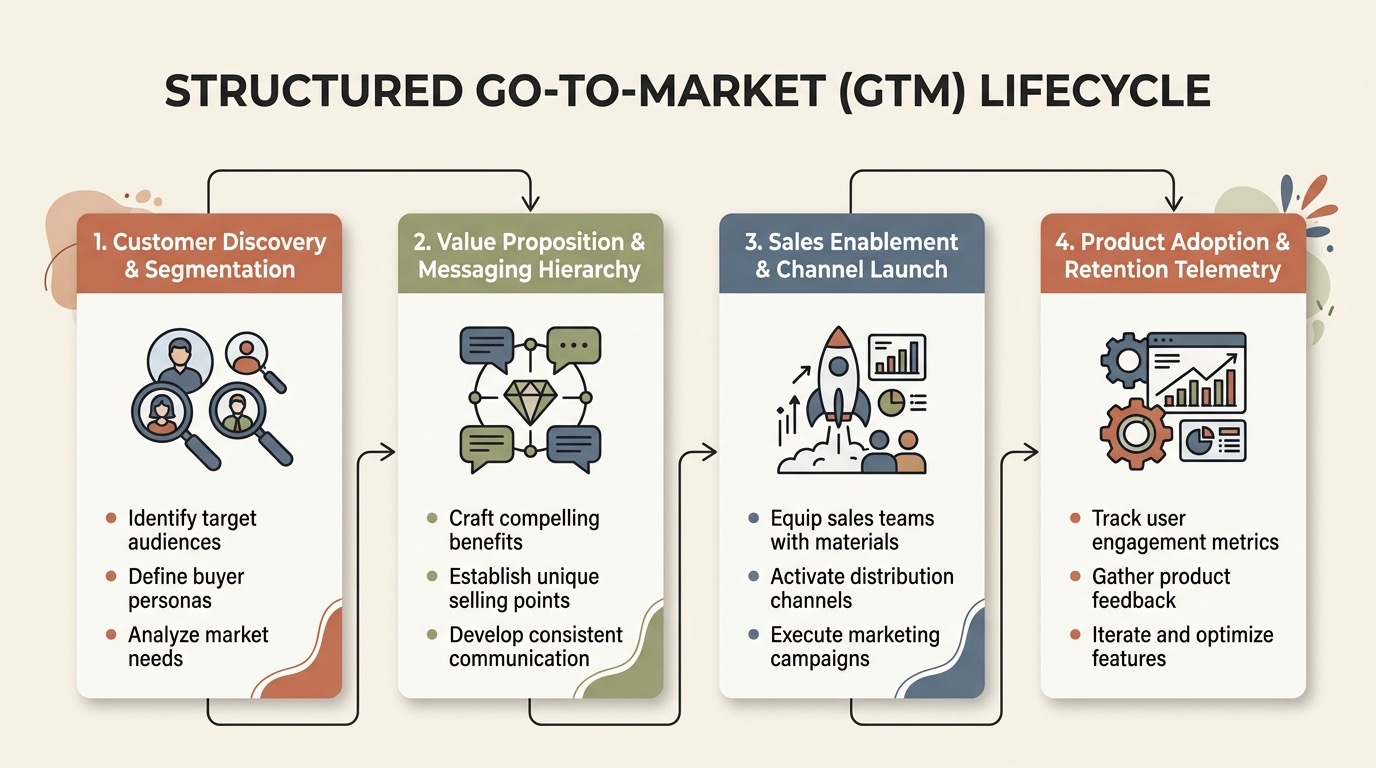
Phase 1: Customer Discovery & Segmentation
- Identifying the Ideal Customer Profile (ICP) and defining primary buyer vs. user personas.
- Uncovering underserved customer friction points, jobs-to-be-done (JTBD), and willingness to pay.
- Segmenting by industry verticals, enterprise tiers, and technical maturity.
Phase 2: Value Proposition & Messaging Hierarchy
- Crafting a defensible positioning statement and unique value proposition (UVP).
- Establishing a three-tiered messaging house (Company $\rightarrow$ Product $\rightarrow$ Feature).
- Translating technical feature specifications into commercial business outcomes.
Phase 3: Sales Enablement & Channel Launch
- Equipping sales engineering and direct sales teams with competitive battlecards, pitch decks, and objection-handling scripts.
- Coordinating multi-channel demand generation campaigns across digital marketing, partner ecosystems, and PR.
- Aligning customer success on renewal and expansion positioning.
Phase 4: Product Adoption & Retention Telemetry
- Tracking Day-30 and Day-90 product adoption metrics, feature usage frequency, and Net Revenue Retention (NRR).
- Conducting customer win/loss interviews to refine positioning and roadmap priorities.
- Partnering with growth engineering to eliminate onboarding activation bottlenecks.
Framing your interview responses around this four-phase lifecycle signals that you operate as a strategic business leader rather than a reactive asset creator.
Part 2: Core Strategic PMM Interview Questions & Frameworks
Question 1: How do you build a positioning statement, and what framework do you use?
What the Interviewer Is Testing: Positioning is the intellectual cornerstone of product marketing. The interviewer wants to know if you can differentiate a solution in a crowded market without relying on marketing fluff like "all-in-one AI platform."
The Recommended Framework: Use the classic Geoffrey Moore Positioning Matrix adapted for modern SaaS:
$\begin{aligned} \text{\textbf{For}} &\quad \text{[Target Customer / ICP]} \ \text{\textbf{Who}} &\quad \text{[Statement of Need / Friction]} \ \text{\textbf{Our Product}} &\quad \text{[Product Category]} \ \text{\textbf{That}} &\quad \text{[Core Key Benefit / Compelling Reason to Buy]} \ \text{\textbf{Unlike}} &\quad \text{[Primary Competitive Alternative]} \ \text{\textbf{Our Product Brings}} &\quad \text{[Unique Defensible Differentiator]} \end{aligned}$
Sample Answer:
"When creating positioning, I ground the narrative in customer interviews rather than internal assumptions. For instance, in my last enterprise B2B launch, our positioning was: 'For VP-level customer success leaders who struggle with unpredictable churn across multi-cloud accounts, our platform is an automated customer telemetry engine that predicts churn risks 90 days before renewal. Unlike legacy CRM reporting tools that only show backward-looking ticket logs, our solution correlates product API usage with billing triggers to deliver automated intervention playbooks.' This gave both our sales and marketing teams an unshakeable narrative baseline."
For broader campaign alignment, cross-reference our guide on marketing manager interview questions and frameworks to align brand and demand generation strategies.
Question 2: How do you design and execute a tier-1 Go-To-Market (GTM) launch?
What the Interviewer Is Testing: Can you orchestrate complex, multi-stakeholder product launches on tight schedules while maintaining accountability across product, sales, marketing, and customer success?
Structuring Your Answer: Break down the launch into three clear milestones:
- Pre-Launch (T-minus 8 to 4 weeks):
- Conduct customer beta testing and collect 3 to 5 verified customer quotes or case studies.
- Finalize pricing, packaging, and self-serve upgrade flows.
- Run mandatory internal sales certification and objection-handling workshops.
- Launch Week (T-0):
- Coordinated multi-channel distribution: product hunt launch, keynote announcement, email nurture sequence, paid search capture, and press coverage.
- Live demo webinars and dedicated customer portal walkthroughs.
- Post-Launch (T-plus 30 to 90 days):
- Measure pipeline velocity: MQLs, SQLs, sales win rates, and average deal size.
- Product telemetry: Feature adoption rate and monthly active users (MAU).
- Win/Loss analysis: Interview 10 closed-won and 10 closed-lost prospects.
Sample Answer:
"I categorize product releases into Tier 1 (major new product lines), Tier 2 (significant feature updates), and Tier 3 (incremental improvements). For a Tier 1 release, internal enablement is 50% of the battle. If sales reps cannot articulate the value proposition in 30 seconds, external marketing dollars are wasted. Two weeks before public launch, I conduct live roleplay sessions with account executives, supplying two-page battlecards and customer ROI calculators. Post-launch, I host weekly pipeline triage meetings with sales leadership to inspect early deal cycles and immediately adjust messaging if prospects express unexpected objections."
Question 3: How do you conduct competitive intelligence without getting bogged down in feature comparison charts?
What the Interviewer Is Testing: Amateur PMMs build massive 50-row feature matrices comparing checkboxes. Elite PMMs recognize that enterprise buyers do not buy features; they buy risk reduction, time-to-value, and operational leverage.
Key Concepts to Articulate:
- Landmines (Traps for Competitors): Planting strategic questions in prospects' minds that highlight competitors' structural architectural flaws (e.g., "Ask Vendor X how their architecture handles single-tenant data compliance during EU cross-border migrations").
- Competitor Archetypes: Grouping competitors by category (legacy incumbent, modern low-cost point solution, open-source alternative) rather than tracking every small startup.
- Battlecards That Reps Actually Use: Keeping competitive battlecards to three sections: Quick Dismiss (when to walk away), Landmines to Lay, and How to Defend Our Premium Pricing.
Sample Answer:
"Feature-by-feature battlecards become obsolete the moment a competitor ships a patch. Instead, I focus on architectural and business model differences. When competing against legacy on-premise incumbents, our reps don't argue over widget buttons; they highlight total cost of ownership (TCO) and deployment lead times. When competing against low-cost commoditized competitors, we lay landmines around enterprise security, SOC-2 Type II audits, and uptime SLAs. In win/loss reviews, I look for pattern shifts: if our win rate against Competitor A drops from 65% to 45% over one quarter, I listen to Gong call recordings to identify whether they changed discounting or introduced new packaging."
For strategies on addressing competitive risks during behavioral evaluations, review our tactics on answering difficult interview questions.
Question 4: How do you approach pricing and packaging for a new SaaS product?
What the Interviewer Is Testing: Pricing is one of the highest-leverage responsibilities a PMM can own. Do you understand value metrics, willingness-to-pay research, and tier segmentation?
Evaluation Framework:
- Value Metric Selection: Aligning what the customer pays for with how they extract value (e.g., per user/seat, per API request, per gigabyte stored, or percentage of transaction volume).
- Van Westendorp Price Sensitivity Meter: Surveying target buyers across four questions (At what price is this too cheap? A bargain? Getting expensive? Too expensive?).
- Packaging Tiers (Good-Better-Best):
- Starter/Individual: Self-serve, rapid time-to-value, low friction.
- Professional/Team: Collaboration, basic integrations, standard support.
- Enterprise: SSO/SAML, custom audit logs, dedicated CSM, SLA guarantees.
Sample Answer:
"Pricing should never be a cost-plus exercise. It must be rooted in willingness-to-pay and value metric alignment. If you charge per seat for an automation product that reduces the headcount needed, you create perverse incentives that limit your customer expansion. For a workflow automation tool, I model usage-based or consumption-based value metrics—such as active automated workflows—so as the customer scales, our contract value expands naturally. When packaging tiers, I reserve governance features like role-based access control (RBAC), data residency, and SCIM provisioning for the Enterprise tier, because enterprise procurement is willing to pay a significant premium for security compliance."
To understand how pricing models impact customer retention downstream, review our deep dive on customer success manager interview questions.
Part 3: Cross-Functional Alignment & Behavioral Scenarios
Question 5: Product Management wants to ship feature X, but your customer research shows the market wants feature Y. How do you resolve the conflict?
What the Interviewer Is Testing: Do you build collaborative consensus through objective data, or do you enter political turf wars with product engineering?
Resolution Framework:
- Depersonalize the discussion by bringing verified qualitative and quantitative data to the table.
- Segment the customer feedback: Is Feature X demanded by a small vocal minority of existing users, while Feature Y is a blocker for high-value net-new pipeline?
- Find a phased compromise or joint roadmap prioritization.
Sample Answer:
*"I avoid subjective debates of 'marketing opinion vs. product intuition.' I bring pipeline evidence and customer interview recordings into our roadmap sync. I quantify the revenue opportunity: 'Over the last two quarters, 42 prospective enterprise accounts cited the absence of Feature Y as their primary deal-breaker, representing
.8M in lost ARR. In contrast, Feature X is requested by existing power users to improve workflow speed.'By presenting the trade-off in business terms, Product and PMM can align on a phased approach: we release a lightweight MVP of Feature X to satisfy power users, while allocating core sprint cycles to Feature Y to unblock enterprise acquisition."*
Question 6: A major product launch generates high website traffic and signups, but 30-day product adoption and retention fall flat. How do you diagnose and fix it?
What the Interviewer Is Testing: Do you wash your hands of a launch once the press release goes out, or do you take full ownership of the complete customer journey?
Diagnostic Steps:
- Expectation Mismatch: Did marketing positioning over-promise features or target the wrong user persona?
- Activation Cliff: Where in the user onboarding flow did users drop off? (e.g., failing to connect their database or complete workspace setup).
- Time to First Value (TTFV): How many minutes or days does it take for a new user to experience their 'aha!' moment?
Sample Answer:
*"When top-of-funnel conversion is high but retention is low, there is almost always an expectation gap between marketing messaging and product onboarding reality. My first action is analyzing user telemetry in Mixpanel or Amplitude alongside session replays in FullStory.
If users drop off at step three because connecting their API credentials requires engineering assistance, we have an onboarding friction problem, not a messaging problem. I collaborate with product designers to create pre-populated sandbox templates so users experience immediate value within three minutes of signup. Concurrently, I refine our ad copy and landing page headlines to set accurate expectations so we attract users with immediate readiness to adopt."*
For candidates orchestrating modern digital marketing campaigns, explore our companion breakdown on digital marketing interview questions in 2026.
Part 4: The 5-Step PMM Case Study Walkthrough Framework
In final-round PMM interviews, you will almost certainly be assigned a 48-hour take-home presentation or a live whiteboarding challenge (e.g., "How would you launch Slack's new AI features to enterprise IT buyers?").
Always structure your presentation using the PMM 5-Step Blueprint:
Step Core Objective Key Deliverable 1. Target Audience & ICP Define the specific buying committee Primary Persona (CISO) vs. User Persona (DevOps Engineer) 2. Problem Statement Articulate the acute customer friction Quantified pain point (e.g., 40 hours lost per week on manual audits) 3. Positioning & Messaging The core value proposition and proof points 3-tier messaging pillar with customer proof 4. GTM Distribution Channels Internal enablement & external launch mix Sales battlecard, targeted digital campaigns, partner co-marketing 5. Success Metrics (KPIs) How you will measure commercial ROI Leading indicators (MQLs, pipeline) & Lagging indicators (Win rate, NRR) Following this rigorous framework demonstrates that you can take an ambiguous product concept and build a predictable, repeatable revenue engine.
Part 5: Actionable Preparation Checklist for PMM Interviews
- Conduct a Reverse-Engineered Audit: Pick three products made by the company you are interviewing with. Write down their target personas, current positioning statement, and identify two areas where their messaging is weak or unclear.
- Build a Portfolio of Launch Artifacts: Prepare tangible examples of sales battlecards, one-pagers, messaging houses, and customer pitch decks you have created in previous roles.
- Rehearse Aloud with Simulated Interviews: Product marketing is communication-driven. Practicing your GTM presentations and objection-handling out loud is vital. Use totop.app to run realistic, role-specific AI mock interviews and sharpen your cross-functional storytelling under pressure.
- Prepare Questions That Prove Strategic Vision:
- "How is the product marketing team currently measured here—on pipeline contribution, product adoption, or sales enablement velocity?"
- "What is the dynamic between Product Management and PMM when defining roadmap priorities?"
- "Which competitor has been surprising your sales reps the most in recent enterprise deals?"
Take control of your interview preparation with our comprehensive 30-day interview prep schedule, master your Go-To-Market narratives, and enter your next product marketing interview with total authority.