Marketing Interview Questions: The Complete 2026 Guide

If you're preparing for a marketing interview today, I have some news for you: the old playbook is officially dead.
I remember when preparing for a marketing role meant brushing up on the "4 Ps" (Product, Price, Place, Promotion), memorizing a few catchy slogans, and practicing how to describe a creative campaign idea. If you walk into a modern tech or high-growth company with only that toolkit, you're going to face a very short conversation.
Today's marketing roles are highly specialized, intensely data-driven, and closely tied to product growth. Whether you are applying for a brand management role, a performance marketing position, or a growth marketing leadership slot, interviewers are looking for a rare hybrid: people who can think like creative storytellers but execute like data scientists.
In this complete guide, we will break down the exact categories of marketing interview questions you will face in 2026, how to answer them using concrete metrics, and the frameworks you need to stand out from the competition.
The Two Pillars: Brand vs. Performance Marketing
Before we dive into the specific questions, you need to understand the fundamental tension at the heart of modern marketing. Almost every question you are asked will test your understanding of how these two pillars interact:
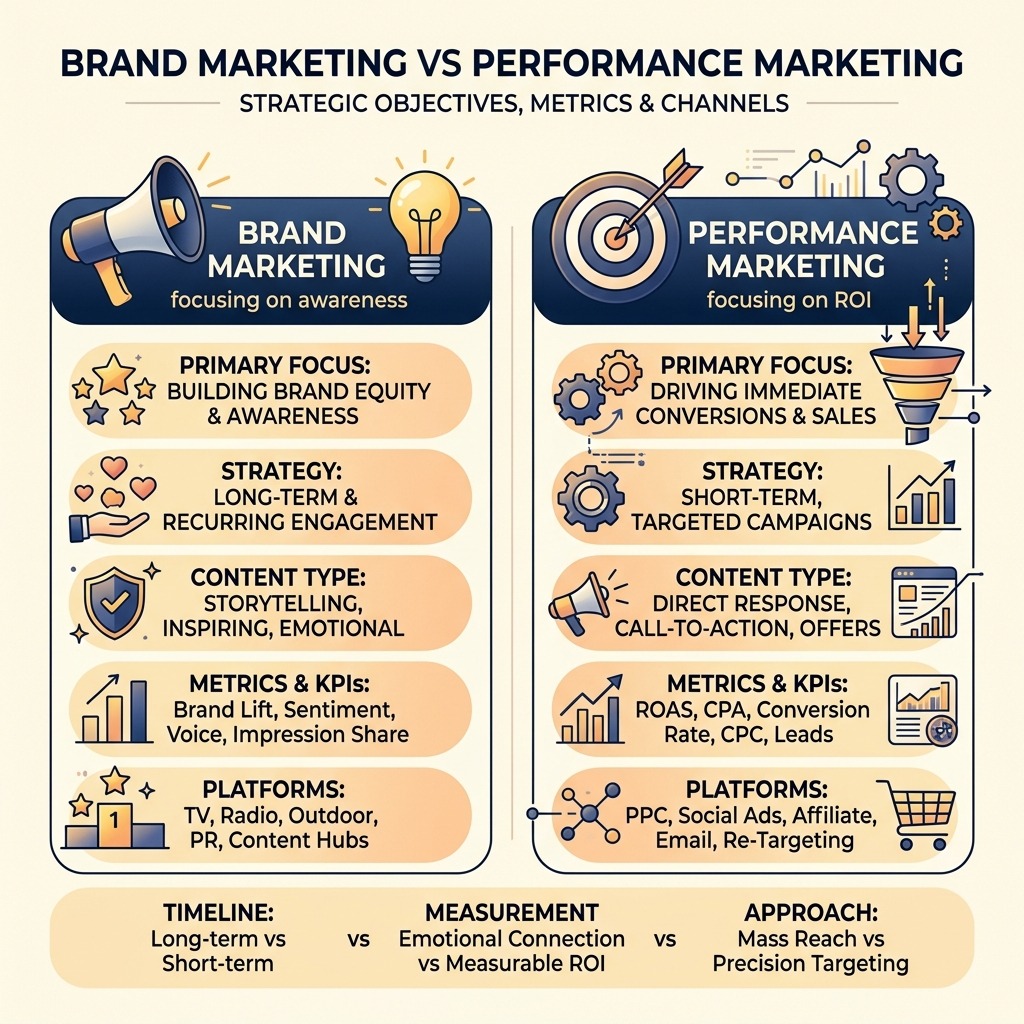
- Brand Marketing (The Top of the Funnel): Focuses on awareness, emotional connection, and long-term brand equity. It is measured by metrics like brand lift, sentiment analysis, share of voice, and organic traffic growth.
- Performance Marketing (The Bottom of the Funnel): Focuses on immediate, measurable actions and direct conversion. It is driven by paid channels (PPC, social ads), and is measured by ROAS (Return on Ad Spend), CPA (Cost Per Acquisition), and conversion rates.
Many candidates make the mistake of over-indexing on one and ignoring the other. Brand specialists dismiss paid media as "just spending money," while performance marketers dismiss brand building as "fluffy and unmeasurable."
The candidates who get hired are the ones who can bridge this gap. They understand that strong brand marketing lowers performance acquisition costs, and that performance marketing data provides the insights needed to refine brand messaging.
1. Core Marketing Strategy Questions
These questions test your high-level business acumen and your ability to launch new products or scale existing ones. Interviewers want to see your structured problem-solving framework.
Question: "How would you design a go-to-market (GTM) strategy for a new SaaS product with a limited budget?"
How to structure your answer: Avoid jumping straight into "I would run Facebook ads" or "I would do influencer marketing." Start with a structured framework:
- Target Audience Discovery: Who has the highest pain point that this product solves? How do we segment them?
- Value Proposition & Positioning: What is our unique angle compared to competitors?
- Channel Selection: Where does this audience hang out? If budget is tight, we should prioritize high-leverage organic channels (SEO, community marketing, partnerships) over expensive paid media.
- Measurement: How do we define success in the first 30, 60, and 90 days?
Sample Answer:
"If I'm working with a limited budget, my GTM strategy would focus heavily on organic loop generation and community positioning rather than paid channels. First, I would spend the first week interviewing ten potential ideal customers to refine our positioning and identify the exact communities where they gather.
Instead of broad advertising, I would launch a highly targeted content marketing engine focused on long-tail, high-intent SEO keywords. I'd pair this with a value-first community outreach plan—providing free guides and templates on platforms like Reddit or specialized Discord servers where our audience is already asking for help.
To measure success, I wouldn't just look at signups. I would track product activation rate and organic referral loops. Our goal in the first 60 days would be achieving a high customer satisfaction score (CSAT) among early adopters, which naturally drives word-of-mouth growth."
2. Performance Marketing & Optimization Questions
If you're interviewing for any growth, digital, or performance marketing role, you must be comfortable with the math. You will be asked to diagnose campaign issues and optimize spend.
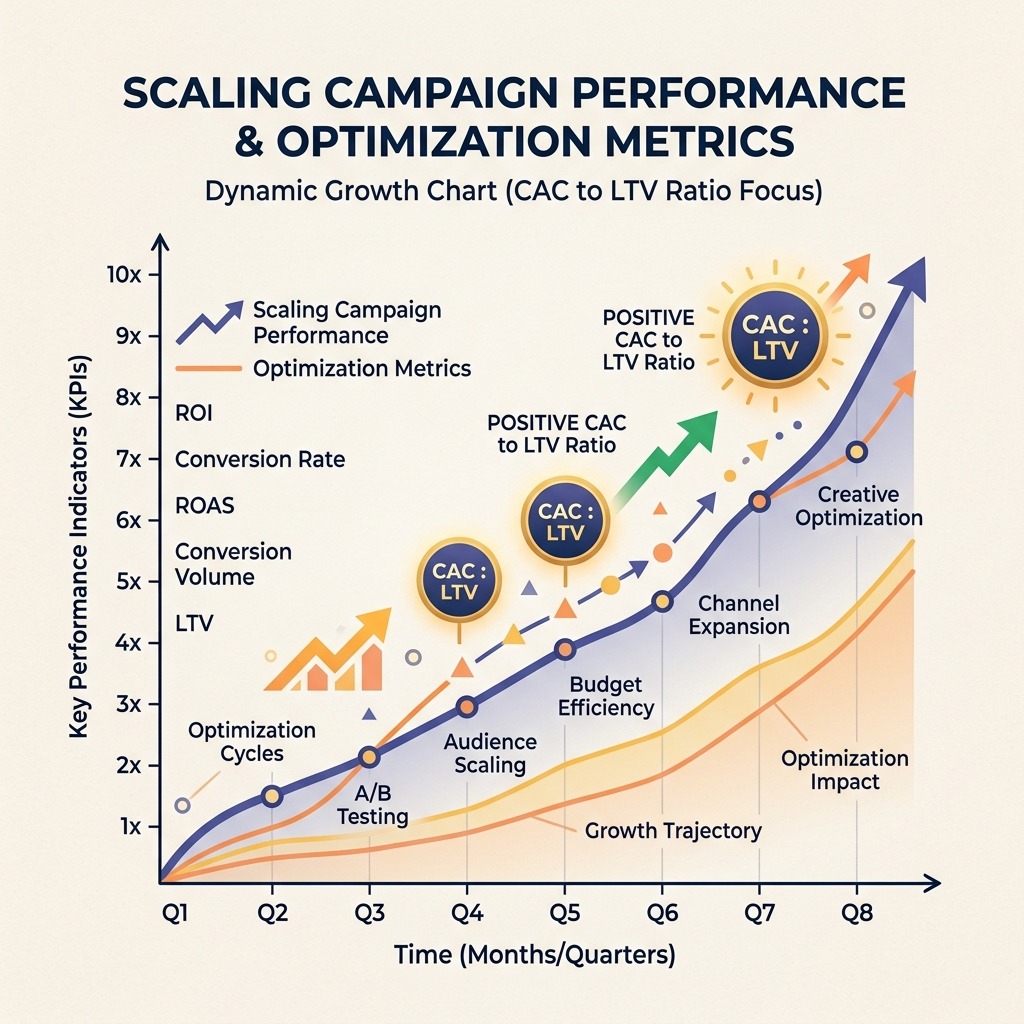
Question: "Our Customer Acquisition Cost (CAC) has increased by 40% over the last quarter, but our conversion rate has remained flat. How do you diagnose and fix this?"
This is a classic diagnostic question. The interviewer wants to see if you can isolate variables and think systematically.
How to structure your answer: Use a top-down diagnostic framework:
- External Factors: Has ad platform competition increased? Have there been algorithm updates or privacy policy changes (like iOS tracking restrictions)?
- Channel-Level Analysis: Is the increase driven by one specific paid channel, or is it happening across the board?
- Creative & Audience Fatigue: Have our click-through rates (CTR) dropped? Are our ads showing to the same audiences too many times?
- Action Plan: How do we optimize? (Audience expansion, creative refresh, budget reallocation).
Sample Answer:
"To diagnose a 40% spike in CAC with flat conversions, I would look at three primary areas. First, I'd check our Click-Through Rate (CTR) and Cost Per Mille (CPM) on our primary paid channels. If CPMs are flat but CTR has dropped, it's a clear indicator of creative fatigue. We are showing the same ads to the same audience, and they are tuning out. I would immediately spin up a new set of creative variations focusing on different emotional hooks.
Second, I'd analyze channel allocation. I've often seen situations where a company scales budget too quickly on a single platform, pushing it past its efficiency threshold. If Facebook CAC doubled but Google Search CAC stayed flat, I would reallocate a portion of the budget back to the search campaign to capture high-intent users.
Finally, I'd check the post-click experience. If conversion rate is flat, the bottleneck isn't the landing page itself; it's the alignment between the ad promise and the landing page reality. I'd run a quick cohort analysis to see if the traffic coming from newer, higher-cost campaigns has lower activation rates, indicating we are attracting lower-intent users."
3. Brand & Content Strategy Questions
These questions test your ability to build long-term relationships with customers and maintain consistency across channels.
Question: "How do you measure the ROI of a brand awareness campaign?"
This is a trick question. An experienced brand marketer knows that you cannot measure brand awareness the same way you measure a paid search ad.
Sample Answer:
"Measuring brand ROI requires shifting from immediate transaction tracking to trend analysis over time. I look at three main buckets of metrics.
First is Direct and Organic Search Traffic. A successful brand campaign prompts people to search for our company by name or type our URL directly. If we see a sustained lift in direct traffic during and after a campaign, that's a direct signal of brand recall.
Second is Share of Voice (SOV) and Sentiment. I track media mentions, social conversations, and customer reviews to see if we are owning a larger share of the conversation compared to our competitors, and if that conversation is positive.
Third, I run brand lift studies using platform tools or customer surveys to measure aided and unaided recall. Ultimately, the long-term ROI of a brand campaign shows up in our performance marketing metrics: a strong brand awareness campaign typically increases click-through rates on paid ads and decreases overall blended CAC over a 3-to-6 month horizon."
How to Stand Out: The STAR Method for Marketers
When answering behavioral questions (like "Tell me about a time you managed a failing campaign"), always use the STAR method:
- Situation: Set the scene. (e.g., "We were running a launch campaign for a new app feature, and our CPA was 3x our target.")
- Task: Define your responsibility. (e.g., "My job was to bring the CPA down to target within two weeks without reducing total leads.")
- Action: Explain exactly what you did. (e.g., "I paused our broad-targeting ad sets, set up dynamic creative testing, and built a custom retargeting funnel for drop-offs.")
- Result: Share the numbers. (e.g., "Within 10 days, CPA dropped by 45%, and overall conversion volume increased by 20%.")
Make sure you have 3 to 4 solid STAR stories prepared before you walk into the interview. Include stories of success, stories of failure (and what you learned), and stories of cross-functional collaboration.
Final Preparation Checklist
Before your next interview, make sure you can speak fluently about:
- Your numbers: Know the exact conversion rates, CPA, ROAS, and budgets of campaigns you've run in the past.
- Industry trends: Understand how privacy regulations, generative AI content, and platform changes are affecting customer acquisition.
- The company's marketing: Look at the company’s current social channels, ads (using tools like the Meta Ad Library), and blog. Identify one area they are doing well and one clear opportunity for improvement.
If you want to practice these scenarios in a realistic setting, tools like totop.app offer interactive, role-specific interview practice. You can paste the job description of the marketing role you're targeting, and get grilled on real-world marketing cases with direct, actionable feedback on your communication style and technical metrics.
Good luck out there! Keep your creative sharp, but keep your eyes on the data.