Junior Developer Interview Questions & Real Examples
Landing your first software engineering role can feel intimidating. Many aspiring engineers dread walking into a live coding session, expecting hiring managers to grill them on obscure graph algorithms or esoteric compiler internals.
In reality, engineering managers evaluate entry-level candidates against a very different rubric. Companies hiring for entry-level positions do not expect you to design massive distributed architectures or memorize hundreds of LeetCode solutions. Instead, they want to assess your core programming fundamentals, structured problem-solving approach, communication clarity, and openness to feedback.

When you know the key junior developer interview questions and understand what interviewers look for behind each question, you can showcase your potential with calm confidence.
What Interviewers Actually Evaluate in Junior Candidates
Before exploring specific questions, let's examine the four core dimensions hiring committees use to evaluate junior engineers.
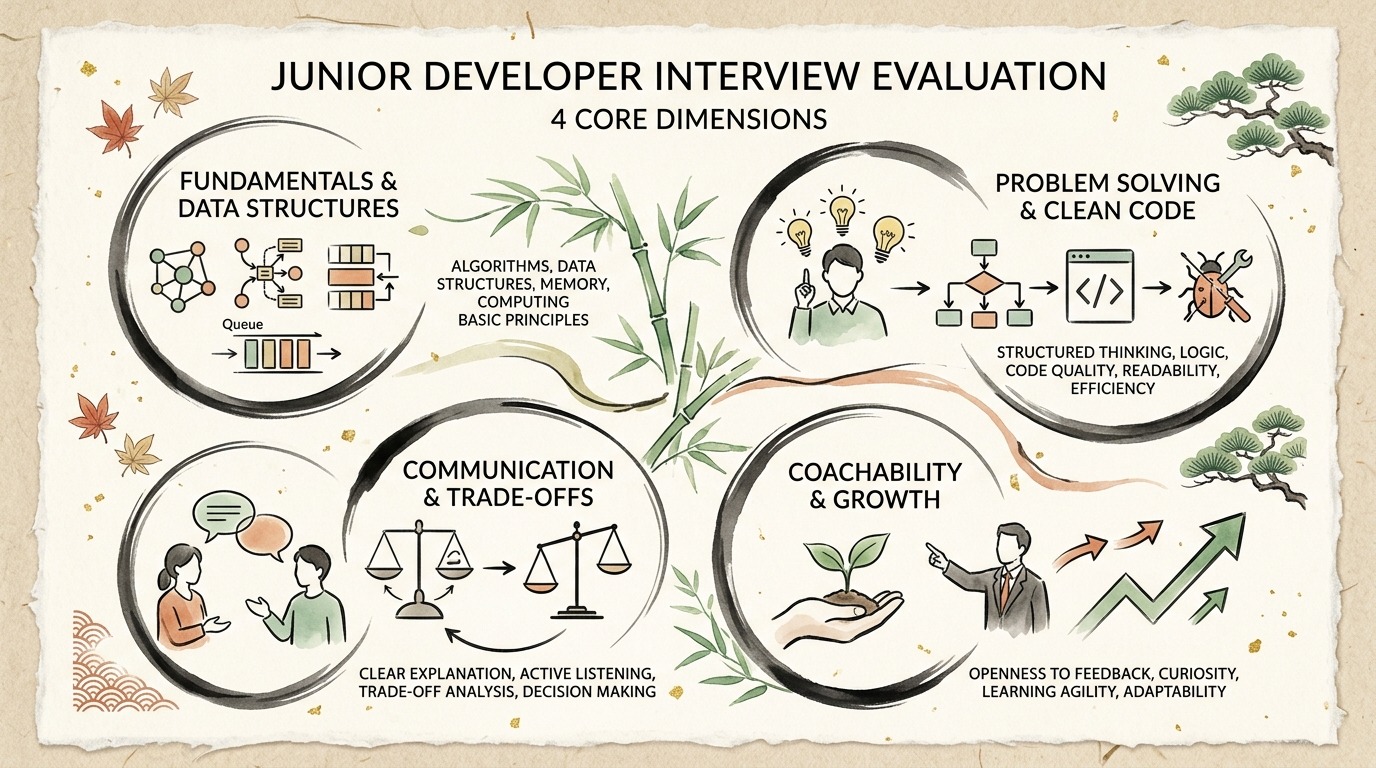
- Fundamentals & Data Structures: Can you pick the right tool for the job (e.g., Array vs. Hash Map vs. Set) and explain basic time and space complexity ($O(1)$ vs $O(n)$)?
- Problem Solving & Clean Code: Do you write readable, maintainable code with clear naming conventions, or do you produce tangled, brittle scripts?
- Communication & Trade-offs: Do you explain your thought process aloud and ask clarifying questions before jumping into code?
- Coachability & Growth Mindset: When the interviewer offers a gentle hint or points out an edge case, do you receive it thoughtfully and adapt, or do you become defensive?
Understanding these evaluation pillars helps you see that getting stuck on an edge case does not disqualify you. How you recover and collaborate is what sets winning candidates apart. For a deeper breakdown of how interviewers score candidates, explore what interviewers actually look for in technical interviews.
The 4-Step Strategy for Junior Coding Questions
When an interviewer hands you a coding prompt, rushing into the code editor without speaking is the most common mistake junior developers make.
Follow this 4-step framework to navigate any live coding challenge:
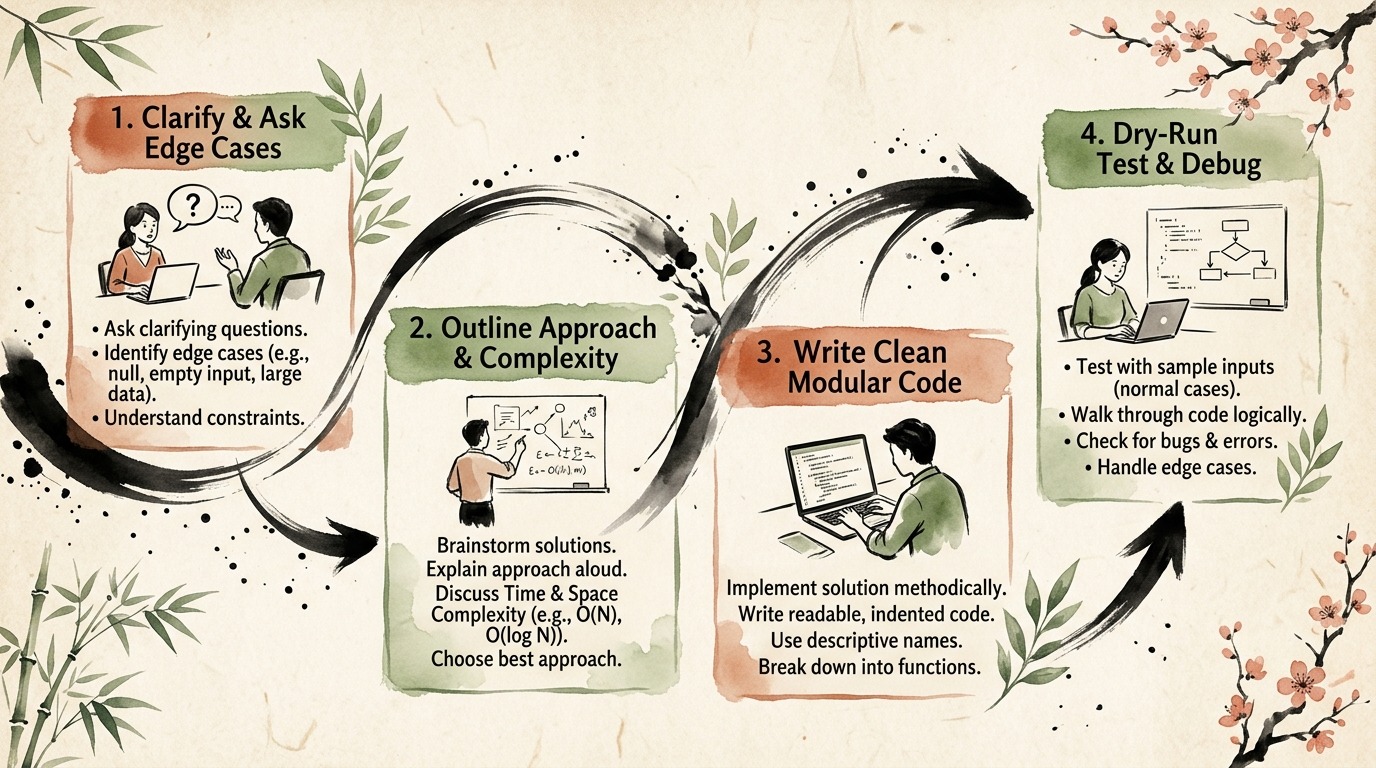
Step 1: Clarify Requirements and Identify Edge Cases
Never assume constraints. Ask targeted questions:
- "Can the input array contain negative numbers or duplicate values?"
- "What should the function return if the input string is empty or null?"
- "Are there performance or memory constraints I should keep in mind?"
Step 2: Outline Your Approach and Complexity
Explain your proposed strategy in plain English before writing a single line of syntax. Mention the expected Big-O time and space complexity. If you only see a brute-force approach first, state it clearly:
"A brute force solution would check every pair with nested loops in $O(n^2)$ time. However, by using a hash map to track complements, we can reduce this to $O(n)$ time with $O(n)$ space. Should I proceed with the hash map implementation?"
Step 3: Write Clean, Modular Code
Write readable code with meaningful variable names (userLookupMap instead of m, currentIndex instead of i1). Keep functions concise and focused on single responsibilities.
Step 4: Dry-Run Test Cases and Debug
Before announcing that you are done, manually step through your code line by line with a sample input. Test:
- A standard happy-path input.
- An empty or single-element input.
- An edge case (e.g., duplicates, zero, boundary values).
Category 1: Core Coding & Algorithm Questions
Let's walk through common coding challenges asked in junior software engineer interviews, along with ideal response patterns.
Question 1: Two Sum / Finding Pairs
The Prompt: "Given an array of integers nums and an integer target, return the indices of the two numbers such that they add up to target."
What the Interviewer Is Testing
- Knowledge of hash maps vs. nested loops.
- Ability to optimize from $O(n^2)$ brute-force to $O(n)$ linear time.
Example Solution & Explanation
function twoSum(nums, target) {
  const seenNumbers = new Map(); // value -> index

  for (let i = 0; i < nums.length; i++) {
    const complement = target - nums[i];

    if (seenNumbers.has(complement)) {
      return [seenNumbers.get(complement), i];
    }

    seenNumbers.set(nums[i], i);
  }

  return []; // Return empty array if no pair exists
}
Walkthrough: Explain to the interviewer: "By iterating through the array once and storing each seen number with its index in a hash map, we can check for the complement in $O(1)$ average time. This gives us an overall time complexity of $O(n)$ and space complexity of $O(n)$."
Question 2: Valid Palindrome (String Manipulation & Pointers)
The Prompt: "Write a function that checks whether a given string is a palindrome, ignoring non-alphanumeric characters and case sensitivity."
What the Interviewer Is Testing
- Two-pointer technique vs. string allocation overhead.
- String cleanup and ASCII validation.
Example Solution & Explanation
def is_palindrome(s: str) -> bool:
    # Two-pointer approach avoiding extra string copies
    left, right = 0, len(s) - 1

    while left < right:
        while left < right and not s[left].isalnum():
            left += 1
        while left < right and not s[right].isalnum():
            right -= 1

        if s[left].lower() != s[right].lower():
            return False

        left += 1
        right -= 1

    return True
Walkthrough: Note the space efficiency: "Instead of creating a reversed copy of the filtered string (which requires $O(n)$ memory), the two-pointer technique uses $O(1)$ auxiliary space and $O(n)$ time."
Question 3: Finding the Most Frequent Element (Hash Counting)
The Prompt: "Given a list of words or numbers, find the element that appears most frequently."
What the Interviewer Is Testing
- Frequency counter pattern.
- Iterating over dictionary/hash map keys and handling tie-breakers.
Example Solution & Explanation
function findMostFrequent(items) {
  if (!items || items.length === 0) return null;

  const counts = new Map();
  let maxCount = 0;
  let mostFrequentItem = items[0];

  for (const item of items) {
    const currentCount = (counts.get(item) || 0) + 1;
    counts.set(item, currentCount);

    if (currentCount > maxCount) {
      maxCount = currentCount;
      mostFrequentItem = item;
    }
  }

  return mostFrequentItem;
}
Category 2: Web Fundamentals & Architecture Questions
In addition to algorithmic coding, junior developers are frequently asked foundational technical questions regarding how modern web applications function.
Question 4: "What happens when you type a URL into your browser and press Enter?"
Why It's Asked: This classic open-ended question tests whether you understand the full stack lifecycle: DNS resolution, TCP handshake, HTTP request/response, and browser DOM rendering.
Strong Junior Response Structure:
- DNS Lookup: The browser checks its local cache, OS cache, and queries DNS servers to resolve the domain name (e.g.,
totop.app) into an IP address. - TCP Connection & TLS Handshake: The client establishes a reliable TCP connection with the server (and negotiates TLS/HTTPS encryption).
- HTTP Request & Server Processing: The browser dispatches an HTTP GET request; the backend web server processes the request and returns an HTTP response (e.g., status 200 with HTML).
- Browser Parsing & Rendering Pipeline: The browser constructs the DOM tree, CSSOM tree, runs JavaScript, computes layout, and paints pixels onto the screen.
Question 5: "What is the difference between synchronous and asynchronous code?"
Why It's Asked: Ensures you understand how non-blocking I/O, event loops, promises, and async/await work in modern application code.
Strong Junior Response:
"Synchronous code executes sequentially, where each operation must complete before the next line runs, potentially blocking the thread during heavy operations. Asynchronous code allows long-running operations—like network API calls or file reading—to execute in the background. In JavaScript, asynchronous tasks are queued and processed via the event loop, ensuring the user interface remains responsive."
Question 6: "What are the differences between SQL and NoSQL databases?"
Why It's Asked: Gauges foundational data modeling awareness.
| Dimension | SQL (Relational) | NoSQL (Document / Key-Value) |
|---|---|---|
| Data Structure | Structured tables with fixed schemas and foreign keys | Flexible JSON documents, key-value pairs, or graphs |
| ACID Guarantees | Strong transactional consistency by default | Often eventual consistency (BASE model) |
| Scaling Strategy | Typically vertical scaling (more CPU/RAM) | Designed for horizontal scaling (sharding across clusters) |
| Ideal Use Case | Financial records, complex joins, strict schemas | Rapid prototyping, variable data schemas, high-throughput caching |
Category 3: Git & Software Development Lifecycle (SDLC)
Hiring managers want to verify that you can integrate smoothly into an existing engineering team without accidentally breaking production branches.
Question 7: "How do you resolve a Git merge conflict?"
Strong Answer:
"When Git encounters conflicting edits on the same lines across branches, it pauses the merge and marks the conflict areas in the affected files with
<<<<<<<,=======, and>>>>>>>markers. I open the conflicting files, examine both incoming and current changes, speak with the teammate who authored the other branch if context is needed, select or combine the correct code, remove conflict markers, run local unit tests to verify correctness, and commit the resolved merge."
Question 8: "What is the difference between git merge and git rebase?"
Strong Answer:
"
git mergecombines two branches by creating a distinct merge commit, preserving the exact chronological commit history.git rebasemoves the base of your current branch onto the target branch tip, creating a linear history. As a best practice, teams often use rebase for local feature branches before opening a PR, but avoid rebasing shared public branches."
Category 4: Behavioral & Situational Questions for Juniors
Technical competence is only half the equation. Because junior engineers require mentorship, hiring managers place immense weight on behavioral responses.
Question 9: "Tell me about a time you encountered a difficult bug and how you solved it."
Answering Framework (STAR Method):
- Situation: Briefly describe the project and feature context.
- Task: The specific bug or unexpected behavior that occurred.
- Action: The systematic debugging steps you took (e.g., analyzing logs, isolating reproducible inputs, using breakpoints or profiling tools).
- Result: What caused the bug, how you fixed it, and what automated test you added to ensure it never recurs.
Question 10: "What do you do when you are stuck and don't know how to proceed?"
Interviewers ask this to make sure you won't spin your wheels in silence for three days.
Strong Response:
"When I get stuck, I follow a time-boxed approach. First, I spend 30 to 45 minutes isolating the issue: reading error stack traces, writing minimal reproducible test cases, and reviewing official documentation. If I remain blocked, I formulate a clear question for a senior colleague that summarizes what I am trying to achieve, the 3 things I have already tried, and where my hypothesis breaks down. This respects their time while keeping progress moving."
When discussing portfolio work or experimental builds, mastering how to talk about projects you haven't shipped yet helps you present technical blockers and pivots with confidence. If you run into a roadblock during the actual interview itself, knowing how to handle unknown questions gracefully is essential for maintaining your composure and demonstrating professional maturity.
The Questions You Should Ask the Interviewer
At the end of every interview, you will be invited to ask questions. Asking thoughtful questions demonstrates genuine enthusiasm and curiosity.
- "What does the typical onboarding process and mentorship look like for a new junior engineer on your team?"
- "How does your team handle code reviews, testing, and continuous deployment?"
- "What is a common challenge recent junior hires face in their first 90 days here, and how can I prepare to overcome it?"
For a curated list of high-impact reverse interview questions, check out our comprehensive guide on questions you should ask your interviewer. To understand how team leaders evaluate career progression and coaching, explore our guide on engineering manager leadership questions.
Practical Action Plan to Prepare for Your Interview
To turn your knowledge into genuine muscle memory:
- Practice Live Explanations: Do not just solve coding problems silently. Talk out loud while typing to build vocal clarity under pressure.
- Review Bootcamp & CS Fundamentals: If you come from a non-traditional background, review our bootcamp to first dev job interview survival guide and complete technical interview preparation guide.
- Simulate Real Interview Rounds: Use totop.app to practice realistic technical and behavioral interviews with tailored AI personas. Receive real-time scoring, actionable feedback on code quality, and structured guidance before your real-world interviews.
Summary Checklist for Junior Developers
| Step | Action Item | Checked |
|---|---|---|
| 1. Clarify | Ask about edge cases, empty inputs, duplicates, and constraints | [ ] |
| 2. Communicate | State brute-force first, then outline optimal $O(n)$ solution | [ ] |
| 3. Code Cleanly | Use descriptive variable names and modular functions | [ ] |
| 4. Test & Debug | Dry-run sample cases line-by-line before declaring completion | [ ] |
| 5. Stay Coachable | Listen actively to hints and incorporate feedback with enthusiasm | [ ] |
Remember: Interviewers are not looking for perfection; they are looking for their future teammate. By approaching problems methodically and communicating with clarity, you will demonstrate the qualities of an exceptional junior engineer.