When interviewing for mid-level, senior, or staff backend engineering positions in the Python ecosystem, one question surfaces consistently across system architecture rounds: "Should we build this new service with FastAPI or Django?"
Candidates often stumble into common traps. Some reflexively declare that FastAPI is superior simply because "it is async and runs faster," while others assert that Django is always better because "it has an admin panel and batteries included." Both answers indicate surface-level comprehension. Engineering leadership and hiring panels do not evaluate framework loyalty; they evaluate whether an engineer understands execution models, concurrency bottlenecks, developer velocity, and total cost of ownership.
Mastering a fastapi vs django backend interview comparison requires articulating how the Asynchronous Server Gateway Interface (ASGI) differs from the Web Server Gateway Interface (WSGI), how Pydantic type validation impacts memory and runtime latency, when an Object-Relational Mapper (ORM) becomes a bottleneck, and how architectural decisions scale with team size.
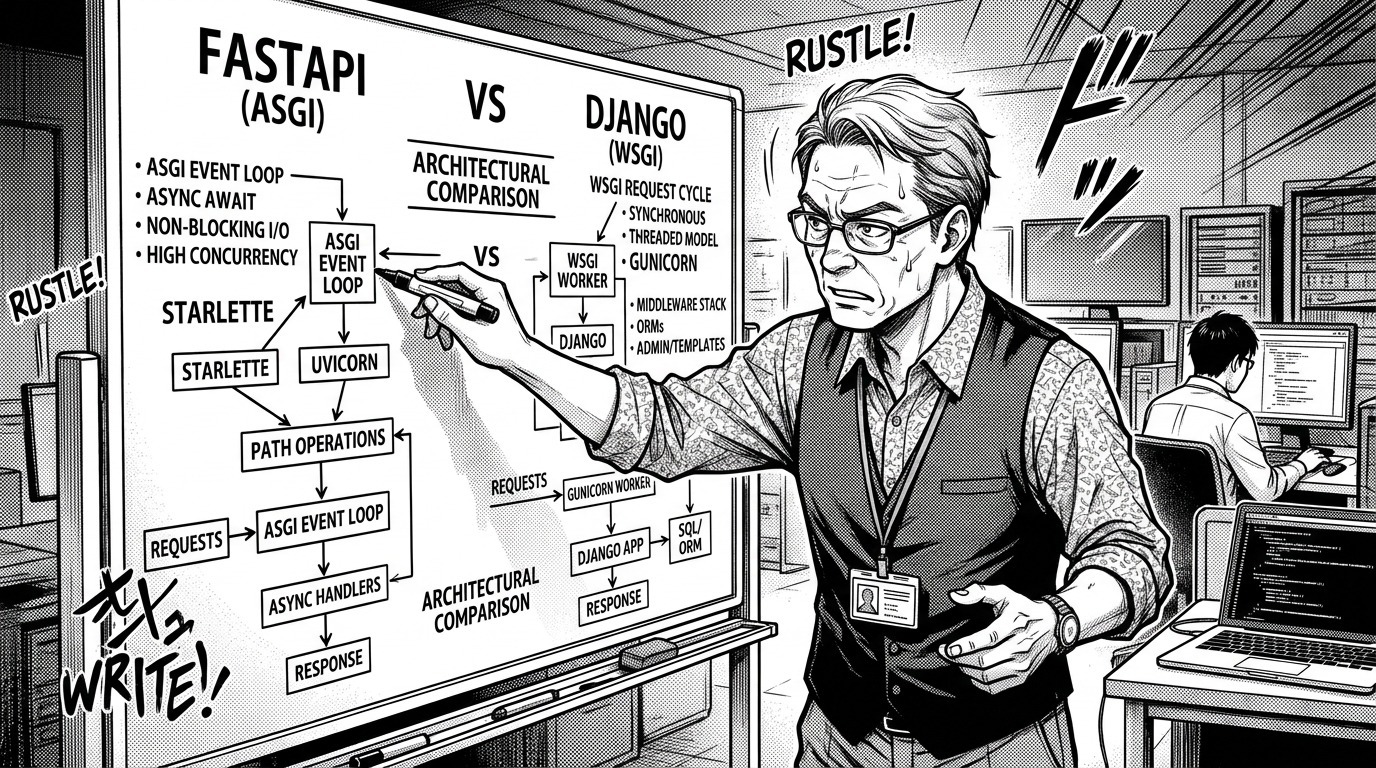
This guide provides an end-to-end blueprint for backend interviews. We dissect architectural foundations, compare execution models, review production code patterns, walk through high-throughput system design scenarios, and outline the scoring rubric technical interviewers use.
1. Architectural Foundations: ASGI Event Loop vs. WSGI Multi-Process
The defining technical boundary between FastAPI and traditional Django lies in how incoming HTTP requests are processed at the network interface layer.
The WSGI Execution Model in Django
Django was originally architected around PEP 3333 (WSGI). Under WSGI, the application server (such as Gunicorn or uWSGI) runs a pool of synchronous worker processes or threads. When an HTTP request reaches the server:
- A single worker thread is assigned to that request.
- The thread synchronously executes Django middleware, routing, view logic, and database queries.
- If a database query or external API call takes 250 milliseconds, that worker thread is completely blocked waiting for I/O.
- During this blocking period, the worker thread cannot accept or process any other incoming request.
To handle 1,000 concurrent blocking I/O requests in a pure WSGI architecture, a system requires either 1,000 worker threads (which introduces severe Linux kernel context-switching overhead and high memory consumption) or an upfront connection-pooling layer. While Django 4.x and 5.x introduced asynchronous views and ORM methods, Django core remains fundamentally a synchronous-first framework with async adapters layered over WSGI roots.
The ASGI Event Loop in FastAPI
FastAPI was built natively on the Asynchronous Server Gateway Interface (ASGI) via Starlette and Uvicorn. Powered by uvloop (a fast Python C-extension binding to libuv), FastAPI operates on a single-threaded cooperative multitasking event loop per worker process:
- When a client initiates an HTTP request, the event loop schedules the coroutine.
- When the coroutine encounters an
awaitexpression (such as an asynchronous database query or third-party HTTP request), it yields execution control back to the event loop. - The event loop immediately switches context to process another incoming request or resume an I/O callback that has completed.
- A single FastAPI worker process can sustain tens of thousands of idle or concurrent I/O connections with minimal memory footprint.
Understanding this cooperative mechanism is essential when discussing Python asyncio in production settings.
| Architectural Dimension | FastAPI | Django (with DRF) |
|---|---|---|
| Interface Standard | Native ASGI (Asynchronous Server Gateway Interface) | Hybrid WSGI / ASGI (historically WSGI-first) |
| Default Concurrency | Single event loop per worker (uvloop + cooperative multitasking) | Multi-process / multi-threaded worker pools |
| Data Validation | Pydantic v2 (Rust-compiled pydantic-core) | Django Forms / DRF Serializers (pure Python) |
| OpenAPI / Swagger | Automatic generation via type hints at application boot | Requires third-party tools (drf-spectacular, drf-yasg) |
| Database ORM | Bring Your Own (SQLAlchemy 2.0 async, Tortoise, SQLModel) | Built-in Django ORM with migration engine |
| Admin Interface | None built-in (third-party libraries require setup) | Enterprise-grade, production-ready admin panel |
| Authentication & RBAC | Lightweight OAuth2/JWT security utilities | Built-in sessions, password hashing, and permissions |
| Primary Optimal Niche | High-concurrency microservices, AI/ML APIs, streaming endpoints | Content-heavy platforms, enterprise SaaS monoliths, CRM/ERP backends |
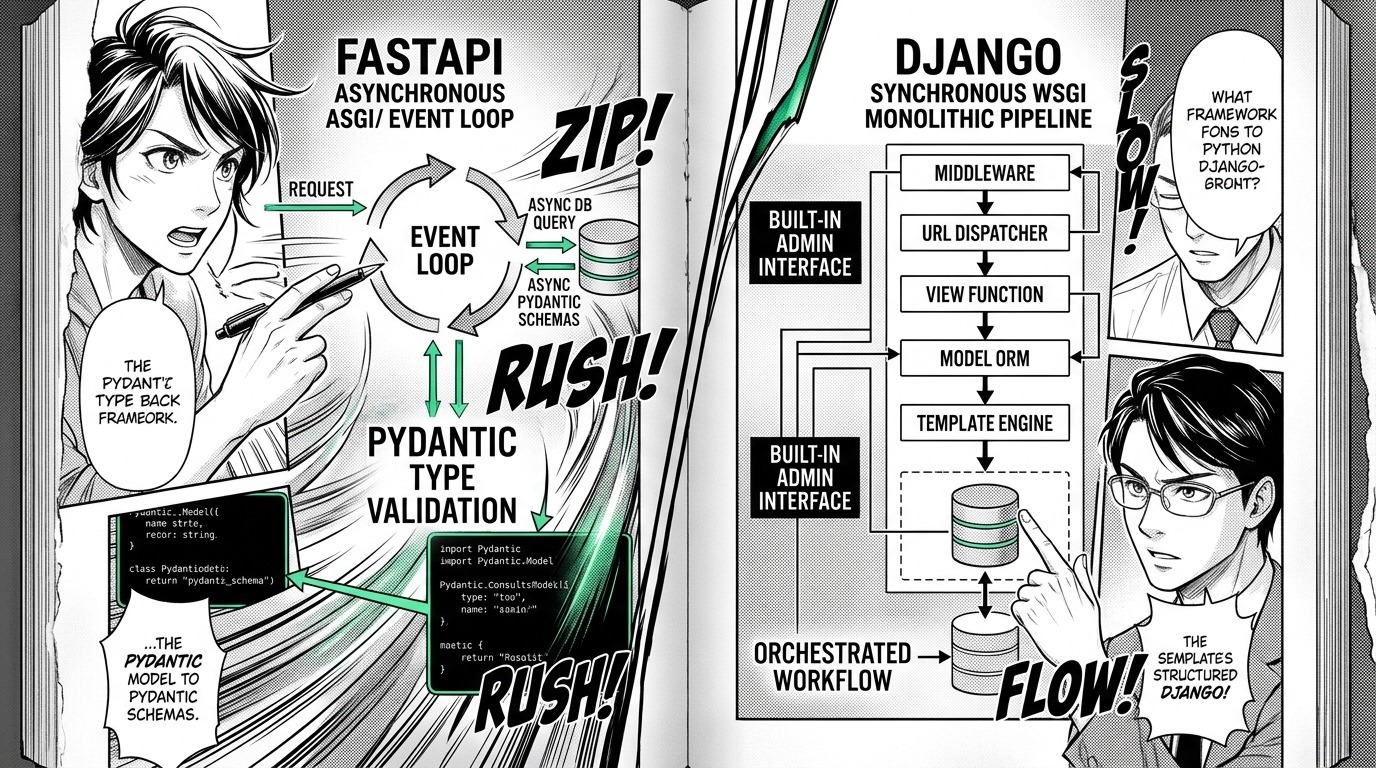
2. Data Validation & Type Safety: Pydantic v2 vs. Django Serializers
Technical interviewers frequently ask candidates to explain how incoming request payloads are deserialized, validated, and serialized back to JSON. This highlights the divergence between FastAPI's reliance on type annotations and Django's traditional object-oriented serializer hierarchy.
FastAPI: Schema Validation via Pydantic v2
FastAPI leverages Python type hints. In FastAPI, request bodies, query parameters, path variables, and headers are declared as type-annotated function parameters using Pydantic models.
Under Pydantic v2, data validation logic was rewritten in Rust (pydantic-core), resulting in validation and serialization speeds up to 15 to 20 times faster than pure Python validation libraries. Furthermore, FastAPI automatically parses these type hints to generate an interactive OpenAPI (Swagger) schema at /docs without extra configuration.
Here is a typical production-grade FastAPI endpoint utilizing asynchronous dependency injection and SQLAlchemy 2.0:
from fastapi import FastAPI, Depends, HTTPException, status
from pydantic import BaseModel, EmailStr, Field
from sqlalchemy.ext.asyncio import AsyncSession
from sqlalchemy import select
from typing import Annotated

app = FastAPI(title="User Service", version="1.0.0")

# Request / Response Schemas
class UserCreateRequest(BaseModel):
    email: EmailStr
    username: str = Field(..., min_length=3, max_length=50)
    tier: str = Field(default="free", pattern="^(free|pro|enterprise)$")

class UserResponse(BaseModel):
    id: int
    email: EmailStr
    username: str
    is_active: bool

    class Config:
        from_attributes = True

# Asynchronous Database Dependency
async def get_db_session() -> AsyncSession:
    async with AsyncSessionLocal() as session:
        try:
            yield session
        finally:
            await session.close()

@app.post("/api/v1/users", response_model=UserResponse, status_code=status.HTTP_201_CREATED)
async def create_user(
    payload: UserCreateRequest,
    db: Annotated[AsyncSession, Depends(get_db_session)],
) -> UserResponse:
    # Check for existing email without blocking the worker thread
    query = select(UserModel).where(UserModel.email == payload.email)
    result = await db.execute(query)
    if result.scalar_one_or_none():
        raise HTTPException(
            status_code=status.HTTP_409_CONFLICT,
            detail="A user with this email address already exists.",
        )

    new_user = UserModel(
        email=payload.email,
        username=payload.username,
        tier=payload.tier,
        is_active=True,
    )
    db.add(new_user)
    await db.commit()
    await db.refresh(new_user)
    return new_user
Notice the elegance of this pattern: input parsing, validation error handling, dependency injection, and documentation are unified. If a client transmits an invalid email format, FastAPI returns an RFC 7807 compliant JSON error payload automatically.
Django REST Framework (DRF): Serializers and Model Coupling
In Django, building RESTful APIs is usually achieved via Django REST Framework (DRF). DRF mirrors Django's Model-View-Controller (MVC) paradigm:
# serializers.py
from rest_framework import serializers
from .models import User

class UserSerializer(serializers.ModelSerializer):
    class Meta:
        model = User
        fields = ['id', 'email', 'username', 'tier', 'is_active']
        read_only_fields = ['id', 'is_active']

    def validate_tier(self, value):
        if value not in ['free', 'pro', 'enterprise']:
            raise serializers.ValidationError("Invalid tier selection.")
        return value

# views.py
from rest_framework import generics, status
from rest_framework.response import Response

class UserCreateView(generics.CreateAPIView):
    queryset = User.objects.all()
    serializer_class = UserSerializer

    def create(self, request, *args, **kwargs):
        serializer = self.get_serializer(data=request.data)
        serializer.is_valid(raise_exception=True)
        self.perform_create(serializer)
        headers = self.get_success_headers(serializer.data)
        return Response(serializer.data, status=status.HTTP_201_CREATED, headers=headers)
The trade-off is clear: DRF ModelSerializers drastically reduce boilerplate when mapping directly to relational database tables. However, DRF serializers instantiate Python class trees for each object, introducing measurable CPU overhead when serializing large collections (e.g., thousands of database records). In contrast, FastAPI serializes at the C/Rust layer.
For deeper insights into Python class structures and object hierarchies, explore our review of Python OOP interview questions.
3. High-Throughput Scenarios: Concurrency, I/O, and CPU Constraints
A recurring senior-level interview question asks: "We have an endpoint that accepts incoming telemetry events from 50,000 IoT sensors every second. How would you choose between FastAPI and Django?"
Candidates who demonstrate principal-level engineering analyze three critical system design trade-offs:
1. I/O-Bound Workloads vs. CPU-Bound Workloads
Asynchronous programming (async/await) excels when tasks spend their time waiting for external systems:
- Fetching data from Redis or PostgreSQL
- Making downstream HTTP calls to payment providers or LLM APIs
- Handling persistent WebSocket connections or server-sent events (SSE)
In these I/O-bound regimes, FastAPI using asyncio outperforms synchronous Django by orders of magnitude in concurrent connection capacity.
However, if an endpoint is CPU-bound—such as calculating image transforms, running cryptographic operations, or parsing massive JSON arrays in Python—asyncio provides zero performance benefit. In fact, a long-running CPU computation inside an async def function in FastAPI freezes the entire event loop, preventing all other concurrent requests on that worker process from executing.
When answering backend interview questions regarding CPU-heavy workloads, senior engineers recommend offloading computations to a background task queue (such as Celery or RQ) or delegating to a compiled extension, rather than relying on raw async framework performance.
2. Database Connection Pool Dynamics
A common production disaster when adopting FastAPI is database connection pool exhaustion.
In traditional Django running with Gunicorn (e.g., 4 worker processes with 2 threads each), the application opens at most 8 persistent database connections.
In FastAPI running an asynchronous driver like asyncpg, a single worker can concurrently accept 2,000 requests. If each request opens a database transaction simultaneously without strict pool limits, the service will overwhelm PostgreSQL's max_connections, triggering connection refusals.
[FastAPI ASGI Worker] ──(2,000 concurrent requests)──> [PostgreSQL Connection Pool Limit: 100]
                                                                  │
                                                       (Connection Refusal / 500 Spike)
In technical interviews, explain that deploying FastAPI at scale requires tuning connection pool parameters (pool_size, max_overflow) and deploying an external connection pooler like PgBouncer or AWS RDS Proxy to manage multiplexing.
3. Asynchronous Django (ASGI Mode) Reality Check
Since version 4.1, Django supports async def views and asynchronous ORM queries (User.objects.filter(...).afirst()). Why not simply use Django with ASGI?
Hiring managers look for candidates who understand operational reality:
- Django's middleware pipeline is hybrid; if a third-party middleware is synchronous, Django must transition threads between the sync and async boundaries (
sync_to_async/async_to_sync), incurring context-switch latency. - Many popular Django ecosystem packages (such as legacy authentication extensions or third-party storage backends) remain synchronous.
- While Django ASGI is viable, FastAPI was engineered as an ASGI-native framework from inception, avoiding thread-switching adapters.
4. Total Cost of Ownership: Batteries-Included vs. Custom Scaffolding
Performance benchmarks only measure execution latency; they do not account for developer velocity, maintenance overhead, or organizational scaling. Interviewers want to hear how you balance speed of execution against speed of delivery.
When Django Wins Decisively
Django's philosophy is "batteries-included." It provides hardened, battle-tested solutions for problems almost every web product encounters:
- The Django Admin: A production-grade backoffice interface generated automatically from model definitions. For business operations, customer support, and content management teams, this feature alone saves engineering teams hundreds of hours of frontend development.
- Built-in Security Ecosystem: Out-of-the-box protection against Cross-Site Request Forgery (CSRF), Cross-Site Scripting (XSS), SQL Injection, and Clickjacking.
- Database Migrations Engine: Django's migration engine detects schema changes, handles renaming, manages foreign key constraints, and maintains migration dependency graphs automatically.
- Standardized Architecture: Every Django codebase follows consistent structural conventions (
models.py,views.py,urls.py). A newly hired engineer can become productive in hours without needing to learn custom internal routing abstractions.
If your team is building a classic enterprise SaaS product, an internal portal, an e-commerce platform, or a feature-rich monolith with extensive relational business logic, Django provides unmatched time-to-market.
When FastAPI Wins Decisively
FastAPI's philosophy is modular minimalism. It provides an HTTP routing engine, validation layer, and dependency injection system, leaving all other architectural decisions to the engineering team.
- High-Concurrency Microservices: When designing isolated microservices that communicate via lightweight JSON APIs or WebSockets.
- AI / ML Model Serving: Machine learning models hosted on PyTorch or ONNX Runtime frequently require async streaming endpoints, strict input tensor validation, and zero framework overhead. FastAPI has become the undisputed standard for AI agent backends and LLM serving gateways.
- Frontend-Agnostic Single Page Applications (SPAs): When the backend's sole responsibility is exposing a typed REST or GraphQL contract to a React, Vue, or mobile frontend.
- Strict Type-Driven Contracts: Teams maintaining monorepos or code-generation pipelines benefit immensely from FastAPI's auto-generated OpenAPI definitions, which integrate seamlessly with TypeScript client generators (
openapi-typescript-codegen).
To compare this architectural trade-off against other backend ecosystems, review our guide on Node.js backend interview questions and our comprehensive REST API interview questions archive.
5. Candidate Evaluation Rubric: How Hiring Panels Score You
Hiring panels grade backend candidates against a structured evaluation matrix during architectural rounds. Understanding these benchmarks allows you to tailor your answers to senior and staff engineer expectations.
| Competency Area | Developing (Level 1) | Proficient (Level 2) | Staff / Principal Standard (Level 3) |
|---|---|---|---|
| Concurrency & Async Mechanics | Claims FastAPI is faster simply because it has async. Cannot explain ASGI vs. WSGI. | Explains event loop mechanics, non-blocking I/O, and the difference between thread pools and coroutines. | Diagnoses event loop blocking hazards, tunes uvloop workers, models connection pool saturation, and addresses thread-switch penalties in hybrid runtimes. |
| Data Layer & Validation | Believes ORM choice has no performance impact. Unaware of Pydantic v2's compilation architecture. | Accurately compares Pydantic schemas with DRF serializers; understands N+1 query risks in both SQLAlchemy and Django ORM. | Evaluates query compilation overhead, memory allocation under heavy serialization, transaction boundary management, and schema migration governance at scale. |
| System Architecture Selection | Defaults dogmatically to a personal favorite framework regardless of constraints. | Recommends Django for monoliths/admin tooling and FastAPI for microservices/APIs with clear reasoning. | Evaluates total cost of ownership: developer onboarding velocity, third-party ecosystem stability, operational debugging complexity, and maintenance lifecycle costs. |
| Production Operations & Hardening | Focuses exclusively on local development (runserver / uvicorn --reload). | Specifies Gunicorn/Uvicorn production deployment configs, basic environment variables, and Docker containerization. | Defines worker-to-CPU ratios, graceful termination lifecycle hooks, OpenTelemetry distributed tracing, circuit breakers, and PgBouncer connection multiplexing. |
Aiming for Level 3 answers signals to interviewers that you evaluate software through the lens of long-term business resilience and operational reliability.
6. High-Pressure Behavioral Traps and How to Defend Them
During interview rounds, interviewers often ask provocative, challenging questions to see if you can defend technical trade-offs calmly without becoming dogmatic. If you encounter difficult interview questions, apply principles from our guide on handling difficult interview questions gracefully.
Trap 1: "Django now supports async views and async ORM queries. Doesn't that make FastAPI obsolete?"
Recommended Response:
"Django's evolution toward async support is impressive, but it does not make FastAPI obsolete. Django's async capabilities are layered over a heritage WSGI core. Many popular third-party Django packages, custom middlewares, and database adapters remain synchronous, which forces Django into frequent thread-switching between the event loop and thread pools via
sync_to_async. In contrast, FastAPI is ASGI-native from the ground up, with first-class Pydantic v2 validation compiled in Rust. For microservices, AI inference endpoints, and high-concurrency real-time systems, FastAPI offers lower memory overhead and simpler async ergonomics."
Trap 2: "Our team wants to build a new service in FastAPI because it's newer and faster, even though our entire existing platform is Django. Should we approve it?"
Recommended Response:
"Unless the new service has explicit technical requirements that Django cannot fulfill—such as handling tens of thousands of persistent WebSocket connections, streaming LLM tokens, or serving ML models with low latency—introducing FastAPI into a pure Django organization carries hidden costs. It fragments CI/CD pipelines, splits team knowledge between two different ORMs (Django ORM vs. SQLAlchemy/Alembic), duplicates authentication logic, and loses the out-of-the-box Django admin. Technological heterogeneity must be justified by substantial operational advantages, not novelty."
Trap 3: "FastAPI doesn't come with an ORM or migration tool. Isn't it risky to use in production?"
Recommended Response:
"FastAPI's lack of a built-in ORM is an intentional architectural decision, not an oversight. It decouples the HTTP transport layer from the persistence layer. In production, FastAPI pairs cleanly with SQLAlchemy 2.0 or Tortoise ORM alongside Alembic for schema migrations. This decoupled design allows engineers to implement Clean Architecture or Hexagonal Architecture, where database models are isolated from API schemas. For high-scale services, having explicit control over database connections and query planning is often an advantage rather than a risk."
7. Interactive Practice for Python Backend Interviews
Mastering architectural comparisons requires spoken fluency. While reading documentation builds theoretical knowledge, articulating trade-offs clearly under time constraints demands active rehearsal.
To sharpen your backend interview readiness:
- Test your rapid-fire technical reflexes using our free 60-Second Job Blitz to challenge yourself on Python, databases, and system design concepts with zero login required.
- Simulate comprehensive technical screen rounds with AI interviewer personas tailored to your target job descriptions using totop.app pricing plans.
- Structure your complete multi-week study roadmap by reviewing our complete guide to technical interview prep.
- Deepen your core language mastery with our guides on 50 Python interview questions and common Python mistakes in technical interviews.
Approaching your interview with structured architectural reasoning, verified performance data, and a deep appreciation for operational pragmatism will set you apart from candidates who merely recite framework buzzwords.
Practice Staff Backend Engineer Questions Live with AI Mock Interviews
Turn any job description across Engineering, DevOps, Data, Marketing, Sales, Finance, or HR into a personalized test and live voice or text AI mock interview on totop.app, or test your speed right now in the 60-Second Staff Backend Engineer Blitz.
Play 60s Staff Backend Engineer Blitz (Free, No Login) | Start 14-Day Free Trial | Browse All Interview Guides