Python Data Structures for Coding Interviews

Python data structures show up in almost every coding interview because they reveal how you think about tradeoffs. A correct solution is rarely enough on its own. Interviewers also want to hear why you chose a dict instead of a list, when a set removes unnecessary work, and how your choice affects time and space complexity.
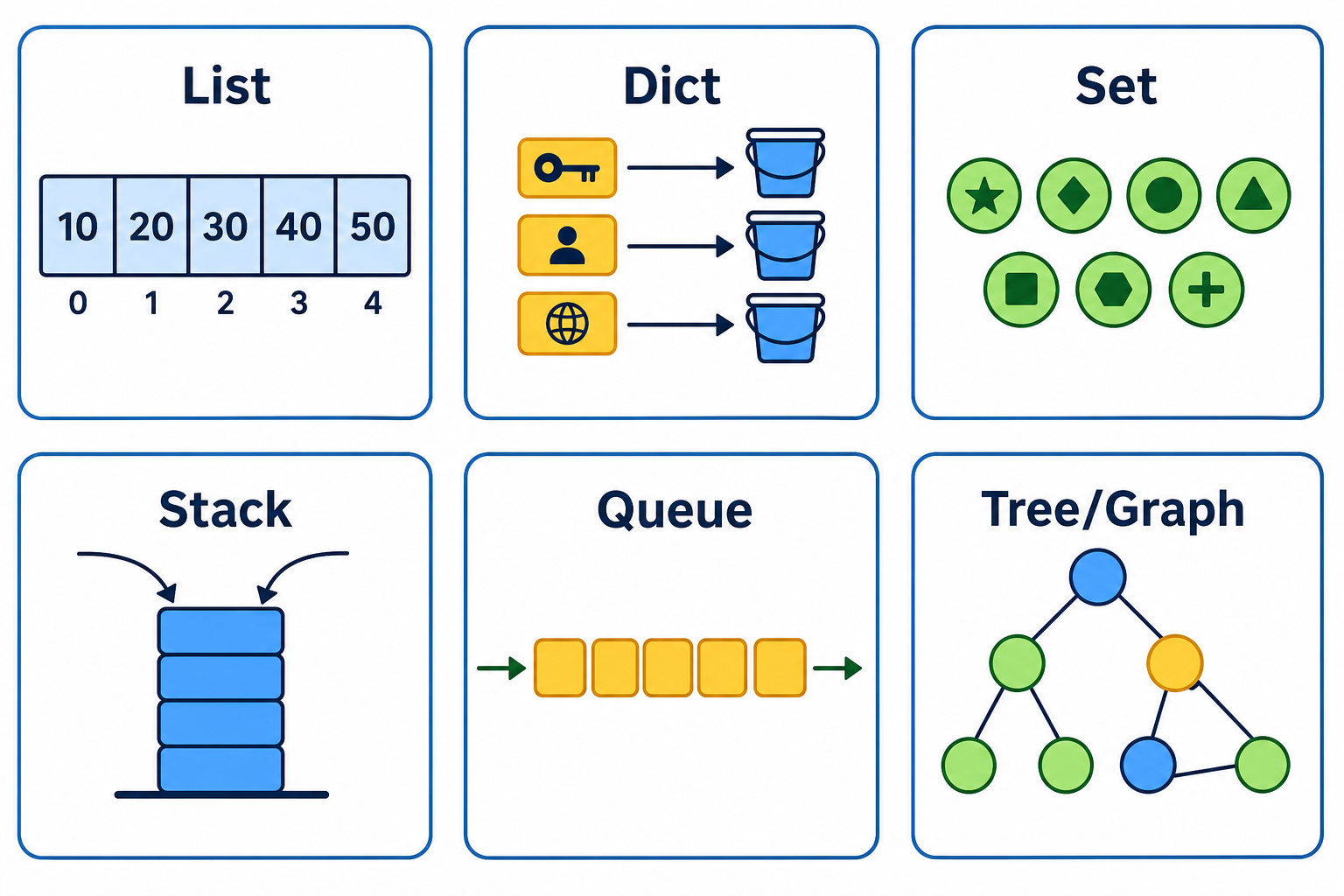
This guide focuses on the Python data structures that matter most in coding interviews: lists, tuples, dictionaries, sets, stacks, queues, heaps, trees, and graphs. You will see when to use each one, how to explain the tradeoffs, and what mistakes to avoid while solving problems under time pressure.
If you want to practice these choices in a realistic interview setting, totop.app can help you rehearse both the code and the explanation that interviewers expect.
The Interview Mental Model
Most data structure decisions start with three questions:
- Do I need fast lookup?
- Do I need ordering?
- Do I need to repeatedly access the smallest, largest, newest, or oldest item?
Those questions point you toward a small set of reliable choices:
| Need | Python structure | Common interview use |
|---|---|---|
| Indexed sequence | list | Two pointers, sliding window, dynamic programming |
| Immutable record | tuple | Coordinates, hashable composite keys |
| Fast key lookup | dict | Frequency maps, memoization, adjacency lists |
| Unique membership | set | Duplicate detection, visited tracking |
| Last-in first-out | list as stack | DFS, parsing, monotonic stack |
| First-in first-out | collections.deque | BFS, level order traversal |
| Priority access | heapq | Top K, scheduling, shortest path |
Lists: The Default Sequence
Python lists are dynamic arrays. They provide fast indexed reads and appends at the end, which makes them ideal for two-pointer problems, sliding windows, prefix sums, and dynamic programming tables.
Typical operations:
nums = [3, 1, 4, 1, 5]

nums.append(9)       # Amortized O(1)
last = nums[-1]      # O(1)
nums.sort()          # O(n log n)
In interviews, be precise about list costs. append() is usually constant time, but inserting or removing at the front is linear because elements must shift.
nums.pop(0) # O(n), avoid this for queue behavior
Use collections.deque when you need efficient operations at both ends.
Tuples: Small Immutable Records
Tuples are immutable sequences. They are useful when you need a stable, hashable value, such as a grid coordinate or a compound dictionary key.
visited = set()
cell = (row, col)

if cell not in visited:
    visited.add(cell)
The interview advantage is clarity. A tuple says, "this is a value that should not change." That is especially helpful in graph search, matrix traversal, and memoization.
Dictionaries: Fast Lookup and Counting
Python dictionaries are hash maps. They are the first tool to consider when a problem involves lookup, counting, grouping, memoization, or mapping one value to another.
def two_sum(nums, target):
    seen = {}

    for i, value in enumerate(nums):
        needed = target - value
        if needed in seen:
            return [seen[needed], i]
        seen[value] = i

    return []
The key interview point is that average lookup, insert, and delete are O(1). The tradeoff is extra memory. That is usually acceptable when it reduces a nested loop from O(n^2) to O(n).
For counting, reach for collections.Counter when it improves readability:
from collections import Counter

counts = Counter("interview")
print(counts["i"])  # 2
For grouping, defaultdict(list) often avoids noisy setup code:
from collections import defaultdict

groups = defaultdict(list)
for word in ["eat", "tea", "tan", "ate"]:
    key = tuple(sorted(word))
    groups[key].append(word)
Sets: Membership Without Duplicates
Sets are built for fast membership checks and uniqueness. They are common in duplicate detection, cycle detection, and "have we seen this before?" logic.
def contains_duplicate(nums):
    seen = set()

    for value in nums:
        if value in seen:
            return True
        seen.add(value)

    return False
A set is often the simplest way to move from brute force to linear time. Instead of scanning a list repeatedly, you store what you have already seen.
Be ready to mention that set elements must be hashable. Lists cannot go inside a set, but tuples can.
bad = [1, 2]
good = (1, 2)
Stacks: Last-In First-Out
Python does not need a separate stack type for most interview problems. A list works well when you only push and pop from the end.
stack = []
stack.append("open")
top = stack.pop()
Stacks are especially useful for:
- Valid parentheses
- Depth-first search
- Undo-like processing
- Expression evaluation
- Monotonic stack problems
Example:
def is_valid_parentheses(s):
    pairs = {")": "(", "]": "[", "}": "{"}
    stack = []

    for char in s:
        if char in "([{":
            stack.append(char)
        elif not stack or stack.pop() != pairs[char]:
            return False

    return not stack
When explaining this solution, say that the stack stores unresolved opening brackets. The most recent opening bracket must be the first one closed.
Queues and Deques: First-In First-Out
For queue behavior, use collections.deque. It provides efficient append and pop operations from both ends.
from collections import deque

queue = deque(["start"])
queue.append("next")
current = queue.popleft()
Queues are the natural fit for breadth-first search because BFS processes nodes in the order they are discovered.
from collections import deque

def shortest_path_length(graph, start, target):
    queue = deque([(start, 0)])
    visited = {start}

    while queue:
        node, distance = queue.popleft()
        if node == target:
            return distance

        for neighbor in graph[node]:
            if neighbor not in visited:
                visited.add(neighbor)
                queue.append((neighbor, distance + 1))

    return -1
Avoid using list.pop(0) for BFS. It works on small examples, but it creates an unnecessary O(n) cost each time you remove from the front.

Heaps: Priority Without Sorting Everything
Python's heapq module implements a min heap. It lets you repeatedly access the smallest item without sorting the full collection after each change.
import heapq

items = [5, 1, 8, 3]
heapq.heapify(items)

smallest = heapq.heappop(items)  # 1
Heaps are common in:
- Top K elements
- K closest points
- Merge K sorted lists
- Scheduling problems
- Dijkstra's shortest path algorithm
For a max heap, store negative values:
heap = []
for value in [5, 1, 8, 3]:
    heapq.heappush(heap, -value)

largest = -heapq.heappop(heap)
In an interview, explain that heap operations are O(log n), while peeking at the smallest item is O(1).
Trees and Graphs: Structure Plus Traversal
Trees and graphs are usually represented with nodes, adjacency lists, or dictionaries. The data structure is only half the solution; the traversal strategy matters just as much.
For binary trees, recursion is often clean:
def max_depth(root):
    if not root:
        return 0

    return 1 + max(max_depth(root.left), max_depth(root.right))
For graphs, a dictionary-backed adjacency list is usually the most interview-friendly representation:
graph = {
    "A": ["B", "C"],
    "B": ["D"],
    "C": [],
    "D": []
}
Use a set for visited nodes so you do not loop forever in cyclic graphs:
def dfs(graph, start):
    visited = set()
    stack = [start]

    while stack:
        node = stack.pop()
        if node in visited:
            continue

        visited.add(node)
        stack.extend(graph[node])

    return visited
Common Pitfalls to Avoid
Do not choose a data structure only because it is familiar. A list is easy to reach for, but it is the wrong choice for frequent membership checks when a set would be clearer and faster.
Watch for hidden linear operations:
if value in nums:  # O(n) for a list
    ...
Prefer this when membership is the core operation:
seen = set(nums)
if value in seen:  # Average O(1)
    ...
Do not overuse sorting. Sorting can simplify a problem, but it changes the time complexity to O(n log n) and may discard useful original order. If the problem asks for a linear solution, a hash map or two-pointer approach may be the intended path.
Finally, explain memory tradeoffs. Many strong Python interview solutions use extra space deliberately. That is not a weakness if you can justify the improvement in runtime.
How to Talk Through Your Choice
A strong explanation sounds like this:
"I need constant-time lookup for previously seen values, so I will use a dictionary. That gives me O(n) time with O(n) extra space instead of checking every pair."
Or:
"Because BFS needs first-in first-out behavior, I will use a deque. A list would work functionally, but removing from the front would be linear."
Those explanations show that you are not just writing Python syntax. You are making deliberate engineering decisions.
Conclusion
Python data structures are interview tools, not trivia. Lists, dictionaries, sets, stacks, queues, heaps, trees, and graphs each solve a different shape of problem. The goal is to recognize the shape quickly, choose the right structure, and explain the tradeoff clearly.
When you practice, do not only ask, "Did my code pass?" Ask, "Can I justify each data structure out loud?" That habit will make your solutions easier to follow in a real interview. For extra practice, use totop.app to rehearse the explanation as well as the implementation.