Java remains one of the most in-demand programming languages across enterprise software, Android development, and big data ecosystems. Whether you're a recent graduate or a seasoned developer aiming for a senior role, mastering Java interview questions is a critical step towards landing your dream job in 2026. This comprehensive guide covers the essential concepts, typical questions, and the best approaches to demonstrate your expertise.
1. Core Java Concepts and OOP Principles
At the heart of every Java interview is a deep dive into Object-Oriented Programming (OOP) principles and core language mechanics. Interviewers want to ensure you don't just know the syntax, but understand the why behind the design.
Key Topics to Master:
- Encapsulation, Inheritance, Polymorphism, and Abstraction: Be prepared to explain these concepts with real-world analogies and code examples.
- Interfaces vs. Abstract Classes: Understand the nuances, especially with the introduction of default methods in interfaces (Java 8+).
- String Pool and Immutability: Why are Strings immutable in Java? How does the String Constant Pool work?
- Exceptions: Checked vs. Unchecked exceptions, and the proper use of
try-catch-finallyblocks.
Example Question: Can you explain the difference between == and .equals() in Java?
Ideal Answer: == compares object references (memory addresses), while .equals() is a method used to compare the actual content or state of the objects. It's crucial to override .equals() (and hashCode()) when creating custom classes if you intend to compare their values.
2. JVM Architecture and Garbage Collection
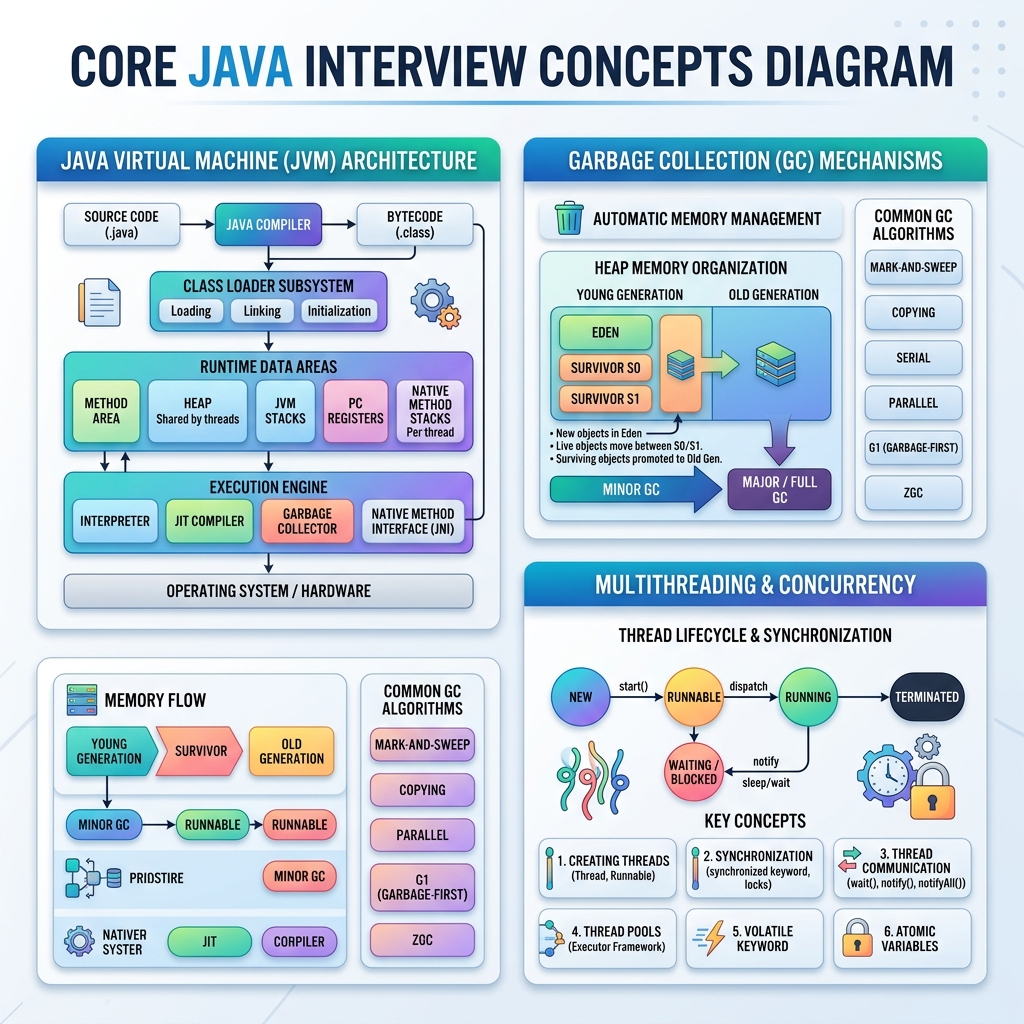
A solid understanding of the Java Virtual Machine (JVM) is what separates junior developers from senior engineers. You need to know how your code is executed and how memory is managed.
What to Review:
- Class Loader Subsystem: How classes are loaded, linked, and initialized.
- Runtime Data Areas: Method Area, Heap, Stack, PC Register, and Native Method Stack.
- Garbage Collection (GC): How automatic memory management works. Understand the different generations (Young, Old, Permanent/Metaspace) and common algorithms like Mark-and-Sweep, G1, and ZGC.
Example Question: How does Garbage Collection work in Java, and can you force it?
Ideal Answer: Garbage Collection is the process of automatically reclaiming unused memory by destroying unreferenced objects. While you can request GC using System.gc(), you cannot force it; the JVM decides when it's best to run the garbage collector.
3. Java Collections Framework
The Collections Framework is ubiquitous in Java development. You must know which collection to use in which scenario to write efficient and optimal code.
Essential Collections:
- List:
ArrayListvs.LinkedList. When to use which based on read/write operations. - Set:
HashSetvs.TreeSet. Understanding uniqueness and ordering. - Map:
HashMapvs.TreeMapvs.ConcurrentHashMap. How collision is handled inHashMapand when to use concurrent alternatives.
Example Question: How does a HashMap work internally?
Ideal Answer: A HashMap stores elements as key-value pairs using a hash table. It uses the key's hashCode() to determine the bucket location. If multiple keys have the same hash (a collision), they are stored in a linked list (or a balanced tree if the list gets too long, introduced in Java 8) within that bucket.
4. Multithreading and Concurrency
Modern applications require concurrent processing. Multithreading is a notoriously difficult topic, making it a favorite for interviewers to test your problem-solving skills and understanding of synchronization.
Crucial Concepts:
- Thread Lifecycle: New, Runnable, Running, Waiting/Blocked, Terminated.
- Synchronization: Using the
synchronizedkeyword, intrinsic locks, and thevolatilekeyword. - Executor Framework: Using Thread Pools instead of manually creating threads.
- Concurrent Collections: Using
ConcurrentHashMap,CopyOnWriteArrayList, etc., for thread safety without explicit synchronization.
// Example of a simple synchronized block
public class Counter {
    private int count = 0;

    public synchronized void increment() {
        count++;
    }

    public int getCount() {
        return count;
    }
}
5. Modern Java Features (Java 8 - Java 21+)
Interviewers will want to see that you've kept your skills up-to-date. Familiarity with newer language features shows that you are an active learner and can write modern, concise Java code.
Must-Know Features:
- Lambdas and Functional Interfaces: Writing concise code for single-method interfaces.
- Streams API: Functional-style operations on streams of elements (filter, map, reduce).
- Optional: Avoiding
NullPointerException. - Records (Java 14+): Compact syntax for declaring data-carrying classes.
- Pattern Matching (Java 16+): Simplifying
instanceofchecks andswitchstatements.
Modern Java (JDK 21–25) Deep Dive: Virtual Threads, G1GC vs. ZGC & Records
Modern Java interviews in 2026 heavily emphasize Project Loom (Virtual Threads), low-latency Garbage Collectors, and JVM memory model guarantees:
| Feature / Mechanism | Classic Platform Threads / Legacy Java | Modern Java (JDK 21+) | Interview Trade-Off Insight |
|---|---|---|---|
| Concurrency Model | java.lang.Thread wraps 1:1 OS kernel thread (~1 MB stack RAM, expensive context switches). | Virtual Threads (Executors.newVirtualThreadPerTaskExecutor()) multiplexed M:N over carrier pool (~few KB heap). | Virtual threads dramatically increase throughput for high-concurrency blocking I/O (JDBC, REST calls), but do NOT make CPU-bound loops run faster. |
| Garbage Collection | G1GC (Region-based, targets balanced throughput & ~50–200ms pause targets). | Generational ZGC (-XX:+UseZGC -XX:+ZGenerational) | Generational ZGC keeps pause times under 1 millisecond even on multi-terabyte heaps using colored pointers and load barriers, at the cost of slightly higher CPU overhead. |
| Data Carriers | Verbose mutable POJOs with boilerplate getters, equals, and hashCode. | record + sealed interface + Pattern Matching for switch | Enables algebraic data types (ADTs) where the compiler verifies exhaustiveness at compile time without default branches. |
6. What is "Thread Pinning" in Java Virtual Threads, and how do you prevent it?
Answer: Normally, when a Virtual Thread encounters a blocking I/O operation (like a socket read), the JVM unmounts it from its underlying OS carrier thread so the carrier thread can execute other virtual threads. However, if the virtual thread blocks while inside a synchronized block/method or a native JNI call (prior to JDK 24 JEP 491), it becomes pinned to the OS carrier thread, starving the carrier pool. To prevent pinning in high-throughput services, replace long-held synchronized locks around I/O operations with java.util.concurrent.locks.ReentrantLock.
7. How does the Java Memory Model (JMM) "Happens-Before" guarantee prevent concurrency bugs?
Answer: Without a happens-before relationship, the JVM JIT compiler and CPU cores are free to reorder instructions and cache variables in thread-local CPU registers, causing one thread to read stale state written by another thread. A happens-before edge—established by volatile reads/writes, synchronized monitor exits/entries, Thread.start()/join(), or java.util.concurrent atomics—guarantees both memory visibility (flushing CPU store buffers to main memory) and instruction ordering across threads.
Prepare with Confidence
Preparing for a Java interview requires reviewing concepts, practicing coding problems, and articulating your thought process clearly. To truly test your readiness in a realistic environment, try practicing with totop.app. It provides excellent resources and realistic mock interviews to help you perform your best when it matters most.
Good luck with your 2026 Java interviews!
Practice Staff Backend Engineer Questions Live with AI Mock Interviews
Turn any job description across Engineering, DevOps, Data, Marketing, Sales, Finance, or HR into a personalized test and live voice or text AI mock interview on totop.app, or test your speed right now in the 60-Second Staff Backend Engineer Blitz.
Play 60s Staff Backend Engineer Blitz (Free, No Login) | Start 14-Day Free Trial | Browse All Interview Guides