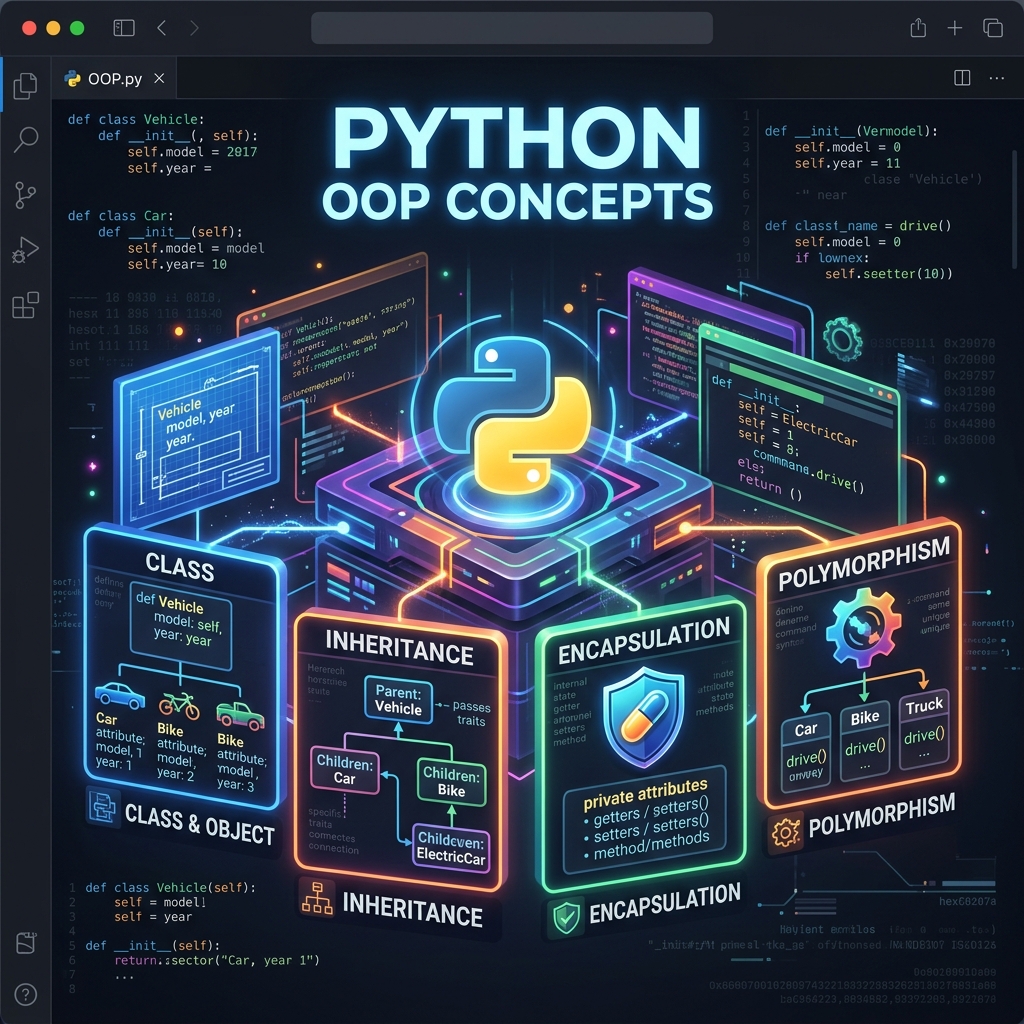
Object-Oriented Programming (OOP) is a programming paradigm that relies on the concept of classes and objects. It is used to structure a software program into simple, reusable pieces of code blueprints (usually called classes), which are used to create individual instances of objects.
If you are preparing for a Python software engineering interview, demonstrating a solid understanding of OOP principles is absolutely crucial. Interviewers will test your knowledge on how you design systems, encapsulate logic, and leverage inheritance to write DRY (Don't Repeat Yourself) code.
In this guide, we'll cover the top Python OOP interview questions and answers, complete with clear code examples. If you want to practice these concepts in a realistic interview setting, check out totop.app for AI-driven mock interviews tailored to your experience level.
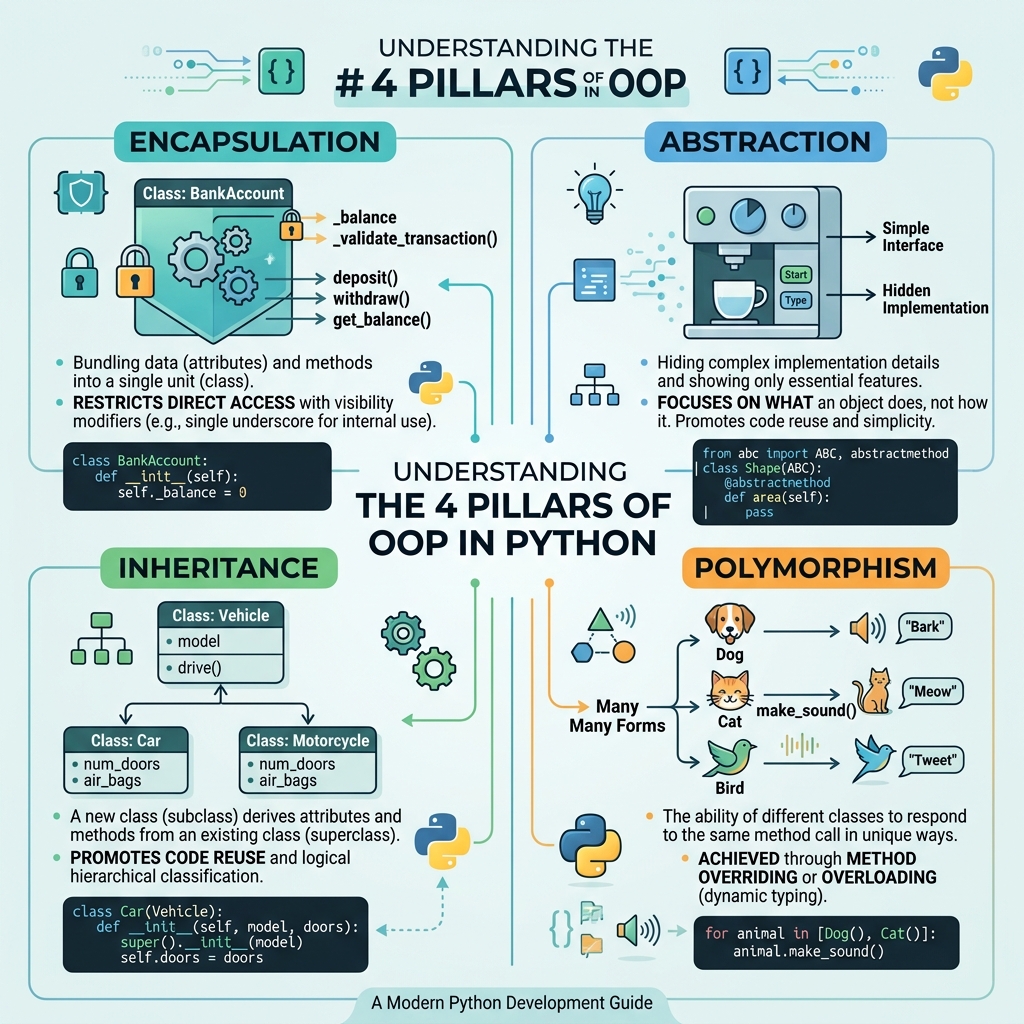
1. What are the four pillars of OOP?
This is the most fundamental question you will encounter. The four pillars are:
- Encapsulation: The bundling of data (attributes) and methods that operate on that data into a single unit (a class). It also restricts direct access to some of the object's components.
- Abstraction: Hiding complex implementation details and showing only the essential features of the object.
- Inheritance: A mechanism where a new class inherits properties and behaviors from an existing class.
- Polymorphism: The ability of different classes to respond to the same method call in their own unique way.
2. How is Encapsulation implemented in Python?
Unlike languages like Java or C++, Python does not have strict access modifiers like public, private, or protected. Instead, Python relies on conventions:
- Public attributes: Accessible from anywhere. (e.g.,
self.name) - Protected attributes: Prefix with a single underscore
_. It's a convention indicating that the attribute is meant for internal use, though it can still be accessed. (e.g.,self._age) - Private attributes: Prefix with a double underscore
__. This triggers "name mangling," making it harder (though not impossible) to access from outside the class. (e.g.,self.__password)
Example:
class BankAccount:
    def __init__(self, owner, balance):
        self.owner = owner          # Public
        self._account_type = "Checking" # Protected
        self.__balance = balance    # Private (Name Mangled)

    def get_balance(self):
        return self.__balance # Proper way to access private attribute

account = BankAccount("Alice", 1000)
print(account.owner) # Output: Alice
print(account.get_balance()) # Output: 1000
# print(account.__balance) # Raises AttributeError!
3. What is the purpose of the self parameter in Python?
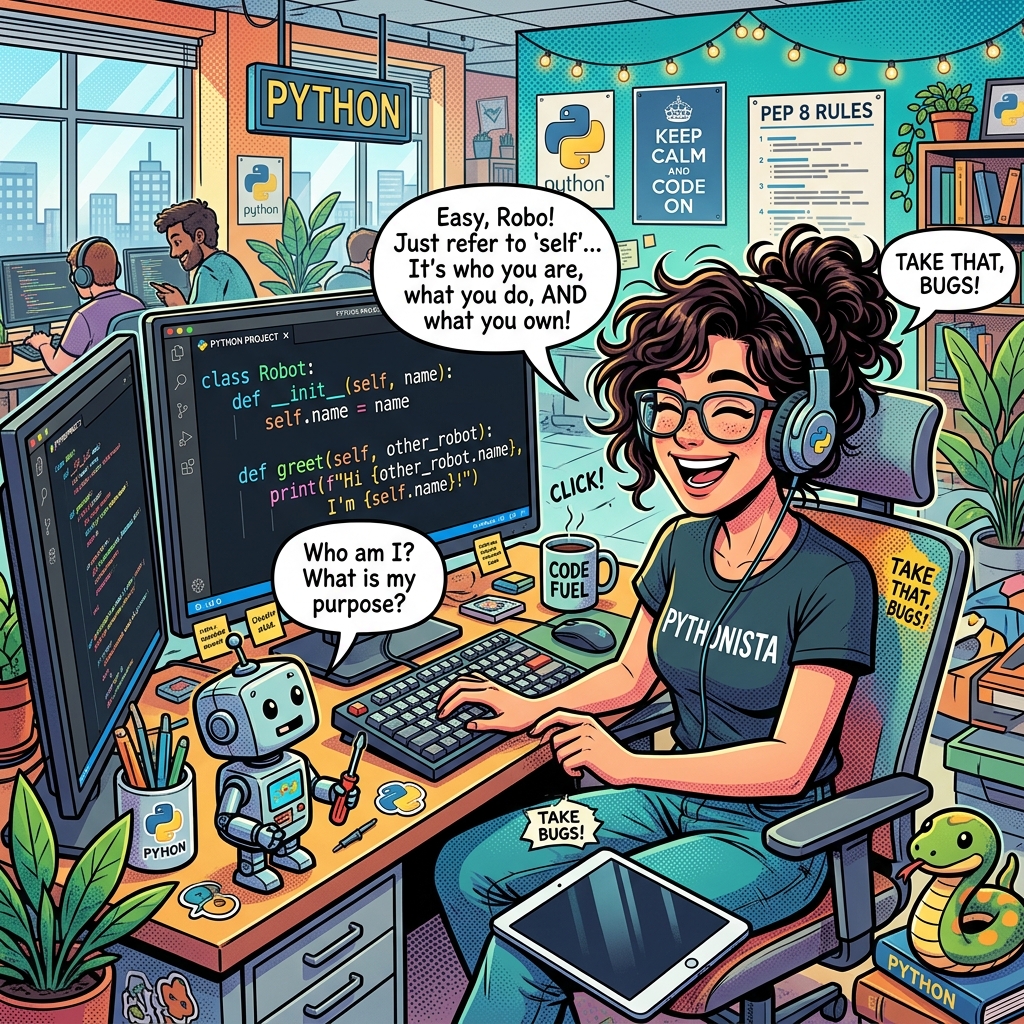
In Python, self represents the instance of the class. By using the self keyword, we can access the attributes and methods of the class in python. It binds the attributes with the given arguments.
Unlike other languages where this is implicit (like this in Java or C++), Python requires self to be explicitly passed as the first parameter in instance methods.
Example:
class Dog:
    def __init__(self, name):
        self.name = name # 'self' binds the name to the specific instance

    def bark(self):
        print(f"{self.name} says woof!") # Accessing instance attribute using 'self'

my_dog = Dog("Buddy")
my_dog.bark() # Output: Buddy says woof!
4. Explain Inheritance and super() in Python.
Inheritance allows a child class to acquire the properties and methods of a parent class. It promotes code reusability. The super() built-in function returns a temporary object of the superclass that allows you to call its methods, most commonly used in the __init__ method.
Example:
class Animal:
    def __init__(self, species):
        self.species = species

    def make_sound(self):
        return "Generic animal sound"

class Cat(Animal):
    def __init__(self, name):
        # Call the parent class's __init__ method
        super().__init__(species="Feline")
        self.name = name

    def make_sound(self):
        return "Meow" # Overriding the parent method

my_cat = Cat("Whiskers")
print(my_cat.species)    # Output: Feline (Inherited)
print(my_cat.make_sound()) # Output: Meow (Overridden)
5. How does Python support Multiple Inheritance?
Python, unlike Java, supports multiple inheritance, meaning a class can inherit from more than one parent class. When multiple inheritance is used, Python resolves method calls using the Method Resolution Order (MRO).
MRO determines the order in which base classes are searched when executing a method. You can view the MRO by calling the __mro__ attribute or the mro() method on a class.
Example:
class Flyer:
    def fly(self):
        return "Flapping wings"

class Swimmer:
    def swim(self):
        return "Paddling water"

class Duck(Flyer, Swimmer):
    pass

daffy = Duck()
print(daffy.fly())  # Output: Flapping wings
print(daffy.swim()) # Output: Paddling water
print(Duck.__mro__) # Output: (<class '__main__.Duck'>, <class '__main__.Flyer'>, <class '__main__.Swimmer'>, <class 'object'>)
6. What are @classmethod and @staticmethod?
Both decorators are used to define methods that can be called on the class itself, rather than on an instance of the class.
@classmethod: Takes the class itself (cls) as the first argument instead of the instance (self). They are often used as alternative constructors (such asfrom_jsonorfrom_Timestampfactory methods) or to read and modify class-level state safely across subclasses.@staticmethod: Does not take a default first argument (neitherselfnorcls). It behaves like a regular function but belongs to the class's namespace. It is used for pure utility functions that logically group with the class without needing access to class or instance attributes.
Example:
class MathUtils:
    multiplier = 2

    @classmethod
    def multiply_by_class_variable(cls, value):
        return value * cls.multiplier

    @staticmethod
    def add(x, y):
        return x + y

print(MathUtils.multiply_by_class_variable(5)) # Output: 10
print(MathUtils.add(3, 4))                     # Output: 7
Encapsulation in Python: Public, Protected (_), Private (__) & @property
Unlike Java or C++, Python does not enforce strict compile-time private access modifiers. Instead, Python follows the philosophy "We are all consenting adults here" and implements encapsulation in Python through three mechanisms:
| Convention | Syntax | Runtime Behavior in Python | When to Use It in Production |
|---|---|---|---|
| Public Attribute | self.balance | Accessible and mutable from anywhere. | Default for simple data attributes; can be upgraded to a @property later without breaking callers! |
| Protected (Single Underscore) | self._balance | Convention signaling "internal implementation detail—do not touch outside class/subclasses"; skipped by from module import *. | Internal state shared across subclasses or package modules. |
| Private Name Mangling (Double Underscore) | self.__balance | Interpreter rewrites the attribute name to _ClassName__balance in __dict__ to prevent accidental override in subclasses. | Avoiding attribute name collisions in deep inheritance hierarchies or mixins. |
Managed Property (@property) | @property def balance(self) | Intercepts attribute reads/writes (@balance.setter) via the Descriptor Protocol while keeping clean obj.balance dot syntax. | Validating invariants (e.g., rejecting negative balances) or computing derived values lazily. |
Code Example: Enforcing Encapsulation with @property and __slots__
class BankAccount:
    __slots__ = ("_owner", "_balance")  # Prevents dynamic attribute creation & saves ~50% RAM

    def __init__(self, owner: str, initial_balance: float = 0.0) -> None:
        self._owner = owner
        self._balance = 0.0
        self.balance = initial_balance  # Routes through @balance.setter validation!

    @property
    def balance(self) -> float:
        return self._balance

    @balance.setter
    def balance(self, amount: float) -> None:
        if amount < 0:
            raise ValueError("Account balance cannot be negative")
        self._balance = float(amount)
7. How does Python's Method Resolution Order (MRO) and the C3 Linearization Algorithm resolve the "Diamond Problem" in Multiple Inheritance?
Answer: When a class inherits from multiple parent classes that share a common base class, Python computes a deterministic linear lookup sequence stored in ClassName.__mro__ (or ClassName.mro()) using C3 Linearization. C3 preserves three invariants: subclasses always appear before their base classes, left-to-right base declaration order is respected, and no class is visited twice. Calling super().__init__() inside a method does not simply call the immediate parent class—it delegates to the next class in the active instance's MRO, enabling cooperative multiple inheritance and mixin composition without initializing the root base class twice! When designing modern domain models in Python, combine Abstract Base Classes or Structural Protocols with dataclasses to keep inheritance hierarchies shallow and easy to test.
Conclusion
Understanding Object-Oriented Programming in Python is a fundamental requirement for most software engineering roles. Mastering encapsulation, inheritance, polymorphism, and Python-specific concepts like self, super(), and method resolution order will make you a much stronger candidate.
To truly prepare for your upcoming interviews, you need to practice articulating these concepts verbally. Head over to totop.app and try a realistic mock interview today. You'll get immediate feedback on your answers and build the confidence you need to ace the real thing!
Practice Staff Backend Engineer Questions Live with AI Mock Interviews
Turn any job description across Engineering, DevOps, Data, Marketing, Sales, Finance, or HR into a personalized test and live voice or text AI mock interview on totop.app, or test your speed right now in the 60-Second Staff Backend Engineer Blitz.
Play 60s Staff Backend Engineer Blitz (Free, No Login) | Start 14-Day Free Trial | Browse All Interview Guides