In modern corporate hiring, interviews for Employee Relations (ER) Managers, HR Directors, and People Operations leaders have shifted away from theoretical policy questions. Reciting statutory compliance rules or defining Title VII is no longer sufficient to impress an executive hiring committee. Today, hiring panels consisting of Chief People Officers, General Counsels, and VP-level business leaders utilize live situational simulations to test your investigative rigor under pressure.
You are placed in the hot seat with an unscripted scenario: "You are our Employee Relations Lead. A Senior Engineering Manager has just received a formal complaint from a junior software developer alleging hostile work environment conditions and targeted microaggressions. Concurrently, the manager submitted a poor performance rating and recommended placing the developer on an immediate Performance Improvement Plan (PIP). Both parties are demanding an urgent resolution before end of day. Walk us through your triage, witness interview strategy, and risk containment plan."
Preparing for an employee relations workplace investigation hr interview requires mastering procedural due process, evidence evaluation standards, witness interrogation dynamics, and executive conflict management. This guide breaks down the core competencies hiring committees evaluate, details an end-to-end investigative lifecycle, provides three high-stakes roleplay prompts with model answers, and shares an objective credibility assessment matrix.

Anatomy of the Scenario-Based HR Interview: What Panels Evaluate
When an executive panel evaluates an ER candidate during a simulation or case study, they look far beyond textbook human resources knowledge. They assess whether you possess the professional maturity to remain completely impartial while protecting both employee rights and organizational integrity.
Executive interviewers evaluate candidates across four distinct evaluation pillars:
- Procedural Rigor and Due Process: Does the candidate adhere to structured legal frameworks, document contemporaneous notes, define a clear scope of investigation, and ensure that respondents receive fair notice and an opportunity to respond before findings are reached?
- Evidentiary Neutrality and Bias Mitigation: Can the candidate separate emotion, hearsay, and political influence from verifiable empirical facts? Candidates must resist the temptation to take sides prematurely or accept circumstantial claims without corroboration.
- Legal Risk Balancing: Can the candidate recognize critical legal exposures, including protected whistleblowing disclosures, retaliation risks under Title VII and state labor statutes, and constructive discharge threats?
- Executive Stakeholder Communication: How does the candidate deliver adverse findings to senior executives? Great candidates present clear, fact-backed recommendations without hedging, while guiding leadership through corrective disciplinary actions.
While standard HR Business Partners focus on organizational development, headcount planning, and coaching managers (as covered in our guide on HR business partner interview questions), dedicated Employee Relations professionals act as neutral fact-finders. In an interview, confusing advocacy with objective investigation is the fastest way to receive a rejection.
End-to-End Investigation Lifecycle: The 5-Phase Protocol
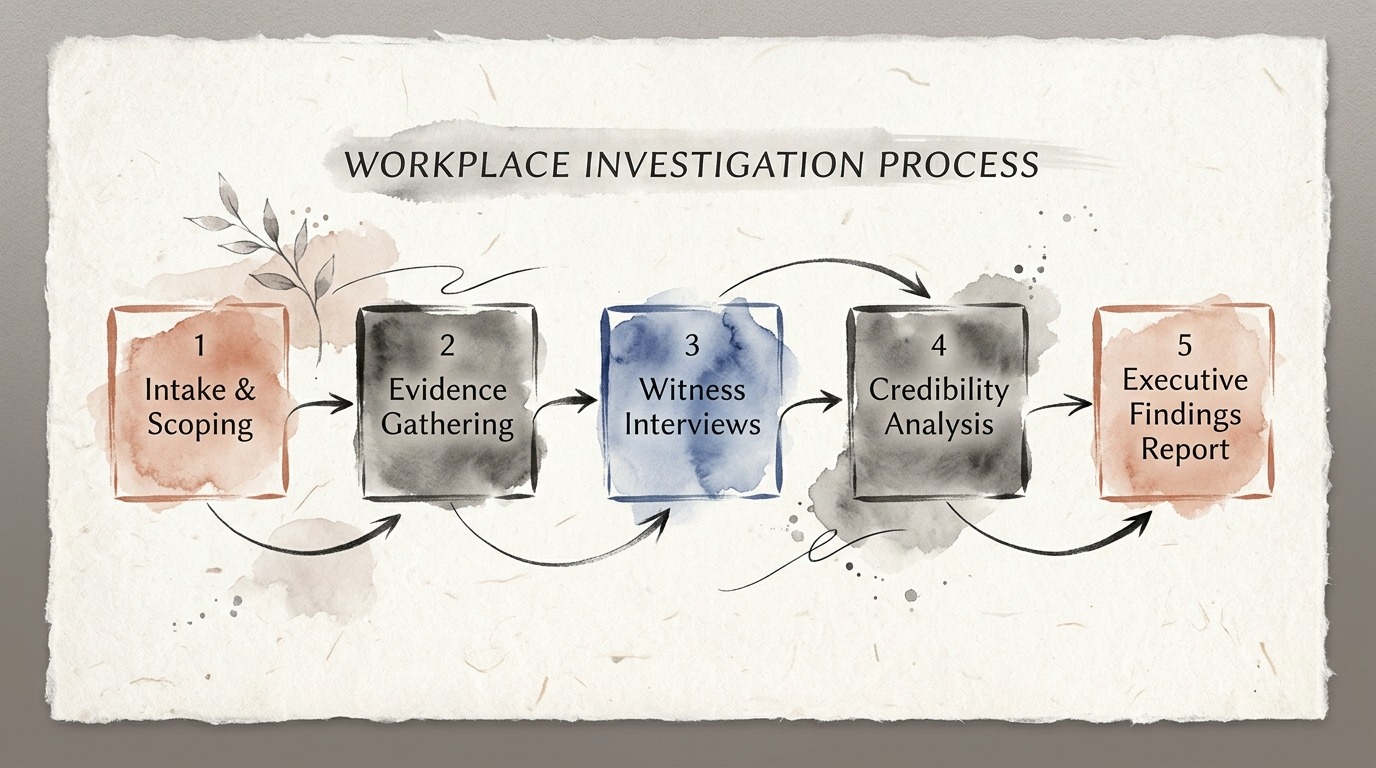
To structure your answers during an investigative simulation, you need a disciplined, repeatable framework. Seasoned ER leaders organize their response across five systematic phases.
Phase 1: Intake, Triage & Scope Definition
Every investigation begins with intake. The ER professional must document the initial allegations, determine whether the complaint falls under formal policy violations (harassment, discrimination, retaliation, fraud) or interpersonal workplace conflict, and establish jurisdictional scope. If immediate physical safety, criminal conduct, or severe executive misconduct is alleged, interim measures (such as paid administrative leave or temporary reporting line changes) must be enacted immediately without penalizing the reporting party.
Phase 2: Evidence Preservation & Digital Forensics
Before interviewing witnesses who might alter evidence or coordinate narratives, the investigator preserves objective digital records. This includes:
- Slack, Microsoft Teams, and email communications logs.
- Document revision histories, pull request review comments, and Jira ticket updates.
- Badge swipe access logs, calendar invitations, and system audit trails.
Securing contemporaneous digital artifacts provides an unvarnished baseline against which witness recollections can later be evaluated.
Phase 3: Witness Interview Sequencing
The order in which you interview individuals determines the quality of your findings. A disciplined investigator follows a structured sequence:
- Complainant: Elicit detailed, chronological accounts, identify specific statements, times, locations, and request names of direct witnesses and supporting documents.
- Direct Fact Witnesses: Interview individuals directly identified as present during specific incidents before rumors spread across the department.
- Indirect / Contextual Witnesses: Interview peers or supervisors solely to verify standard operational procedures or baseline team dynamics.
- Respondent: Present the specific factual allegations clearly, provide full opportunity to explain or dispute each point, and collect their supporting evidence.
Phase 4: Credibility Analysis & Standard of Proof
Unlike criminal court proceedings that require proof beyond a reasonable doubt, workplace investigations operate under the civil standard: the preponderance of the evidence (i.e., whether it is more likely than not that the alleged conduct occurred). When accounts conflict directly in a he-said-she-said scenario, the investigator applies established credibility factors rather than throwing their hands up in defeat.
Phase 5: Investigative Findings & Executive Remediation
The final phase produces a formal Investigative Summary Report. This document outlines the initial complaint, investigative scope, undisputed facts, disputed claims, credibility assessments, factual findings (substantiated, unsubstantiated, or inconclusive), and actionable policy recommendations.
The 3 High-Stakes Roleplay Prompts Interviewers Use
Interviewers test your instincts by giving you complex, multi-layered roleplay scenarios where there are no easy answers. Here are three representative prompts frequently used by enterprise interview panels, along with breakdown strategies and model responses.
Prompt 1: The High-Performing Revenue Leader Harassment Complaint
The Scenario: "You are our Head of Employee Relations. The company's top enterprise Account Executive, responsible for 35% of annual software revenue, has been accused by an SDR of sending inappropriate late-night WhatsApp messages during an offsite conference. The VP of Sales approaches you privately and whispers: 'We are closing a $10M enterprise deal this Friday. Do not blow this out of proportion or distract my team until the contract is signed.' How do you respond to the VP of Sales, and how do you execute this investigation?"
The Trap
Weak candidates either capitulate to commercial pressure by delaying the investigation until after the quarter closes, or react combatively by accusing the VP of Sales of obstruction. Both approaches fail the interview. Delaying exposes the organization to massive legal liability and damages culture, while hostility alienates key stakeholders.
Model Candidate Response Walkthrough
- "I begin by acknowledging the commercial significance of the quarter-end deadline with the VP of Sales, but firmly establish the non-negotiable legal and ethical imperative: prompt and thorough investigation of harassment claims is mandated by company policy and statutory guidelines. Postponing an inquiry exposes the company to severe legal liability under Title VII and compromises witness testimony integrity.
- I implement immediate, non-punitive interim safeguards to protect the complainant while minimizing operational disruption. I instruct the Account Executive and SDR to maintain zero direct communication, temporarily routing deal qualification through an alternate Sales Manager.
- I conduct an urgent intake interview with the reporting SDR within 24 hours, reviewing the exported WhatsApp communication transcripts, timestamps, and contextual messages.
- Next, I interview the Account Executive in a private, formal setting. I present the messages objectively without editorializing: 'We have documented these messages sent from your device at 11:45 PM on October 12th. Walk me through the context of these communications.'
- Once the evidentiary review is complete, I deliver findings to Legal and the Chief People Officer. If substantiated, accountability must be enforced uniformly, regardless of quota achievement or revenue generation. High performance never excuses statutory workplace harassment."
For candidates navigating high-stakes business environments, our analysis of enterprise sales interview questions illustrates the organizational pressures revenue leaders operate under.
Prompt 2: The Retaliation Claim and Covert Performance PIP
The Scenario: "An engineer reported safety and accounting irregularities in an internal audit three weeks ago. Yesterday, their Director issued a formal Performance Improvement Plan (PIP) citing missed sprint deliverables over the past two quarters. The engineer immediately files an ER complaint alleging unlawful retaliation. The Director insists the performance issues were documented long before the whistleblower report. How do you investigate this situation?"
The Trap
Many candidates take the manager's PIP documentation at face value or assume the employee's poor performance automatically disqualifies their retaliation claim. In reality, close temporal proximity (three weeks between protected activity and an adverse employment action) creates a prime prima facie case of retaliation.
Model Candidate Response Walkthrough
- "I immediately treat this as a high-risk retaliation investigation. Under whistleblower protection standards, temporal proximity creates significant legal exposure.
- My first action is requesting an immediate administrative hold on the PIP progression. Pausing the PIP preserves the status quo and shields the company from retaliation claims while we examine the underlying facts.
- I conduct an objective chronological audit. I inspect performance documentation generated prior to the protected disclosure: Did the Director give verbal warnings or written feedback in 1:1 notes, sprint reviews, or quarterly evaluations before the audit disclosure? Or did the negative ratings emerge abruptly following the report?
- I compare peer calibration data across the engineering department: Are other engineers with identical sprint velocity metrics placed on PIPs, or is this employee being held to a disparate standard? You can review how engineering managers calibrate technical contributions in our overview of leadership questions in engineering manager interviews.
- During the Director's interview, I ask precise, neutral timeline questions: 'Can you provide the contemporaneous documentation and Slack conversations from Q1 and Q2 where these delivery shortfalls were communicated to the employee?'
- If the Director cannot produce pre-existing written documentation, the PIP must be rescinded due to procedural deficiency and retaliation risk, and management coaching or disciplinary action must be initiated."
Prompt 3: The Zero-Witness He-Said-She-Said Hostile Environment
The Scenario: "An employee alleges that their team lead made derogatory comments regarding their national origin during a 1-on-1 hallway discussion. There are no Slack records, no emails, and no direct eyewitnesses. The team lead categorically denies ever making the remark and claims the employee is fabricating the incident due to resentment over project assignments. How do you reach a finding?"
The Trap
Inexperienced HR professionals conclude the investigation as 'inconclusive' simply because there are no eyewitnesses or written records. Inconclusive findings in credible cases erode employee trust and signal organizational helplessness.
Model Candidate Response Walkthrough
- "A lack of eyewitnesses does not mean an investigation is inconclusive. In civil and workplace jurisprudence, credibility assessments allow investigators to determine findings based on the preponderance of evidence.
- I apply the standard Equal Employment Opportunity Commission (EEOC) credibility assessment matrix, evaluating five distinct objective criteria:
- Inherent Plausibility: Is the testimony believable on its face? Does the sequence of events make logical sense within the workplace context?
- Contemporaneous Disclosures: Did the complainant confide in a colleague, mentor, spouse, or medical professional immediately after exiting the hallway? A text message sent ten minutes later saying 'I am in shock by what my lead just said to me' serves as potent corroborating evidence.
- Demeanor and Consistency: Did both parties maintain consistent accounts across multiple interview sessions, or did details shift when pressed on specific timelines?
- Motive to Falsify: Did either party have a tangible personal or financial incentive to misrepresent the facts?
- Past Patterns and Historical Complaints: Has this lead been the subject of similar informal grievances or exit interview remarks from former team members?
- By cross-referencing contemporaneous third-party disclosures and historical departmental patterns, an investigator can reliably establish whether the incident is substantiated or unsubstantiated under the preponderance standard."
The Credibility Assessment Matrix & Evidence Rubric
When presenting investigation strategies in an hr interview, utilizing a structured rubric demonstrates analytical excellence. The following credibility assessment matrix contrasts superficial candidate responses with senior enterprise standards:
| Credibility Evaluation Factor | Practical Evidence Examined | Novice Candidate Approach | Staff ER Lead Standard |
|---|---|---|---|
| Inherent Plausibility | Logical coherence, physical possibility, timeline feasibility | Accepts statements at face value without validating spatial or physical logistics | Maps physical locations, calendar conflicts, and verify badge logs to confirm possibility |
| Contemporaneous Documentation | Notes taken during or immediately following incidents, messages to peers | Relies solely on formal company emails and official Jira tickets | Subpoenas or requests instant messaging logs, personal call logs, and contemporaneous peer disclosures |
| Motive to Falsify | Pending layoffs, disciplinary write-ups, romantic disputes, promotions | Assumes employees either never lie or always exaggerate claims | Analyzes timing of disciplinary actions, promotion denials, or compensation negotiations objectively |
| Internal & External Consistency | Stability of narrative across multiple interview rounds | Takes notes once and rarely probes slight timeline contradictions | Uses the cognitive interview funnel; cross-checks interview statements against prior depositions |
| Past Conduct & Pattern Evidence | Historical ER files, past warnings, exit interview feedback trends | Treats each incident in complete isolation, ignoring institutional history | Analyzes systemic departmental turnover, prior settlement records, and informal complaint logs |
Mastering this rubric proves to hiring managers that you conduct rigorous investigations that withstand scrutiny from outside labor attorneys.
Witness Interview Scripting: Funnel Technique & Question Formats
Interview technique is a crucial differentiator in roleplay assessments. Seasoned ER investigators employ the Cognitive Funnel Method, transitioning from broad open-ended discovery to focused clarifying probes, concluding with direct factual confrontation.
       ▼ Broad Open-Ended Narrative ("Tell me what occurred during the meeting...")
      ▼▼ Clarifying Sensory Probes ("Who was standing nearby? Where were you seated?")
     ▼▼▼ Direct Fact Verification ("The complainant stated X was said; how do you respond?")
    ▼▼▼▼ Administrative & Non-Retaliation Closing ("Acknowledge confidentiality obligations...")
1. Open-Ended Narrative Gathering
Start interviews by allowing the witness to tell their story without interruption:
- "In your own words, walk me through what occurred during the project debrief last Tuesday."
- "What happened next?"
- "Who else was present or within earshot during that conversation?"
2. Clarifying and Sensory Probes
Once the baseline story is established, probe for sensory and contextual precision:
- "Where specifically were you standing relative to the conference table when that statement was made?"
- "What was the tone of voice and physical posture of each individual?"
- "Did you discuss this interaction with anyone else afterward? If so, when and through what channel?"
3. Direct Fact Verification and Confrontation
When questioning the respondent, do not dance around sensitive topics. Present allegations clearly and neutrally:
- "The reporting party stated that on Thursday at 3:15 PM, you said [exact quote]. How do you respond to that specific account?"
- "We have reviewed Slack chat logs from that afternoon showing [statement]. Can you help me understand the context behind this communication?"
4. Due Process and Anti-Retaliation Closing Script
Every investigative interview must conclude with clear procedural admonitions:
- "I want to remind you that our company maintains a strict zero-tolerance policy regarding retaliation. Any adverse action, change in behavior, or negative commentary directed toward anyone involved in this inquiry constitutes a standalone terminable offense."
- "While we maintain confidentiality to the greatest extent possible to conduct a thorough review, absolute secrecy cannot be promised when corrective action or legal obligations require disclosure."
Candidates interviewing for broader people leadership roles will find similar structural communication techniques in our guide to people operations interview questions.
Avoiding Common Traps in Employee Relations Case Studies
During live interview roleplay, candidates frequently stumble into common operational pitfalls. Being conscious of these traps will set you apart from other applicants:
Trap 1: Promising Absolute Confidentiality
Novice HR candidates often attempt to comfort an anxious complainant by promising: "Everything you share with me will stay strictly between us." In a legal context, this is a catastrophic error. Employers have a statutory obligation to investigate severe misconduct once put on notice. The correct formulation is: "We will protect your privacy and treat this information with the highest degree of discretion, sharing details solely with individuals who have a legitimate business need to know." If an unexpected line of questioning arises during your interview, remember the principles in handling tough interview questions gracefully.
Trap 2: Conflating Company Advocate with Impartial Fact-Finder
Executive interviewers often test your neutrality by having a roleplayer push you to protect company optics: "Can we just quietly settle this so it doesn't leak to TechCrunch?" Your answer must emphasize that the best protection for the enterprise is an impeccable, unassailable investigation. Compromising procedural integrity creates far greater legal liability down the road.
Trap 3: Neglecting Post-Investigation Health Checks
An investigation does not end when the final report is signed. Top-tier candidates explicitly discuss post-investigation monitoring:
- Scheduling 30, 60, and 90-day check-ins with the complainant to ensure no subtle retaliation is occurring.
- Auditing team performance review distributions to verify objective scoring.
- Conducting department-wide culture pulse surveys to remediate underlying friction.
Simulating High-Pressure Case Studies Before the Live Round
Mastering an employee relations workplace investigation hr interview requires practice in verbal articulation. Reading investigation manuals gives you theoretical knowledge, but real-time simulations test your emotional control, tone modulation, and ability to handle hostile respondents.
Before stepping into your next interview loop:
- Test Your Baseline Knowledge Under Clock Pressure: Challenge yourself with rapid-fire questions covering compliance regulations, conflict management, and triage logic using our free 60-Second Job Blitz.
- Rehearse Unscripted Roleplay with AI Personas: Practice witness interviews out loud with specialized AI interviewers that simulate emotional complainants, defensive managers, and skeptical executives. Explore our comprehensive voice roleplay modules on our pricing and plans page.
Approaching your interview with structured frameworks, disciplined credibility assessment methods, and clear due process guarantees will position you as an indispensable Employee Relations leader ready to protect your company's workforce and culture.
Practice HR Business Partner Questions Live with AI Mock Interviews
Turn any job description across Engineering, DevOps, Data, Marketing, Sales, Finance, or HR into a personalized test and live voice or text AI mock interview on totop.app, or test your speed right now in the 60-Second HR Business Partner Blitz.
Play 60s HR Business Partner Blitz (Free, No Login) | Start 14-Day Free Trial | Browse All Interview Guides