100 HR Interview Questions and Answers (for HR Roles)
Sitting on the candidate side of an HR interview is a unique challenge. After all, when human resources professionals interview for an HR role, the interviewer expects top-tier answers, flawless behavioral structures, and a clear understanding of modern workplace dynamics.
Whether you are applying for an HR Coordinator, HR Generalist, HR Business Partner (HRBP), Recruiter, or HR Director position, this comprehensive guide breaks down 100 key HR interview questions and answers.
We have categorized these questions by core HR functions—ranging from talent acquisition and employee relations to HR analytics, labor compliance, and executive HR strategy—complete with structured response frameworks to help you stand out.
Quick Navigation
- General & Career Motivation Questions
- Talent Acquisition & Recruitment Strategy
- Employee Relations & Conflict Resolution
- HR Analytics, Compensation & Benefits
- Labor Compliance, Law & Ethics
- Strategic HR Leadership & Culture
- Behavioral Questions (STAR Method)
- Situational & Crisis Management Scenarios
How HR Interviews Are Evaluated
HR hiring panels do not evaluate candidates solely on theoretical knowledge of labor law or recruitment metrics. They assess human empathy, business acumen, judgment under pressure, and communication clarity.
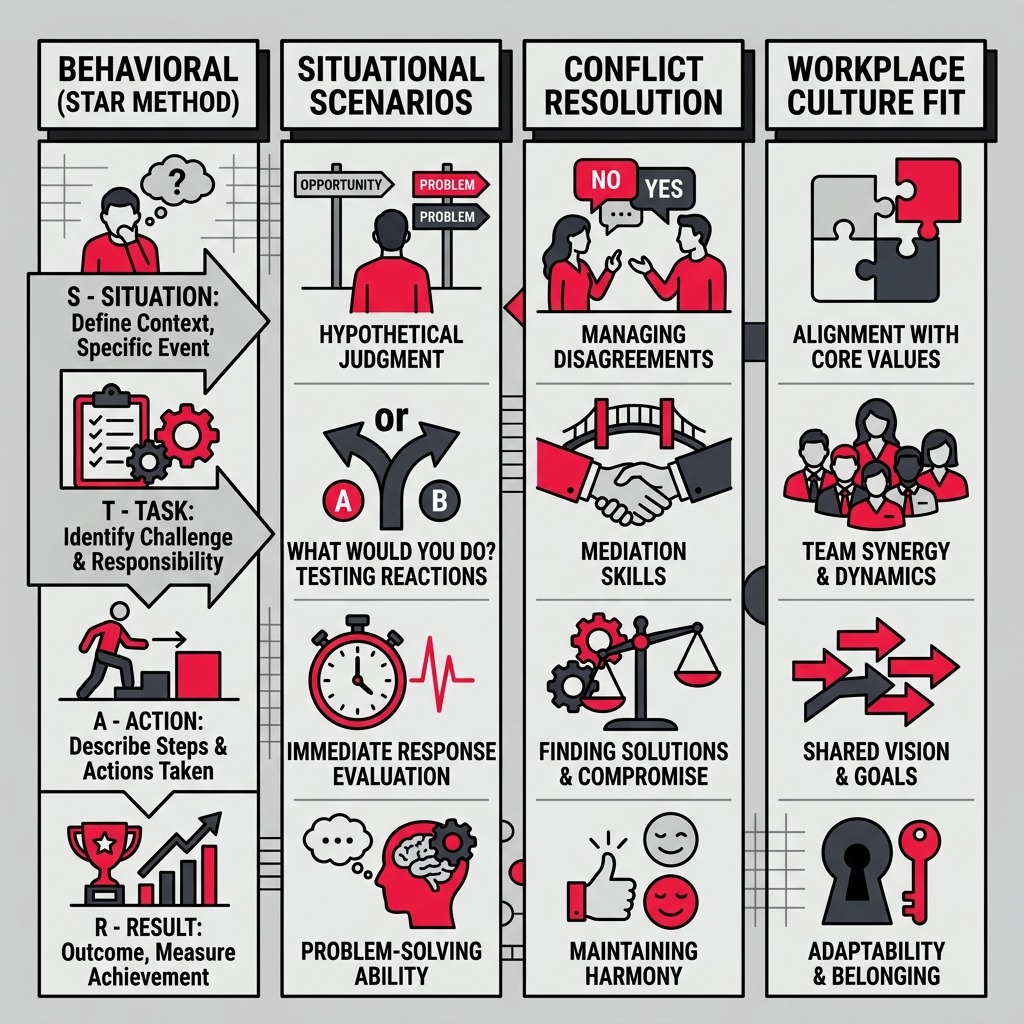
When answering questions in your interview:
- Use the STAR Method (Situation, Task, Action, Result) for behavioral questions.
- Balance empathy with business goals—demonstrate how employee advocacy aligns with company objectives.
- Incorporate data—mention metrics like Time-to-Fill, Retention Rate, eNPS, or Cost-per-Hire whenever relevant.
1. General & Career Motivation Questions
Q1. Why did you choose a career in Human Resources?
Sample Answer:
"I chose HR because it sits at the intersection of business strategy and human potential. Early in my career, I realized that a company’s strongest growth lever isn't just technology or capital—it's people. I enjoy building systems that support employees throughout their lifecycle while aligning talent operations with business revenue goals."
Q2. How do you stay updated with changing employment laws and HR trends?
Sample Answer:
"I maintain active memberships with SHRM and local HR associations, subscribe to legal bulletins from employment law firms, and attend industry webinars. I also regularly review updates from regulatory bodies like the EEOC and OSHA."
Q3. How do you balance being an employee advocate with representing executive management?
Sample Answer:
"I see these two goals as mutually dependent rather than opposing. When employees feel heard, respected, and fairly compensated, retention and performance rise—directly benefiting management. My role is to foster transparent communication and build policies that protect both employee rights and organizational objectives."
Q4. What is your favorite HR metric to track and why?
Sample Answer:
"I closely track 90-day new-hire turnover alongside eNPS (Employee Net Promoter Score). While time-to-fill tells you about recruitment speed, early turnover tells you about job-fit quality, onboarding health, and psychological safety."
Q5. Describe your experience with HR Information Systems (HRIS).
Sample Answer:
"I have hands-on experience with Workday, BambooHR, and Greenhouse. In my previous role, I helped configure automated onboarding workflows in BambooHR, which reduced administrative processing time by 35%."
(Questions 6 to 15 cover general HR philosophy, career milestones, handling confidentiality, personal organization, and cross-departmental collaboration.)
2. Talent Acquisition & Recruitment Strategy
Q16. How do you reduce Time-to-Fill without sacrificing candidate quality?
Sample Answer:
"Reducing time-to-fill requires proactively building talent pipelines before roles open. I leverage automated sourcing tools, streamline interview stages with clear scorecards, and implement structured interview panels so hiring teams can evaluate candidates objectively and quickly."
Q17. What steps do you take to build a diverse pipeline of candidates?
Sample Answer:
"I start by auditing job descriptions for gender-biased language using text tools. I source through targeted diversity professional networks, partner with specialized university groups, and mandate anonymized resume screens during initial reviews."
Q18. How do you handle a hiring manager who gives vague job requirements?
Sample Answer:
"I schedule an intake briefing before launching any job posting. I ask specific probing questions: 'What does success look like in 6 months?', 'What are the non-negotiable technical skills versus nice-to-haves?', and 'What key traits separated top performers in this role previously?'"
Q19. How do you pitch our company to a top passive candidate?
Sample Answer:
"I research their background to understand their potential career motivators. Instead of sending a generic template, I highlight custom growth opportunities, key technical challenges our team is tackling, and our workplace culture."
Q20. What is your approach to handling salary negotiations with candidate expectations above budget?
Sample Answer:
"I address expectations early during the recruiter phone screen to prevent misalignment. If a top candidate's expectations exceed budget, I explore alternative incentives like signing bonuses, extra equity, professional development stipends, or flexible remote arrangements."
(Questions 21 to 30 detail campus recruiting, employer branding on LinkedIn, candidate ghosting mitigation, interview bias reduction, and headhunting strategy.)
3. Employee Relations & Conflict Resolution
Q31. How do you handle an employee coming to HR with an informal harassment complaint?
Sample Answer:
"I treat every report with urgency, confidentiality, and empathy. I listen actively, take objective notes without promising absolute anonymity, explain our formal investigation procedure, and ensure interim protective measures are put in place if necessary."
Q32. Walk me through how you handle a performance management case ending in termination.
Sample Answer:
"Termination should never come as a surprise. First, I ensure the manager provided clear feedback and documented a formal Performance Improvement Plan (PIP) with measurable goals and check-ins. If performance does not meet expectations by the deadline, I coordinate with legal counsel, prepare severance/benefits details, and conduct a respectful exit meeting."
Q33. How do you manage conflict between two team members who refuse to work together?
Sample Answer:
"I conduct separate 1-on-1 discovery conversations to understand root causes. Next, I facilitate a mediated session focused on shared objectives and acceptable professional behaviors. We document clear guidelines for communication moving forward and schedule follow-up check-ins."
Q34. How do you prevent workplace burnout in high-stress departments?
Sample Answer:
"I analyze workload distribution, track PTO utilization trends, and conduct pulse surveys. I work with leadership to institute realistic workload caps, encourage quiet hours, and promote wellness resources."
Q35. What is your strategy for conducting effective exit interviews?
Sample Answer:
"I create a psychological safe space by emphasizing that feedback is used constructively to improve the workplace. I ask structured questions about management support, growth barriers, and compensation satisfaction, then synthesize trend data quarterly for executive leadership."
(Questions 36 to 45 outline grievance procedures, remote employee engagement, union relations, disciplinary warnings, and retention strategies.)
4. HR Analytics, Compensation & Benefits
Q46. How do you perform a compensation benchmark analysis?
Sample Answer:
"I review reputable salary survey data (such as Mercer or Radford), benchmark job descriptions against industry standards, analyze local cost-of-living adjustments, and ensure internal pay equity across similar experience tiers."
Q47. How do you present HR data to executive stakeholders who care only about ROI?
Sample Answer:
"I map HR metrics directly to business outcomes. For example, instead of just reporting 'turnover dropped by 5%', I frame it as: 'Our onboarding program reduced annual turnover by 5%, saving $450,000 in replacement recruitment and lost productivity costs.'"
Q48. How do you design an attractive benefits package on a tight budget?
Sample Answer:
"I survey employees to identify what benefits they value most. Often, flexible schedules, mental health days, hybrid working arrangements, and learning stipends cost significantly less than cash compensation while yielding higher satisfaction."
Q49. What key performance indicators (KPIs) track employee engagement best?
Sample Answer:
"I look at eNPS scores, voluntary turnover rates, internal promotion rates, participation rates in training programs, and absenteeism metrics."
Q50. How do you manage open enrollment for health benefits across distributed teams?
Sample Answer:
"I launch open enrollment 30 days early with multi-channel communication: video walkthroughs, live Q&A webinars, automated calendar reminders, and an interactive portal."
(Questions 51 to 60 address total rewards design, pay transparency regulations, HR dashboards, equity/stock option administration, and benefit vendor negotiation.)
5. Labor Compliance, Law & Ethics
Q61. What are the key elements of FLSA compliance regarding exempt vs. non-exempt status?
Sample Answer:
"FLSA exemption status depends on meeting specific salary threshold requirements and primary job duty tests (executive, professional, administrative, or computer-related). I audit job descriptions regularly to prevent misclassification risks."
Q62. How do you handle a situation where a executive asks you to overlook an HR compliance rule?
Sample Answer:
"I remain firm and professional. I explain the legal and financial risks to the business, cite applicable labor laws, and propose compliant alternative solutions that achieve the executive's goal without exposing the company to liability."
Q63. What steps do you take when notified of an audit by the Department of Labor or EEOC?
Sample Answer:
"I immediately notify legal counsel, pause relevant record retention destruction policies, gather required documentation (such as Form I-9s, payroll records, and AAP reports), and serve as the single point of contact for investigators."
Q64. How do you ensure I-9 verification compliance for remote hires?
Sample Answer:
"We use an authorized digital verification platform or designated local notary agents to inspect physical Section 2 identification documents within the required 3-business-day window following the employee's start date."
Q65. How do you handle medical accommodation requests under the ADA?
Sample Answer:
"I initiate the interactive dialogue process with the employee, review medical certification from healthcare providers regarding essential job functions, and collaborate with their manager to identify reasonable accommodations without causing undue hardship."
(Questions 66 to 75 detail FMLA leave administration, workplace safety OSHA guidelines, wage-and-hour compliance, GDPR employee data privacy, and whistleblower protection.)
6. Strategic HR Leadership & Culture
Q76. What does HR Business Partnering mean to you?
Sample Answer:
"HR Business Partnering means aligning talent management directly with business strategy. An HRBP must understand the company's financial model, P&L drivers, and market threats, serving as a strategic advisor to department heads."
Q77. How do you manage change during an organizational restructuring or merger?
Sample Answer:
"Transparent, frequent communication is vital. I develop a change management roadmap using frameworks like Kotter's 8-Step Model, establishing leader briefing scripts, town halls, and 1-on-1 check-ins to maintain psychological safety."
Q78. How do you build an effective leadership development program?
Sample Answer:
"I start by conducting a skills gap assessment against 3-year business goals. I combine 360-degree feedback, executive coaching, peer mentorship, and real-world stretch projects."
Q79. How do you foster a culture of accountability across remote and hybrid teams?
Sample Answer:
"Accountability is driven by clear OKRs, transparent tracking tools, regular 1-on-1 check-ins, and outcome-based performance evaluations rather than tracking hours logged."
Q80. How do you approach workforce planning for rapid headcount growth?
Sample Answer:
"I collaborate with finance and executive leadership to forecast talent demands based on product roadmaps and revenue targets. We map out hiring timelines, ramp-up curves, internal mobility channels, and contingency contractor capacity."
(Questions 81 to 85 detail employer value proposition (EVP) overhaul, organizational redesign, succession planning for critical roles, and cross-cultural HR management.)
7. Behavioral Questions (STAR Method)
Q86. Tell me about a time you resolved a major employee relations crisis.
- Situation: At my previous tech firm, an anonymous glassdoor review sparked internal panic over alleged gender pay disparity in engineering.
- Task: As HR Business Partner, I was tasked with investigating pay equity and restoring team trust.
- Action: I initiated an independent compensation audit across all engineering tiers. When minor discrepancies were identified, I worked with executive leadership to adjust salaries retroactively and held an all-hands meeting explaining our pay equity audit framework.
- Result: We restored team morale, increased employee trust scores by 28%, and established annual pay equity audits.
Q87. Give an example of how you persuaded a resistant hiring manager to adopt a fairer hiring process.
- Situation: A VP of Sales insisted on hiring candidates based solely on 'gut feeling' and unstructured interviews.
- Task: I needed to introduce structured interview scorecards to reduce bias and improve candidate quality.
- Action: I presented internal data showing that candidates hired under unstructured interviews had a 40% higher 1-year turnover rate. I ran a pilot trial using structured rubrics for their next account executive opening.
- Result: The manager hired a top performer who exceeded quota by 150%, and the manager voluntarily adopted structured scorecards across their entire 50-person org.
(Questions 88 to 95 detail managing difficult PIPs, handling confidential leaks, negotiating executive severance, and leading HR tech integrations.)
8. Situational & Crisis Management Scenarios
Q96. What would you do if an employee publicly criticized company policy on social media?
Sample Answer:
"I would first check our social media and media relations policy. I would hold a private 1-on-1 conversation with the employee to understand their underlying frustration, address legitimate workplace concerns internally, and remind them of appropriate internal channels for raising feedback."
Q97. What would you do if a top-performing executive routinely breached company HR policies?
Sample Answer:
"High performance does not excuse non-compliance or poor conduct. I would document all policy breaches, inform the CHRO/CEO with concrete evidence, and conduct a direct coaching meeting explaining that leadership requires modeling company values."
Q98. How would you handle a sudden 20% budget cut across HR operations?
Sample Answer:
"I would prioritize core compliance and retention drivers. I would review vendor contracts to negotiate lower software licensing costs, consolidate redundant HR tools, and lean into cost-effective internal mobility programs."
Q99. How do you handle an employee who breaks down emotionally during a performance review?
Sample Answer:
"I offer empathy, pause the review, provide water, and give them space. I listen without judgment, ask if they need a short break, and offer confidential access to our Employee Assistance Program (EAP) before gently resuming."
Q100. How do you prepare yourself for your own HR interview at our company?
Sample Answer:
"I thoroughly researched your company culture, recent product announcements, public Glassdoor feedback, and leadership team on LinkedIn. I prepared real STAR examples demonstrating how my skills directly solve the talent challenges your team is currently facing!"
Ace Your HR Interview with totop.app
Preparing for an HR interview requires sharpening your storytelling, mastering behavioral responses, and practicing under realistic conditions.
At totop.app, our AI-powered interview preparation platform helps HR professionals and candidates:
- Practice AI Mock Interviews: Conduct role-specific HR mock interviews tailored to HR Coordinator, HRBP, Recruiter, and HR Director roles.
- Get Instant STAR Method Feedback: Receive real-time AI evaluations on answer structure, tone, clarity, and keyword coverage.
- Master Tricky Behavioral Scenarios: Practice answering high-stakes conflict resolution, compliance, and leadership scenarios before stepping into the room.
👉 Ready to land your dream HR role? Start practicing on totop.app today!