In modern enterprise hiring loops, SaaS companies evaluate candidates through unscripted discovery simulations.
Candidates face a realistic scenario: "You are an Enterprise Account Executive at CloudScale, an observability platform with an average contract value (ACV) of $140,000. You are leading a 30-minute discovery call with the VP of Engineering and Director of DevOps at Global Logistics Corp. The prospect agreed to meet after an 18-minute outage on their tracking portal. However, they maintain open-source Prometheus and Grafana, and their engineers resist commercial vendors. The hiring panel will roleplay the prospect team. Run the discovery call."
Navigating a meddpicc enterprise sales discovery call roleplay requires commercial acumen, assertive call control, and the forensic qualification of the MEDDPICC framework.
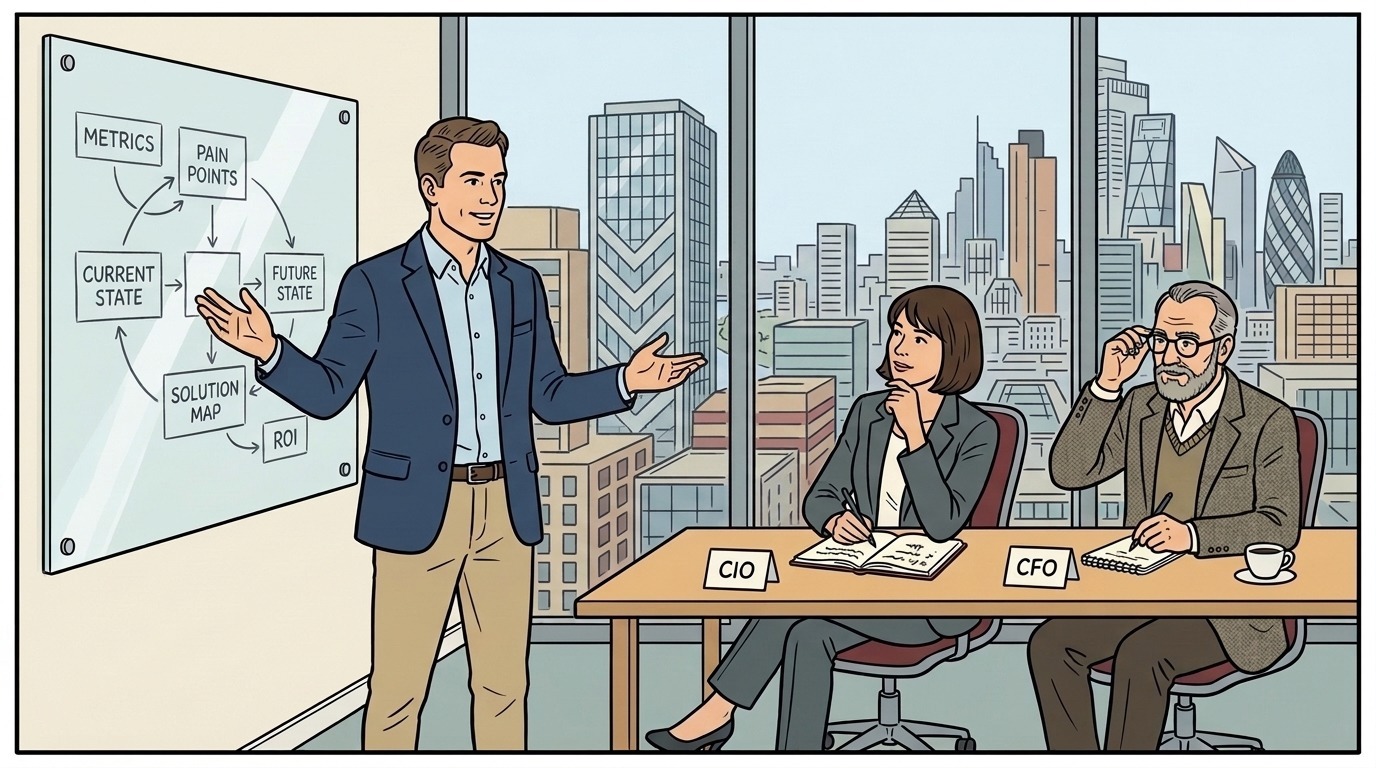
This guide provides an operational blueprint for mastering the enterprise AE discovery roleplay. We examine the eight MEDDPICC pillars, analyze call choreography, demonstrate objection handling, and provide candidate evaluation rubrics drawn from our enterprise sales interview questions archive.
1. The MEDDPICC Framework Decoded for Live Roleplays
Traditional qualification methodologies like BANT (Budget, Authority, Need, Timeline) collapse in enterprise deals. In six-figure contracts involving security councils and architecture review boards, budget is created dynamically when quantifiable business pain justifies executive intervention.
MEDDPICC provides the diagnostic structure needed to determine whether an opportunity is real, winnable, and forecastable. During a roleplay, the panel evaluates how naturally you weave these diagnostic vectors into an organic conversation.
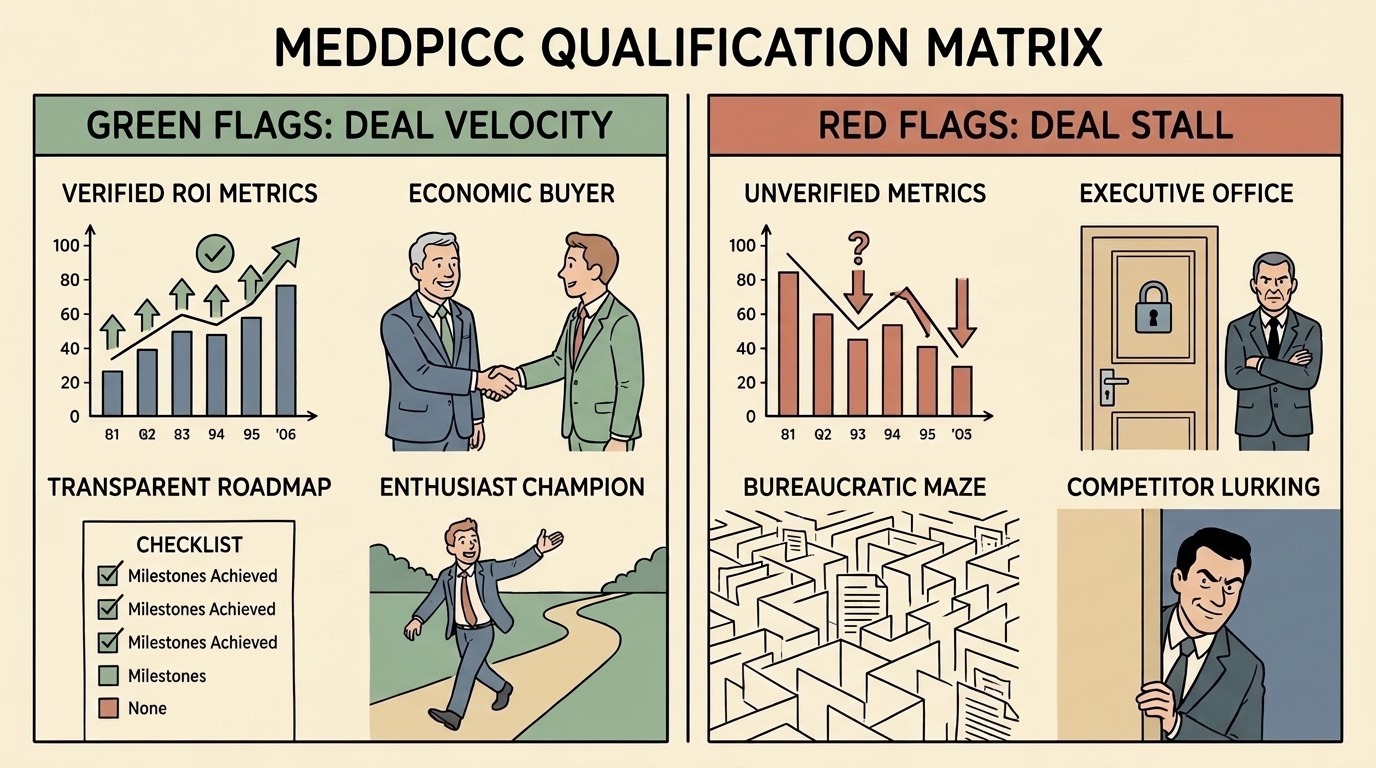
| MEDDPICC Dimension | Core Discovery Objective | Consultative Roleplay Question Stem | Dangerous Candidate Red Flag | Green Flag Mastery Behavior |
|---|---|---|---|---|
| M — Metrics | Quantify financial cost of inaction. | "When checkout stalled for 18 minutes, what was the estimated revenue loss per minute across regional hubs?" | Accepting vague answers like "it slowed engineers down." | Isolating revenue loss, SLA penalties, and customer churn into a business case. |
| E — Economic Buyer | Identify discretionary P&L veto power. | "Beyond engineering, whose budget absorbs unscheduled downtime, and what determines their annual bonus?" | Assuming the VP of Engineering is the final buyer without confirming capital authority. | Mapping how the CTO, CFO, or COO approves unbudgeted enterprise spend. |
| D — Decision Criteria | Uncover technical and commercial requirements. | "What specific technical benchmarks must a solution satisfy before your team would retire an in-house open-source cluster?" | Asking "What are you looking for?" rather than probing architectural limits. | Guiding the prospect to define criteria that highlight your platform moats. |
| D — Decision Process | Trace milestones from technical proof to signature. | "Once engineering validates fit, what sequence of reviews—InfoSec, Legal, Procurement—must occur before a contract issues?" | Confusing a verbal technical endorsement with contractual commitment. | Mapping each milestone, designated owner, review cadence, and deadline. |
| P — Paper Process | Identify legal, procurement, and privacy hurdles. | "Does legal require standard enterprise paper, or can we mark up vendor terms, and what is your legal queue turnaround?" | Ignoring procurement until the scheduled close date, delaying deals by months. | Proactively uncovering data sovereignty requirements, audits, and vendor intake steps. |
| I — Identify Pain | Expose negative business and personal consequences. | "If another major incident occurs during peak season, what is the ripple effect on your engineering roadmap and on-call turnover?" | Treating technical symptoms (e.g. slow queries) as business pain. | Uncovering personal executive pain, career reputational risk, and team burnout. |
| C — Champion | Validate an advocate with influence and skin in the game. | "If leadership pushes back on funding, how comfortable are you presenting the risk data to the executive committee with us?" | Relying on a friendly "Coach" who lacks organizational influence or capital. | Testing your champion's willingness to grant Economic Buyer access. |
| C — Competition | Identify internal inertia, DIY scripts, and rival vendors. | "Aside from commercial SaaS platforms, how viable is dedicating two senior DevOps engineers full-time to maintain Prometheus storage?" | Pretending competitors do not exist or criticizing legacy tools. | Framing internal development and rival architectures through total cost of ownership. |
2. The 4-Phase Discovery Call Arc
A common pitfall in sales interviews is allowing the prospect to turn the session into a product interrogation. When an interviewer asks, "Can you just show us the demo?", an inexperienced candidate complies. An elite AE executes an assertive four-phase call structure.
Phase 1: The Upfront Contract and Agenda Alignment
The first three minutes set the trajectory of the interaction. You must establish an Upfront Contract that defines the meeting purpose, allocates time, and pre-negotiates outcomes.
Candidate Script: "Thank you for your time today, Sarah and Marcus. We have 30 minutes scheduled. My goal is not to pitch software or walk through generic slides. I want to understand what happened during last week's logistics outage, explore how your engineering team manages observability, and determine whether our architectural approach makes sense for your scale. If we uncover a compelling fit, we can reserve the last five minutes to agree on next steps. If we determine we are not the right solution, we can shake hands as friends. Does that sound fair?"
This upfront contract demonstrates executive presence, removes sales pressure, and establishes psychological equality.
Phase 2: Root-Cause Investigation and Pain Amplification
Once permission to discover is secured, move from technical symptoms to operational implications and financial outcomes across three levels of discovery pain:
- Level 1: Technical Symptom: "Our Prometheus time-series database runs out of memory during traffic spikes."
- Level 2: Operational Impact: "Our site reliability engineers spend 14 hours a week manually sharding nodes and reindexing metrics."
- Level 3: Financial Consequence: "When tracing failed during the system crash, delayed package delivery cost $320,000 in SLA rebates."
Candidates who pause at Level 1 remain commoditized. Candidates who guide the prospect to articulate Level 3 pain build seven-figure pipeline.
Phase 3: Stakeholder Mapping and Champion Qualification
Enterprise deals are rarely closed with a single buyer. During the roleplay, examine the political landscape:
- Does your contact have the authority to act, or are they a technical screener?
- Can they articulate how leadership evaluates capital expenditures?
- Are they willing to collaborate on a Mutual Action Plan (MAP)?
Test your Champion directly: "Marcus, when you requested capital budget for infrastructure over the past twelve months, what was the internal review process with finance, and who carried the flag?"
Phase 4: Commercial Next Steps and Mutual Action Plan
Never end an interview discovery session with "I'll send you an email with some case studies." End by locking in a tangible, reciprocal next step. If the prospect requests a custom technical demonstration, require reciprocal access to the Economic Buyer.
3. Dialogue Walkthrough: Navigating Real-Time Roleplay Curves
To illustrate how an elite candidate executes under pressure, consider this excerpt from a live AE interview simulation.
Interviewer (Playing VP of Engineering):
"We understand what CloudScale does. Our engineers built our core logistics platform from scratch. We don't like commercial tools, and our budget is committed to expanding our machine learning team. Can you just show us the demo and send pricing?"
Candidate (Mastery Response):
"I appreciate your directness, Sarah. If your engineering team can reliably scale open-source tools without compromising platform uptime, you shouldn't buy our software. Building internal tooling gives you total control. But help me understand: if your current stack is handling the load, what prompted Marcus to accept our invitation after last Tuesday's incident?"
Interviewer (VP of Engineering):
"Tuesday was painful. Our regional dispatchers were flying blind for twenty minutes while our engineers searched across disconnected log clusters. It took four hours to find the memory leak. But that was an anomaly."
Candidate (Deep Discovery & Metric Quantification):
"Four hours of mean-time-to-resolution on a core revenue system is exhausting for on-call engineers. Marcus, when your team was troubleshooting blind across those disconnected clusters, what happened to automated route optimization for the 15,000 trucks on the road?"
Interviewer (Director of DevOps):
"Our freight operations team had to revert to manual dispatch queues. We missed scheduled distribution windows in three metropolitan centers. Our COO was furious."
Candidate (Economic Buyer & Pain Elevation):
"Sarah, when the COO steps into an engineering post-mortem after missed distribution windows, is the primary concern the cost of lost shipments, or is it customer retention risk with your enterprise logistics clients? And how is that risk prioritized against the budget for your machine learning initiatives?"
Notice what the candidate achieved:
- Refused the premature demo trap with composure and respect.
- Validated internal engineering pride instead of attacking their Prometheus setup.
- Pivoted from technical symptoms to business impact (manual dispatch queues and missed distribution windows).
- Introduced the Economic Buyer (COO) without asking a clumsy question like "Who is the decision maker?"
For additional conversational patterns and tactical objection frameworks, review our account executive interview questions guide.
4. Neutralizing the 3 Fatal Interview Traps
During interview simulations, hiring managers deliberately deploy curveballs. If you encounter an unexpected scenario or technical question, practice frameworks for handling high-pressure unknown interview questions.
Trap 1: "We Don't Have Budget Allocated for This."
Poor Response: "We have flexible discount tiers, or we can offer a 60-day free trial." (Destroys margin and sounds desperate).
Elite Response:
"That makes complete sense, Sarah. Enterprise organizations rarely have six figures sitting in an unallocated account waiting for an observability vendor. Every enterprise project we support is funded by reallocating capital from less urgent priorities. If we cannot prove that eliminating these outages saves your team three times the cost of our platform within six months, we shouldn't ask for a dollar of your budget. If we can validate that return together, how does your executive team handle off-cycle budget adjustments?"
Trap 2: "Our Internal Team Can Build This Themselves."
Poor Response: "Internal tools always fail and your engineers will hate maintaining it." (Insults the engineering leadership).
Elite Response:
"Your engineering organization has world-class talent, and if this was a core competitive differentiator for Global Logistics, I would advise you to build it in-house. But when you dedicate senior platform engineers to building monitoring dashboards and trace storage clusters, what core customer-facing logistics features get delayed? And what happens when the senior engineers who built the custom scripts leave the company?"
Trap 3: "Just Email Us Your Slide Deck and Pricing Sheet."
Poor Response: "Sure, I'll send that over right after this call!" (Abdicates deal control; your email will be forwarded or ignored).
Elite Response:
"I can certainly share documentation, Sarah, but our pricing is tied directly to data ingestion scale, cluster architecture, and support tiers. Sending a pricing sheet without understanding your infrastructure requirements would be a disservice. Let's spend ten minutes mapping out your current node count and retention policies. If there is a mutual fit, I will produce an exact commercial business case. If not, I won't clutter your inbox. Fair enough?"
5. Candidate Evaluation Rubric: What Hiring Panels Look For
Hiring managers, VPs of Sales, and CROs score roleplay exercises using structured assessment rubrics. Demonstrating Level 3 behaviors is the benchmark for securing enterprise tier-one compensation packages.
| Assessment Category | Level 1: Transactional Pitcher | Level 2: Consultative Specialist | Level 3: Strategic Enterprise AE |
|---|---|---|---|
| Discovery Architecture | Follows a linear questionnaire; interrupts prospect to pitch feature capabilities. | Asks open-ended questions; listens actively and summarizes technical requirements. | Uses hypotheses-led discovery; connects technical architecture directly to executive business outcomes. |
| Deal Control & Cadence | Lets the prospect derail the agenda; agrees immediately to premature demo requests. | Establishes an agenda; occasionally struggles when the prospect introduces aggressive pushback. | Sets assertive Upfront Contracts; challenges customer assumptions with commercial empathy and composure. |
| Qualification Rigor | Checks basic BANT criteria; assumes the technical point of contact is the decision-maker. | Explores budget and timeline; uncovers basic competitor dynamics. | Conducts systematic MEDDPICC qualification; tests champion influence and uncovers the Paper Process. |
| Commercial Literacy | Speaks exclusively in software features, dashboard widgets, and user interface speed. | Understands engineering productivity gains and basic team efficiency metrics. | Speaks the language of the CFO; calculates MTTR cost of downtime, capital reallocation, and ROI payback. |
Excelling at Level 3 behaviors requires combining conversational poise with systematic process rigor, reflecting skills analyzed in our SDR interview questions and B2B growth marketing case study attribution interview resources.
6. How to Prepare for Your Discovery Roleplay
Mastering the unscripted discovery roleplay requires deliberate out-loud rehearsal. Reading sales books builds conceptual understanding, but executive delivery requires muscular memory under pressure.
To prepare for your upcoming enterprise interview rounds:
- Practice Spoken Roleplay Scenarios: Drill rapid-fire objection handling and qualification prompts out loud using our 60-Second Job Blitz.
- Simulate Executive Buyer Personas: Rehearse discovery sessions against demanding CTO, CFO, and VP of Sales AI interviewer personas on totop.app pricing plans.
- Structure Your Full Preparation Roadmap: Review our comprehensive technical interview preparation blueprint to align your behavioral, commercial, and case study interview prep.
When you step into the interview room, remember: the hiring panel does not want you to demonstrate how smart your software is. They want you to prove that you can guide enterprise leaders through complex decisions with authority, curiosity, and commercial discipline.
Practice Account Executive Questions Live with AI Mock Interviews
Turn any job description across Engineering, DevOps, Data, Marketing, Sales, Finance, or HR into a personalized test and live voice or text AI mock interview on totop.app, or test your speed right now in the 60-Second Account Executive Blitz.
Play 60s Account Executive Blitz (Free, No Login) | Start 14-Day Free Trial | Browse All Interview Guides