Enterprise Sales Interview Questions & Answers: The 2026 Guide
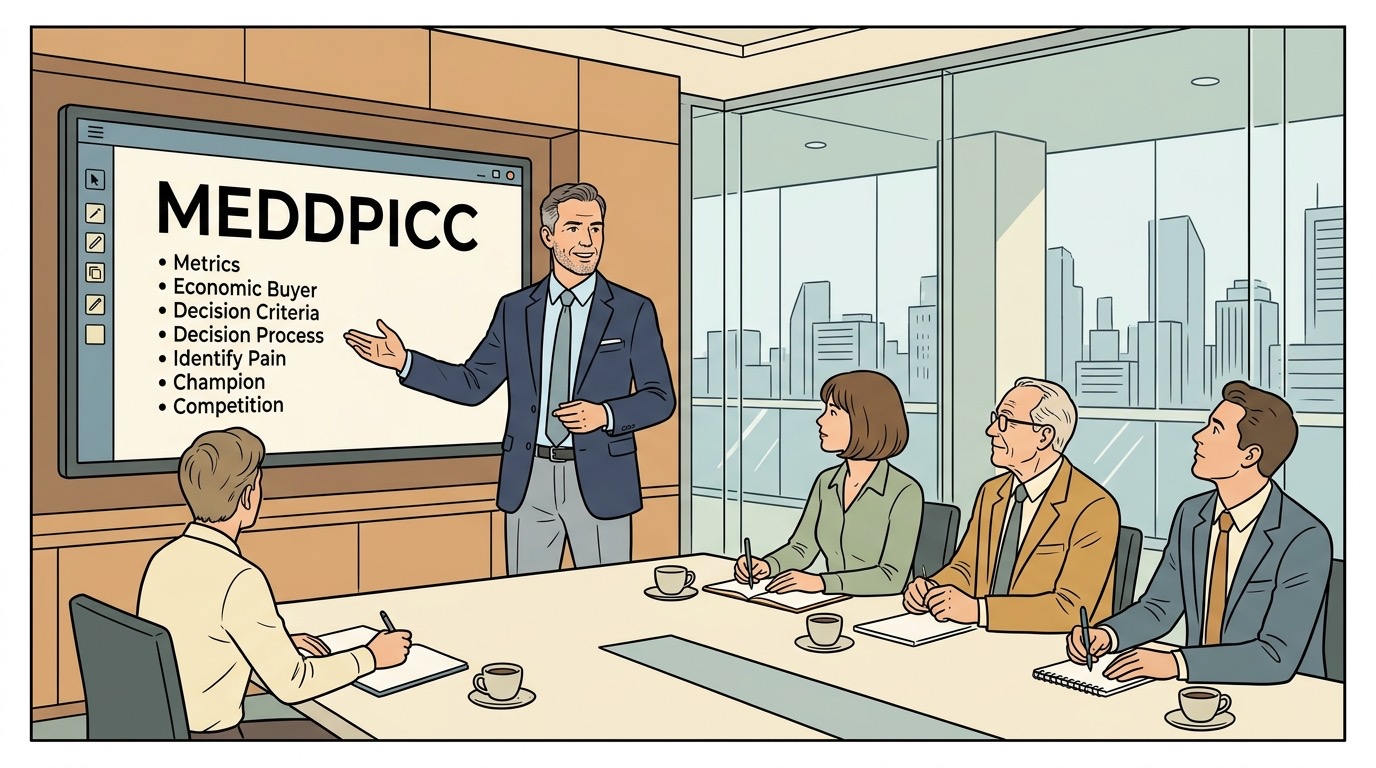
Enterprise sales represents the upper echelon of commercial execution in the technology ecosystem. Unlike transactional sales cycles where individual contributors pitch software directly to a single business user and close in two weeks, enterprise account executives navigate six- to seven-figure annual contract values (ACVs), nine- to twelve-month buying timelines, and purchasing committees encompassing ten or more cross-functional stakeholders.
Because the stakes involve millions in pipeline revenue, hiring managers conduct rigorous evaluations. Interview panels for enterprise account executive (Enterprise AE), strategic sales director, and enterprise client partner roles look beyond charisma. They seek methodical operators who master deal qualification frameworks, navigate procurement bureaucracy, and orchestrate technical, legal, and executive alignment.
Whether you are stepping up from mid-market sales or interviewing at top cloud, infrastructure, and enterprise software companies, mastering these core enterprise sales interview questions will help you stand out from the competition.
The Evolution of Enterprise Sales Hiring in 2026
The enterprise buying environment has transformed significantly over recent quarters. Tighter enterprise IT budgets, mandatory CFO-level approval thresholds, and rigorous vendor consolidation have altered how deals close. Interviewers no longer reward "lone wolf" reps who rely on intuition. Instead, hiring teams prioritize:
- Mathematical Business Cases: Sellers must quantify return on investment (ROI), payback periods, and total cost of ownership (TCO) with financial precision.
- Deep Multi-Threading: Navigating security, legal, compliance, procurement, and line-of-business sponsors simultaneously rather than relying on a single contact.
- Rigorous Qualification: Knowing when to disqualify deals early to protect pipeline velocity and company resources.
- Co-Selling and Ecosystem Alignment: Leveraging systems integrators, hyperscaler marketplace credits, and executive sponsors throughout the sales cycle.
If you are already familiar with standard Account Executive interview frameworks and foundational B2B sales interview preparation, enterprise interviews test your strategic depth, operational discipline, and emotional resilience under pressure.
Core Enterprise Deal Mechanics: What Interviewers Evaluate
Before examining specific questions, understand the underlying dimensions interviewers assess during your responses:
Deal Size and Sales Cycle Realities
Enterprise interviewers want proof that you have closed contracts with six-figure annual recurring revenue (
Multi-Stakeholder Consensus Building
According to enterprise sales research, enterprise buying groups average between eight and twelve decision-makers. Interviewers evaluate how you identify personal wins for the Chief Information Security Officer (CISO), Chief Financial Officer (CFO), VP of Engineering, and Head of Procurement—unifying disparate priorities into a single corporate initiative.
The Shift from Solution Selling to Business Impact
Pitching feature checklists is disqualifying in enterprise interviews. Elite enterprise reps sell strategic business transformation: reducing operational expenditures, mitigating regulatory risk, or accelerating time-to-market.
Top Enterprise Sales Interview Questions and Strategic Answers
1. How do you qualify complex enterprise opportunities using MEDDPICC?
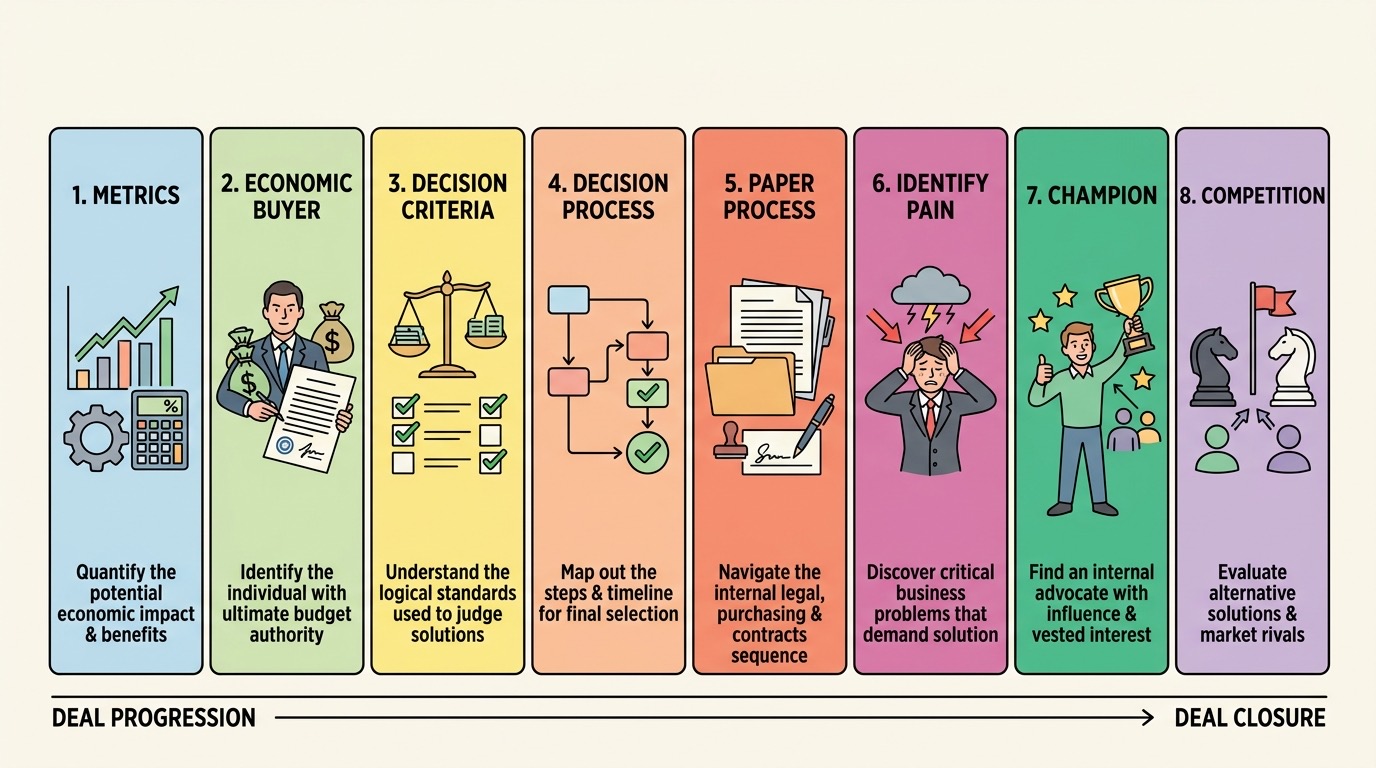
Why Interviewers Ask: MEDDPICC (Metrics, Economic Buyer, Decision Criteria, Decision Process, Paper Process, Implicated Pain, Champion, Competition) is the industry standard for enterprise qualification. Interviewers want to see that MEDDPICC is not a theoretical buzzword for you, but an operating cadence you execute daily.
What Great Answers Include:
- Define how you separate an enthusiastic coach from a verified Champion who has access to the Economic Buyer and skin in the game.
- Clarify the difference between the Decision Process (how decisions are agreed upon) and the Paper Process (how contracts, infosec reviews, and purchase orders are signed).
- Detail how you calculate quantifiable Metrics tied directly to the customer's strategic priorities.
Sample Strong Response:
"I treat MEDDPICC as a continuous diagnostic engine throughout the entire deal cycle rather than an inspection checklist. When qualifying a deal, I prioritize three elements early: Implicated Pain, Economic Buyer, and Champion.
First, I uncover Implicated Pain by determining not just what is inefficient, but what that inefficiency costs the enterprise annually in measurable dollars, latency, or compliance risk.
Second, I identify and test my Champion. A true champion can articulate our value proposition when we are not in the room, has political capital, and provides backstage access. I test them early by asking for a thirty-minute introductory discussion with the Economic Buyer or requesting internal architectural diagrams. If they cannot or will not facilitate that access, they are a coach or a supporter, not a champion.
Finally, I map the Paper Process early—ideally before formal vendor selection. By uncovering who in legal redlines indemnification clauses and understanding procurement's signing threshold limits, I prevent deals from slipping into quarter-end limbo."
2. Walk me through a multi-threaded enterprise deal you closed from discovery to signature.
Why Interviewers Ask: Enterprise sales leaders want to see the complete narrative arc of a complex deal. This question tests your ability to drive strategic momentum across multiple departments over six to nine months.
What Great Answers Include:
- Clearly state the account name (or industry if confidential), ACV/TCV, and timeline.
- Detail the initial entry point and how you branched out across departments.
- Describe a serious obstacle (e.g., competing vendor, security objection, budget freeze) and how you navigated it.
- Explain the closing mechanism and mutual success plan.
Sample Strong Response:
"In my previous enterprise role, I closed a $420,000 ARR platform contract with a Fortune 500 logistics provider over an eight-month sales cycle.
Our initial entry point was an inbound inquiry from a Senior Infrastructure Architect facing severe telemetry latency issues. After our first technical discovery call, I realized the technical pain was tied to a larger business crisis: delayed dispatch decisions were costing the company an estimated
.8 million in SLA penalties each quarter.To multi-thread, I used our technical champion to map the executive organization. I scheduled parallel discovery tracks: one with the VP of Cloud Engineering focusing on architecture reliability and uptime metrics, and another with the VP of Supply Chain Operations focusing on dispatch SLA compliance and revenue protection.
At month four, the Chief Information Security Officer raised concerns about data sovereignty and SOC2 Type II compliance. Instead of delegating this entirely to a solutions engineer, I organized a dedicated security workshop between our Head of Security Compliance and their Infosec team, resolving their fifteen vendor risk assessment queries within seven business days.
To finalize the deal, I established a Mutual Action Plan (MAP) with the VP of Operations—the Economic Buyer—working backward from their Q4 peak shipping season. By aligning our contract execution with their peak rollout deadline, we secured executive signature three weeks before the quarter closed."
3. How do you identify, test, and cultivate a genuine economic champion?
Why Interviewers Ask: Inexperienced reps often mistake friendly contacts for true champions. If your primary contact cannot advocate for budget or influence senior executives, the deal stalls the moment procurement or competing internal projects challenge it.
What Great Answers Include:
- The distinction between a "coach/friend" and a "champion."
- Concrete test criteria used to measure champion commitment.
- How you empower your champion with executive summaries, business cases, and internal sell decks.
Sample Strong Response:
"A champion must satisfy three conditions: they have personal win criteria tied to project success, they possess organizational influence, and they actively sell on your behalf behind closed doors.
I test suspected champions using incremental commitments. In week two, I might ask: 'If we compile this ROI analysis, will you co-present it with me to your VP next Thursday?' If they hesitate or block access, I know they lack influence.
To cultivate a tested champion, I make them look exceptional in front of their leadership. I provide customizable executive one-pagers, ROI calculation models, and vendor comparison frameworks tailored to their internal narrative. I constantly reinforce their personal win—whether that is career promotion, organizational visibility, or eliminating an exhausting operational bottleneck."
4. How do you handle a CFO or procurement team demanding a 30% contract discount late in the cycle?
Why Interviewers Ask: Enterprise procurement departments are evaluated on discount extraction. Weak reps panic and immediately concede margin. Elite enterprise sellers protect deal value, trade concessions strategically, and anchor to business impact.
What Great Answers Include:
- Remaining calm and validating procurement's role without capitulating.
- Re-anchoring the conversation to the previously agreed ROI and business case.
- The principle of "Give to Get": never granting a price reduction without receiving tangible business value in return (e.g., multi-year commitment, upfront annual payment, case study rights, faster signature timeline).
Sample Strong Response:
"When procurement demands a 30% discount late in the cycle, my first step is not to react or immediately offer 15%. I acknowledge their position and re-anchor to the business impact agreed upon with the Economic Buyer.
I respond: 'I completely respect your mandate to optimize software spend. However, when we reviewed the business case with your VP of Operations, we verified that solving this telemetry delay saves the organization
.8 million annually. The proposed investment is calibrated directly to deliver that return. If the budget ceiling is genuinely constrained, we can adjust the scope or implementation phases to meet that number.'80,000 deal stall after a successful technical evaluation when our primary contact went quiet for three weeks. Rather than sending generic 'just checking in' emails, I conducted a MEDDPICC diagnostic audit.If we do choose to offer a commercial concession, I enforce strict 'give-to-get' trades. For instance, I might offer a 7% adjustment only in exchange for a three-year commit with annual upfront billing, inclusion of a public press release and customer case study, and a contract signature finalized within five business days. Never give away margin for free."
5. What is your strategy for unseating an embedded legacy competitor?
Why Interviewers Ask: In modern enterprise tech, "greenfield" opportunities are rare. Most accounts already use a legacy incumbent or enterprise ERP/suite provider (such as Oracle, SAP, IBM, or Salesforce). You must demonstrate how you overcome incumbent inertia and vendor switching costs.
What Great Answers Include:
- Uncovering hidden dissatisfaction and technical debt associated with the legacy tool.
- Focusing on total cost of ownership (TCO) including maintenance overhead and lost agility.
- De-risking migration through phased rollouts and proof-of-value (POV) pilots.
Sample Strong Response:
"Unseating an incumbent is never about attacking their software; criticizing a competitor insults the executive who originally purchased it. Instead, I focus on the gap between what their legacy platform was built to do ten years ago and the realities of modern scale.
I uncover the hidden 'tax' of the incumbent: excessive professional services costs, brittle custom integrations, developer burnout, and inability to support cloud-native workflows.
To reduce migration anxiety, I propose a phased 'land-and-expand' rollout. Rather than asking them to 'rip and replace' an established system across the entire company on day one, we identify a single high-priority business unit or new digital initiative. We run a tightly scoped Proof of Value with clear success criteria. Once we demonstrate superior performance and cost efficiency in that isolated environment, the internal momentum for full displacement becomes self-sustaining."
6. Tell me about an enterprise deal that stalled. How did you diagnose the blocker and salvage it?
Why Interviewers Ask: Deals stall routinely in enterprise sales due to priority shifts, executive turnover, and economic caution. Interviewers evaluate your diagnostic problem-solving and willingness to take calculated risks to resurrect dead momentum.
What Great Answers Include:
- Diagnosing the root cause: loss of champion, unaddressed technical blocker, or lack of urgency.
- Reframing the cost of inaction (COI).
- Knowing when to go around a blocker or engage an executive peer sponsor.
Sample Strong Response:
"I had a
I realized our business case had stalled between technical evaluation and procurement because the VP of Infrastructure was prioritizing an unannounced cloud migration. Our project was important to the engineers, but not urgent to the VP.
I drafted an executive impact memo addressed to the VP of Infrastructure, highlighting the Cost of Inaction: delaying our implementation three months would force them to renew their legacy support contract for another full year at
40,000. Simultaneously, I asked our VP of Product to reach out peer-to-peer to their VP to discuss architectural roadmap alignment.That executive outreach validated our understanding of their cloud migration and positioned our solution as an accelerator for that initiative rather than a competing priority. The conversation restarted within 48 hours, and we closed the deal the following month."
7. How do you tailor executive discovery for C-suite buyers versus operational champions?
Why Interviewers Ask: Enterprise AEs must speak multiple corporate languages. Pitching API performance to a CFO or enterprise EBITDA margins to a junior systems engineer results in immediate loss of credibility.
What Great Answers Include:
- Contrast discovery questions for operational leads (usability, workflows, technical debt, pain) versus C-suite leaders (revenue growth, risk mitigation, resource allocation, shareholder value).
- Understanding executive time constraints (concise, hypothesis-driven inquiry).
Sample Strong Response:
"Operational champions care about their daily experience: workflow automation, maintenance headaches, false-positive alerts, and team productivity. When speaking with engineers or managers, I ask questions like: 'How many hours does your team spend troubleshooting pipeline failures each week?' and 'What happens when an unhandled exception hits production at 2 AM?'
Conversely, C-suite executives—such as the CIO, CTO, or CFO—operate at the strategic portfolio level. They care about risk mitigation, board-level compliance, market expansion, and capital efficiency.
When conducting C-suite discovery, I lead with an informed hypothesis rather than open-ended interrogation. I might say: 'In speaking with your engineering directors, we observed that your teams spend approximately 25% of sprint cycles maintaining legacy pipeline tooling. At your current engineering headcount, that equates to roughly $3.2 million annually in delayed product velocity. How does that align with your board objective to ship the new consumer portal by Q3?'"
8. How do you manage your pipeline to maintain consistent quota attainment across 9-month sales cycles?
Why Interviewers Ask: Because enterprise deals have long gestation cycles, reps who fail to maintain continuous outbound prospecting suffer severe "revenue roller coasters"—hitting 180% one quarter and 20% the next.
What Great Answers Include:
- Pipeline coverage ratios (maintaining 3.5x to 4x pipeline coverage).
- Time management: protecting recurring hours for account research and multi-channel outreach.
- Close collaboration with Business Development Representatives (BDRs) and Customer Success teams.
Sample Strong Response:
"Consistency in enterprise sales requires relentless discipline during winning quarters. When closing major deals, it is tempting to neglect top-of-funnel activity.
I maintain a minimum of 4x qualified pipeline coverage relative to my annual quota. I block non-negotiable prospecting blocks on my calendar every Tuesday and Thursday morning dedicated to tier-one target account research and executive outreach.
Furthermore, I treat our BDR team and Customer Success Managers as strategic partners. I hold weekly account mapping sessions with our BDRs to identify expansion angles, and I coordinate closely with post-sale alignment with Customer Success Managers to uncover cross-sell and upsell opportunities in existing enterprise accounts."
The Enterprise Sales Mock Presentation & Whiteboard Case Study
Many top-tier enterprise software firms (such as Snowflake, Datadog, Salesforce, and AWS) include a mandatory 45-to-60-minute mock sales presentation or whiteboard roleplay as the final interview round.
To excel in this high-pressure simulation:
The First 5 Minutes: Framing the Executive Agenda
Never jump immediately into slide decks or software demos. Begin by confirming meeting objectives, verifying stakeholder roles, and establishing the meeting governance:
- "Before we dive in, let me confirm our agenda. We have 45 minutes today. My goal is to review our findings from technical discovery, validate the ROI model, and determine whether there is mutual alignment to explore next steps. How does that sound for our time today?"
Diagnostic Inquiry Over Feature Demos
During the simulation, interviewers will deliberately throw objections or act disengaged. Pause frequently to verify agreement:
- "Does this architectural approach solve the latency concerns we discussed earlier, or is there another dimension your team wants to explore?"
Mutually Agreed Action Plans (MAP)
Always reserve the final seven minutes to establish a concrete Mutual Action Plan. Never conclude with vague pleasantries like "I will follow up next week." Agree on dates, deliverables, and responsibilities for both sides.
If you ever encounter an unexpected curveball question or highly technical architecture query during your interview, remember the fundamentals of handling high-stakes moments when you do not know the answer gracefully—never guess or invent figures.
Common Pitfalls That Disqualify Enterprise Sales Candidates
Interview panels frequently reject candidates who make these critical mistakes:
- Talking More Than 30% of the Time in Discovery: Enterprise sales is diagnostic. Candidates who deliver monologues fail to uncover the business pain required to build seven-figure proposals.
- Accepting Verbal Commitments Without Written MAPs: Over-optimistic forecasting based on a single stakeholder saying "we love your product" signals poor qualification discipline.
- Failing to Know the Numbers: Inability to quote average deal sizes, win rates against primary competitors, quota attainment percentages, or customer retention metrics raises immediate red flags.
- Ignoring Post-Sale Deployment Realities: Enterprise software that fails implementation causes customer churn and commission clawbacks. Interviewers respect sellers who care deeply about deployment success and customer time-to-value.
Preparing for Enterprise Sales Interviews with AI Simulations
Rehearsing enterprise sales scenarios out loud is essential for developing conversational agility. While reading MEDDPICC guides builds conceptual understanding, verbalizing concise answers under time constraints requires deliberate practice.
Using realistic interactive mock interview tools on totop.app allows you to practice answering rigorous enterprise sales interview questions with realistic AI interviewers. You can simulate tough procurement negotiations, rehearse your 90-day pipeline ramp plan, and receive objective feedback on your executive communication and objection-handling tactics.
Combine these mock simulations with a structured, comprehensive interview preparation roadmap to approach your enterprise sales interviews with total confidence and close your next career-defining offer.