Architecture Decision Records: What Interviewers Want to Hear

When candidates fail senior and staff-level system design interviews, they rarely fail because they did not know about Redis caches, Kafka queues, or database sharding. They fail because their design explanations sound like an uncurated laundry list of modern cloud technologies rather than an intentional, reasoned engineering decision.
In modern software engineering, the single most critical differentiator between mid-level engineers and senior technical leaders is decision hygiene. Senior engineers do not merely assemble components; they justify architectural compromises, document assumptions, and explicitly account for negative consequences.
In production engineering organizations, this discipline is formalized through Architecture Decision Records (ADRs)—lightweight, structured documents that capture why a particular architectural decision was made, what alternatives were evaluated, and what trade-offs were accepted.
When you internalize the mental model of architecture decision records in system design interviews, you transform an otherwise chaotic whiteboard session into a structured, highly persuasive architectural presentation that directly satisfies what principal engineers and hiring managers want to hear.
What is an Architecture Decision Record (ADR)?
An Architecture Decision Record is a short text document—typically one to two pages in Markdown—that records an important architectural choice made on a project along with its context and consequences. Originally popularized by Michael Nygard, ADRs have become standard practice in modern high-throughput engineering organizations.
In production, an ADR consists of five core sections:
- Title: A clear, numbered statement describing the decision (e.g., ADR-004: Adopt Event Sourcing for Order Fulfillment).
- Status: The lifecycle state (Proposed, Accepted, Deprecated, or Superseded).
- Context: The technical, operational, and organizational drivers forcing the decision. What constraints exist? What business problem are we solving?
- Decision: The concrete solution chosen, articulated in active voice, detailing what will be built and what will explicitly not be built.
- Consequences: The complete impact of the decision—both positive outcomes (scalability, low latency) and negative side effects (operational complexity, eventual consistency overhead).
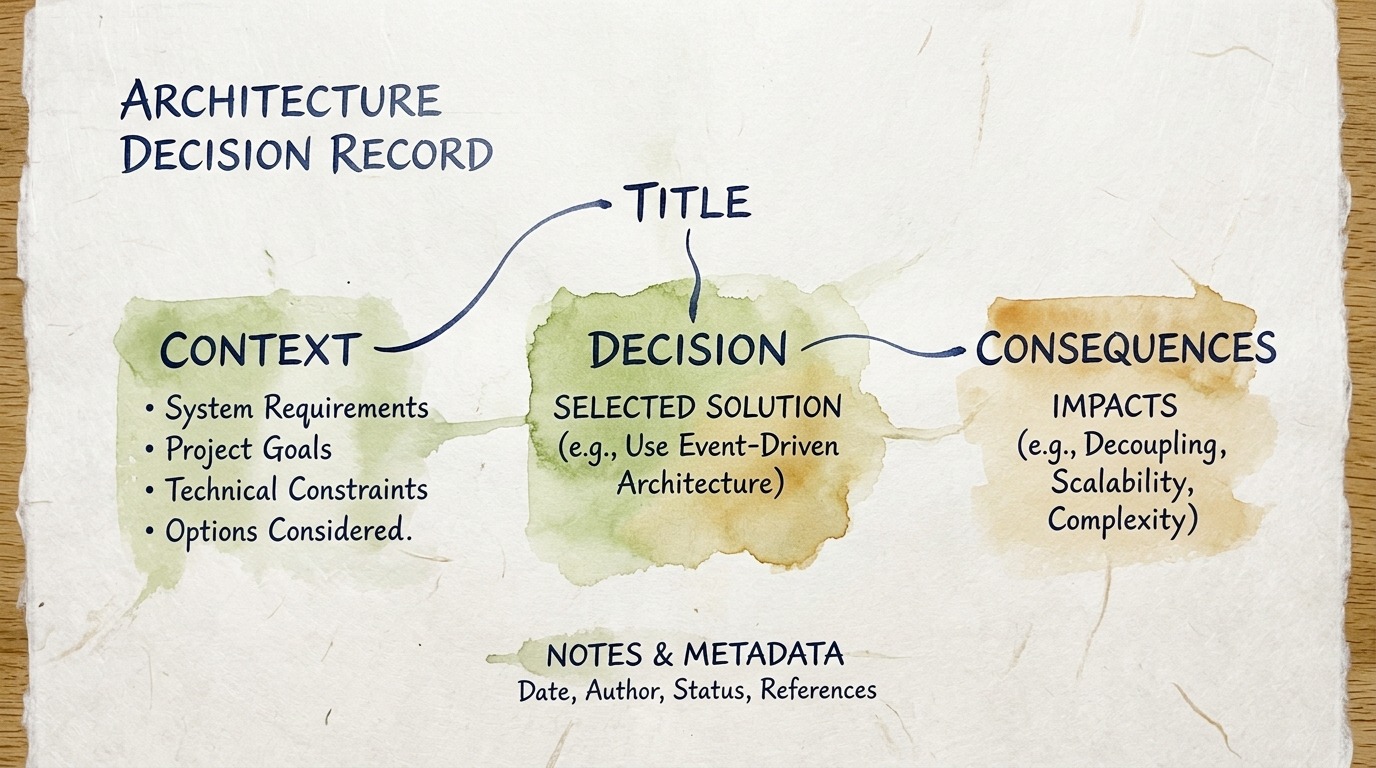
In an interview, you do not write a formal document on a whiteboard. Instead, you adopt ADR thinking as your verbal communication framework. When an interviewer asks, "How would you design the storage layer for a distributed payment gateway?", junior candidates immediately blurt out "Cassandra". Senior candidates respond by walking through the exact mental structure of an ADR.
Why Interviewers Secretly Grade You on ADR Thinking
To understand why ADR-structured answers score so highly, consider what an interviewer's evaluation scorecard actually measures during a system design interview:
1. Separation of Context from Preference
Mediocre candidates recommend technologies based on personal familiarity ("I used DynamoDB at my last job, so let's use DynamoDB here"). Senior candidates ground every component choice in explicit system constraints ("Given our 99.999% availability requirement and strict sub-50ms write latency budget across multi-region deployments, we need an active-active multi-master datastore").
Interviewers want to see that your decisions are driven by the problem's unique shape, not resume-driven development.
2. Rigorous Alternative Elimination
A decision cannot be evaluated in isolation; it only makes sense relative to the alternatives you considered and rejected. When you explain why you chose a relational database with read replicas instead of MongoDB, you demonstrate broad domain knowledge and deep awareness of data consistency guarantees.
3. Intellectual Honesty About Negative Consequences
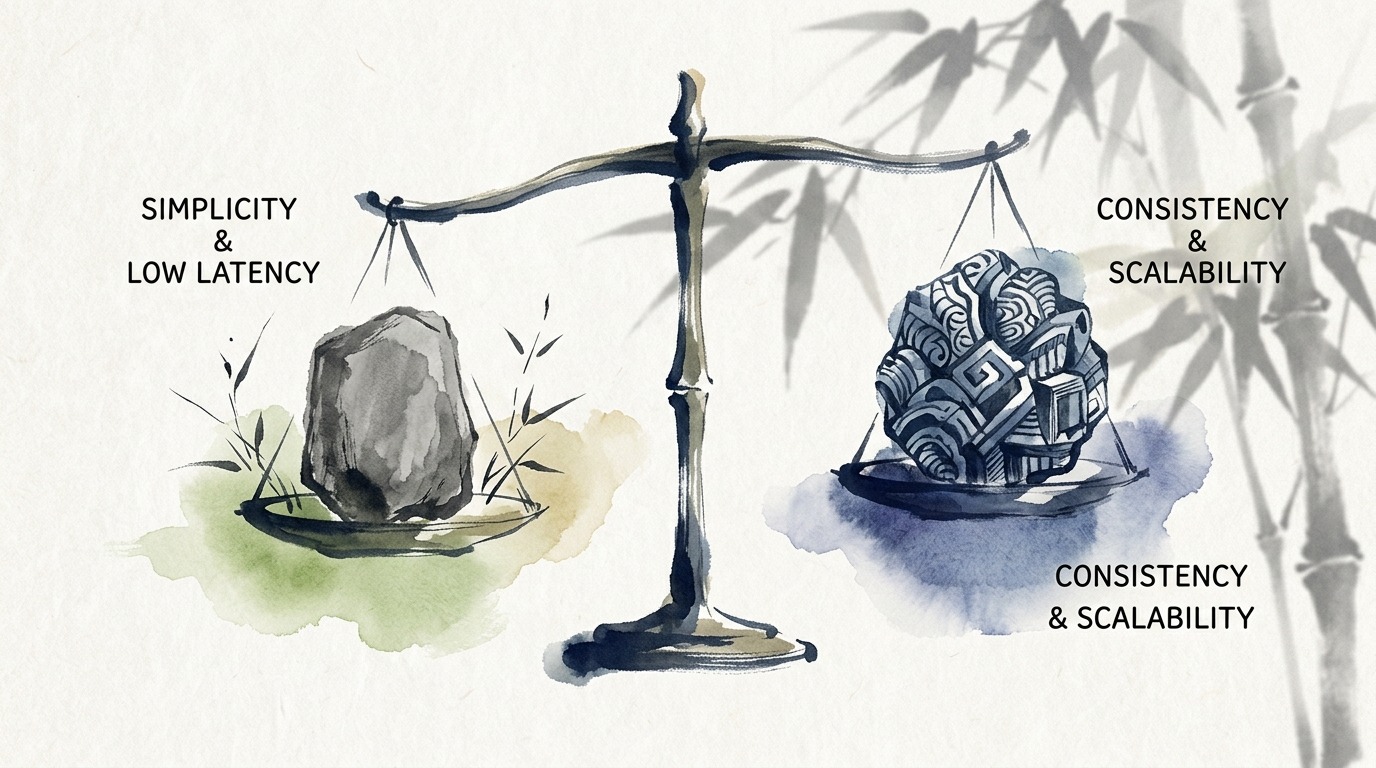
Every architectural choice is a trade-off. There are no perfect solutions in distributed systems, only compromises. When a candidate claims a design has "infinite scalability, zero latency, and 100% consistency," interviewers immediately deduct points for lack of production maturity.
Interviewers want to hear you say: "By adopting asynchronous event publication via Kafka, we decouple order ingestion from payment processing. However, the consequence is that our client applications must now handle eventual consistency and display pending states to users."
The 4-Part ADR Framework for System Design Rounds
Here is how to translate the static structure of an ADR into a dynamic, 45-minute whiteboard conversation:
| ADR Component | Whiteboard Phase | What You Should Verbalize Aloud |
|---|---|---|
| Context & Constraints | Requirements & Sizing (0–10 mins) | "Before choosing databases, let's identify our read/write ratio, availability SLAs, and data durability constraints." |
| Options Considered | High-Level Architecture (10–25 mins) | "We have two viable paths for the ingestion pipeline: push-based HTTP webhooks or pull-based message streaming." |
| Decision & Rationale | Deep Dive & Component Design (25–35 mins) | "I am choosing option B because our traffic has 10x spiky bursts that would overwhelm downstream sync workers." |
| Consequences & Trade-offs | Bottlenecks & Failure Modes (35–45 mins) | "The cost of this decision is additional queue infrastructure and the risk of message deduplication complexity." |
Real-World Case Study: Designing a Real-Time Ride Matching Service
Let's walk through a concrete example. Suppose your interviewer asks:
"We are designing the driver location tracking and rider matching service for a global ride-sharing platform. How do you store and query driver locations in real time?"
Here is how an inexperienced candidate answers versus how a candidate utilizing ADR-structured reasoning answers:
The Naive Answer (Component Recitation)
"We'll have mobile apps send GPS pings over WebSockets. We will dump the locations into Redis using geospatial indexes like GEOADD, and then use GEORADIUS to find nearby drivers. If Redis crashes, we can fall back to PostgreSQL with PostGIS."
While technically functional, this response gives the interviewer zero signal on your engineering maturity. Why Redis? What happens to memory usage? How do you handle network partitions?
The ADR-Driven Answer (Senior / Staff Signal)
Watch how applying ADR principles elevates the same technical components into a masterclass in architectural reasoning:
Step 1: Establish the Context & Bounding Constraints
"Let's establish our operational context first. We have 500,000 active drivers sending GPS coordinates every 4 seconds. That represents roughly 125,000 writes per second. For matching, our query latency must stay under 20 milliseconds to provide an instantaneous user experience. The key constraint is that driver location data is highly ephemeral—if we lose a driver's position from 8 seconds ago, it is practically worthless because a newer coordinate has already replaced it."
Step 2: Compare Feasible Options
"We have two primary storage architectures for this workload:
- Option A: Persistent spatial database (PostgreSQL + PostGIS). Excellent querying flexibility, ACID guarantees, and rich polygon filtering, but 125k IOPS on disk will require massive database connection pooling and heavy sharding.
- Option B: In-memory geospatial data store (Redis Cluster with Geospatial Indexes / GeoHash). Operates purely in RAM, delivers sub-5ms lookups, and natively supports radial queries, but requires careful memory capacity planning and clustering."
Step 3: State the Decision with Decisive Rationale
"My decision is to use Option B: a sharded Redis cluster keyed on geographic cell IDs (such as Uber H3 or S2 geometry). Because location data is ephemeral, we do not require durable disk writes for every ping. We will set TTLs of 30 seconds on coordinate entries so stale data automatically purges without explicit garbage collection routines."
Step 4: Address Consequences and Mitigations
"Let's address the consequences of this decision:
- Positive Consequence: We achieve ultra-low write and read latencies well within our 20ms budget.
- Negative Consequence: In-memory storage is expensive, and Redis node failover could temporarily lose active driver locations in that shard.
- Mitigation: Since client apps ping every 4 seconds, a replaced Redis replica will self-populate its state from incoming pings within 10 to 15 seconds, making cold-start warmups unnecessary."
Notice the difference? In less than three minutes, you demonstrated capacity estimation, database trade-off analysis, cache invalidation strategy, disaster recovery planning, and operational cost awareness. That is precisely what interviewers look for when evaluating candidates for system design interviews for staff engineer roles.
5 Specific ADR Phrases That Signal Technical Maturity
To make ADR-style thinking feel natural during a stressful technical screen, commit these five rhetorical bridges to memory:
1. "Under these specific constraints, the optimal trade-off is..."
Never say a technology is "the best." A technology is only optimal relative to constraints. Framing your choice as the best fit for these specific constraints shows you avoid dogmatic architectural purity.
2. "The alternative we considered and rejected was [X], because..."
Proactively eliminating a popular alternative proves you have evaluated the solution space thoroughly. If you pick Kafka, explain why RabbitMQ or AWS SQS was insufficient for this specific throughput requirement.
3. "The negative consequence we are accepting here is..."
Interviewers love candidates who actively volunteer the downsides of their own designs. It proves you understand the day-two operational reality of maintaining distributed software.
4. "This is a reversible decision (Type 2), so we can start simple..."
Demonstrating awareness of Jeff Bezos's famous framework—distinguishing between irreversible one-way doors (Type 1) and easily reversible two-way doors (Type 2)—proves you know when to optimize for developer velocity versus deep architectural rigor.
5. "If our traffic scales by an order of magnitude, our pivot point will be..."
Show the interviewer that your architecture has room to grow. Explain what metric threshold would trigger a transition from a monolithic relational database to a sharded NoSQL architecture or event-sourced pipeline.
Common ADR Pitfalls in Technical Interviews
While using ADR structure is overwhelmingly positive, avoid these three common traps:
- Over-Formalizing: Do not spend 10 minutes writing out boilerplate markdown headers on the whiteboard. The ADR structure is a mental checklist for your verbal dialogue, not bureaucratic paperwork.
- Ignoring the Interviewer's Nudges: If the interviewer interrupts and says, "Let's assume memory is not constrained," immediately update your Context section and adjust your Decision accordingly.
- Refusing to Concede Weaknesses: If the interviewer points out a legitimate bottleneck in your design, welcome the feedback. Say: "That is a valid point. In an ADR, we would capture that risk under Consequences and introduce a dead-letter queue or circuit breaker as our mitigation."
Sharpening Your ADR Verbalization with AI Mock Practice
Knowing the components of an ADR is simple; smoothly articulating them out loud under observation while drawing distributed architecture boxes is a completely different skill.
Most engineers fail because they only practice passive reading. They study architectural textbooks, memorize CAP theorem definitions, and read blog posts without ever practicing the verbal delivery of complex technical justifications.
This is where targeted mock interview practice becomes essential. On totop.app, you can practice end-to-end technical interviews with AI-powered interviewer personas tailored to your target company and role level.
Instead of generic quiz questions, totop.app provides realistic, interactive system design scenarios where the AI pushes back on your database choices, interrogates your scaling bottlenecks, and forces you to articulate precise architectural trade-offs in real time. Practicing with instant, actionable feedback helps you eliminate rambling explanations and replace them with crisp, confident ADR-style answers.
For candidates preparing their overall timeline, our comprehensive technical interview preparation roadmap outlines how to balance system design practice with algorithmic problem-solving and behavioral storytelling. If you find yourself needing advice on articulating non-shipped or past systems, check out our guide on how to talk about projects you haven't shipped yet. Additionally, understanding what interviewers actually look for will help you tailor your responses to different interview panels.
Conclusion: Lead the Design, Don't Just Answer Questions
System design interviews are not exams where you try to guess the secret answer in the interviewer's head. They are collaborative design reviews where senior engineers assess whether they would trust you to lead technical decisions on their production systems.
By framing your whiteboard designs through the lens of Architecture Decision Records, you demonstrate the clarity of thought, intellectual humility, and trade-off consciousness that define world-class technical leaders. In your next interview, do not merely draw components—state the context, eliminate the alternatives, own the consequences, and deliver the architectural answers interviewers want to hear.