During a senior or staff distributed systems interview, candidates rarely encounter questions with simple, binary answers. When an interviewer asks, "Would you use Kafka or RabbitMQ to decouple these microservices?", they are not asking which tool has higher GitHub stars or broader adoption. They are evaluating whether the candidate understands the fundamental dichotomy in asynchronous messaging: the difference between an append-only distributed event log and a smart broker message queue.
Candidates who recite generic benchmarks like "Kafka is faster for big data and RabbitMQ is better for complex routing" often fail to demonstrate deep technical mastery. Interviewers look for architectural precision: how consumer groups scale across partitions, how message acknowledgments affect broker memory pressure, why backpressure mechanisms differ under load, and how message replayability dictates disaster recovery strategies.
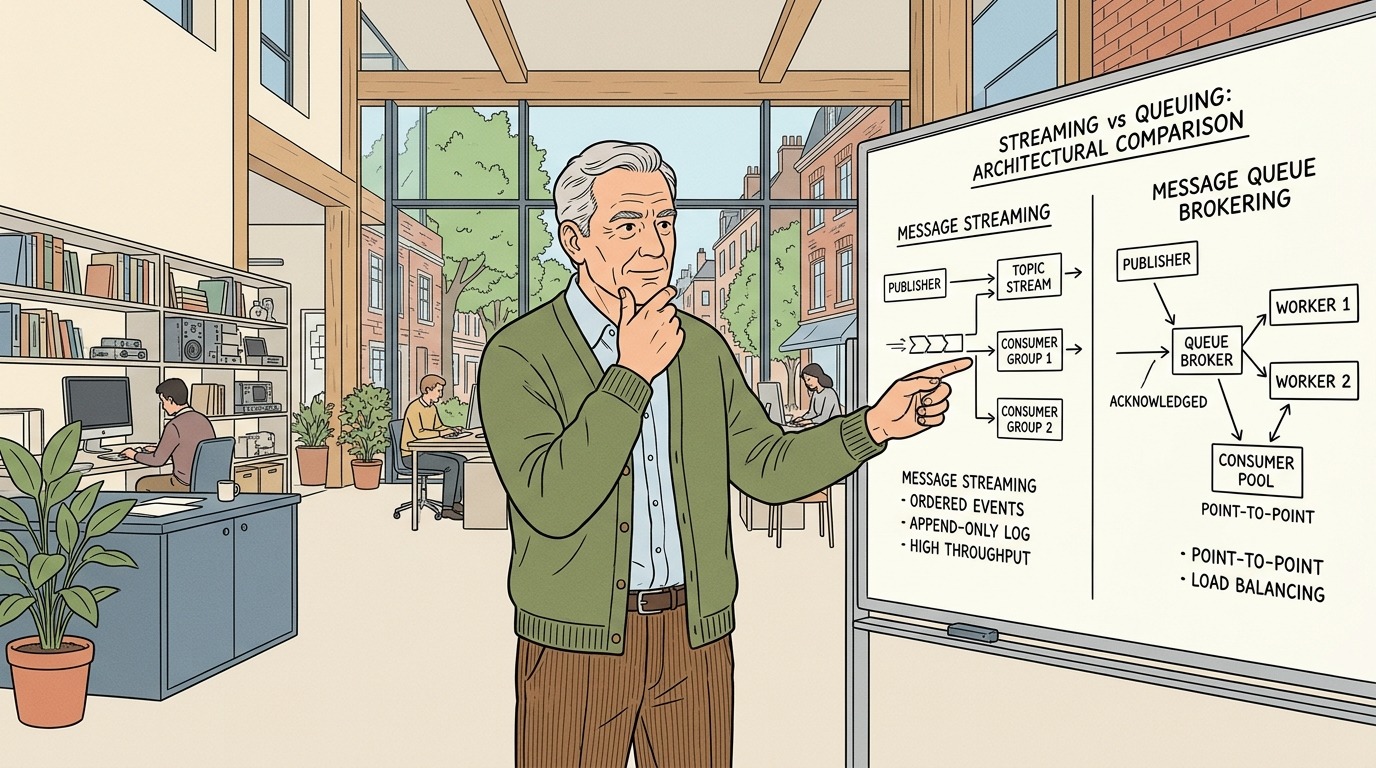
This guide breaks down the core architecture of both platforms, provides a side-by-side technical evaluation rubric, explores concrete production code walkthroughs, and demonstrates how to structure high-scoring answers for your next kafka vs rabbitmq system design interview.
1. Core Architectural Paradigms: Log vs. Queue
The confusion between Apache Kafka and RabbitMQ stems from the fact that both transport messages asynchronously between producers and consumers. Under the hood, however, their data storage engines, state models, and delivery protocols serve completely opposite architectural philosophies.
Apache Kafka: The Distributed Append-Only Commit Log
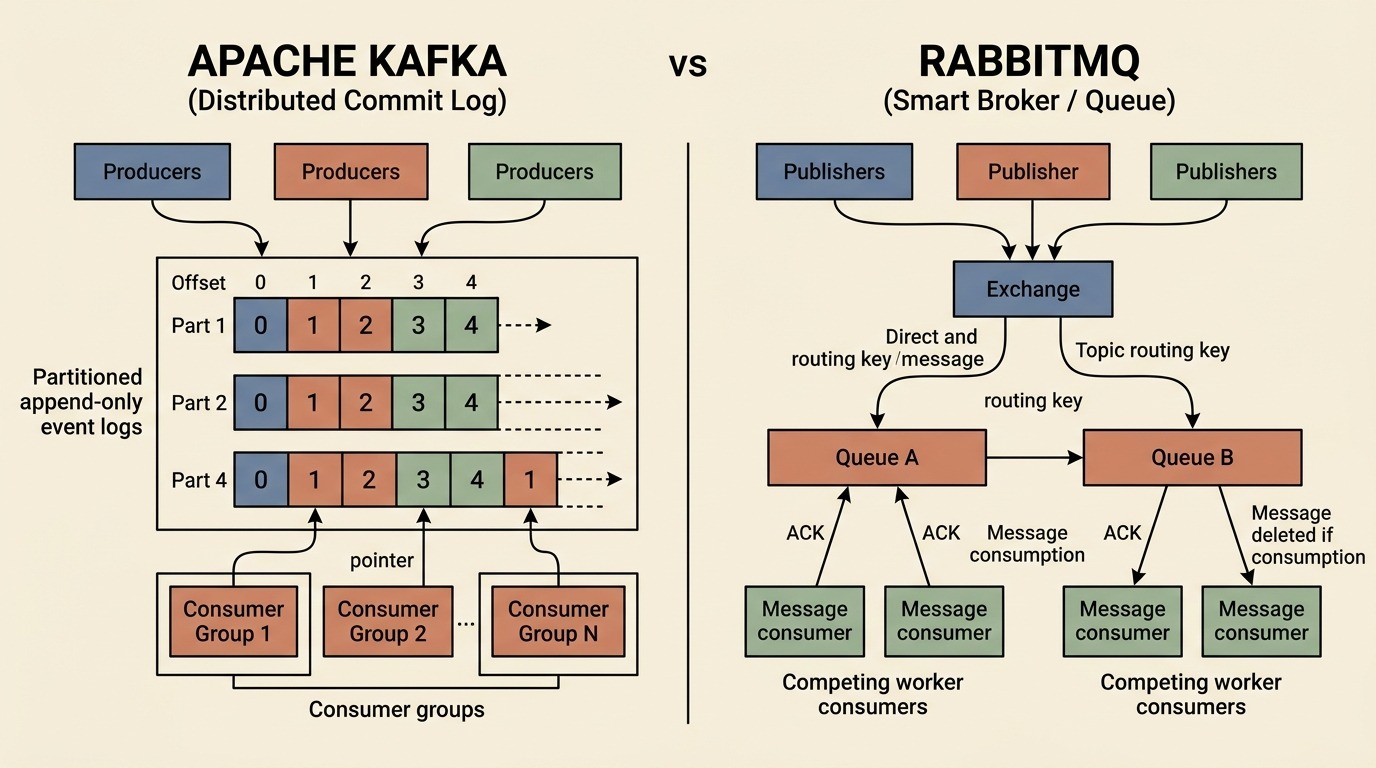
Kafka is an event streaming platform designed around distributed, partitioned append-only disk logs. In Kafka:
- Broker State: The broker is intentionally "dumb" and stateless regarding individual consumer progress. The broker writes incoming events sequentially to disk partitions and retains them based on a time- or size-based retention policy (for example, 7 days), regardless of whether consumers have processed them.
- Consumer State: Consumers are "smart" and maintain their own cursor, known as an offset. Multiple independent consumer groups can read from the exact same topic partition at different speeds and offsets without interfering with each other.
- Consumption Model: Pull-based. Consumers poll the broker for batches of records when their CPU and memory have available capacity.
RabbitMQ: The Smart Broker with Ephemeral Queues
RabbitMQ is a general-purpose message broker built on the Erlang OTP framework, originally implementing the Advanced Message Queuing Protocol (AMQP 0-9-1). In RabbitMQ:
- Broker State: The broker is "smart". It maintains detailed runtime state for every queue, message, and connected consumer. It tracks unacknowledged in-flight messages, handles complex routing rules through exchanges, and deletes messages from disk or memory as soon as a consumer acknowledges successful receipt.
- Consumer State: Consumers are simple workers. They listen on a queue, receive pushed messages from the broker, process the payload, and return an acknowledgment (
ackornack). - Consumption Model: Push-based with prefetch limits. The broker pushes messages to connected worker channels up to a configured
basic.qosprefetch window.
2. Technical Comparison Matrix
When presenting trade-offs in a system design interview, organizing your comparison across architectural vectors helps demonstrate structured engineering thought. Use the following operational rubric:
| Architectural Vector | Apache Kafka | RabbitMQ |
|---|---|---|
| Primary Data Abstraction | Append-only distributed commit log (Partitioned Topics) | Ephemeral First-In, First-Out (FIFO) Queues behind Exchanges |
| Message Consumption Paradigm | Pull-based (Consumers issue poll() requests for record batches) | Push-based (Broker dispatches messages to consumers up to prefetch limit) |
| Message Retention | Persistent & immutable; retained on disk by time (e.g., 7 days) or compacted key | Ephemeral; removed immediately upon successful consumer acknowledgment |
| Routing Complexity | Basic hash-based partitioning by message key (hash(key) % num_partitions) | Advanced routing via Direct, Fanout, Topic (wildcard globbing), and Headers exchanges |
| Consumer Scalability Limit | Strictly bounded: Active consumers per consumer group ≤ number of topic partitions | Flexible: Arbitrary number of competing worker consumers can pull from a single queue |
| Message Ordering Guarantees | Strict total ordering within a single partition; no global ordering across partitions | Strict FIFO per queue under single-consumer conditions; broken by redeliveries or concurrency |
| Backpressure Mechanism | Natural client pull backpressure; broker is immune to slow consumer buffer bloat | Broker credit flow and socket backpressure; unacknowledged message queues consume RAM |
| Throughput & Latency Profile | Millions of messages/sec with sequential disk I/O and zero-copy sendfile; 5–20 ms latency | Tens of thousands of messages/sec per node; sub-millisecond end-to-end latency |
| Message Replayability | Native: Any consumer group can reset offset pointers to time t or offset 0 | None out of the box: Once acknowledged and removed, messages cannot be replayed |
3. Deep-Dive Architectural Mechanics
To earn top marks from interviewers assessing staff-level technical depth, candidates must explain the lower-level mechanics that drive these behavioral differences.
1. Consumer Concurrency and the "Partition Ceiling"
One of the most critical operational constraints in Kafka is the relationship between partitions and consumer threads within a single consumer group:
- If a Kafka topic has 12 partitions, you can run at most 12 active consumer instances in that consumer group.
- If you spin up a 13th consumer instance, it sits idle in standby mode because Kafka allocates partitions exclusively to one consumer per group to preserve strict ordering.
- If processing a message requires slow downstream calls (such as a 300 ms third-party credit bureau API), you cannot simply add 50 worker threads to that consumer group without repartitioning the topic—which requires careful operational planning and data rebalancing.
In contrast, RabbitMQ treats a queue as a shared work pool:
- You can attach 100 concurrent worker containers to a single RabbitMQ queue.
- RabbitMQ distributes individual messages across all available workers in a round-robin or prefetch-balanced fashion.
- If an unexpected spike in workload occurs, autoscaling your consumer deployment from 5 pods to 50 pods immediately absorbs the queue backlog without repartitioning or cluster reconfiguration.
Kafka Partition Mapping:
[Partition 0] ---> Consumer Instance A
[Partition 1] ---> Consumer Instance B
[Partition 2] ---> Consumer Instance C
(Active consumer count cannot exceed partition count)

RabbitMQ Competing Consumer Mapping:
             /---> Worker 1 (processes task)
[Queue A] ---+---> Worker 2 (processes task)
             \---> Worker 3 (processes task)
(Arbitrary workers consume concurrently from one queue)
2. Backpressure and Memory Footprint Under Strain
How each broker behaves when downstream consumers lag or crash reveals stark differences in operational resilience:
- In Kafka: When consumers crash or fall behind, the Kafka broker remains completely unbothered. New messages are appended sequentially to the segment files on disk. The storage footprint grows predictably based on disk capacity and retention time, not consumer state. When consumers recover, they resume reading from their last committed offset at their own sustainable pace.
- In RabbitMQ: Unconsumed messages accumulate in the broker's RAM. While RabbitMQ can page messages to disk under memory alarms, large backlogs of unacknowledged or queued messages degrade broker performance significantly, triggering flow control that blocks upstream publishers to protect the broker from out-of-memory (OOM) crashes.
3. Routing Topologies: Exchanges vs. Consumer Filtering
RabbitMQ excels in environments where message routing decisions are dynamic and fine-grained:
- A publisher sends a message to an exchange with a routing key such as
orders.us.electronics.priority. - A Topic Exchange inspects the binding keys of connected queues using pattern matching:
*.us.*routes to the US compliance queue, whileorders.#routes to the inventory analytics queue. - Producers and consumers remain completely decoupled from network topologies.
In Kafka, producers write directly to specific topics. While a topic can represent a category of events, any complex filtering must be performed either downstream by consumer application logic or upstream via a stream processing engine like Apache Flink or Kafka Streams.
4. Real-World Production Scenarios & Code Walkthroughs
During a design interview, grounding theoretical claims in concrete system architectures convinces interviewers that you have built and debugged production infrastructure.
Scenario A: High-Throughput E-Commerce Event Streaming (Kafka)
Consider an e-commerce platform processing 80,000 requests per second. Every completed purchase triggers events needed by fraud detection, real-time analytics, user notification pipelines, order fulfillment, and long-term data lake ingestion (Apache Iceberg).
Why Kafka is the required choice:
- Multiple Independent Readers: The fraud detection engine needs real-time evaluation with low latency; the data warehouse pipeline batches writes into Parquet files every 10 minutes; the compliance auditor inspects events 24 hours later. With Kafka, each team operates an isolated consumer group reading the immutable
order-eventslog without impacting other consumers. - Replayability for Model Retraining: When the machine learning team deploys an updated fraud detection model, they can deploy a new consumer group with its offset reset to 30 days prior to evaluate model performance against historical transaction streams.
# Kafka Consumer Offset Management Pattern
from kafka import KafkaConsumer, TopicPartition

consumer = KafkaConsumer(
    'order-events',
    bootstrap_servers=['kafka-broker-1:9092', 'kafka-broker-2:9092'],
    group_id='fraud-detection-service',
    enable_auto_commit=False,  # Manual commit ensures at-least-once processing
    auto_offset_reset='earliest'
)

for message in consumer:
    try:
        # Process event payload
        transaction = parse_payload(message.value)
        evaluate_fraud_risk(transaction)

        # Explicitly commit offset only after successful processing
        consumer.commit()
    except TransientProcessingError as err:
        # Back off and retry without advancing the partition offset
        log_retry_warning(err, message.offset)
For broader microservice architecture patterns and event schema validation, review our comprehensive guide to microservices interview questions.
Scenario B: Asynchronous Job Processing & Dead-Letter Workflows (RabbitMQ)
Consider a SaaS application where users trigger long-running background tasks: generating high-resolution PDF invoices, encoding uploaded videos, and dispatching multi-channel push notifications with granular retry logic.
Why RabbitMQ is the optimal choice:
- Dynamic Task Distribution: PDF generation tasks vary in execution time from 200 ms to 15 seconds. RabbitMQ's worker queue distributes incoming jobs to the first available idle worker using
basic.qos(prefetch_count=1), preventing fast tasks from getting blocked behind slow tasks. - Native Dead-Letter Exchanges (DLX): When a background job fails after three exponential retries, RabbitMQ automatically routes the poisoned message to a Dead-Letter Exchange with inspection headers, isolating bad inputs without stalling the processing pipeline.
// RabbitMQ AMQP Dead-Letter & Competing Consumer Setup (amqplib)
const amqp = require('amqplib');

async function setupInvoiceWorker() {
  const connection = await amqp.connect('amqp://guest:guest@rabbitmq-cluster:5672');
  const channel = await connection.createChannel();

  // 1. Declare Dead-Letter Exchange & Queue for failed jobs
  await channel.assertExchange('dlx.invoices', 'direct', { durable: true });
  await channel.assertQueue('invoices.dead_letter', { durable: true });
  await channel.bindQueue('invoices.dead_letter', 'dlx.invoices', 'failed-invoice');

  // 2. Declare primary worker queue with DLX configuration
  await channel.assertQueue('invoices.processing', {
    durable: true,
    arguments: {
      'x-dead-letter-exchange': 'dlx.invoices',
      'x-dead-letter-routing-key': 'failed-invoice',
      'x-message-ttl': 86400000 // 24-hour expiration
    }
  });

  // 3. Set prefetch to 1 for fair dispatch across heterogeneous workers
  await channel.prefetch(1);

  channel.consume('invoices.processing', async (msg) => {
    if (!msg) return;
    try {
      const invoiceData = JSON.parse(msg.content.toString());
      await generatePdfInvoice(invoiceData);
      channel.ack(msg); // Acknowledge successful execution
    } catch (error) {
      // Reject and send directly to Dead-Letter Queue (requeue = false)
      channel.nack(msg, false, false);
    }
  });
}
When implementing distributed services, coordinating queue processing with protective gateway controls is essential. Explore how token bucket and sliding log techniques prevent traffic spikes in our deep dive on rate limiting algorithms in system design interviews.
5. Candidate Evaluation Rubric: Junior vs. Staff Responses
Interviewers evaluate answers on a maturity continuum. The following rubric illustrates how interviewers distinguish junior responses from senior and staff-level answers when evaluating the kafka vs rabbitmq system design interview question:
The Junior Candidate Response (Level: L3/L4)
"I would pick Kafka because it is faster and built for big data. RabbitMQ is older and slower. In our design, we have a lot of microservices, so Kafka is the modern standard for microservice communication."
Interviewer Assessment: Fail / Needs Improvement.
- Relies on superficial buzzwords ("faster", "big data", "modern").
- Fails to address data access patterns, consumer scaling ceilings, or operational maintenance overhead.
- Ignores RabbitMQ's strengths in routing, task scheduling, and sub-millisecond delivery.
The Senior Candidate Response (Level: L5)
"I would choose based on whether we are building an event stream or a task queue. If we need pub/sub where multiple consumers need to read the same event stream independently—such as order creation triggering fraud, analytics, and shipping—Kafka is ideal because of its distributed append-only log and consumer groups.
However, if we are distributing distinct background jobs that take variable amounts of time, like PDF generation or notification delivery, RabbitMQ is superior because multiple competing workers can consume from the same queue without partition limits, and RabbitMQ natively handles message acknowledgments and dead-letter queues."
Interviewer Assessment: Strong Pass.
- Accurately differentiates event streaming from task queuing.
- Highlights consumer concurrency and dead-lettering capabilities.
The Staff Candidate Response (Level: L6+)
"The decision hinges on three architectural trade-offs: data retention semantics, consumer scaling topology, and routing topology.
First, Kafka treats data as an immutable event stream where the broker is stateless regarding consumer progress; consumers manage their own offsets via consumer groups. This gives us zero-impact replayability, batch disk writes via OS page cache zero-copy, and linear horizontal scale, but caps active consumer parallelism to partition count.
Second, RabbitMQ acts as a stateful broker that tracks message lifecycles and acknowledgments. It gives us flexible AMQP routing exchanges and dynamic competing consumers on a single queue, making it the right fit for complex task dispatch. However, accumulating unacknowledged backlogs degrades broker memory.
For our order processing pipeline, I recommend a hybrid approach: publish core transactional domain events to Kafka topics to serve as the unified event backbone for analytics and downstream syncs. For ephemeral, retry-heavy notification and export tasks, have a lightweight consumer push individual jobs into RabbitMQ queues to leverage fine-grained prefetch and dead-lettering without blocking partition offsets."
Interviewer Assessment: Outstanding / Level Up.
- Highlights internal storage mechanics (OS page cache, zero-copy, memory alarms).
- Articulates partition scaling constraints and backpressure dynamics.
- Demonstrates pragmatic real-world architecture by proposing a decoupled, hybrid messaging topology.
To understand how hiring committees evaluate architectural scope and influence at the staff level, read our detailed analysis of system design interviews for staff engineer roles.
6. How to Structure Your Live Interview Answer
When this question arises during an on-site interview, follow this 4-step framework to keep your response structured and calm:
- Clarify Message Ingestion & Consumer Characteristics:
- Ask about throughput: Are we handling 5,000 events/sec or 500,000 events/sec?
- Ask about consumer consumers: Does a message get handled by exactly one worker, or do multiple independent teams need to subscribe to the same data?
- Inspect Message Lifecycle & Retention Requirements:
- Ask: Do we ever need to replay historical messages from yesterday to recover from a downstream bug? If yes, Kafka's immutable log is a decisive factor.
- Analyze Routing & Task Complexity:
- Ask: Do messages require dynamic pattern matching, priority ordering, or immediate dead-letter isolation? If yes, RabbitMQ's exchange architecture simplifies implementation.
- Present the Operational Trade-Off:
- Discuss cluster operations: managing a ZooKeeper/KRaft Kafka cluster requires dedicated operational tooling, partition sizing foresight, and consumer group rebalance tuning. RabbitMQ requires careful RAM sizing, queue length monitoring, and cluster network partition handling (pause-minority vs. autoheal modes).
To build a holistic preparation strategy across system architecture, algorithms, and behavioral rounds, start with our complete guide to technical interview prep. If you are targeting tier-one tech firms, review the full evaluation criteria outlined in our FAANG interview process breakdown.
Interactive Practice & Next Steps
Reading architectural comparisons builds theoretical knowledge, but articulating high-stakes trade-offs under real-time questioning requires deliberate practice.
- 60-Second Job Blitz: Test your technical instincts with rapid-fire, timed interview questions covering system design, networking, and distributed systems architecture with zero login required.
- Tailored AI Mock Interviews & Socratic Tutor: Practice full whiteboard system design scenarios with AI personas that challenge your broker selection, probe edge cases, and provide instant rubric-based scoring.
Practice Staff Backend Engineer Questions Live with AI Mock Interviews
Turn any job description across Engineering, DevOps, Data, Marketing, Sales, Finance, or HR into a personalized test and live voice or text AI mock interview on totop.app, or test your speed right now in the 60-Second Staff Backend Engineer Blitz.
Play 60s Staff Backend Engineer Blitz (Free, No Login) | Start 14-Day Free Trial | Browse All Interview Guides