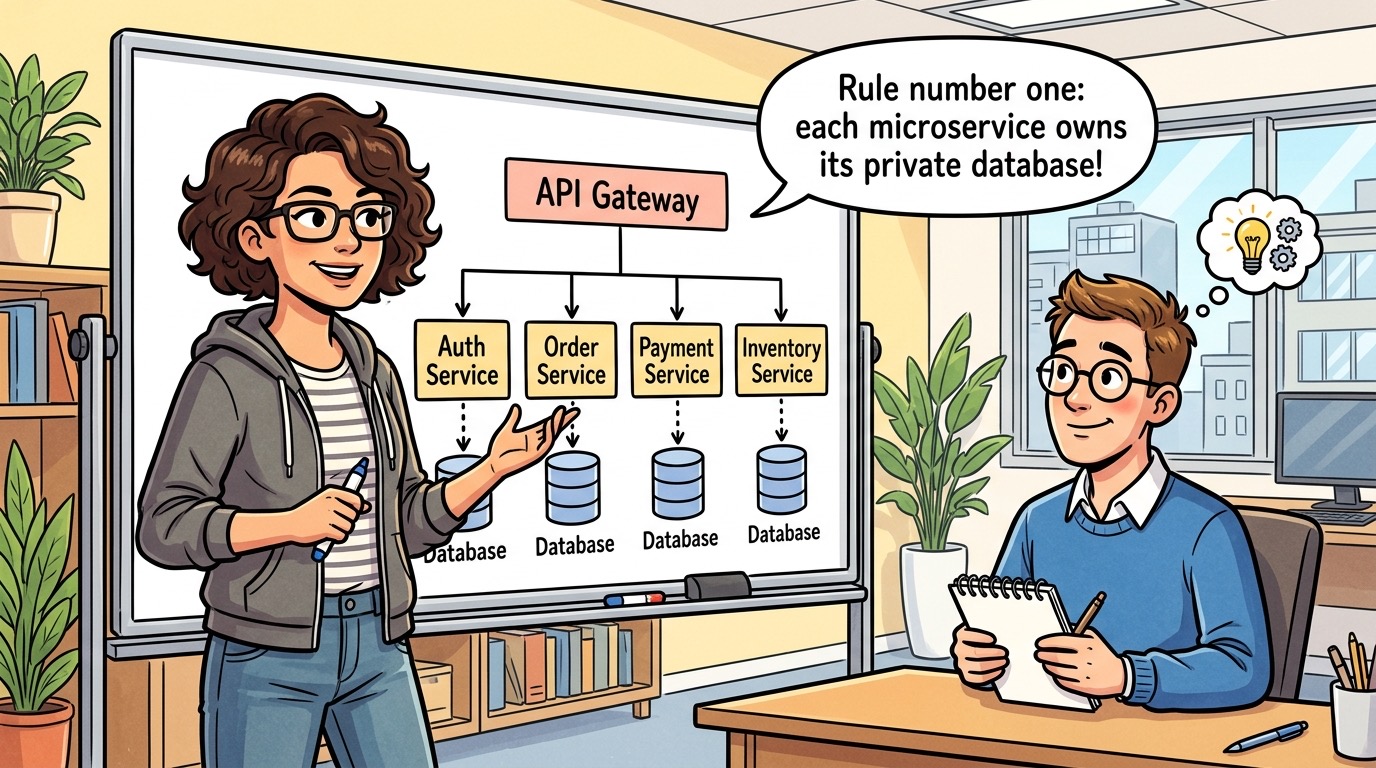
In modern software engineering interviews, distributed systems questions have shifted from niche staff-level inquiries into baseline requirements for backend, full-stack, and DevOps candidates. When an interviewer introduces microservices interview questions, they are rarely testing whether you know buzzwords like Kubernetes or Docker. Instead, they are probing your ability to navigate the brutal realities of distributed computing: network latency, partial failures, distributed state, eventual consistency, and organizational boundaries.
A candidate who blindly suggests decomposing every application into forty microservices immediately raises red flags. Senior interviewers look for pragmatic architectural judgment: knowing when microservices deliver scalable velocity, when a modular monolith is superior, and how to safely orchestrate distributed data flows.
Whether you are preparing for a mid-level backend role or a staff-level systems design round in our complete technical interview preparation guide, this comprehensive guide breaks down the core concepts, common traps, and production-tested answers for the most critical microservices interview questions.
1. When Should You Choose Microservices vs. a Monolith?
The Core Interview Question
"How do you decide between building a monolithic architecture and splitting into microservices? If we are designing a new product from scratch today, which would you recommend?"
What the Interviewer Is Really Evaluating
Interviewers want to see whether you view architecture through the lens of business velocity and operational overhead rather than resume-driven development. They want to hear about Conway's Law, team autonomy, and operational complexity.
Strategic Answer & Architecture Trade-offs
A strong answer articulates that microservices are primarily an organizational scaling tool, not merely a performance optimization:
- Start with a Modular Monolith: For early-stage products or new teams, a modular monolith with well-defined domain boundaries in code (e.g., separate packages or modules with strict interfaces) minimizes deployment friction, simplifies local testing, and eliminates network latency between components.
- Decomposition Triggers: You migrate to microservices when specific organizational or technical scaling thresholds are crossed:
- Independent Deployment Velocity: Multiple engineering squads are stepping on each other's toes during monolithic releases, creating deployment bottlenecks and merge conflicts.
- Heterogeneous Scaling Requirements: A video transcoding service requires massive GPU compute, while an authentication service requires low-latency, memory-optimized instances. In a monolith, you must scale the entire application uniformly.
- Fault Isolation: A crash or memory leak in a reporting background worker should not take down the checkout engine.
- Technological Heterogeneity: Different domains benefit from specialized runtimes (e.g., Python for machine learning inference, Go for high-concurrency event routing).
[Monolith]                       [Microservices Architecture]
+-------------------------+      +-------------+   +-------------+
| UI / Presentation Layer |      | Auth Squad  |   | Order Squad |
| Order / Billing Logic   |      | Auth Svc    |   | Order Svc   |
| Inventory / Search      |      | (Postgres)  |   | (Postgres)  |
| Shared Database (DB)    |      +-------------+   +-------------+
+-------------------------+              \               /
Single deployable artifact;               \             /
low latency in-memory calls.         API Gateway / Event Mesh
What to Avoid: Never claim microservices make software simpler. Microservices trade in-process simplicity for operational, network, and data consistency complexity. If you want to dive deeper into broader evaluation criteria, review our comprehensive system design interview guide.
2. How Do You Manage Distributed Transactions Across Microservices?
The Core Interview Question
"In a microservices architecture, how do you execute an order workflow where you must charge a customer card, update product inventory, and send a notification, when each service owns its own database?"
What the Interviewer Is Really Evaluating
This is the single most common data management question. Interviewers want to see if you understand why traditional ACID two-phase commits (2PC) fail in modern cloud environments, and whether you can structure a resilient Saga pattern.
Strategic Answer: The Saga Pattern
In microservices, the Database-per-Service pattern prevents distributed SQL joins and centralized transaction managers. Two-Phase Commit (2PC) coordinates locks across nodes, creating severe availability bottlenecks, single points of failure, and unacceptable tail latency across network hops.
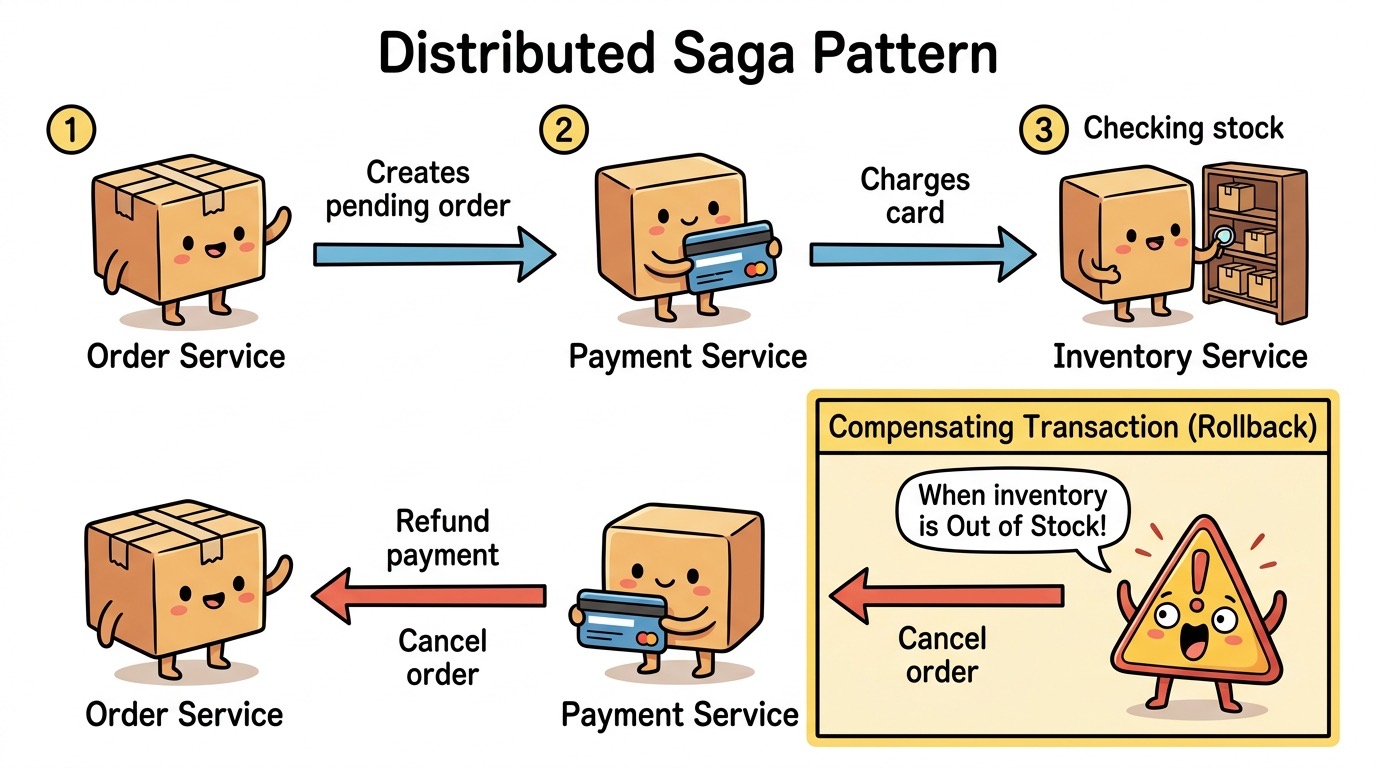
Instead, production systems implement the Saga Pattern: a sequence of local transactions where each microservice executes its work and emits an event. If any step fails, the saga executes explicit compensating transactions in reverse order to rollback state.
Orchestration vs. Choreography
You must explain the trade-offs between the two Saga implementations:
- Choreography (Event-Driven):
- Services communicate by publishing and listening to domain events via message brokers (e.g., Kafka, RabbitMQ).
- Pros: Decoupled, simple for workflows with 2-3 steps.
- Cons: Cyclic dependencies emerge quickly; difficult to track global state; hard to debug when workflows span 5+ services.
- Orchestration (Centralized Coordinator):
- A dedicated orchestrator service (e.g., Temporal, AWS Step Functions, or custom state machine) explicitly directs services: "Order Service, reserve item. Payment Service, charge card."
- Pros: Clear end-to-end visibility, centralized timeout handling, simplified compensation logic.
- Cons: Additional component to maintain; potential bottleneck if not designed statelessly.
Concrete Scenario: Compensating Rollback
Consider an e-commerce order workflow:
Order Servicecreates an order inPENDINGstate.Payment Servicecharges the credit card successfully.Inventory Servicefails because the warehouse stock is depleted.- Compensating Action: The orchestrator instructs
Payment Serviceto issue a refund andOrder Serviceto mark the order asCANCELLED_OUT_OF_STOCK.
Key Concept to Mention: All compensating actions must be idempotent. If a network timeout occurs during the refund call, retrying the refund with the same idempotency key must not refund the customer twice.
3. How Do You Maintain Data Consistency Without Distributed Locks?
The Core Interview Question
"If service A updates an entity and service B needs that updated data to make decisions, how do you guarantee they don't drift out of sync if a network outage or service restart happens?"
What the Interviewer Is Really Evaluating
Interviewers are testing your grasp of eventual consistency, the Transactional Outbox Pattern, and Change Data Capture (CDC).
Strategic Answer: The Transactional Outbox Pattern
The classic trap in microservices is updating a local database and then immediately attempting to send an HTTP call or Kafka message:
// ANTI-PATTERN: Dual-Write Vulnerability
async function createOrder(orderData) {
  await db.orders.insert(orderData); // Step 1: DB write succeeds
  // What happens if network crashes right here?
  await kafkaProducer.send('order-created', orderData); // Step 2: Message fails!
}
If the database write succeeds but the message broker call fails (or the server crashes between the two statements), downstream services never receive the event. You now have silent data inconsistency.
The Solution: Transactional Outbox
- Single Local Transaction: When
Order Servicewrites the order to theorderstable, it writes the corresponding event into anoutboxtable in the same local relational database transaction. This is guaranteed by ACID. - Message Relay (CDC / Polling): An asynchronous worker or Change Data Capture tool (such as Debezium reading the database Write-Ahead Log / WAL) reads committed records from
outboxand publishes them to the message broker. - At-Least-Once Delivery: The relay marks outbox rows as published only after receiving broker acknowledgment (
ACK). - Idempotent Consumers: Downstream microservices de-duplicate incoming messages using a message ID or unique idempotency token stored in a Redis cache or relational table.
[Order Service]
  │
  ├── 1. BEGIN TRANSACTION
  │      ├── INSERT INTO orders (...)
  │      └── INSERT INTO outbox_events (...)
  └── 2. COMMIT TRANSACTION (Atomic local guarantee)
         │
         ▼
[Debezium / CDC Tailer] ──► Reads DB WAL Engine ──► Publishes to [Kafka Cluster]
Combining the Outbox Pattern with CQRS (Command Query Responsibility Segregation) allows read-heavy views to be materialized asynchronously without locking write services or exposing internal schemas.
4. How Should Microservices Communicate: Synchronous vs. Asynchronous?
The Core Interview Question
"How do you choose between synchronous protocols like REST and gRPC versus asynchronous event brokers like Kafka or RabbitMQ?"
What the Interviewer Is Really Evaluating
Can you design communication topologies that avoid temporal coupling, thread pool starvation, and cascading outages?
Strategic Answer & Protocol Comparison
| Dimension | REST (JSON over HTTP/1.1) | gRPC (Protobuf over HTTP/2) | Asynchronous (Kafka / RabbitMQ) |
|---|---|---|---|
| Coupling | High temporal coupling | High temporal coupling | Low temporal coupling (Decoupled) |
| Payload Format | Human-readable JSON | Compact binary serialization | Binary or JSON |
| Performance | Moderate (text parsing) | Extremely high (5-10x faster) | High throughput, batch-optimized |
| Best Used For | External client APIs, public webhooks | Internal inter-service sync calls | Event streaming, state replication, audits |
Practical Interview Guidelines
- Use Asynchronous Event Streaming as the Default: For state-changing operations where the caller does not require an immediate calculation (e.g., order processing, analytics, notification generation), publish an event and return an immediate
202 Acceptedresponse. - Use gRPC for Low-Latency Inter-Service Queries: When a microservice genuinely requires synchronous response data before completing (e.g., checking an anti-fraud risk score before processing a payment), gRPC over HTTP/2 provides binary efficiency, streaming support, and strongly typed schema contracts via Protocol Buffers.
- Use REST at the Edge: Keep public API gateways on REST/JSON to maximize browser, mobile, and third-party developer ergonomics. To align your API designs with industry standards, consult our guide on REST API interview questions and best practices.
5. How Do You Prevent Cascading Failures in Distributed Systems?
The Core Interview Question
"Service A calls Service B, which calls Service C. Service C experiences high database contention and responds in 15 seconds instead of 50ms. What happens to the entire system, and how do you protect it?"
What the Interviewer Is Really Evaluating
Interviewers want to see whether you recognize the danger of thread pool exhaustion and whether you can apply fault-tolerance patterns: Circuit Breakers, Bulkheads, Timeouts, and Rate Limiters.
Strategic Answer: The Resilience Toolkit
When Service C slows down:
- Service B's worker threads wait synchronously on Service C.
- Incoming requests to Service B queue up, exhausting Service B's connection pool.
- Service A's threads backing up waiting on Service B.
- Within seconds, the entire ecosystem suffers a cascading blackout from a single slow downstream dependency.
Core Protection Patterns
- Aggressive Timeouts: Never make an inter-service call without explicit connection and read timeouts (e.g., 500ms). Failing fast is infinitely better than hanging indefinitely.
- Circuit Breaker Pattern (Closed -> Open -> Half-Open):
- Closed: Normal operation; calls pass through.
- Open: If error rates or timeout percentages exceed a threshold (e.g., 50% failures over 10 seconds), the circuit trips OPEN. All subsequent requests fail immediately without touching Service C, sparing resources.
- Half-Open: After a cool-down window (e.g., 30 seconds), a single probe request is allowed through. If it succeeds, the breaker resets to CLOSED; if it fails, it trips OPEN again.
- Bulkhead Pattern: Isolate thread pools or resources per downstream dependency. Even if the thread pool reserved for Service C is exhausted, the thread pool serving Service D remains completely healthy.
- Exponential Backoff with Jitter: When retrying transient network errors, avoid thundering herd storms by introducing randomized jitter:
Wait Time = 2^attempt × 100ms + random(0, 50ms)
- Rate Limiting at Edge & Service Mesh: Protect downstream services using token bucket or sliding window limiters. Explore detailed algorithm implementations in our breakdown of rate limiting algorithms for system design.
6. How Do Microservices Handle Service Discovery and API Gateways?
The Core Interview Question
"In a cloud environment where containers auto-scale, crash, and change IP addresses every minute, how do services find each other? What is the role of an API Gateway?"
What the Interviewer Is Really Evaluating
Understanding client-side vs. server-side service discovery, DNS limitations, and the Backend-For-Frontend (BFF) pattern.
Strategic Answer
[Client Apps: Web / Mobile]
            │
            ▼
   [API Gateway / BFF]
   - TLS Termination
   - JWT Auth & Validation
   - Global Rate Limiting
   - Path-based routing (/api/v1/orders -> Order Svc)
            │
     ┌──────┴──────┐
     ▼             ▼
[Service Mesh / Envoy Sidecar Proxy]
  ├── Dynamic Service Discovery (Kubernetes CoreDNS / Consul)
  ├── Mutual TLS (mTLS) Encryption
  └── Distributed Tracing Spans
- Service Discovery:
- In modern container platforms (Kubernetes), service discovery is abstracted via cluster DNS and
kube-proxy. A stable service name (e.g.,order-service.production.svc.cluster.local) resolves to virtual IPs that load balance traffic across dynamic pod IPs. - For hybrid or multi-cloud environments, dedicated registries like HashiCorp Consul or Netflix Eureka maintain real-time health-checked catalogs.
- In modern container platforms (Kubernetes), service discovery is abstracted via cluster DNS and
- The API Gateway Pattern:
- Acting as the single point of entry, the gateway handles cross-cutting concerns: SSL termination, authentication token validation (JWT), CORS, DDoS shielding, and API rate limiting.
- Backend-For-Frontend (BFF): Rather than exposing one monolithic API gateway, deploy dedicated lightweight gateways tailored to specific consumer clients (e.g., Mobile BFF vs. Web Desktop BFF), preventing bloated payloads over cellular networks.
7. How Do You Debug and Monitor Distributed Microservices?
The Core Interview Question
"A customer reports that clicking 'Checkout' took 12 seconds and returned an error. The request traversed 14 different microservices and 3 message queues. How do you find the root cause?"
What the Interviewer Is Really Evaluating
Whether you possess operational maturity in Distributed Tracing, observability standards (OpenTelemetry), and correlation IDs.
Strategic Answer: The Three Pillars of Observability
A senior engineer knows that searching through independent service log files via SSH is impossible at scale.
- Distributed Tracing (OpenTelemetry / W3C Trace Context):
- At the API Gateway, every incoming request is stamped with a unique
trace_idand an initialspan_id. - As requests propagate via HTTP headers (
traceparent) or Kafka message metadata, each downstream service propagates thetrace_idand records its own nestedspan_idwith start/end timestamps. - Distributed trace collectors (Jaeger, Datadog, Zipkin) assemble a flame graph showing exactly which service or database query consumed the 12 seconds.
- At the API Gateway, every incoming request is stamped with a unique
- Structured JSON Logging with Correlation IDs:
- All services format logs as JSON, automatically injecting the current
trace_id,span_id, anduser_id. - Log aggregators (Grafana Loki, Elasticsearch) allow instant filtering: querying
trace_id = "abc-123"returns chronological log statements across all 14 services in a single unified view.
- All services format logs as JSON, automatically injecting the current
- Actionable RED Metrics:
- Monitor every microservice using the RED method: Rate (requests per second), Errors (failed HTTP status codes), and Duration (p95 and p99 latency percentiles).
8. How Do You Manage Database Migrations and Breaking API Changes?
The Core Interview Question
"How do you deploy a database schema change or a breaking API field modification when multiple microservices rely on that data in production without downtime?"
What the Interviewer Is Really Evaluating
Can you execute zero-downtime evolutionary database design and backward-compatible deployments?
Strategic Answer: Expand and Contract Pattern
In a distributed environment, you can never perform atomic simultaneous updates across multiple services and databases. You must use the Parallel Change (Expand and Contract) pattern:
- Phase 1 (Expand): Add the new column or API field alongside the existing one. For example, if changing
fullNametofirstNameandlastName, addfirstNameandlastNameas nullable columns. - Phase 2 (Dual Write / Fallback Read): Update the writing service to populate both the old and new fields. Update the reading service to check the new fields, falling back to the old field if null.
- Phase 3 (Backfill): Run an asynchronous background migration to populate
firstNameandlastNamefor historical records. - Phase 4 (Contract): Once all microservices are deployed and reading exclusively from the new fields, remove the old code paths and safely drop the legacy
fullNamecolumn.
For broader architectural evaluation across staff-level roles, read our breakdown of staff engineer system design interview expectations.
5-Step Framework to Answer Any Microservices Interview Question
When an interviewer throws an unexpected distributed systems scenario your way, follow this structured blueprint:
Step 1: Clarify Boundaries & Scale
        (RPS, Read/Write Ratio, Data Volume, SLA latency)
   │
   ▼
Step 2: Define Domain Boundaries
        (Decompose entities by Bounded Contexts, not arbitrary layers)
   │
   ▼
Step 3: Establish Communication & Data Ownership
        (Database-per-service, Sync vs Async, Transactional Outbox)
   │
   ▼
Step 4: Design for Failure & Resilience
        (Circuit breakers, timeouts, idempotent retries, fallbacks)
   │
   ▼
Step 5: Operationalize & Observe
        (Distributed tracing, RED metrics, deployment rollback strategy)
- Clarify Scale and SLAs: Ask for read/write volume, acceptable latency, and consistency requirements (Can this be eventually consistent, or does it require strict linearizability?).
- Identify Bounded Contexts: Group related operations into cohesive domains following Domain-Driven Design (DDD). Avoid creating "micro-monoliths" or single-table nanoservices.
- State Data Ownership Clearly: Explicitly state: "Service A owns this database schema; no other service may query it directly."
- Address Failure Modes First: Don't wait for the interviewer to ask "What if this service goes down?" Proactively introduce timeouts, circuit breakers, and compensating sagas.
- Close with Observability: Conclude by mentioning distributed tracing spans and monitoring metrics to ensure system health in production.
Practical Preparation Checklist for 2026
To solidify your distributed architecture skills before your next tech screen:
- Practice Explaining Trade-offs Out Loud: Articulate why you chose Kafka over RabbitMQ or why you chose a Saga orchestrator over choreography without relying on hand-wavy assumptions.
- Master Cross-Cutting Concepts: Review distributed caching, database indexing, and message queue backpressure.
- Prepare Behavioral Contexts: System design rounds often blend into behavioral scenarios. Be ready to explain how you navigated architectural disagreements with our guide on behavioral interview questions for software engineers.
- Prepare Thoughtful Inquiries: At the end of your technical screen, demonstrate architectural curiosity using our curated list of smart questions to ask your interviewer.
- Simulate Live Interview Pressure on totop.app: Whiteboarding complex microservices under time pressure requires verbal agility. Practice end-to-end distributed system design rounds with totop.app's AI interview agent, receiving instant rubric-based feedback on scalability, failure isolation, and communication patterns.
Mastering microservices is not about memorizing architectural dogmas—it is about articulating conscious trade-offs between velocity, complexity, and operational resilience. Use this framework to turn intimidating system design interviews into compelling demonstrations of senior engineering capability.
Practice Staff Backend Engineer Questions Live with AI Mock Interviews
Turn any job description across Engineering, DevOps, Data, Marketing, Sales, Finance, or HR into a personalized test and live voice or text AI mock interview on totop.app, or test your speed right now in the 60-Second Staff Backend Engineer Blitz.
Play 60s Staff Backend Engineer Blitz (Free, No Login) | Start 14-Day Free Trial | Browse All Interview Guides