Landing a Sales Development Representative (SDR) or Business Development Representative (BDR) role in tech requires far more than generic enthusiasm. Modern high-growth SaaS companies and enterprise software teams evaluate candidates on outbound prospecting methodology, psychological resilience, coachability, and structured discovery rigor.
Whether you are breaking into software sales for the first time or leveling up your pipeline generation career, hiring managers look for candidates who understand how top-of-funnel momentum translates directly into closed revenue. In this guide, we break down essential sdr interview questions, mock cold-call simulations, objection-handling frameworks, and practical strategies to ace your sales screen.

What Sales Hiring Managers Actually Evaluate
Before diving into specific questions, understand the scorecard sales leaders use when evaluating SDR candidates. Unlike closing roles like Account Executives who manage negotiation and contracting, the SDR engine is judged on volume, precision, and qualification speed:
- Coachability and Active Listening: Can you absorb direct feedback during a roleplay and immediately adjust your pitch on the second attempt?
- Resilience and Grit: How do you navigate a day of 60 dials with 55 rejections without losing vocal warmth or strategic discipline?
- Qualification Rigor: Can you distinguish between an interested prospect with zero purchasing budget and a qualified buying champion?
- Research and Personalization: Do you blast generic copy, or do you conduct account-based research using LinkedIn, quarterly earnings calls, and trigger events?
- Clear Handoff Mechanics: Do you understand how your booked discovery meetings feed directly into the pipeline managed by your account executive interview questions colleagues?
Core SDR Behavioral & Situational Questions
1. "Walk me through how you research a target account before making your first touchpoint."
Why Interviewers Ask: Top SDRs do not dial blindly. Interviewers want to see that you prioritize high-yield accounts using intent signals and trigger events rather than spraying and praying.
Winning Response Strategy:
- Tiering Strategy: Explain how you segment target accounts into Tier 1 (high-touch, custom video/multichannel outreach), Tier 2 (semi-customized persona messaging), and Tier 3 (automated cadences).
- Trigger Events: Look for executive leadership changes, recent funding rounds, job postings signaling technical bottlenecks, or software migrations.
- Multi-Threading: Identify 2 to 3 buyer personas within the organization (e.g., VP of Sales, Head of Revenue Operations, Sales Enablement Lead).
Sample Answer: "I prioritize accounts based on trigger events rather than static firmographic data. When assigned a target account, I review their recent LinkedIn hiring trends, press announcements, and leadership additions. For a Tier 1 account, I identify both the economic buyer—such as a VP of Revenue—and the end-user champion, like a frontline sales manager. I look for specific friction points, such as new hiring classes that need ramp-up acceleration. I then craft a multi-touch sequence combining phone, email, and social engagement tailored to those exact organizational priorities."
2. "How do you handle a prospect who immediately says, 'We already have a vendor for this'?"
Why Interviewers Ask: This is the most common early objection on cold outbound calls. An unprepared candidate apologizes and hangs up. A seasoned SDR acknowledges the relationship and pivots to exploratory curiosity without being combative.
Winning Response Strategy:
- Validate, Don't Argue: Acknowledge that an existing tool is expected for healthy companies.
- Shift From Replacement to Benchmark: You are not asking them to cancel their contract today; you are offering intelligence on upcoming capabilities or contract renewals.
- Ask a Gap-Finding Question: Focus on feature gaps or operational overhead.
Sample Answer: "I treat this as a positive signal because it validates budget and category need. My response is: 'That makes complete sense—most industry leaders we partner with were already using Vendor X when we first connected. We definitely aren't asking you to switch platforms today. Out of curiosity, when your current contract comes up for renewal in Q4, what is the single biggest reporting bottleneck your team still deals with manually?' This disarms defensive posture and uncovers dissatisfaction without attacking their previous buying decision."
3. "Tell me about a time you missed your weekly or monthly quota. How did you react?"
Why Interviewers Ask: Sales quotas fluctuate. Hiring leaders need to know whether you blame external factors (lead quality, bad territories) or analyze conversion metrics to self-correct. When under pressure, knowing when you don't know the answer or addressing performance dips transparently builds genuine executive credibility.
Winning Response Strategy:
- Own the outcome without making excuses about the CRM or territory.
- Diagnose the root cause using funnel metrics (activity volume, connect rate, booked rate, show rate).
- Highlight proactive corrective action and the resulting rebound.
Sample Answer: "In month two of my previous outbound rotation, I finished at 78% of my meeting-booked quota. Instead of rationalizing the dip, I audited my funnel metrics with my team lead. My dial volume was on target (70 dials daily), but my connect-to-meeting rate had plummeted from 12% to 4%. I listened to call recordings and realized my pitch was focused too heavily on product features rather than immediate workflow pains. I reworked my 30-second value proposition around operational time savings and scheduled two peer roleplay sessions each week. The following month, my connect-to-booked conversion jumped to 14%, and I finished at 115% of quota."
Frameworks: Structuring the Modern SDR Prospecting Pipeline
Top sales candidates do not view outbound as random calls—they follow an analytical progression from list hygiene to qualified pipeline handoff.
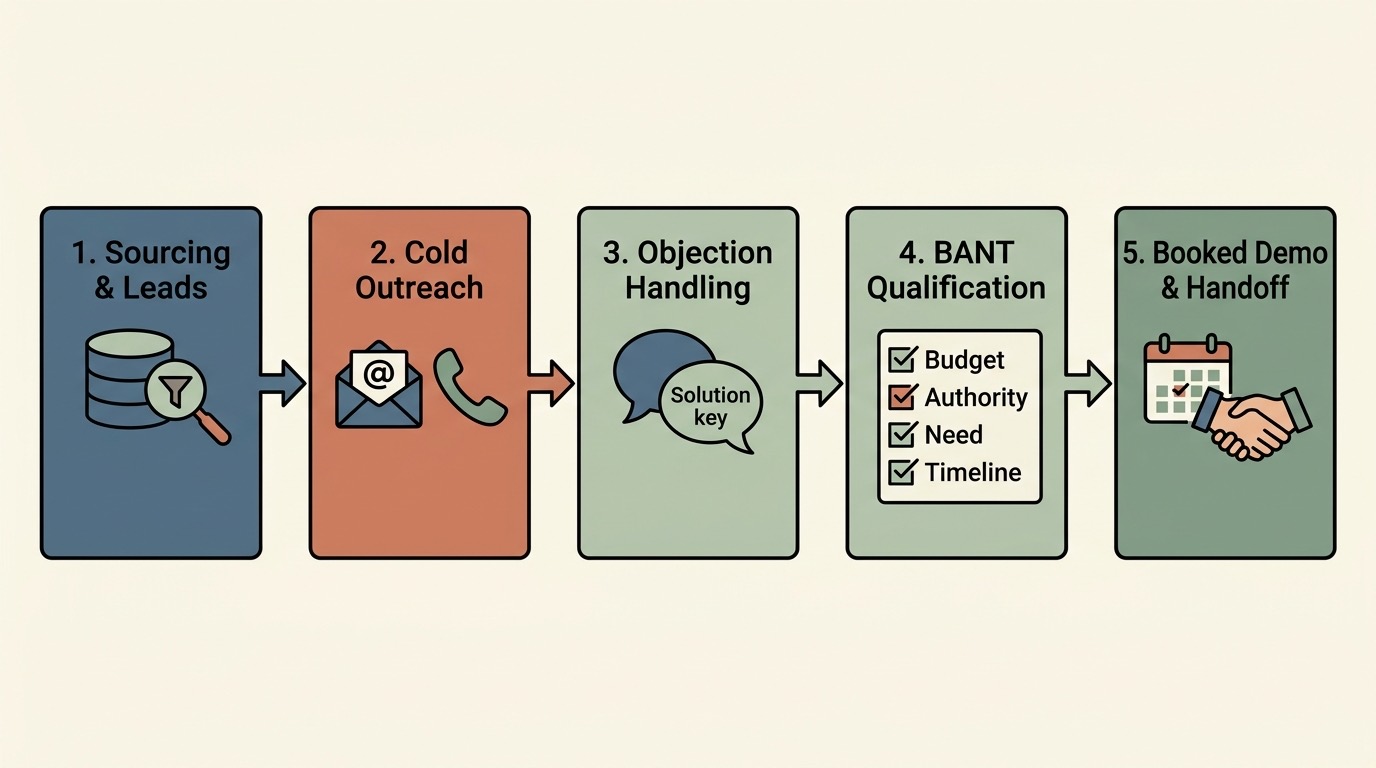
The 5-Stage SDR Prospecting Pipeline
- Target Account Research & ICP Verification: Verify company employee size, revenue tier, tech stack installation, and contact validity.
- Omnichannel Outreach Sequencing: Execute structured touches across cold calling, personalized email, LinkedIn engagement, and video snippets across days 1 through 18.
- Pattern-Interrupt Cold Calling: Hook the prospect within 7 seconds, establish common ground, and uncover latent operational friction.
- Qualification Frameworks (BANT vs. MEDDIC): Determine whether the account warrants Account Executive calendar time.
- Handoff & Calendar Lock: Secure calendar invites with verified agendas and brief the closing team in the CRM.
Qualification Frameworks: BANT vs. MEDDIC in Interview Responses
When interviewers ask "How do you determine if a prospect is truly qualified to speak with an AE?", showcase structured sales methodology rather than vague impressions.
| Qualification Stage | BANT Framework | MEDDIC Framework | Practical SDR Question |
|---|---|---|---|
| Budget / Economic Buyer | Budget allocated | Economic Buyer identified | "How are initiatives like this typically funded within your department?" |
| Authority / Decision | Authority confirmed | Decision Criteria & Process | "Who else on your operations team evaluates platforms when contract renewals arise?" |
| Need / Pain | Core Business Need | Identified Pain | "What is the downstream cost to your engineers if this pipeline stalls?" |
| Timeline / Champion | Target Timeline | Metrics & Champion | "If you find a solution that fits, are you targeting implementation for Q1 or Q2?" |
In large complex environments, your qualification tactics bridge the gap between initial outbound touches and the deep multi-stakeholder strategy covered in enterprise sales interview questions. Furthermore, understanding how prospective customers transition post-sale into account retention enables seamless collaboration with peers in customer success manager interview questions.
The Cold Call Roleplay: Live Simulation Tactics
Nearly every serious SDR interview includes a live mock cold call. The hiring manager will play a busy, distracted prospect (often an engineering director or VP) who answers the phone curtly with "Yes? Who is this? I have two minutes before my next meeting."
Here is the exact playbook to score a top evaluation:
Step 1: The Pattern Interrupt Opener
Avoid weak openers like "Did I catch you at a bad time?" (which invites an immediate "yes"). Instead, use a polite, direct pattern interrupt:
"Hi Alex, this is Jordan with totop.app. I know I caught you in the middle of your morning—do you have 30 seconds for me to tell you why I called, and you can tell me if it makes sense to continue?"
Step 2: Relatable Problem Framing
Tie your value proposition directly to their operational realities:
"The reason for my call is that engineering and sales leaders we partner with tell us that prepping candidates across technical and non-technical domains takes weeks of manual interviewing hours. We built an AI interview simulator that helps teams screen candidates 3x faster with interactive voice roleplays."
Step 3: Low-Friction Closing for Time, Not the Sale
Remember: As an SDR, you are not selling the product on a 90-second cold call—you are selling a 20-minute discovery conversation.
"I am not expecting you to evaluate our entire platform right now on your cell phone. But would you be open to a quick 15-minute introductory screen next Tuesday at 10 AM to see how other fast-growing teams automate their screening pipelines?"
Step 4: The Coachability Adjustment
After the roleplay, the interviewer will say: "Good job, but you spoke a little too quickly and didn't leave room for me to answer your second question. Let's run it again."
The Trap: Explaining why you spoke quickly or defending your choice. The Winning Move: Smile, say "Understood, thank you. Let's reset—I will pace my cadence and pause after highlighting the time-saving metric." Then immediately deliver a flawless, calm second take. This single interaction proves high coachability, which is the #1 predictor of sales rep tenure.
Behavioral Questions: Measuring Motivation and Culture
Sales requires grit. Interviewers will test your internal drive with questions designed to detect burnout risk:
"What motivates you to work in sales rather than marketing or product?"
Explain your preference for objective, measurable accountability. In sales, output connects directly to input: your effort, preparation, and conversational sharpness produce tangible numbers on a leaderboard.
"How do you organize your daily prospecting cadence?"
Highlight time-blocking. Top SDRs designate morning golden hours (8:30 AM – 10:30 AM) for primary outbound dials, midday for sequence copywriting and CRM data hygiene, and late afternoons (3:30 PM – 5:00 PM) for secondary follow-up dials and social touchpoints. Structured daily discipline beats sporadic bursts of motivation.
If you are transitioning into tech from another field or studying general career strategies, reviewing our guide on how interview prep applies to any role provides additional actionable context.
Technical & Non-Technical Practice on totop.app
Preparing for high-stakes sales conversations requires vocal practice, rapid objection response, and realistic pressure testing. Reading scripts off a sheet of paper will not build conversational agility under pressure.
With totop.app, candidates practice with interactive AI interview avatars that simulate diverse interviewer personalities—from demanding, time-strapped enterprise buyers to analytical sales leaders probing your qualification logic. You receive real-time scoring on vocal pacing, question clarity, objection handling structure, and confidence metrics.
Refine your discovery hooks, rehearse cold-call objections against responsive AI agents, and walk into your next SDR interview prepared to secure your offer.
Practice SDR / BDR Specialist Questions Live with AI Mock Interviews
Turn any job description across Engineering, DevOps, Data, Marketing, Sales, Finance, or HR into a personalized test and live voice or text AI mock interview on totop.app, or test your speed right now in the 60-Second SDR / BDR Specialist Blitz.
Play 60s SDR / BDR Specialist Blitz (Free, No Login) | Start 14-Day Free Trial | Browse All Interview Guides