Account Executive Interview Questions: 2026 Guide
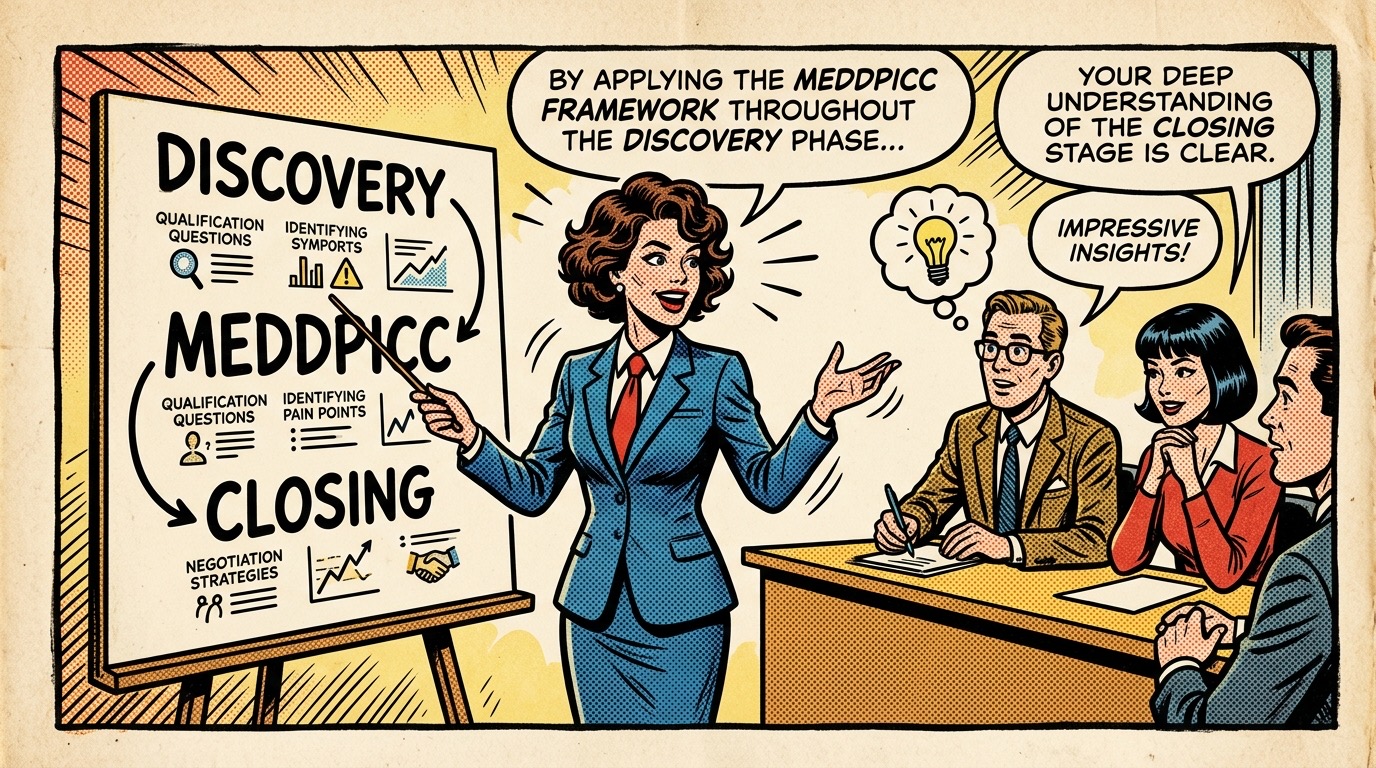
The role of the B2B Account Executive (AE) has undergone a dramatic shift over the past several years. Gone are the days when closing software deals depended on charismatic lunch pitches, generic product walkthroughs, and aggressive end-of-quarter discount pressure. In today's enterprise sales environment, buyers are cautious, Chief Financial Officers scrutinize every dollar of software spend, and buying committees average eight to twelve cross-functional stakeholders.
When sales leaders and hiring managers interview Account Executive candidates, they are not evaluating whether you have a booming voice or an assertive demeanor. They are evaluating whether you operate as a disciplined business consultant and strategic deal quarterback. They want to see that you can run forensic discovery, uncover quantifiable business pain, align disparate stakeholders, and forecast your pipeline with statistical accuracy.
Whether you are interviewing for a Mid-Market AE, Commercial AE, or Strategic Enterprise AE role, this guide breaks down the essential account executive interview questions, high-impact answering frameworks, and live roleplay strategies you need to demonstrate quota mastery.
The Modern Enterprise AE Deal Architecture
Before diving into specific questions, you must articulate a structured perspective on how deals actually move from cold pipeline to signature. Hiring managers listen closely to whether you treat the sales process as an ad-hoc art or a repeatable operating rhythm.
Every question an interviewer asks maps directly to one of the four phases of the enterprise deal cycle:
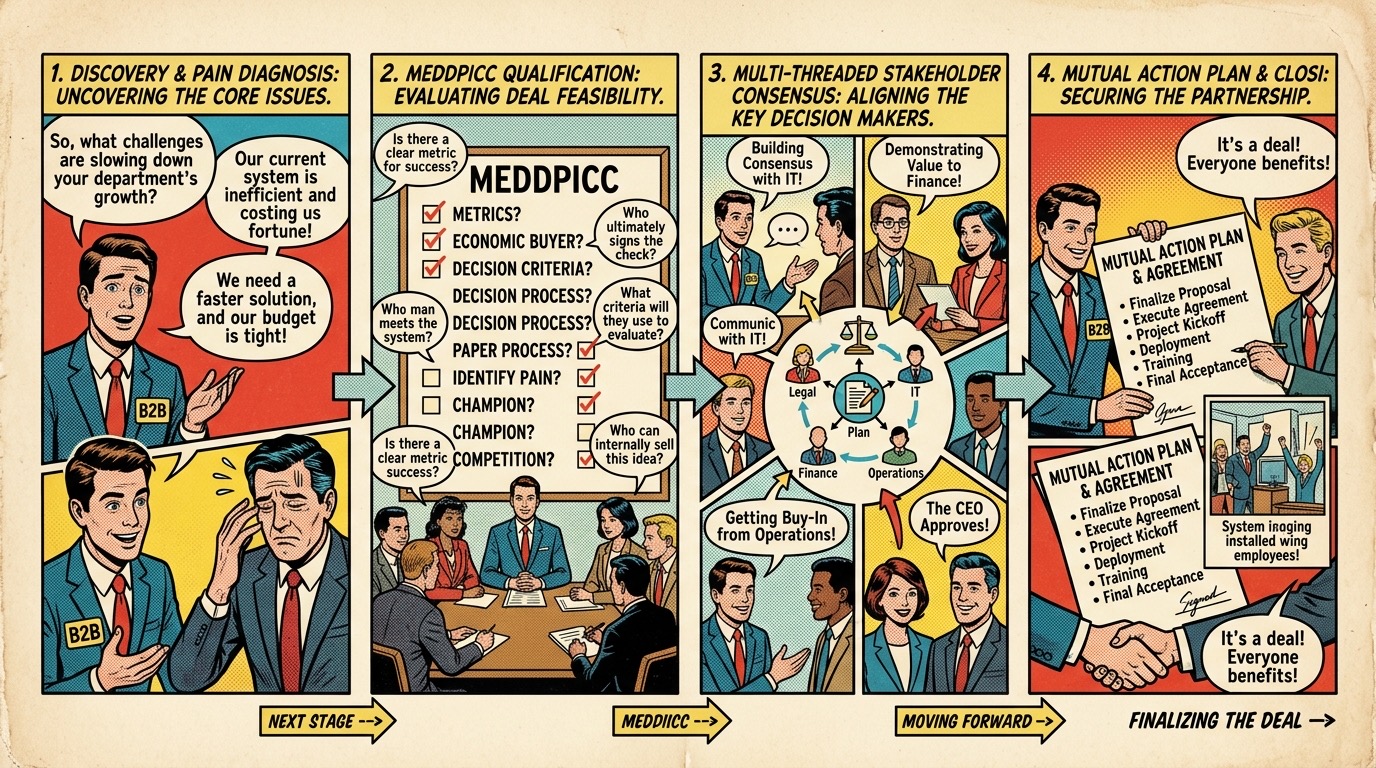
- Discovery & Pain Diagnosis: Moving beyond superficial feature requests to unearth the root business problem and the cost of inaction.
- MEDDPICC Qualification: Rigorously evaluating whether the deal has a verifiable path to close before committing precious time and technical resources.
- Multi-Threaded Stakeholder Consensus: Establishing champions while simultaneously winning over IT security, legal counsel, procurement, and the Economic Buyer.
- Mutual Action Plan & Closing: Managing the paper process, legal redlines, and final executive approvals with structured timelines rather than desperate follow-ups.
Discovery and Qualification Interview Questions
Discovery is the single most critical discipline in modern software sales. If your discovery is shallow, your demos become generic feature dumps, your pricing conversations stall, and deals slip past quarter-end.
1. "Walk me through how you structure a first discovery call with a prospective buyer."
What the Interviewer Is Really Testing: The interviewer wants to see if you control the agenda, build genuine peer-to-peer credibility, and resist the temptation to immediately show the product.
How to Structure Your Answer: Break your call into a clear time allocation model:
- Set the Agenda & Contract (First 2 minutes): Confirm goals, timing, and permission to ask probing questions.
- Context & Hypotheses (Next 5 minutes): Validate research rather than asking questions easily answered on their company website.
- Current State vs. Future State (Next 15 minutes): Diagnose business bottlenecks, workflow failures, and economic impact.
- Solution Teaser & Next Step Commitment (Final 8 minutes): Provide a targeted teaser of the solution and lock down a concrete next step with key stakeholders.
Example Winning Response:
"I structure a 30-minute discovery call around the SPICED framework: Situation, Pain, Impact, Critical Event, and Decision criteria.
In the first two minutes, I establish an upfront contract: 'My goal today is to understand your team's workflow for customer data ingestion, share how comparable firms tackle latency, and determine whether exploring a partnership makes sense. If by the end you feel this isn't a fit, feel free to tell me directly. Does that work for you?'
From there, I avoid asking basic questions like 'Tell me about your tech stack.' Instead, I lead with an informed hypothesis: 'Based on your recent product launch into European markets, most VPs of Engineering tell us compliance bottlenecks slow down deployment cycles by 30%. How is your infrastructure handling that transition?'
I spend the bulk of the call quantifying the delta between their current pain and desired future state. Before ending, I never accept a vague follow-up. I schedule a specific next milestone with the relevant technical evaluation team."
2. "How do you utilize MEDDPICC to qualify deals and maintain forecast integrity?"
What the Interviewer Is Really Testing: Sales VPs dread deals that sit in "Commit" for 90 days only to vanish into "Closed-Lost." They want proof that you can disqualify bad deals early and protect your conversion metrics.
How to Structure Your Answer: Explain how each letter of the MEDDPICC framework protects the deal, focusing particularly on the difference between a "Coach" and a true "Champion," and how you identify the true "Economic Buyer."
Key Elements to Emphasize:
- Metrics (M): The exact quantitative KPIs the prospect must move (e.g., reduce customer onboarding churn from 4.2% to 1.8%).
- Economic Buyer (EB): The individual with discretionary spending authority and veto power.
- Decision Criteria & Process (DC/DP): Technical requirements, commercial vetting, and legal validation steps.
- Paper Process (PP): Security reviews, procurement portals, MSAs, and signature authorization thresholds.
- Implicate Pain (I): What happens to the company or the individual if they do nothing for six months?
- Champion (C): A person of influence who has access to the Economic Buyer and actively sells on your behalf when you are not in the room.
- Competition (C): Not just rival SaaS vendors, but internal build projects and the status quo.
Example Winning Response:
"MEDDPICC is not a checklist I complete at the end of the quarter; it is my diagnostic operating system from day one.
The two areas where most sales reps make critical errors are Champion testing and Paper Process management. A coach tells you what is happening; a champion has political capital and acts on your behalf. I always test champions early by asking them to introduce me to the Economic Buyer or share internal slide decks. If they hesitate, I know I do not have a true champion yet.
Furthermore, I map out the Paper Process at stage two rather than stage four. Understanding whether InfoSec takes four weeks or procurement requires triple-bidding prevents artificial slip in my commit forecast."
Pipeline Velocity and Objection Handling Questions
In enterprise environments, deals rarely stall because the software lacks a specific feature. They stall because organizational inertia makes doing nothing safer than taking a purchasing risk.
3. "How do you advance a deal when your champion suddenly goes silent?"
What the Interviewer Is Really Testing: Do you panic and send desperate "just checking in" emails, or do you leverage multi-threading and value-based re-engagement?
How to Structure Your Answer:
- Acknowledge the cause: Ghosting usually means an internal priority shifted, budget was reallocated, or the champion felt unequipped to sell the project internally.
- Multi-threaded outreach: Leverage relationships you previously established with parallel stakeholders.
- The 'Breakup' or Value-Add reset: Offer fresh market research or an executive peer-to-peer connection without guilt-tripping.
Example Winning Response:
"First, I prevent single-point-of-failure risk by multi-threading early. If my champion is a Director of Operations, I already have parallel relationships with the VP of Engineering and the Finance Lead.
If my primary contact stops responding, I never send emails asking 'Are you still interested?' or 'Just bumping this to the top of your inbox.' Those messages deliver zero value. Instead, I share a relevant industry benchmark or invite them to a closed roundtable discussing an issue we discovered during their audit.
If silence persists after two strategic attempts, I deploy a polite 'permission to close the file' note: 'Hi Sarah, typically when communication pauses, it means priorities have shifted or this project is on hold for this quarter. If that is the case, no worries at all—I will close out our working file so I do not clutter your inbox. Let me know if we should revisit this next year.' That email consistently generates a candid, clarifying response within 24 hours."
4. "The prospect demands a 35% discount right before signing, claiming a competitor offered lower pricing. What do you do?"
What the Interviewer Is Really Testing: Are you an order-taker who caves to pricing pressure, or can you negotiate commercially while defending product value?
How to Structure Your Answer:
- Pause and Seek Clarification: Do not immediately reject or accept the request. Unpack what is driving the discount demand.
- Re-anchor to Quantified Business Value: Remind them of the specific financial ROI and cost of inaction they agreed to in discovery.
- Trade Value for Concessions: Never give a price discount without taking something off the table in return (e.g., payment terms, multi-year commitment, case study participation).
Example Winning Response:
"I first isolate the objection: 'Aside from price, is there any other reason we wouldn't move forward with this rollout today?' This ensures price isn't hiding an unresolved security or feature concern.
Once isolated, I address the competitor comparison: 'We have never been the cheapest option on the market, and there is a direct reason for that. During our discovery, you mentioned that system downtime costs your business $45,000 every single hour. The other platform doesn't include our high-availability SLA. Saving 30% on software licensing will not offset a single four-hour outage.'
If commercial flexibility is genuinely required to meet a strict budget cap, I follow the golden rule of enterprise negotiation: never give without taking. I will say: 'If we adjust the annual license to fit your board-approved ceiling, what can we adjust in return? Could we commit to a multi-year agreement, annual upfront payment, or participate in a public co-marketing case study?' This protects margin and establishes mutual commercial respect."
Behavioral and Leadership Questions
Hiring managers want to understand your mental resilience, coachability, and how you behave when things do not go according to plan.
5. "Tell me about a high-stakes deal you lost. What happened, and what did you learn?"
What the Interviewer Is Really Testing: Do you blame product marketing, buggy engineering, or bad leads? Or do you demonstrate radical self-accountability?
How to Structure Your Answer: Use the STAR framework (Situation, Task, Action, Result) with an emphasis on the Reflection & Process Improvement:
- Situation: A real enterprise deal with genuine ARR at stake.
- Where the error occurred: A specific qualification oversight or failure to identify an influential blocker.
- The outcome: The deal went to a competitor or status quo.
- The systemic fix: How you permanently upgraded your selling motion as a result.
Situation: 20k ARR deal with a mid-market logistics firm.
Complication: Strong champion, but skipped direct CFO meeting.
Outcome: Deal killed by CFO due to unvalidated ERP integration fears.
Process Upgrade: Mandated Economic Buyer alignment before submitting formal proposals.
Example Winning Response:
"In 2024, I worked an eight-month sales cycle for a
20,000 annual contract with a regional logistics provider. I had an incredible internal champion—the VP of Fleet Operations—who loved our product and participated in five demos.
Where I failed was allowing my champion to gatekeep the Chief Financial Officer. My champion assured me, 'Don't worry, the CFO signs whatever I approve.' I accepted that reassurance rather than insisting on a commercial alignment meeting with finance.
Two weeks before quarter-end, the CFO reviewed the contract, saw an unaddressed integration concern with their legacy ERP system, and killed the initiative entirely. We lost the deal to the status quo.
It was a painful lesson, but it fundamentally transformed my enterprise selling motion. From that day on, I made executive sponsor engagement a mandatory milestone in my Mutual Action Plans. If an executive refuses to meet for a 15-minute business case alignment, I adjust the forecast stage immediately."
6. "How do you partner with Customer Success and Solution Engineers throughout the sales cycle?"
What the Interviewer Is Really Testing:
Sales is a team sport. The interviewer wants to ensure you do not oversell features, create post-sale customer onboarding nightmares, or treat Solutions Engineers (SEs) like administrative note-takers.
Example Winning Response:
"I treat my Solutions Engineer as a co-pilot and my Customer Success Manager as the ultimate custodian of the relationship.
Before introducing an SE to a technical demonstration, I conduct a thorough internal debrief so they know the client's architecture, pain points, and evaluation criteria in advance. I never expect an SE to run discovery from scratch.
Furthermore, during contract negotiation, I conduct a formal handoff meeting with Customer Success. We document the client's key business objectives, project timelines, and agreed-upon success metrics in a unified kickoff document. Setting realistic expectations during the sales cycle directly drives net revenue retention and smooth renewals."
For a deeper dive into the operational expectations of post-sales teams, review our comprehensive breakdown of customer success manager interview questions.
Mastering the Live Mock Pitch and Demo Round
Nearly every competitive Account Executive interview includes a practical roleplay round. You will be asked to run a 15-to-30 minute mock discovery call or pitch the company's platform to an executive panel.
Core Principles for Acing the Sales Roleplay:
- Do Not Rush into Feature Presentations: Spend at least 60% of the allocated interview time diagnosing the interviewer's simulated pain points before screen-sharing or presenting slides.
- Tailor Every Slide to What They Just Said: Instead of showing all ten features in a deck, show only the two features that solve the specific pain point the interviewer articulated five minutes earlier.
- Anticipate Deliberate Curveball Objections: Interview panels will purposefully interrupt you with difficult objections—such as claiming your solution lacks compliance certifications or costs three times their budget. Stay composed and curious rather than defensive.
- Always Close on a Concrete Next Step: At the end of the simulation, do not say 'Thanks for your time, let me know what you think.' Ask: 'Based on our conversation today, our next logical step is a technical scoping session with your security architect. Does Tuesday at 2 PM work for your team?'
If you find yourself confronted by an unexpected product question during a live panel, consult our guide on handling difficult interview questions gracefully when you don't know the answer.
High-Leverage Questions to Ask Your Interviewers
At the end of your interviews, the questions you ask the VP of Sales and hiring panel reveal your operational maturity. Avoid generic questions like "What is the company culture like?" Instead, ask questions that demonstrate you think like a commercial business owner.
Question What It Demonstrates "What percentage of your AE team hit or exceeded quota over the last two quarters?" Demonstrates you evaluate quota realism and company pipeline health. "What is the split between inbound SDR-generated pipeline and AE self-sourced pipeline?" Proves you are prepared to build your own pipeline and understand territory mechanics. "What is the most common reason deals stall in stage three of your sales cycle?" Shows you are already diagnosing deal velocity and common product hurdles. "How long is your current average enterprise sales cycle from initial discovery to closed-won?" Highlights your focus on sales cycle duration and pipeline forecasting.
To understand the broader behavioral expectations across different hiring stages, read our overview of what interviewers actually look for across hiring rounds and explore our foundation guide on sales interview questions and preparation.
Practice High-Pressure Enterprise Roleplays with totop.app
The greatest hurdle candidates face in Account Executive interviews is not a lack of sales knowledge—it is the pressure of thinking on their feet during unpredictable, adversarial panel roleplays.
Reading interview frameworks provides theory, but execution requires live muscle memory. With totop.app, you can practice realistic, AI-powered mock interviews tailored to specific B2B sales roles:
- Adversarial Buyer Personas: Practice discovery calls against skeptical CFOs, impatient IT Directors, and reluctant champions who push back with realistic enterprise objections.
- MEDDPICC Diagnostic Feedback: Receive instantaneous, structured scoring on your qualification depth, pain diagnosis, and closing velocity.
- Audio & Video Roleplay Simulations: Refine your verbal presence, cadence, and tonality before stepping into executive interview panels.
Begin practicing today on totop.app and step into your next Account Executive interview ready to command the room and close the offer.