SEO Specialist Interview Questions You Should Master (with Expert Sample Answers)
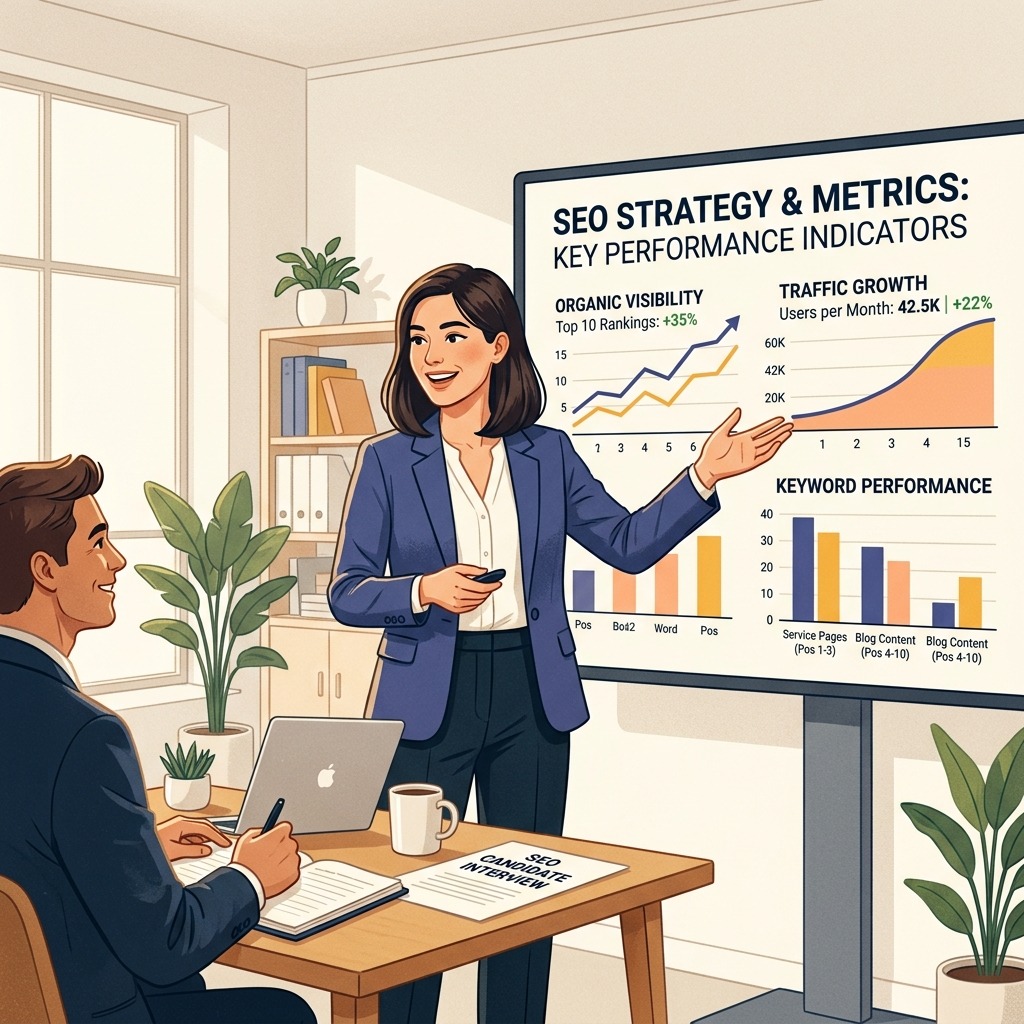
Walking into an SEO specialist interview can feel a bit unpredictable. One hiring manager might ask you to explain how Google handles JavaScript rendering, while another wants to know your exact framework for diagnosing a sudden 30% drop in organic sessions.
The search engine optimization landscape has shifted dramatically over the past few years. Keyword density and basic meta tags won't impress modern SEO leads or Directors of Marketing. Today, companies look for candidates who understand technical architecture, user intent alignment, data analytics, and the emerging impact of AI search overviews.
Whether you're prepping for a junior SEO role or a Senior Technical SEO Strategist position, mastering these core interview questions—and understanding why interviewers ask them—will set you apart.
1. Core Fundamentals & Search Engine Mechanics
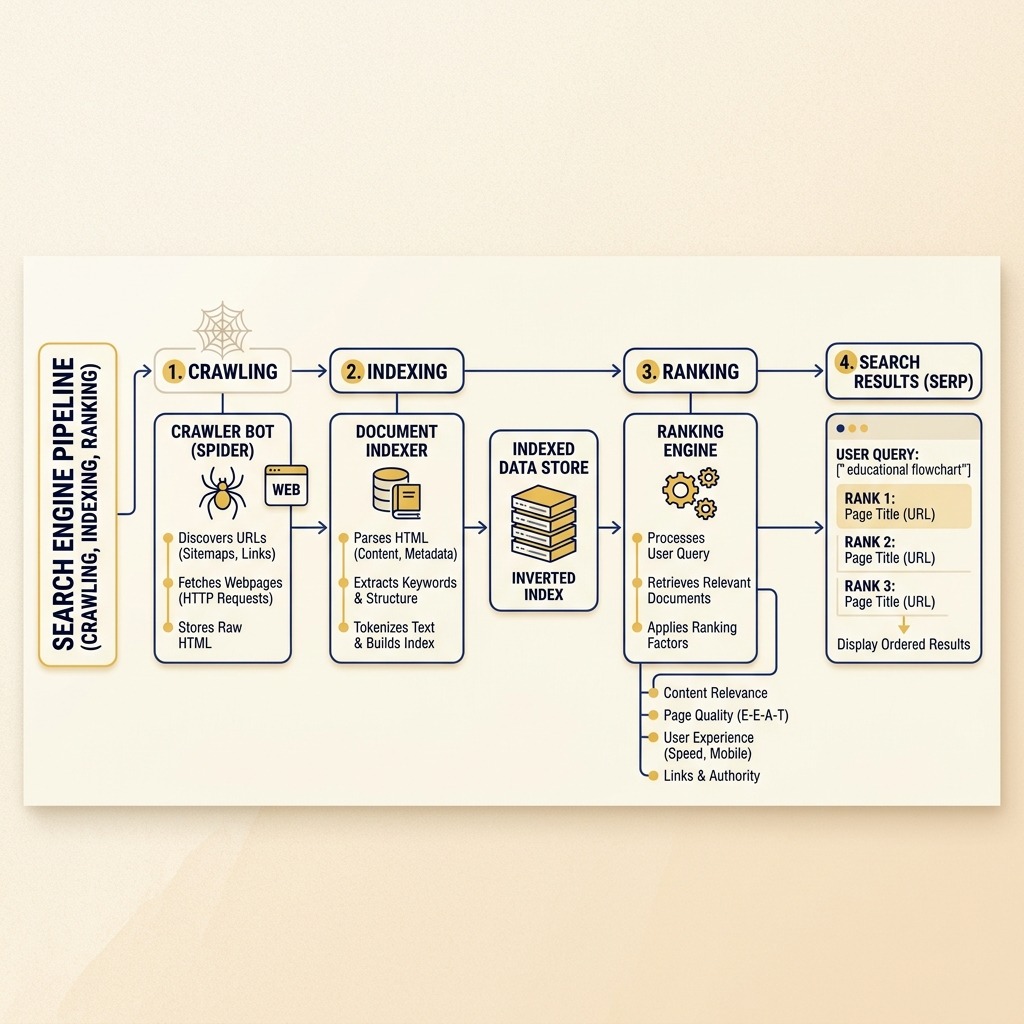
Question 1: How do search engines discover, crawl, index, and rank web pages?
Why interviewers ask this: This is the bedrock of SEO. If a candidate cannot explain the multi-step lifecycle of how Googlebot processes a webpage, they will struggle with technical troubleshooting.
Sample Answer: Search engine discovery happens through a four-stage pipeline:
- Discovery & Crawling: Search engines use automated bots (spiders/crawlers) to discover URLs via existing links, XML sitemaps, and direct submissions. Bots send HTTP requests to download webpage HTML.
- Parsing & Rendering: The crawler parses HTML, CSS, and JavaScript to understand the DOM layout and extract links to discover further URLs.
- Indexing: Extracted content, metadata, and signals are tokenized and stored in Google's massive database (the inverted index). If a page has a
noindextag or severe duplicate content issues, it may be excluded. - Ranking: When a user enters a query, the search engine's ranking algorithm evaluates thousands of indexed pages against relevance signals, intent, user experience (Core Web Vitals), and domain authority to output an ordered Search Engine Results Page (SERP).
Question 2: What is the difference between 301 and 302 redirects, and how do they impact link equity?
Why interviewers ask this: Redirect selection directly impacts how search engine crawlers pass page authority (PageRank) and handle canonicalization.
Sample Answer:
- 301 Redirect (Permanent): Signals to crawlers and browsers that a page has moved permanently to a new URL. It transfers nearly 100% of link equity (PageRank) to the target page and tells Google to replace the indexed URL with the destination URL.
- 302 Redirect (Temporary): Tells search engines that the move is temporary. Browsers do not cache 302 redirects aggressively, and crawlers retain the original URL in the search index. While modern search engines will eventually treat a long-standing 302 as a 301, using a 302 incorrectly for permanent site restructures can delay link equity transfer.
2. Technical SEO & Site Architecture
Question 3: How do canonical tags prevent duplicate content issues?
Why interviewers ask this: Duplicate content wastes crawl budget and dilutes ranking signals across multiple URLs.
Sample Answer:
A canonical tag (rel="canonical") is an HTML element in the <head> of a webpage that specifies the "master" or primary version of a URL to search engines.
For instance, if an e-commerce product page is accessible via parameter variations like example.com/shoes?color=blue and example.com/shoes?sort=price, adding a self-referential or master canonical tag pointing to example.com/shoes instructs Googlebot to consolidate indexing signals, link equity, and rankings onto the primary product URL.
Question 4: How do Core Web Vitals influence rankings, and how do you diagnose performance issues?
Why interviewers ask this: Page experience is an official Google ranking factor. Interviewers want to see that you can bridge the gap between marketing goals and engineering performance.
Sample Answer: Core Web Vitals focus on three user-centric performance metrics:
- LCP (Largest Contentful Paint): Measures loading performance. Target is under 2.5 seconds.
- INP (Interaction to Next Paint): Replaced FID in 2024 to measure overall page responsiveness to user inputs. Target is 200 milliseconds or less.
- CLS (Cumulative Layout Shift): Measures visual stability during page load. Target score is under 0.1.
Diagnostic workflow: I start with PageSpeed Insights and Chrome DevTools (Performance panel) to collect field and lab data. For LCP, I inspect unoptimized hero images, slow server response times (TTFB), or render-blocking CSS/JS. For INP, I check long tasks blocking the main thread. For CLS, I ensure images and ad slots have explicit width and height CSS attributes.
Question 5: Walk me through your process for diagnosing a sudden 40% drop in organic traffic.
Why interviewers ask this: This is a classic situational question designed to evaluate your analytical problem-solving and structured diagnostic thinking.
Sample Answer: I approach traffic drops systematically rather than panicking:
- Isolate the drop: Check Google Search Console and Google Analytics 4 to determine if the drop affected all pages, specific subfolders, specific device types, or specific countries.
- Differentiate Organic vs. Global Site Issues: Verify if organic traffic dropped while direct and paid traffic remained stable, or if tracking code snippet errors caused a false drop in GA4.
- Check GSC Manual Actions & Security: Ensure no manual penalties or security warnings were issued in Search Console.
- Identify Algorithm Updates: Compare the drop date against confirmed Google Core or Spam Updates.
- Technical & Indexation Audit: Run a crawl with Screaming Frog or Sitebulb to check for accidental
noindexdeployments, robot.txt blocks, or broken redirect chains. - SERP Layout Changes: Inspect if Google added AI Overviews, featured snippets, or heavy ad blocks for core keywords, turning organic clicks into zero-click searches.
3. On-Page SEO & Content Strategy
Question 6: How do you conduct keyword research that prioritizes search intent over search volume?
Why interviewers ask this: Ranking for high-volume keywords means nothing if visitors don't convert due to mismatched intent.
Sample Answer: Keyword research isn't just about finding metrics in Ahrefs or SEMrush; it's about mapping user intent stages:
- Informational (Top-of-Funnel): Queries seeking answers ("how to fix slow page load"). Best served by comprehensive guide articles and blog posts.
- Commercial Investigation (Mid-Funnel): Queries comparing options ("best technical SEO tools 2026"). Best served by comparison tables and review roundups.
- Transactional (Bottom-of-Funnel): Queries with high intent to purchase ("buy SEO audit service online"). Best served by direct product or landing pages.
I analyze the current SERP for target queries. If top ranking results are all long-form guides, publishing a product page won't rank, regardless of domain authority.
Question 7: What is Schema Markup, and how does it help with Rich Snippets?
Why interviewers ask this: Structured data helps search engines understand entity relationships and unlocks eye-catching SERP features.
Sample Answer: Schema markup is standardized code (typically formatted as JSON-LD) added to a webpage's HTML to explicitly inform search engines about the page content—such as Products, Articles, FAQs, Organizations, Reviews, or Events.
By providing structured metadata, schema increases the likelihood of earning Rich Snippets (e.g., star ratings, recipe times, FAQ drop-downs, software prices) on the SERP, which significantly boosts Click-Through Rate (CTR).
4. Off-Page SEO & Link Building Strategy
Question 8: How do you evaluate the quality of a backlink opportunity?
Why interviewers ask this: Low-quality link building can trigger Google spam penalties. Interviewers want to ensure you build links safely and strategically.
Sample Answer: I evaluate backlink quality using four main criteria:
- Topical Relevance: A backlink from a smaller niche tech blog is far more valuable than a link from an irrelevant high-authority automotive site.
- Organic Traffic & Health: The referring domain must have steady organic search traffic. If a site's traffic curve is tanking, it may be hit by a link spam penalty.
- Editorial Placement: Contextual links embedded inside body copy carry significantly more weight than footer, sidebar, or author bio links.
- Anchor Text Naturalness: Anchor text profiles should be diverse and unmanipulated, avoiding exact-match anchor text spam.
5. Modern Trends & Strategy
Question 9: How are Google AI Overviews (SGE) changing SEO, and how do you optimize for them?
Why interviewers ask this: Tests whether you stay ahead of industry trends and understand Generative Engine Optimization (GEO).
Sample Answer: AI Overviews synthesize information from top web sources directly at the top of the SERP, reducing traditional organic link CTR for simple informational queries.
To optimize for AI Overviews:
- Direct Answer Formatting: Structure content with concise, authoritative answers in the first 50 words of key sections.
- Unique Data & Insights: Provide proprietary research, expert quotes, and original case studies that LLMs cannot synthesize from generic web data.
- Strong E-E-A-T: Ensure author bios demonstrate firsthand experience, and build entity presence across trusted third-party publications.
Mastering Your SEO Interview with totop.app
Knowing the theoretical answers is only half the battle. In a high-stakes interview, your delivery matters just as much as your technical depth. Communicating complex concepts like client-side rendering or log file analysis clearly to non-technical stakeholders requires practice.
That’s where totop.app comes in.
totop.app provides an interactive mock interview platform where you can:
- Practice real-world technical and marketing scenarios with adaptive AI interviewers.
- Receive instant feedback on your answer structure, technical accuracy, and communication clarity.
- Build confidence answering tough follow-up questions under real interview conditions.
Final Checklist for SEO Candidates
Before heading into your next SEO interview:
- Review your personal case studies: Be ready to share exact numbers (e.g., "grew organic sessions by 45% in 6 months").
- Know your favorite SEO tools inside and out (Google Search Console, Screaming Frog, Ahrefs, GA4).
- Be ready to audit a live page on the spot if asked during a whiteboard session.
- Prepare thoughtful questions for the interviewer about their site architecture, content publishing velocity, and dev resources.
Mastering these questions demonstrates that you aren't just following checklists—you're a strategic growth driver who understands search engine mechanics inside and out.