Corporate finance sits at the epicenter of strategic corporate decision-making. Whether determining the optimal debt-to-equity ratio, evaluating a multimillion-dollar capital expansion, or assessing potential M&A targets, corporate finance professionals dictate how capital is raised, deployed, and safeguarded.
Interviews for corporate finance analyst, senior manager, and director positions demand far more than rote memorization of accounting formulas. Hiring committees evaluate your ability to connect financial theory directly to operating cash flows, risk management, and shareholder value creation.

This comprehensive guide unpacks the most crucial corporate finance interview questions you will encounter in 2026, complete with quantitative breakdowns, structural frameworks, and model candidate responses.
Core Pillars of Corporate Finance Interviews
Corporate finance interviews generally assess four interconnected competency domains:
- Capital Budgeting & Investment Appraisal: Evaluating long-term investments using Net Present Value (NPV), Internal Rate of Return (IRR), payback period, and profitability index.
- Capital Structure & WACC: Balancing cost of debt, cost of equity, tax shields, and financial distress risks to minimize the firm's cost of capital.
- Working Capital Management: Managing liquidity, cash conversion cycles (CCC), inventory velocity, and short-term operational solvency.
- Strategic Valuation & Corporate Transactions: Assessing M&A accretion/dilution, synergy realism, debt covenants, and capital allocation between reinvestment and shareholder returns.
Candidates who bridge these technical calculations with executive communication consistently outperform their peers. If you come from an adjacent track, reviewing financial analyst interview questions and FP&A analyst interview questions will reinforce your core three-statement foundations.
Capital Budgeting & Investment Appraisal Questions
Question 1: When evaluating competing projects, why is Net Present Value (NPV) theoretically superior to Internal Rate of Return (IRR)?
Why Interviewers Ask
This is the quintessential capital budgeting question. Interviewers use it to separate practitioners who merely operate Excel templates from finance professionals who understand reinvestment assumptions and non-linear cash flow behaviors.
Model Answer
"While both Net Present Value (NPV) and Internal Rate of Return (IRR) serve as discounted cash flow metrics, NPV is theoretically superior for three core reasons:
First, reinvestment rate assumptions. NPV explicitly assumes that interim cash inflows can be reinvested at the firm's opportunity cost of capital (WACC), which is a realistic and conservative benchmark. In contrast, IRR implicitly assumes that intermediate cash flows are reinvested at the project's own IRR. For a high-performing project with an IRR of 35%, assuming the company can continuously find additional 35% return opportunities is financially unrealistic.
Second, project scale and magnitude. IRR is a relative percentage metric, whereas NPV is an absolute dollar measure of shareholder value creation. A project requiring a $1,000 investment with an 80% IRR produces an NPV of less than $800. A competing project requiring a $50 million investment with a 15% IRR against an 8% WACC generates millions in net economic profit. Maximizing enterprise value requires choosing the higher dollar NPV.
Third, unconventional cash flows. Projects with multiple sign changes in their cash flows (such as nuclear decommissioning, strip mining remediation, or heavy midterm maintenance overhauls) produce multiple mathematical IRRs, making the IRR metric ambiguous or entirely unusable."
Question 2: How do you choose the discount rate for a new capital investment project that enters an adjacent, unfamiliar market?
Why Interviewers Ask
Corporate finance teams frequently assess investments outside their parent corporation's historical risk profile. The interviewer wants to verify that you don't blindly default to the corporate-wide WACC.
Model Answer
"You cannot use the parent company's existing WACC if the new venture's systematic risk (beta) and capital structure differ substantially from the core business. Applying an enterprise WACC of 8% to a high-risk venture artificially subsidizes dangerous projects, while applying an enterprise WACC of 12% to a low-risk infrastructure project rejects value-accretive initiatives.
Instead, I use the pure-play method:
- Identify Pure-Play Comparables: Find publicly traded peer companies whose primary operations reside entirely within the target adjacent industry.
- Unlever the Peer Betas: Strip out each peer's unique financial leverage to isolate asset risk:
β_unlevered = (β_levered) / (1 + (1 - t) × (D / E))
- Calculate Industry Asset Beta: Take the median or trimmed mean of the unlevered betas.
- Relever the Beta: Relever the benchmark beta using our target project's planned debt-to-equity ratio:
β_project = β_unlevered × [1 + (1 - t) × (D_target / E_target)]
- Estimate Cost of Capital: Feed this project beta into the Capital Asset Pricing Model (CAPM) to determine cost of equity (
r_e = r_f + β × ERP), estimate project-specific borrowing spreads, and compute the tailored project hurdle rate."
Capital Structure and WACC Questions
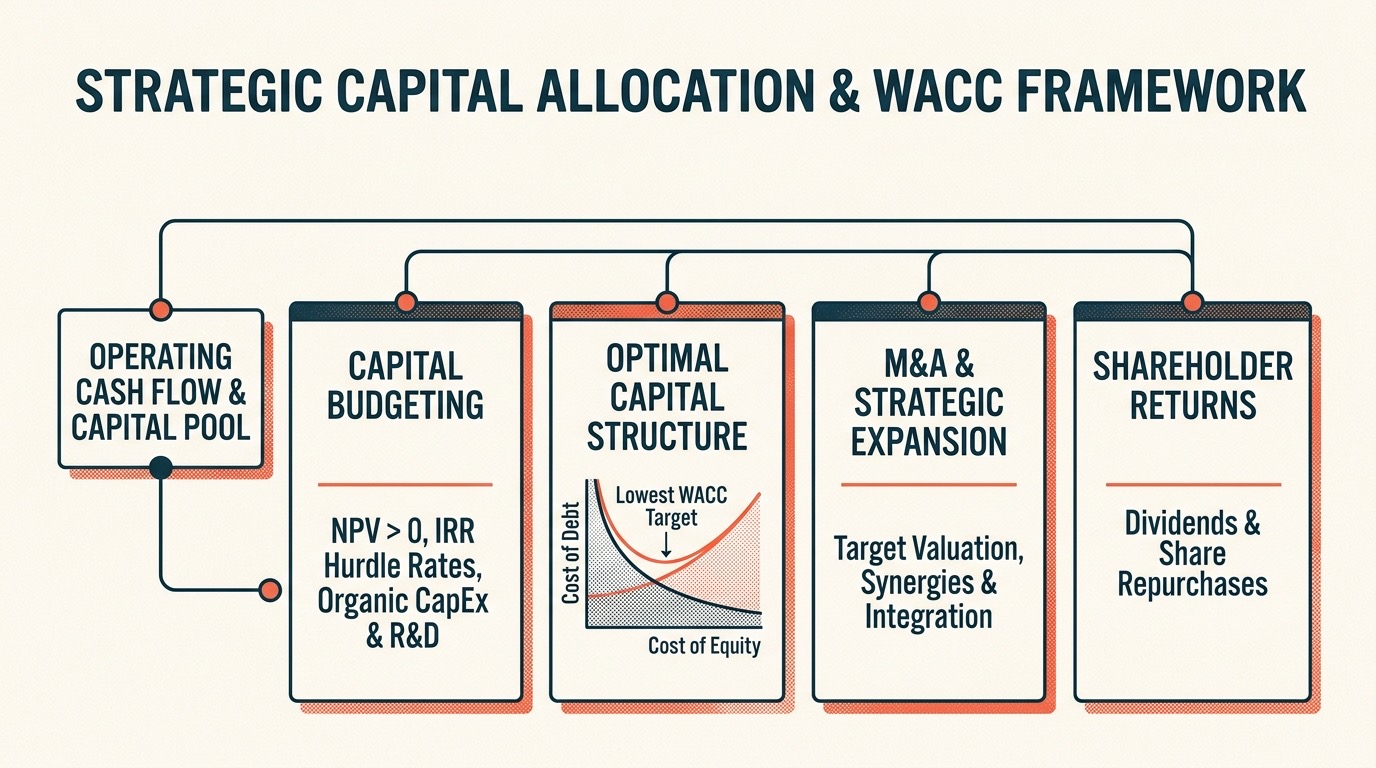
Question 3: Walk me through the Weighted Average Cost of Capital (WACC) formula. If debt is cheaper than equity, why shouldn't a company finance 100% of operations with debt?
Why Interviewers Ask
This tests your grasp of Modigliani-Miller theorem, the trade-off theory of capital structure, and bankruptcy risk dynamics.
Model Answer
"The Weighted Average Cost of Capital represents the blended hurdle rate required by all capital providers:
WACC = ((E) / (V) × r_e) + ((D) / (V) × r_d × (1 - t)) + ((P) / (V) × r_p)
Where E, D, and P represent the market values of Equity, Debt, and Preferred Stock, V is total firm value, r_e is cost of equity, r_d is pre-tax cost of debt, and t is the marginal corporate tax rate.
Debt is inherently cheaper than equity for two structural reasons:
- Seniority in Capital Structure: Debt holders hold contractual repayment priority over assets and cash flows in liquidation, making debt lower risk than residual equity.
- Interest Tax Shield: Interest expense is tax-deductible in most jurisdictions, reducing the effective after-tax cost of debt by
(1 - t).
However, a firm cannot fund 100% of its balance sheet with debt due to Trade-Off Theory and Financial Distress Costs:
- Escalating Cost of Equity: As the debt-to-equity ratio increases, equity volatility and default risk rise. Unlevered shareholders demand a significantly higher required return (
r_e), offsetting the benefits of cheap debt. - Rising Marginal Borrowing Rates: Beyond a sustainable credit rating, lenders charge aggressive risk premiums, and bond yields spike.
- Direct and Indirect Distress Costs: Direct costs include legal and restructuring fees. Indirect costs are far more destructive—loss of enterprise customers unwilling to rely on a precarious supplier, brain drain of top talent, and supplier tightening of payment terms.
- Debt Covenants & Flexibility: Restrictive covenants impede strategic M&A and R&D agility. The optimal capital structure is the exact inflection point where the marginal tax shield benefit equals the present value of expected financial distress costs."
Question 4: How does a $100 million corporate share repurchase funded entirely by new debt impact EPS, ROE, and WACC?
Why Interviewers Ask
Corporate share buybacks financed with debt are common treasury maneuvers. Interviewers want to observe your ability to trace a transaction across the balance sheet, income statement, and valuation metrics simultaneously.
Model Answer
"Let's trace the transaction across the financial statements:
- Earnings Per Share (EPS):
- After-tax interest expense increases by
$100M × r_d × (1 - t), which reduces Net Income. - However, the share count in the denominator drops by
$100M / P_share. - EPS will increase if the after-tax yield of debt is lower than the inverse of the company's price-to-earnings ratio (the earnings yield,
E / P). If after-tax debt cost is 4.5% and the company's earnings yield is 7% (P/E of ~14.3x), the transaction is immediately accretive to EPS.
- After-tax interest expense increases by
- Return on Equity (ROE):
- ROE is
Net Income / Shareholders' Equity. - Shareholders' equity contracts by the full $100 million repurchase price (via treasury stock).
- Because equity drops by a much higher percentage than the after-tax interest drag on net income, ROE will mathematically rise.
- ROE is
- Weighted Average Cost of Capital (WACC):
- Initially, substituting higher-cost equity with lower-cost after-tax debt can modestly reduce WACC if the company operates below its optimal leverage ratio.
- However, if the company is already highly levered, credit rating downgrades, increased beta, and higher bond coupons could increase overall WACC."
If your role requires building dynamic schedules to stress-test these scenarios, practicing financial modeling interview questions will ensure your operational mechanics remain sharp.
Working Capital Management & Liquidity Questions
Question 5: Define the Cash Conversion Cycle (CCC). What strategic initiatives would you implement to compress it without damaging business relationships?
Why Interviewers Ask
Working capital management separates theoretical corporate finance from day-to-day operational liquidity. This question evaluates whether you understand supply chain realities and commercial counterparty relationships.
Model Answer
"The Cash Conversion Cycle (CCC) measures the duration in days required for a company to convert cash invested in inventory into cash inflows from customer sales:
CCC = Days Inventory Outstanding (DIO) + Days Sales Outstanding (DSO) - Days Payable Outstanding (DPO)
Where:
DIO = (Average Inventory / COGS) × 365DSO = (Accounts Receivable / Total Credit Sales) × 365DPO = (Accounts Payable / COGS) × 365
To strategically compress the cycle without damaging partnerships, I focus on four pragmatic initiatives:
- Dynamic Early Payment Discounts (DSO): Rather than blunt collections pressure, offer 1.5% or 2% discounts for invoice settlement within 10 days (e.g., 2/10 Net 30). For enterprise customers, implement automated electronic invoicing to eliminate billing friction and dispute delays.
- Supply Chain Financing / Reverse Factoring (DPO): Instead of unilaterally stretching supplier payment terms from 30 to 90 days—which risks alienating critical vendors—partner with a corporate bank to set up supply chain financing. Suppliers can sell their verified receivables to the bank at our low corporate borrowing cost while we settle on 90-day terms.
- Just-In-Time and SKU Rationalization (DIO): Conduct ABC inventory categorization. Liquidate dead stock and configure automated reorder triggers tied directly to real-time sales pipelines, reducing carrying costs and working capital drag."
M&A and Strategic Capital Allocation Questions
Question 6: Walk me through an M&A accretion/dilution analysis. Why might a transaction that is accretive to EPS actually destroy shareholder value?
Why Interviewers Ask
Senior leadership and board members depend on corporate finance teams to vet M&A proposals. This question tests whether you rely solely on accounting metrics or evaluate fundamental economic value.
Model Answer
"An accretion/dilution analysis assesses whether an acquisition will increase or decrease the buyer's pro-forma Earnings Per Share:
- Calculate Acquirer Standalone Net Income & Shares: Establish baseline EPS.
- Estimate Pro-Forma Combined Net Income: Combine target's projected net income, add after-tax operational and cost synergies, deduct after-tax transaction and restructuring amortization, and deduct new after-tax interest expense on debt used to finance the deal (or forgone interest income on cash spent).
- Determine Pro-Forma Diluted Share Count: Add newly issued acquirer shares if equity was used as consideration.
- Compare Standalone vs Pro-Forma EPS: If pro-forma EPS > standalone EPS, the deal is accretive.
Why Accretive Deals Can Destroy Economic Value: EPS accretion does not guarantee value creation. An acquisition can be mathematically accretive while destroying massive enterprise value under three common conditions:
- Cost of Capital Exceeds Return on Invested Capital (ROIC < WACC): If a company with a high P/E multiple (e.g., 30x, earnings yield 3.3%) acquires a low P/E business (10x, earnings yield 10%) using all stock, the deal is instantly accretive on day one. However, if the target operates in a dying industry generating a return on capital below the cost of funding, economic profit is negative.
- Phantom Synergies: Deals often budget aggressive revenue cross-sell synergies that fail to materialize while incurring heavy severance and system integration costs.
- Overleveraging and Distress Risk: If funded with high-yield debt, the added leverage may trigger credit downgrades that raise the acquirer's enterprise-wide cost of capital, depressing the valuation multiple applied to the combined firm."
Behavioral & Situational Questions in Corporate Finance
Technical precision is a baseline requirement, but executive alignment determines hiring decisions. Corporate finance teams frequently interact with BU general managers, legal counsel, and board directors.
Question 7: Describe a situation where a Business Unit Leader pushed aggressively for a project that failed your financial hurdle rate. How did you handle it?
Framework for Success (STAR Method)
- Situation: Contextualize the BU leader's proposal (e.g., a proposed European warehouse expansion requiring $12M with an estimated IRR of 7.5% against a 9.5% divisional hurdle rate).
- Task: Explain your dual responsibility: safeguarding corporate return on capital while maintaining collaborative business partnership.
- Action: Outline how you audited their underlying assumptions (utilization ramp, maintenance capex, lease alternatives) and worked together on scenario modeling.
- Result: Demonstrate an outcome where you either restructured the project (e.g., 3PL partnership reducing upfront capex, lifting IRR to 11.2%) or helped the leader reallocate their budget toward higher-return digital automation.
When answering behavioral scenarios under pressure, remember how to handle unknown interview questions gracefully. Articulating a transparent, structured line of thought matters far more than pretending to have an instantaneous answer.
Advanced Corporate Finance Interview Cheat Sheet
| Financial Concept | Formula / Rule | Key Trade-Off to Articulate |
|---|---|---|
| WACC | (E/V · r_e) + (D/V · r_d(1-t)) | Low after-tax debt cost vs rising financial distress & higher levered beta. |
| NPV | Σ (CF_t) / ((1+r)^t) - Initial Outlay | Absolute dollar value created; assumes reinvestment at cost of capital. |
| IRR | Discount rate where NPV = 0 | Percentage return; vulnerable to unconventional cash flows & unrealistic reinvestment. |
| ROIC | NOPAT / Invested Capital | True measure of operating efficiency; must exceed WACC to create economic value. |
| Cash Conversion Cycle | DIO + DSO - DPO | Working capital efficiency vs supplier stability and customer satisfaction. |
| Dividend vs Buyback | Cash return vs Share reduction | Ongoing commitment & signaling effect (dividends) vs flexibility & undervaluation timing (buybacks). |
Before wrapping up your preparation, review what to expect at each interview round to tailor your technical depth from the initial recruiter screen to the final CFO presentation. Don't forget to prepare questions you should ask your interviewer about their treasury structure and capital allocation priorities.
Practicing Corporate Finance Interviews with AI
Explaining complex finance concepts verbally requires practice. In an executive interview, you cannot hide behind an Excel workbook; you must clearly articulate how a debt refinancing alters the cash conversion cycle or why a project's hurdle rate requires adjusting for country risk premiums.
Platforms like totop.app provide AI-driven, role-tailored mock interviews specifically customized for corporate finance, treasury, and financial analyst candidates. You can practice real-time technical cases, receive instant feedback on your valuation reasoning, and refine your executive communication before meeting the hiring committee.
Commit to mastering the foundational trade-offs of capital structure, liquidity, and investment appraisal, and you will walk into your corporate finance interview with complete confidence.
Practice Financial Analyst Questions Live with AI Mock Interviews
Turn any job description across Engineering, DevOps, Data, Marketing, Sales, Finance, or HR into a personalized test and live voice or text AI mock interview on totop.app, or test your speed right now in the 60-Second Financial Analyst Blitz.
Play 60s Financial Analyst Blitz (Free, No Login) | Start 14-Day Free Trial | Browse All Interview Guides