Financial Modeling Interview Questions: 2026 Guide

Financial modeling lies at the core of strategic corporate finance, private equity, investment banking, and FP&A decision-making. Whether evaluating a potential merger, forecasting cash burn for an expansion initiative, or determining fair value for capital allocation, leadership depends on robust, dynamic financial models.
In 2026, recruiting panels have raised the bar significantly for modeling candidates. Interviewers are no longer satisfied with candidates who merely know keyboard shortcuts in Excel. Today's interviewers evaluate whether you grasp underlying accounting mechanics, can design flexible sensitivity architectures, and clearly articulate the operational business story behind every cell and formula.
If you are preparing for corporate development, investment banking, private equity, or strategic finance interviews, mastering these essential financial modeling interview questions will help you stand out with technical rigor and executive poise.
The Core Financial Modeling Architecture
Before diving into individual questions, it is vital to visualize how the core components of financial valuation connect. A financial model is not an isolated sheet of calculations; it is an integrated system where financial statements feed directly into valuation methodologies.
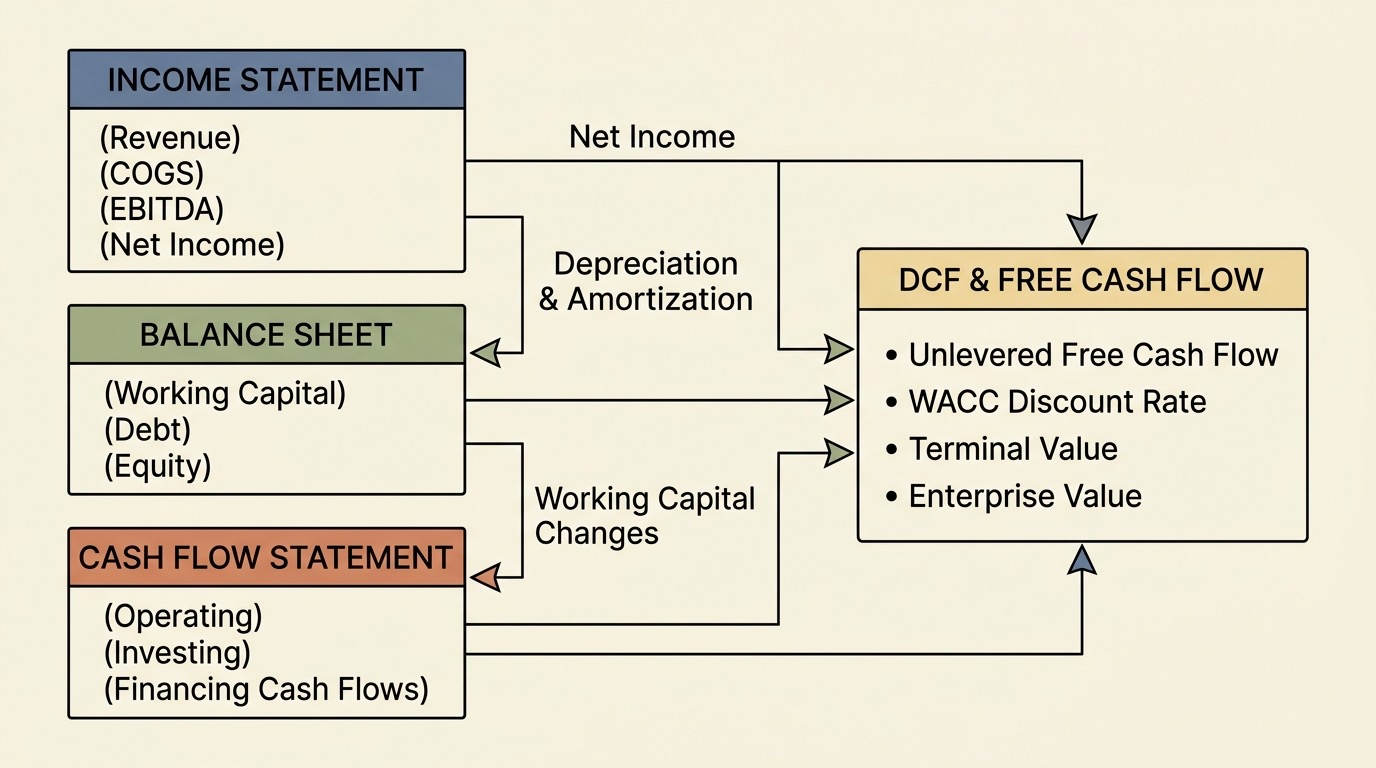
The framework highlights the standard progression every seasoned analyst should master:
- Historical Financial Data & Assumptions: Cleaning past revenue, gross margins, working capital turns, and capex cycles.
- Three-Statement Integration: Linking Net Income from the Income Statement through non-cash adjustments in the Cash Flow Statement into the Balance Sheet cash balance.
- Valuation Layer: Deriving Unlevered Free Cash Flow (UFCF), discounting via Weighted Average Cost of Capital (WACC), and adding Terminal Value.
- Scenario & Sensitivity Analysis: Stress-testing assumptions across revenue growth, exit multiples, and cost-of-capital fluctuations.
For broader role preparation, you can pair this guide with our breakdown of financial analyst interview questions and operational FP&A analyst interview questions.
1. Three-Statement Financial Modeling Questions
Question 1: "Walk me through how the three financial statements link together."
What the Interviewer Is Really Asking: Can you trace accounting transactions across the Income Statement, Balance Sheet, and Cash Flow Statement without getting confused under pressure?
How to Structure Your Answer:
- Net Income Link: Net income from the bottom of the Income Statement flows as the first line of Cash Flow from Operations (CFO) on the Cash Flow Statement. It also flows into Retained Earnings under Stockholders' Equity on the Balance Sheet (minus dividends).
- Non-Cash Adjustments: Non-cash expenses (such as Depreciation and Amortization) are added back to Net Income on the Cash Flow Statement.
- Working Capital Changes: Changes in current assets and current liabilities on the Balance Sheet dictate operational cash adjustments on the Cash Flow Statement.
- Ending Cash & Balance Sheet Reconciliation: The net change in cash from operating, investing, and financing activities on the Cash Flow Statement added to beginning cash yields ending cash, which updates the Cash asset on the Balance Sheet.
Sample Answer:
"The three financial statements link through three primary pathways. First, Net Income from the Income Statement flows directly to the top of Cash Flow from Operations and into Retained Earnings on the Balance Sheet. Second, non-cash charges like Depreciation and Amortization are added back in CFO, while capital expenditures from the investing section flow into Property, Plant & Equipment on the Balance Sheet. Finally, changes in working capital accounts—such as Accounts Receivable and Accounts Payable—bridge operational earnings to actual cash flow. The resulting ending cash on the Cash Flow Statement balances the cash asset line on the Balance Sheet, ensuring Assets strictly equal Liabilities plus Equity."
Question 2: "If depreciation increases by 0, how does that affect all three statements?" (Assuming a 20% tax rate)
What the Interviewer Is Really Asking:
Do you understand the cash tax shield created by non-cash expenses?
Step-by-Step Walkthrough:
- Income Statement:
- Operating income (EBIT) decreases by 0.
- Assuming a 20% tax rate, pre-tax income is down 0, so taxes decrease by (0 × 20%).
- Net Income decreases by $8 (0 - ).
- Cash Flow Statement:
- Net Income starts down $8 in Cash Flow from Operations.
- Depreciation of 0 is added back because it is non-cash.
- Overall Cash Flow from Operations increases by +
(the tax shield benefit).
- Balance Sheet:
- Cash is up +
.
- Net PP&E decreases by 0 due to higher accumulated depreciation.
- Total Assets decrease by $8 (-0 PP&E + Cash).
- On the Liabilities & Equity side, Retained Earnings decreases by $8 due to lower Net Income.
- Assets balance Liabilities and Equity (-$8 = -$8).
2. Discounted Cash Flow (DCF) & Valuation Mechanics
Question 3: "What is the difference between Levered and Unlevered Free Cash Flow?"
What the Interviewer Is Really Asking:
Do you know which cash flow stream belongs to which capital providers, and which discount rate matches each stream?
Key Concepts to Contrast:
- Unlevered Free Cash Flow (Free Cash Flow to Firm / FCFF): Cash generated by core business operations available to all capital providers (both debt holders and equity investors). It is calculated before interest expense payments.
$\text{UFCF} = \text{EBIT} \times (1 - t) + \text{D&A} - \text{CapEx} - \Delta\text{NWC}$
Discounted using WACC to determine Enterprise Value.
- Levered Free Cash Flow (Free Cash Flow to Equity / FCFE): Cash remaining after mandatory debt service obligations (interest expense and principal repayments).
$\text{LFCF} = \text{Net Income} + \text{D&A} - \text{CapEx} - \Delta\text{NWC} + \text{Net Debt Issued/(Repaid)}$
Discounted using the Cost of Equity to determine Equity Value directly.
Question 4: "How do you calculate WACC, and when does it break down?"
What the Interviewer Is Really Asking:
Do you understand how capital structure weights and cost of debt/equity interplay, and can you spot real-world limitations?
Formula Breakdown:
$\text{WACC} = \left(\frac{E}{D+E} \times K_e\right) + \left(\frac{D}{D+E} \times K_d \times (1 - t)\right)$
Where:
- $E$ = Market Value of Equity
- $D$ = Market Value of Debt
- $K_e$ = Cost of Equity (derived via CAPM: $R_f + \beta \times \text{ERP}$)
- $K_d$ = Pre-tax Cost of Debt (yield to maturity on debt)
- $t$ = Marginal Corporate Tax Rate
Critical Nuances & Limitations:
- Book vs. Market Values: Always use market value of equity and debt, never book values.
- Optimal Capital Structure: As leverage increases, the tax shield lowers WACC initially, but high debt loads escalate financial distress costs, causing both cost of debt and beta to spike.
- Distressed Companies: For negative-EBITDA or highly levered turnaround firms, CAPM beta estimates often become unreliable.
Question 5: "How do you calculate Terminal Value, and which method is preferred?"
What the Interviewer Is Really Asking:
Since Terminal Value often represents 60% to 80% of total DCF Enterprise Value, can you defend your methodology?
The Two Methodologies:
- Gordon Growth / Perpetuity Growth Method:
$\text{Terminal Value} = \frac{\text{UFCF}_{N+1}}{\text{WACC} - g}$
Where $g$ (long-term perpetual growth rate) must never exceed the long-term GDP growth rate of the economy (typically 2% to 3%).
- Exit Multiple Method:
Applies an industry-standard operational multiple (such as EV/EBITDA or EV/EBIT) to the final forecast year's metric.
$\text{Terminal Value} = \text{EBITDA}_N \times \text{Exit Multiple}$
How to Reconcile Both in Interviews:
Always explain that top modelers use both methods to cross-validate. If your chosen exit multiple implies an implied perpetual growth rate of 6%, your assumptions are overly aggressive and inconsistent with economic reality.
3. LBO & Transaction Modeling Concepts
Question 6: "What are the primary drivers of returns in a Leveraged Buyout (LBO)?"
What the Interviewer Is Really Asking:
Do you understand how private equity sponsors create value and achieve target Internal Rates of Return (IRR)?
The Three Value Creation Pillars:
- Deleveraging (Debt Paydown): Using the target company’s free cash flow generation over a 3-to-5-year holding period to amortize senior and subordinated debt, transferring enterprise value from lenders to equity holders.
- Operational Improvement (EBITDA Expansion): Growing organic revenue, optimizing gross margins, expanding into new markets, and cutting overhead costs to exit with a higher earnings base.
- Multiple Expansion (Arbitrage): Selling the asset at a higher valuation multiple (e.g., buying at 8x EV/EBITDA and exiting at 10x EV/EBITDA). Interviewers appreciate candidates who note that conservative sponsors do not rely on multiple expansion for their base case returns.
4. Best Practices for Financial Modeling Tests
Many corporate finance interview processes include a timed 2-to-3-hour modeling assessment. Keep these best practices top of mind:
- Color Code Consistently: Industry standards mandate blue text for hardcoded inputs/historical data, black text for formulas and dynamic calculations, and green text for external sheet links.
- Eliminate Circular References: Avoid linking interest expense directly to ending cash balances without a circuit breaker or average debt toggle. Circular references cause spreadsheets to crash during executive reviews.
- Build Dynamic Sensitivity Tables: Use Excel's data tables (
Alt + A + W + T) to stress test WACC versus Terminal Growth, or Purchase Multiple versus Exit Multiple.
- Never Leave Broken Links or #REF! Errors: Run error check audits across all summary sheets before submitting.
If you encounter an unfamiliar scenario during a live assessment, remember the core principles in our guide on when you don't know the answer how to handle it gracefully. Staying structured and transparent is far better than guessing formulas.
5. Behavioral Questions for Financial Modelers
Technical excellence is only half the equation. Senior finance executives want modelers who can collaborate effectively with operational department heads:
- "Tell me about a time your financial model produced unexpected results. How did you diagnose the issue?" Highlight audit rigor: checking dynamic formulas, verifying working capital balance checks, and conducting sensitivity stress-testing.
- "How do you explain complex financial model outputs to non-finance stakeholders?" Focus on translating mathematical assumptions into operational narratives—such as how a 2% change in customer churn impacts required cash runway.
To organize your multi-week preparation across both technical modeling drills and behavioral storytelling, follow our 30-day interview prep schedule.
Practice Real-Time Financial Modeling Drills with AI
Building confidence in financial modeling interviews requires verbalizing assumptions in real time under realistic interview conditions.
With totop.app, you can practice job-specific corporate finance and modeling interviews with an AI interviewer trained on real private equity, corporate finance, and FP&A question sets. The platform analyzes your responses for quantitative clarity, structured logic, and business storytelling, delivering instant feedback to help you walk into your next finance round fully prepared.
What the Interviewer Is Really Asking: Do you understand the cash tax shield created by non-cash expenses?
Step-by-Step Walkthrough:
- Income Statement:
- Operating income (EBIT) decreases by 0.
- Assuming a 20% tax rate, pre-tax income is down
0, so taxes decrease by(0 × 20%)..- Net Income decreases by $8 (
0 -).- Cash Flow Statement:
- Net Income starts down $8 in Cash Flow from Operations.
- Depreciation of 0 is added back because it is non-cash.(the tax shield benefit).
- Overall Cash Flow from Operations increases by +
- Balance Sheet:
- Cash is up +
- Net PP&E decreases by
0 due to higher accumulated depreciation.- Total Assets decrease by $8 (-
0 PP&E +Cash).- On the Liabilities & Equity side, Retained Earnings decreases by $8 due to lower Net Income.
- Assets balance Liabilities and Equity (-$8 = -$8).
2. Discounted Cash Flow (DCF) & Valuation Mechanics
Question 3: "What is the difference between Levered and Unlevered Free Cash Flow?"
What the Interviewer Is Really Asking: Do you know which cash flow stream belongs to which capital providers, and which discount rate matches each stream?
Key Concepts to Contrast:
- Unlevered Free Cash Flow (Free Cash Flow to Firm / FCFF): Cash generated by core business operations available to all capital providers (both debt holders and equity investors). It is calculated before interest expense payments. $\text{UFCF} = \text{EBIT} \times (1 - t) + \text{D&A} - \text{CapEx} - \Delta\text{NWC}$ Discounted using WACC to determine Enterprise Value.
- Levered Free Cash Flow (Free Cash Flow to Equity / FCFE): Cash remaining after mandatory debt service obligations (interest expense and principal repayments). $\text{LFCF} = \text{Net Income} + \text{D&A} - \text{CapEx} - \Delta\text{NWC} + \text{Net Debt Issued/(Repaid)}$ Discounted using the Cost of Equity to determine Equity Value directly.
Question 4: "How do you calculate WACC, and when does it break down?"
What the Interviewer Is Really Asking: Do you understand how capital structure weights and cost of debt/equity interplay, and can you spot real-world limitations?
Formula Breakdown: $\text{WACC} = \left(\frac{E}{D+E} \times K_e\right) + \left(\frac{D}{D+E} \times K_d \times (1 - t)\right)$ Where:
- $E$ = Market Value of Equity
- $D$ = Market Value of Debt
- $K_e$ = Cost of Equity (derived via CAPM: $R_f + \beta \times \text{ERP}$)
- $K_d$ = Pre-tax Cost of Debt (yield to maturity on debt)
- $t$ = Marginal Corporate Tax Rate
Critical Nuances & Limitations:
- Book vs. Market Values: Always use market value of equity and debt, never book values.
- Optimal Capital Structure: As leverage increases, the tax shield lowers WACC initially, but high debt loads escalate financial distress costs, causing both cost of debt and beta to spike.
- Distressed Companies: For negative-EBITDA or highly levered turnaround firms, CAPM beta estimates often become unreliable.
Question 5: "How do you calculate Terminal Value, and which method is preferred?"
What the Interviewer Is Really Asking: Since Terminal Value often represents 60% to 80% of total DCF Enterprise Value, can you defend your methodology?
The Two Methodologies:
- Gordon Growth / Perpetuity Growth Method: $\text{Terminal Value} = \frac{\text{UFCF}_{N+1}}{\text{WACC} - g}$ Where $g$ (long-term perpetual growth rate) must never exceed the long-term GDP growth rate of the economy (typically 2% to 3%).
- Exit Multiple Method: Applies an industry-standard operational multiple (such as EV/EBITDA or EV/EBIT) to the final forecast year's metric. $\text{Terminal Value} = \text{EBITDA}_N \times \text{Exit Multiple}$
How to Reconcile Both in Interviews: Always explain that top modelers use both methods to cross-validate. If your chosen exit multiple implies an implied perpetual growth rate of 6%, your assumptions are overly aggressive and inconsistent with economic reality.
3. LBO & Transaction Modeling Concepts
Question 6: "What are the primary drivers of returns in a Leveraged Buyout (LBO)?"
What the Interviewer Is Really Asking: Do you understand how private equity sponsors create value and achieve target Internal Rates of Return (IRR)?
The Three Value Creation Pillars:
- Deleveraging (Debt Paydown): Using the target company’s free cash flow generation over a 3-to-5-year holding period to amortize senior and subordinated debt, transferring enterprise value from lenders to equity holders.
- Operational Improvement (EBITDA Expansion): Growing organic revenue, optimizing gross margins, expanding into new markets, and cutting overhead costs to exit with a higher earnings base.
- Multiple Expansion (Arbitrage): Selling the asset at a higher valuation multiple (e.g., buying at 8x EV/EBITDA and exiting at 10x EV/EBITDA). Interviewers appreciate candidates who note that conservative sponsors do not rely on multiple expansion for their base case returns.
4. Best Practices for Financial Modeling Tests
Many corporate finance interview processes include a timed 2-to-3-hour modeling assessment. Keep these best practices top of mind:
- Color Code Consistently: Industry standards mandate blue text for hardcoded inputs/historical data, black text for formulas and dynamic calculations, and green text for external sheet links.
- Eliminate Circular References: Avoid linking interest expense directly to ending cash balances without a circuit breaker or average debt toggle. Circular references cause spreadsheets to crash during executive reviews.
- Build Dynamic Sensitivity Tables: Use Excel's data tables (
Alt + A + W + T) to stress test WACC versus Terminal Growth, or Purchase Multiple versus Exit Multiple. - Never Leave Broken Links or #REF! Errors: Run error check audits across all summary sheets before submitting.
If you encounter an unfamiliar scenario during a live assessment, remember the core principles in our guide on when you don't know the answer how to handle it gracefully. Staying structured and transparent is far better than guessing formulas.
5. Behavioral Questions for Financial Modelers
Technical excellence is only half the equation. Senior finance executives want modelers who can collaborate effectively with operational department heads:
- "Tell me about a time your financial model produced unexpected results. How did you diagnose the issue?" Highlight audit rigor: checking dynamic formulas, verifying working capital balance checks, and conducting sensitivity stress-testing.
- "How do you explain complex financial model outputs to non-finance stakeholders?" Focus on translating mathematical assumptions into operational narratives—such as how a 2% change in customer churn impacts required cash runway.
To organize your multi-week preparation across both technical modeling drills and behavioral storytelling, follow our 30-day interview prep schedule.
Practice Real-Time Financial Modeling Drills with AI
Building confidence in financial modeling interviews requires verbalizing assumptions in real time under realistic interview conditions.
With totop.app, you can practice job-specific corporate finance and modeling interviews with an AI interviewer trained on real private equity, corporate finance, and FP&A question sets. The platform analyzes your responses for quantitative clarity, structured logic, and business storytelling, delivering instant feedback to help you walk into your next finance round fully prepared.
- Assuming a 20% tax rate, pre-tax income is down
- Operating income (EBIT) decreases by