Enterprise product organizations are moving beyond proof-of-concept generative prototypes into production systems where reliability, hallucination governance, and inference economics determine product viability. Hiring panels evaluating candidates for AI Product Manager roles no longer settle for superficial discussions about prompt engineering. Instead, interview loops center on rigorous case studies that test how a product leader establishes evaluation harnesses, diagnoses retrieval-augmented generation (RAG) failures, and balances precision against latency and unit economics.
Candidates preparing for these rounds must demonstrate both strategic business judgment and architectural literacy. Navigating ai product manager llm evaluation rag interview questions requires a systematic approach to decomposing probabilistic software, structuring golden evaluation datasets, and communicating trade-offs to cross-functional teams of research scientists, backend engineers, and executive stakeholders.

The AI Product Manager Evaluation Mindset
Traditional product management interviews focus on deterministic software products where features produce predictable outputs based on established business logic. Quality assurance relies on unit and integration tests with binary pass/fail assertions. Generative applications powered by Large Language Models operate under probabilistic constraints: two identical prompts can yield differing outputs across temperature variations, model version shifts, or vector retrieval updates.
Interviewers look for leaders who treat model outputs not as magic, but as an empirical engineering pipeline subject to statistical process control. In an AI PM interview loop, high-scoring candidates consistently exhibit four core competencies:
- System Decomposition: Distinguishing whether an inaccurate answer stems from document ingestion flaws, vector retrieval failures, chunk ranking errors, or generator hallucinations.
- Metric Precision: Moving beyond vanity sentiment metrics to track groundedness, context precision, context recall, and answer relevance.
- Economic Governance: Modeling token consumption, context window overhead, and inference latency against business margin constraints.
- Safety and Guardrails: Defining automated fallback policies, personally identifiable information (PII) filtering, and compliance thresholds prior to production deployment.
Just as senior candidates prepare for handling unexpected technical interview hurdles by structuring their problem-solving steps out loud, AI PMs must explicitly articulate how they isolate probabilistic failures into actionable engineering iterations.
Architectural Deep Dive: The RAG Evaluation Triad
When interview panels present a RAG case study, naive candidates frequently propose evaluating the system solely by reviewing final user-facing answers. Seasoned AI Product Managers explain that evaluating end-to-end generation in isolation conceals the root cause of degradation. If an answer contains inaccurate information, an evaluation system must determine whether the retrieval layer fetched irrelevant chunks, or whether the generator synthesized claims unsupported by relevant context.
A production evaluation pipeline isolates performance into the three pillars of the RAG Triad:
1. Context Relevance (Retrieval Precision)
Context relevance measures the signal-to-noise ratio of retrieved information relative to the user query. If a retriever pulls five 500-token chunks but only one contains facts pertinent to the inquiry, context relevance is poor. High retrieval noise increases token costs, inflates latency, and dilutes model attention, increasing hallucination probability.
Context Relevance = (|Retrieved Sentences Relevant to Query|) / (|Total Retrieved Sentences|)
2. Groundedness / Faithfulness (Generator Reliability)
Groundedness evaluates whether every claim made in the generated response is strictly verifiable within the retrieved context chunks. If a language model introduces outside factual knowledge, extrapolates unstated figures, or misinterprets retrieved tables, it fails the faithfulness test. In enterprise environments such as legal, clinical, or financial workflows, ungrounded generation represents an intolerable risk.
Faithfulness = (|Generated Claims Verifiable in Retrieved Chunks|) / (|Total Claims Made in Response|)
3. Answer Relevance (Intent Fulfillment)
Answer relevance measures how directly the synthesized answer addresses the user original prompt. A response can be 100% faithful to the retrieved documents while still failing answer relevance if it evades the question, focuses on tangential background context, or provides an incomplete summary.
Answer Relevance = Cosine Similarity(e_generated, e_inferred_intent)
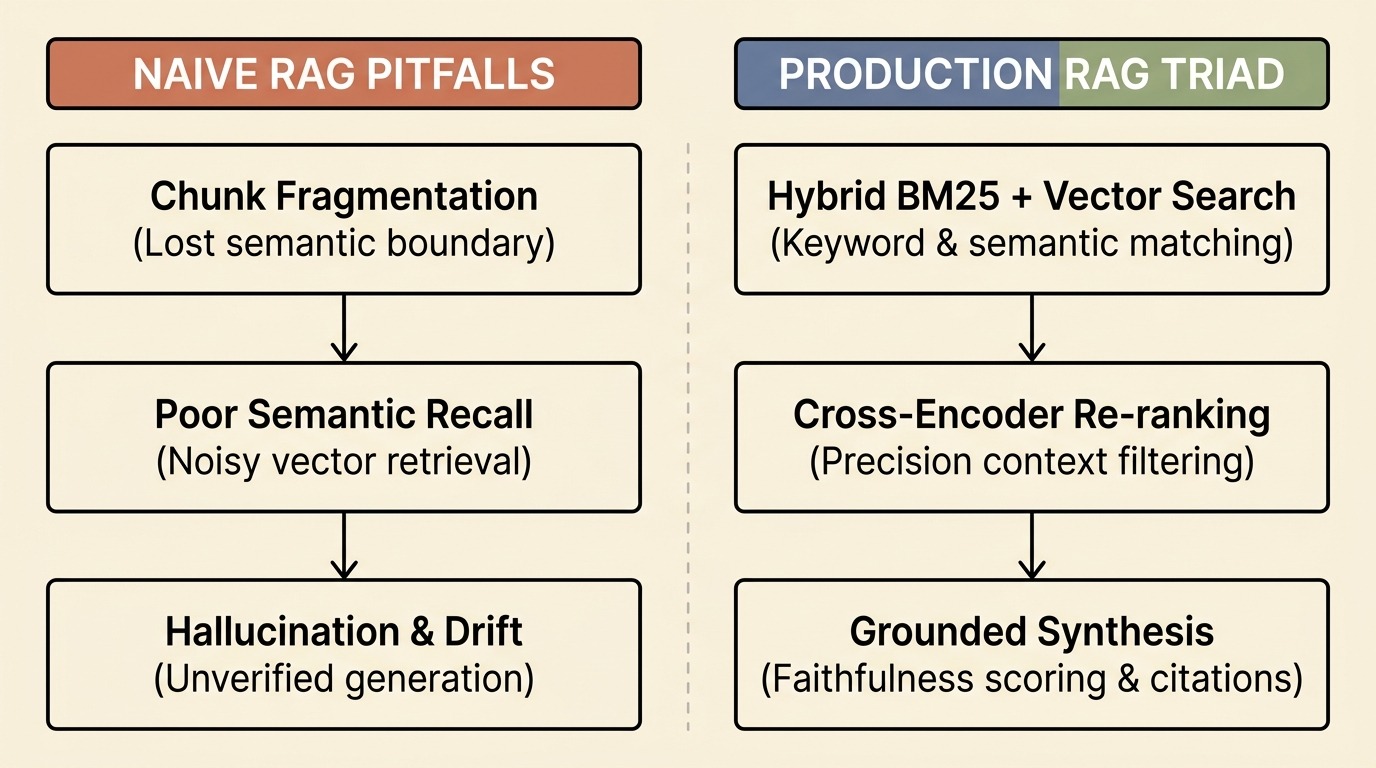
Evaluating candidates on these three dimensions confirms an AI PM can collaborate directly with ML engineers on technical mitigations, such as implementing hybrid search (BM25 combined with dense vectors) or inserting cross-encoder rerankers.
Production Evaluation Rubric
When answering systems evaluation questions, presenting a structured rubric signals operational maturity. Below is the multi-layer evaluation matrix used by enterprise AI teams:
| Evaluation Dimension | Primary Metric | Target Threshold | Measurement Method | Common Root Cause | Targeted Remediation |
|---|---|---|---|---|---|
| Retrieval Quality | Context Precision / Recall | ≥ 0.88 Precision, ≥ 0.92 Recall | Automated evaluation against curated Golden Dataset | Chunking boundary splits semantic units; embedding model mismatch | Implement semantic chunking; add parent-document retrieval or metadata filtering |
| Groundedness | Faithfulness Score | ≥ 0.98 (Enterprise), ≥ 0.95 (General) | LLM-as-a-Judge claim decomposition with chain-of-thought | High generation temperature; model parametric bias overriding context | Reduce temperature to 0.0; enforce strict negative constraints ("Answer only using provided text") |
| Intent Matching | Answer Relevance | ≥ 0.90 | Embedding cosine similarity of generated answer to synthetic queries | Prompt drift; verbose conversational framing obscuring key answer | Tune system prompt instruction hierarchy; provide explicit few-shot response formats |
| Inference Latency | Time to First Token / P95 Total | TTFT < 800ms, P95 < 3.5s | OpenTelemetry distributed tracing across retrieval and generation | Over-retrieval (k > 15 chunks); synchronous cross-encoder rerankers | Implement streaming tokens; cache frequent vector queries; use speculative decoding |
| Economic Cost | Blended Cost per Query | <\0.015$ per session | Token accounting dashboards tagged by model endpoint | Uncompressed prompts; sending redundant chat history turns | Introduce context summarization; route simple queries to distilled SLMs |
| Toxicity & Safety | Guardrail Breach Rate | $0.00%$ acceptable threshold | Input/output content moderation classifiers (e.g. Llama Guard) | Adversarial prompt injection; jailbreak attempts | Deploy dual-layer input sanitization and output validation interceptors |
Roleplay Case Study: "You Are an AI Product Manager"
Interviewers often structure senior AI PM assessments as live case studies. Reviewing this realistic scenario demonstrates the depth expected in executive and technical interview panels.
The Interview Prompt
"You are an AI Product Manager at a B2B SaaS enterprise contract platform. The executive team wants to launch an autonomous 'Contract Intelligence Assistant' that allows enterprise legal teams to query 500-page vendor agreements, extract indemnification liabilities, and flag non-standard governing laws. How do you design the offline and online evaluation framework prior to public launch, and what metrics determine release readiness?"
Candidate Response Framework
A strong candidate organizes the response into three phases:
Phase 1: Curating the Golden Evaluation Dataset
The foundation of any enterprise evaluation strategy is a high-fidelity benchmark dataset:
- Stratified Sampling: Curate 300 representative enterprise contracts spanning diverse formats (scanned PDF OCRs, digital tables, multi-column exhibits, and handwritten signature addenda).
- Expert Ground-Truth Annotation: Partner with internal legal counsel to author 1,000 multi-turn question-context-answer triples categorized into fact extraction, negative retrieval, and cross-document synthesis.
- Synthetic Dataset Augmentation: Use advanced LLM pipelines to generate adversarial variations of user questions, testing semantic permutations, typos, and ambiguous legal terminology.
Phase 2: Dual-Track Evaluation Harness (Offline & Online)
To maintain velocity without exposing enterprise customers to regressions, the evaluation architecture runs dual tracks:
- Offline CI/CD Gate: Every pull request modifying chunking strategy, embedding models, vector index configurations, system prompts, or model endpoints executes against the 1,000 golden test cases. If Faithfulness drops below 0.98 or negative retrieval accuracy drops below 0.99, the build automatically fails.
- Online Telemetry & Synthetic Shadowing: For live traffic, running continuous full-scale human review is impractical. The system logs sanitized query-context-response pairs to an asynchronous inspection queue. An independent evaluator model samples 10% of production interactions nightly to score groundedness and detect semantic drifts.
- Implicit User Feedback Loops: The product team tracks implicit behavioral telemetry (clause copy events, immediate query rephrasing within 15 seconds, and source citation inspection).
Phase 3: Release Gating & Rollback Criteria
The candidate concludes by defining unambiguous go/no-go production gates:
- Zero hallucinations on negative retrieval test suites.
- Context recall
≥ 94%on tables and multi-column contractual schedules. - P95 latency under 3.5 seconds across 100 concurrent streams.
- Automated fallback to deterministic legal search whenever retrieval confidence falls below predefined embedding similarity thresholds.
Technical Walkthrough: Implementing LLM-as-a-Judge
During technical rounds, hiring teams frequently ask AI PMs how they validate automated evaluation models. Using an LLM to evaluate another LLM requires rigorous prompting, structured JSON schema outputs, and chain-of-thought justifications to eliminate evaluator bias.
Below is an evaluation prompt template for programmatically evaluating groundedness:
You are an impartial, highly rigorous legal evaluation system.
Your task is to determine whether the Candidate Answer is fully grounded in and supported by the Provided Context.

[Provided Context]:
{retrieved_context_chunks}

[User Question]:
{user_query}

[Candidate Answer]:
{generated_response}

Instructions:
1. Decompose the Candidate Answer into individual factual claims.
2. For each claim, determine whether it can be directly inferred from the Provided Context.
3. If any claim makes assertions not contained in or directly contradicted by the Provided Context, mark it as UNGROUNDED.
4. Output your analysis strictly in the following JSON schema:

{
  "claims": [
    {
      "claim_text": "string",
      "grounded": true | false,
      "verbatim_context_citation": "string or null",
      "reasoning": "string"
    }
  ],
  "faithfulness_score": float, // (grounded_claims / total_claims)
  "verdict": "PASS" | "FAIL", // PASS requires faithfulness_score >= 0.95
  "hallucination_detected": boolean
}
By mandating claim decomposition and verbatim context citations before calculating the final score, the evaluation system mitigates evaluator hallucination and produces auditable debug logs for engineering teams.
Similar to how candidates prepare for consultative customer discovery in a solutions engineer technical demo discovery interview or articulate positioning in product marketing manager interview questions, AI Product Managers must clearly illustrate how automated evaluation data translates into executive roadmap priorities.
Behavioral and Operational Scenario Questions
Hiring panels complement architecture case studies with situational questions that test how candidates navigate cross-functional conflict, model drift, and budget overruns.
Question 1: "The engineering team argues that testing with 50 hand-crafted prompts is sufficient for launch. How do you respond?"
Evaluation Focus: Rigor, technical leadership, risk mitigation.
Effective Response Strategy: Explain why small, static prompt sets provide a false sense of security due to prompt overfitting and high variance. Propose a collaborative path forward:
- Retain the 50 hand-crafted prompts as a rapid smoke-test suite for local developer debugging.
- Introduce automated synthetic generation to expand the suite to 500+ permutations across edge-case distributions.
- Demonstrate the financial and brand cost of a single production hallucination compared to the negligible compute cost of running an automated evaluation harness.
Question 2: "Production latency spikes from 1.8 seconds to 5.2 seconds after adding a reranker model. Engineering wants to remove the reranker. What is your framework?"
Evaluation Focus: Trade-off analysis, customer empathy, architectural problem-solving.
Effective Response Strategy: Frame the issue as an optimization problem rather than a binary feature decision:
- Audit the impact on retrieval metrics: If removing the cross-encoder drops Context Precision from $92%$ to $74%$ and increases hallucinations by $12%$, removing it is unacceptable in an enterprise legal workflow.
- Propose architectural alternatives such as asynchronous speculative retrieval, caching frequent vector queries, reducing the reranker candidate pool from 50 to 10 chunks, and distilling the cross-encoder model to a lightweight ONNX runtime execution on GPU endpoints.
When discussing go-to-market trade-offs and performance measurement, drawing parallels with b2b growth marketing case study attribution interview frameworks helps demonstrate a holistic understanding of how technical reliability directly drives customer retention and Net Revenue Retention (NRR).
Common Interview Pitfalls and How to Avoid Them
AI product roles attract candidates from diverse backgrounds, but several recurring mistakes cause candidates to stumble in final rounds:
- Over-indexing on Foundation Model Fine-Tuning: Claiming that fine-tuning is the default remedy for hallucinations. Fine-tuning teaches models style, syntax, and task structure; it is inefficient and unreliable for keeping knowledge up to date. Pointing to retrieval hygiene and prompt calibration demonstrates superior technical judgment.
- Ignoring Token Economics: Discussing massive multi-agent pipelines with recursive LLM reflection loops without addressing inference latency (
>30s) or unsustainable unit economics ($0.30per query). - Failing to Define Clear Guardrails: Neglecting to specify what happens when the retrieval layer returns zero matching documents. A production system must gracefully state limitations rather than attempting speculative generation.
- Treating Evaluation as a One-Time Milestone: Overlooking post-launch continuous monitoring. Candidate answers should emphasize automated regression testing, prompt drift tracking, and scheduled golden dataset refreshes.
Elevate Your AI Interview Preparation
Mastering the technical and strategic nuances of AI Product Management requires structured practice under realistic interview pressure. Formulating cohesive responses regarding RAG triads, metric trade-offs, and evaluation harnesses out loud builds real fluency.
Prepare for your upcoming technical and leadership rounds with specialized tools designed to build interview confidence:
- Test your instant recall and problem-solving instincts with the free 60-Second Job Blitz, featuring rapid-fire AI, Product, and Engineering scenario challenges.
- Accelerate your readiness with comprehensive voice and text mock simulations on our Pricing Plans, offering tailored Socratic evaluation rubrics, real-time technical feedback, and roleplay scenarios aligned with tier-1 technology standards.
Practice Product & Engineering Lead Questions Live with AI Mock Interviews
Turn any job description across Engineering, DevOps, Data, Marketing, Sales, Finance, or HR into a personalized test and live voice or text AI mock interview on totop.app, or test your speed right now in the 60-Second Product & Engineering Lead Blitz.
Play 60s Product & Engineering Lead Blitz (Free, No Login) | Start 14-Day Free Trial | Browse All Interview Guides