In modern B2B SaaS and high-growth enterprise technology companies, the Head of Revenue Operations (RevOps) or RevOps Director has transformed from an administrative CRM custodian into an executive business partner. When hiring for senior RevOps roles, founders, Chief Commercial Officers (CCOs), and VPs of Sales rarely spend interview time asking how to build a basic workflow rule or write a formula field. Instead, they present complex, messy operational dilemmas that simulate a live boardroom crisis.
Candidates face a realistic scenario: "You are the incoming Head of Revenue Operations at Datamesh, a Series B enterprise data observability vendor scaling from $12M to $35M ARR. Your average annual contract value (ACV) is $110,000. Over the past three quarters, your sales cycle stretched from 62 to 118 days, quarter-end win rates collapsed from 27% to 13%, and the sales pipeline appears inflated with $28M in nominal pipeline against an $8M quarterly quota. Marketing insists they delivered 4,200 Marketing Qualified Leads (MQLs), but Account Executives (AEs) refuse to follow up, claiming the leads are worthless. Meanwhile, the CFO and CRO are debating conflicting pipeline forecasts ahead of next month's board meeting. The hiring committee is roleplaying the executive leadership team. How do you diagnose, restructure, and operationalize the CRM pipeline across Salesforce and HubSpot, establish objective stage gates, enforce forecast hygiene, and align marketing, sales, and customer success?"
Mastering revenue operations revops crm pipeline interview questions requires far more than reciting SaaS definitions. Top candidates demonstrate systems thinking, data model discipline, sales velocity forensics, and organizational diplomacy.

This guide provides an end-to-end masterclass for conquering the RevOps CRM pipeline case interview. We deconstruct the data architecture of high-velocity funnels, break down the sales velocity equation, provide verbatim roleplay interview prompts with model responses, and share candidate scoring rubrics drawn from our enterprise sales interview questions archive. When confronting tough or ambiguous questions where data is missing, applying a structured diagnostic framework is essential, as detailed in our guide on handling difficult interview questions gracefully.
1. The Core Architecture of an Enterprise CRM Pipeline
Before diving into forecasting disputes or conversion bottlenecks, an elite RevOps candidate establishes the structural foundation: the CRM data model. Without clean object relationships and non-negotiable exit criteria, reporting dashboards produce little more than polished fiction.
The Lead-to-Account Matching (L2A) Dilemma
In enterprise B2B sales, the standard out-of-the-box Salesforce lead model creates immediate friction. When multiple stakeholders from a single Fortune 500 prospect engage—such as an engineering manager, a staff architect, a procurement officer, and an IT security analyst—individual leads created in isolation scatter across the database.
A senior RevOps leader explains how they architect Lead-to-Account (L2A) routing:
- Domain & Hierarchy Resolution: Utilizing automated enrichment (such as Clearbit, ZoomInfo, or Apollo) and deduplication engines (LeanData or Traction Complete) to match inbound leads with existing parent and child Account records using domain matching, corporate hierarchy (Dun & Bradstreet DUNS numbers), and fuzzy entity matching.
- Account-Based Routing: Routing inbound contacts directly to the named Enterprise AE owning the account, rather than blindly round-robining leads to commercial SDRs.
- Activity Rollup: Rolling up campaign touches, meetings booked, and email replies to the Account object so leadership has complete visibility into multi-threaded enterprise penetration.
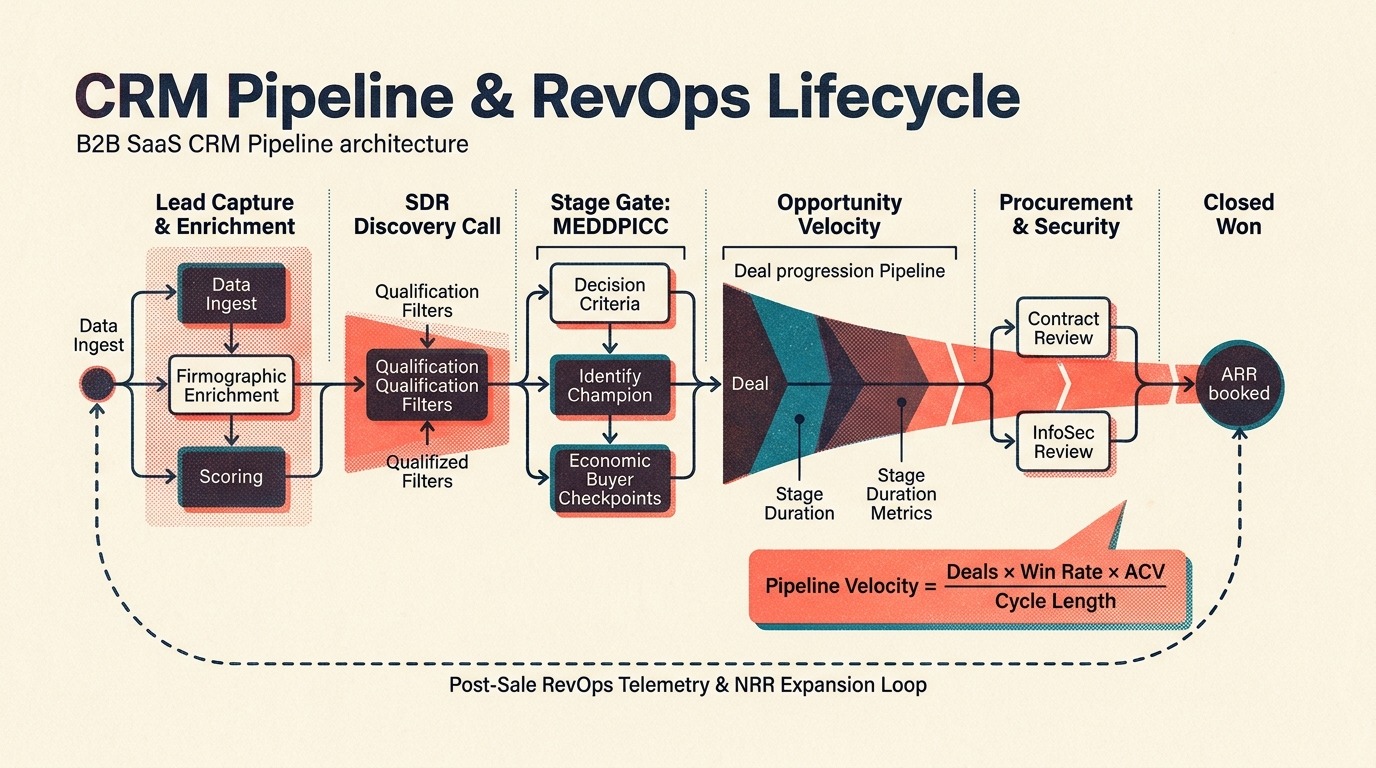
The 6 Universal Pipeline Stages & Non-Negotiable Stage Gates
A frequent trap in RevOps interviews is allowing sales stages to represent seller activity (e.g., "Demo Scheduled", "Sent Proposal") rather than verifiable customer commitment. Advanced RevOps architectures tie each pipeline stage to customer-verified milestones and enforce strict CRM validation rules before an Opportunity can advance.
[ Stage 0: Intake & Enrichment ]
               │
               ▼
[ Stage 1: Discovery & Qualification ] ──> (Exit Gate: 2-Way SLA, Verified Business Pain)
               │
               ▼
[ Stage 2: Technical Validation / PoC ] ──> (Exit Gate: Scoped Success Criteria, Champion Validated)
               │
               ▼
[ Stage 3: Business Case & Proposal ]  ──> (Exit Gate: Economic Buyer Sign-off, ROI Model Approved)
               │
               ▼
[ Stage 4: Procurement, Legal & Security ] ──> (Exit Gate: Redlines in Progress, InfoSec Approved)
               │
               ▼
[ Stage 5: Closed Won / Closed Lost ] ──> (Exit Gate: Executed Master Services Agreement)
- Stage 0: Prospect / Inbound Intake: Inbound MQL or outbound account target. No Opportunity record exists yet.
- Stage 1: Discovery & Qualification: Initial discovery call held by SDR or AE.
- Exit Gate: Verified B2B qualification criteria (e.g., ICP match, identified business problem, budget scope, and next confirmed meeting on the calendar).
- Stage 2: Technical Validation & Evaluation: Deep-dive architectural review or Proof of Concept (PoC).
- Exit Gate: Signed PoC success criteria document, technical sponsor validation, and mapped enterprise security requirements.
- Stage 3: Business Case & Proposal Delivered: Commercial proposal delivered to executive stakeholders.
- Exit Gate: Formal business case presented to the Economic Buyer, validated pricing tier, and mutual evaluation plan agreed upon.
- Stage 4: Procurement, Security & Legal: Deal terms agreed upon; contracts in legal review.
- Exit Gate: InfoSec assessment submitted, redlines active with procurement, and target execution date confirmed by legal counsel.
- Stage 5: Closed Won or Closed Lost: Contract fully executed or formally terminated.
- Exit Gate: Counter-signed contract attached, CPQ quote approved, billing details populated, and mandatory Closed-Lost reason logged with competitor tagging.
2. Diagnosing Pipeline Bloat and Sales Velocity Decay
When an executive team reports that pipeline has tripled while revenue has stagnated, the problem is almost always "pipeline bloat"—stale, un-progressed opportunities clogging the CRM. A strategic RevOps candidate uses the Sales Velocity equation to dissect the underlying mechanics.
The Sales Velocity Equation
The Sales Velocity equation measures the daily dollar value produced by a sales team:
Sales Velocity (V) = (Qualified Opportunities × Win Rate × Average Deal Size) / Sales Cycle Length (Days)
For example, consider Datamesh's initial baseline:
N= 100 active quarterly opportunitiesW= 27% win rate (0.27)A= $110,000 ACVL= 62 daysV= (100 × 0.27 × $110,000) / 62 = $47,903 generated per day
When pipeline bloat occurs, the surface metrics deceive leadership:
N= 250 active nominal opportunities (2.5x increase)W= 13% win rate (due to unqualified junk)A= $110,000 ACVL= 118 days (deals lingering without closing)V= (250 × 0.13 × $110,000) / 118 = $30,296 generated per day
Despite nominally boasting 250 opportunities and $27.5M in pipeline, the company is generating 37% less revenue velocity per day. Revealing this exact dynamic in an interview demonstrates immediate C-suite commercial acumen.
RevOps Forensic SQL Audit for Stale Pipelines
Interviewers respect candidates who know how to extract actionable data directly from underlying data warehouses (Snowflake, BigQuery) synced from Salesforce or HubSpot via Fivetran. The following SQL query demonstrates how a RevOps leader audits opportunity dwell time, push counts, and inactivity flags:
-- RevOps Pipeline Hygiene & Zombie Deal Audit Query
WITH opportunity_metrics AS (
  SELECT
    opp.id AS opportunity_id,
    opp.name AS opportunity_name,
    owner.name AS sales_rep_name,
    opp.stage_name,
    opp.amount,
    opp.created_date,
    opp.close_date,
    opp.push_count,
    DATEDIFF('day', opp.created_date, CURRENT_DATE()) AS opportunity_age_days,
    DATEDIFF('day', opp.last_stage_change_date, CURRENT_DATE()) AS stage_dwell_days,
    DATEDIFF('day', MAX(task.activity_date), CURRENT_DATE()) AS days_since_last_customer_touch
  FROM salesforce_raw.opportunities opp
  JOIN salesforce_raw.users owner ON opp.owner_id = owner.id
  LEFT JOIN salesforce_raw.tasks task ON task.what_id = opp.id
    AND task.type IN ('Call', 'Meeting', 'Customer Email')
  WHERE opp.is_closed = FALSE
  GROUP BY 1, 2, 3, 4, 5, 6, 7, 8, 9, 10
)
SELECT
  stage_name,
  COUNT(opportunity_id) AS open_deal_count,
  SUM(amount) AS total_pipeline_volume,
  ROUND(AVG(opportunity_age_days), 1) AS avg_age_days,
  ROUND(AVG(stage_dwell_days), 1) AS avg_stage_dwell_days,
  COUNT(CASE WHEN stage_dwell_days > 45 THEN 1 END) AS stagnant_deals_over_45d,
  COUNT(CASE WHEN days_since_last_customer_touch > 21 OR days_since_last_customer_touch IS NULL THEN 1 END) AS zombie_deals_no_touch_21d,
  ROUND(AVG(push_count), 1) AS avg_close_date_pushes
FROM opportunity_metrics
GROUP BY stage_name
ORDER BY avg_stage_dwell_days DESC;
When you articulate how you execute this query in an interview, explain how you interpret the output: deals that have pushed their close date more than three times (push_count > 3) or have had zero logged customer touchpoints in 21 days are stripped from weighted forecasts and moved to a dedicated "Stalled / Nurture" category.
3. High-Stakes Roleplay Prompts & Model Answers
Interviewers assess RevOps candidates by playing the roles of executive peers—the CRO, VP of Marketing, Head of Customer Success, and CFO. Here are four essential roleplay prompts and word-for-word strategies to win the hiring team's confidence.
Prompt 1: The Inflated Forecast & Disputing the CRO
Interviewer (playing CRO): "Our pipeline report shows $28M in total pipeline for Q4. With an $8M quota, we have 3.5x pipeline coverage. We are in great shape to hit our numbers. Why are you telling the board we have a forecast risk?"
Recommended Response Framework:
- Acknowledge Commercial Optimism: Validate the CRO's goal without endorsing fictitious pipeline math.
- Deconstruct Nominal vs. Realistic Coverage: Differentiate between gross unweighted pipeline and historical cohort conversion rates.
- Present the Data Anatomy: Break down the $28M:
- "While the top-line pipeline displays $28M, $11M of that total sits in Stage 1 and Stage 2 with close dates expiring in less than 30 days. In our enterprise segment, the historical sales cycle from Stage 1 to Closed-Won is 74 days. A deal entering Stage 1 today mathematically cannot close in Q4."
- "Furthermore, $6.5M of that pipeline has pushed its close date across three consecutive quarters. When we analyze historical cohorts at Datamesh, deals pushed more than twice close at less than 4%."
- Offer a Defensible Forecast Methodology:
- "If we strip out stagnant deals and apply category weighting—Commit at 90%, Best Case at 45%, and Pipeline at 15%—our realistic forecast sits at $5.8M, representing a $2.2M gap to quota. By exposing this gap now, we have six weeks to execute targeted pipeline acceleration campaigns on late-stage Stage 3 and Stage 4 opportunities, rather than delivering an unmitigated surprise at the board meeting."
Prompt 2: Resolving the Marketing vs. Sales Lead Quality Feud
Interviewer (playing VP of Marketing): "We hit 120% of our quarterly MQL goal, delivering 4,200 leads to sales. But the sales team isn't working them, and the AEs keep complaining in Slack that marketing leads are 'worthless'. How do you resolve this dispute without throwing marketing under the bus?"
Recommended Response Framework:
- Redefine the North Star Metric: Shift the organizational definition of success from vanity MQL counts to Sales Accepted Opportunities (SAOs) and Pipeline Generated ($).
- Implement a Two-Way Service Level Agreement (SLA):
- Marketing SLA: Marketing commits to delivering leads that meet rigorous Ideal Customer Profile (ICP) criteria—verified company size (500+ employees), target industry (FinTech, Retail, Healthcare), and qualified seniority (VP, Director, Staff Architect).
- Sales SLA: Sales commits to a verified time-to-first-touch (e.g., within 4 business hours for high-intent demo requests; within 24 hours for content downloads) and a structured 8-touch cadence over 18 days.
- Automate Quality Auditing:
- Build a CRM dashboard tracking "MQL-to-SAO Conversion" and "Lead Rejection Reasons". If an AE rejects a lead, they must select a verified mandatory picklist value (e.g., Non-ICP Size, Wrong Persona, No Active Project, Invalid Contact Info).
- Review weekly rejection logs jointly with marketing demand generation leads to tune lead scoring thresholds dynamically.
Prompt 3: Designing Stage Gates That Reps Actually Follow
Interviewer (playing Head of Sales): "Sales reps hate administrative friction. If you add fifteen mandatory fields and validation rules to every stage in Salesforce, they will either enter fake data or bypass the CRM entirely. How do you design pipeline governance that reps actually follow?"
Recommended Response Framework:
- Minimize In-Line Burden via Automation: Reps should never manually type what technology can capture automatically. Connect email, calendar, and virtual meeting tooling (Gong, Chorus, Outreach, Apollo) to automatically log customer touchpoints, attendee titles, and call transcripts.
- Tie Stage Advancement to Seller Self-Interest:
- Example: An AE cannot generate an official CPQ pricing quote or schedule a Sales Engineering (SE) technical demonstration until Stage 2 qualification fields (Identified Pain, Primary Tech Stack, Technical Champion) are populated. The CRM serves as an operational enabler, not an obstacle.
- Enforce Progressive Disclosure in UI: Do not display 40 fields at once. Use Salesforce Dynamic Forms or HubSpot Conditional Sections so only the 2 to 3 critical fields relevant to the current stage appear.
- Inspect Pipeline in 1-on-1 Deal Reviews: Train front-line Sales Managers to run their weekly 1-on-1 pipeline reviews exclusively from the CRM Opportunity record. If an opportunity isn't updated in the CRM, it doesn't exist for commission and resource allocation.
Prompt 4: Churn Prevention & Post-Sale Alignment with Customer Success
Interviewer (playing VP of Customer Success): "Sales keeps closing enterprise deals with custom verbal promises that our product cannot deliver. Three months after the contract is signed, the customer threatens to cancel, and our CS team gets blamed for poor retention. Where does RevOps fit into solving this handoff crisis?"
Recommended Response Framework:
- Establish a Mandatory Pre-Close Handoff Gate: At Stage 4 (Procurement), before a contract can move to Closed-Won, the AE and assigned Customer Success Manager (CSM) must complete an internal "Sales-to-CS Handoff Review".
- Formalize Product Scope in CPQ: Custom commitments must be documented in CPQ quote line items or an explicit "Implementation Scope of Work (SOW)". Any deal requiring non-standard feature delivery triggers an automated approval workflow to Product Management and Solutions Engineering.
- Align Commercial Incentives: Collaborate with finance and the executive team to adjust sales compensation plans: incorporate a 12-month clawback on commissions or split bonuses between booking and successful 90-day onboarding milestones. Explore complete compensation and retention models in our SaaS finance metrics guide and review customer success manager interview frameworks.
4. RevOps Interview Evaluation Rubric
Hiring committees evaluate RevOps candidates across five distinct functional competencies. The table below illustrates the exact qualitative criteria used to differentiate candidates during interview debriefs.
| Competency Dimension | Junior / Admin Traps (Fail) | Mid-Level Operations (Borderline) | Strategic RevOps Leader (Strong Hire) | Interviewer Scoring Focus |
|---|---|---|---|---|
| Pipeline Architecture & Data Model | Treats CRM as a static address book; allows arbitrary stage skipping; relies on loose text fields. | Builds validation rules but creates excessive friction; understands Lead/Contact distinctions but lacks automated L2A matching. | Architects scalable multi-object data models; implements automated L2A routing; establishes verifiable buyer-centric stage exit gates. | System scalability, data governance, and minimization of seller administrative overhead. |
| Forecasting & Sales Velocity | Accepts rep close dates at face value; reports unweighted pipeline totals; confused by cohort analysis. | Uses standard stage weighting (e.g., Stage 3 = 50%); identifies aged deals but lacks programmatic remediation. | Applies multi-variable forecasting (historical rep slip rate, stage dwell time, engagement scoring); models sales velocity mathematically. | Forensic rigor, predictive accuracy, and willingness to deliver difficult truths to the C-suite. |
| Cross-Functional SLAs | Blames either marketing or sales for lead friction; focuses exclusively on top-of-funnel MQL volume. | Tracks MQL-to-SQL conversion rates; writes basic SLA documentation that lacks behavioral enforcement. | Implements bi-directional SLAs with automated time-to-touch tracking; monitors Closed-Won cohort CAC payback and attribution. | Cross-functional empathy, conflict resolution, and enterprise commercial alignment. |
| Tooling & Automation Strategy | Recommends buying new point solutions for every operational issue; custom-codes brittle Apex scripts. | Manages tech stack integrations adequately; automates basic notifications and alerts. | Audits tech stack utilization; consolidates redundant vendors; builds unified data schemas across CRM, CPQ, ERP, and CS platforms. | Total Cost of Ownership (TCO) discipline, integration resilience, and ROI justification. |
| Executive Stakeholder Leadership | Acts as an order-taker; builds ad-hoc reports whenever an executive asks; avoids challenging the CRO. | Communicates operational bottlenecks clearly but lacks commercial recommendations. | Serves as an objective, strategic truth-teller; frames operational initiatives in terms of ARR growth, EBITDA margin, and NRR preservation. | Executive presence, boardroom gravitas, and business transformation leadership. |
5. Real-World Case Study Walkthrough: Restructuring a $20M Stalled Pipeline
To anchor your interview responses in practical reality, walk the interview panel through a structured 90-day transformation framework.
The Baseline Crisis (Day 0)
- Total Nominal Pipeline: $20.4M across 170 enterprise opportunities.
- Target Annual Quota: $6.0M ($1.5M/quarter).
- Apparent Coverage Ratio:
3.4×(healthy on paper). - Reality: Average deal age had climbed to 134 days; 42% of deals had not experienced customer interaction in over 30 days; quarterly win rate dropped to 11.8%.
Phase 1: The Forensic Purge & Policy Reset (Days 1–30)
- Enact the Stale Deal Sunset Rule: Automatically moved all opportunities with no logged activity for >45 days or >4 close-date slips into an archived "Closed Lost – Inactivity" status.
- Pipeline Re-Baselining: Nominal pipeline contracted from $20.4M to $9.2M, but the remaining deals were verified, active, and multi-threaded.
- Stage Gate Hardening: Enforced mandatory MEDDPICC criteria (Identified Pain, Champion, Economic Buyer) before deals could advance to Stage 3 (Proposal).
Phase 2: SLA & Data Enrichment Automation (Days 31–60)
- L2A Auto-Matching: Deployed automated account-matching rules, cutting lead routing latency from 36 hours to under 8 minutes.
- Two-Way SLA Dashboard: Implemented real-time Slack and CRM alerts for high-priority inbound enterprise demo requests unworked after 2 hours.
- Attribution Modeling: Linked opportunity creation directly to first-touch and multi-touch marketing attribution, as detailed in our B2B growth marketing case study guide.
Phase 3: Predictive Cadence & Sustainable Velocity (Days 61–90)
- Weekly Deal Inspection Rhythm: Replaced subjective sales status reviews with a data-driven pipeline inspection dashboard reviewing stage dwell time and stakeholder engagement.
- Outcome Results at Month 6:
- Average Sales Cycle: Decreased from 134 days to 76 days (43% reduction).
- Win Rate: Rebounded from 11.8% to 26.4% (123% relative improvement).
- Forecast Accuracy: Final quarterly variance closed within 4.8% of actuals.
6. How to Practice RevOps Interview Scenarios
Excelling in a RevOps leadership interview requires fast-paced verbal delivery and the ability to articulate trade-offs without hesitation. Because interviewers will challenge your assumptions, simulate real-time pressure:
- Rehearse High-Pressure Roleplays: Practice responding out loud to unexpected C-suite pushback (e.g., defending why an executive's pet deal must be removed from the forecast).
- Quantify Everything: Never say "we improved pipeline hygiene." Say "we purged $11.2M in phantom pipeline, reducing average stage dwell time by 34%."
- Leverage AI Simulation: Use
totop.appto conduct interactive, voice-driven mock interviews with customized executive personas (CFO, CRO, VP of Marketing). Run rapid-fire scenario drills with the /blitz (60-Second Job Blitz) to test your ability to structure complex operational answers in under a minute, and explore personalized coaching packages on our /pricing page.
Mastering the revenue operations revops crm pipeline interview questions positions you not merely as a systems administrator, but as the indispensable growth architect every high-performing executive team requires.
Practice Full Stack Engineer Questions Live with AI Mock Interviews
Turn any job description across Engineering, DevOps, Data, Marketing, Sales, Finance, or HR into a personalized test and live voice or text AI mock interview on totop.app, or test your speed right now in the 60-Second Full Stack Engineer Blitz.
Play 60s Full Stack Engineer Blitz (Free, No Login) | Start 14-Day Free Trial | Browse All Interview Guides