In enterprise cloud and platform sales, the Solutions Engineer (SE) owns the "Technical Win." While Account Executives navigate procurement and commercial contracts, the Solutions Engineer validates that the software actually satisfies complex architectural requirements. Without the technical win, an enterprise deal cannot close.
Consequently, hiring committees for senior Solutions Engineer positions bypass generic coding puzzles. Instead, evaluation centers on a live simulation: the solutions engineer technical demo discovery interview. Candidates are placed in a realistic roleplay scenario with challenging enterprise stakeholders—such as a skeptical CTO, a compliance-focused CISO, and a lead architect.
Consider this standard scenario: "You are an enterprise Solutions Engineer at ApexStream, a real-time event streaming and API gateway platform. You are delivering a 45-minute technical discovery and demo to GlobalLogix, a Fortune 500 logistics provider processing 120 million events daily. Their existing message broker suffers severe latency spikes during peak holiday shipping, causing webhook dropouts and inventory desynchronization. Their CTO prefers building an in-house Kafka solution, while their CISO unannouncedly joins to probe tenant isolation. How do you lead discovery, construct a tailored architectural proof-of-value, defuse technical skepticism, and secure champion consensus?"
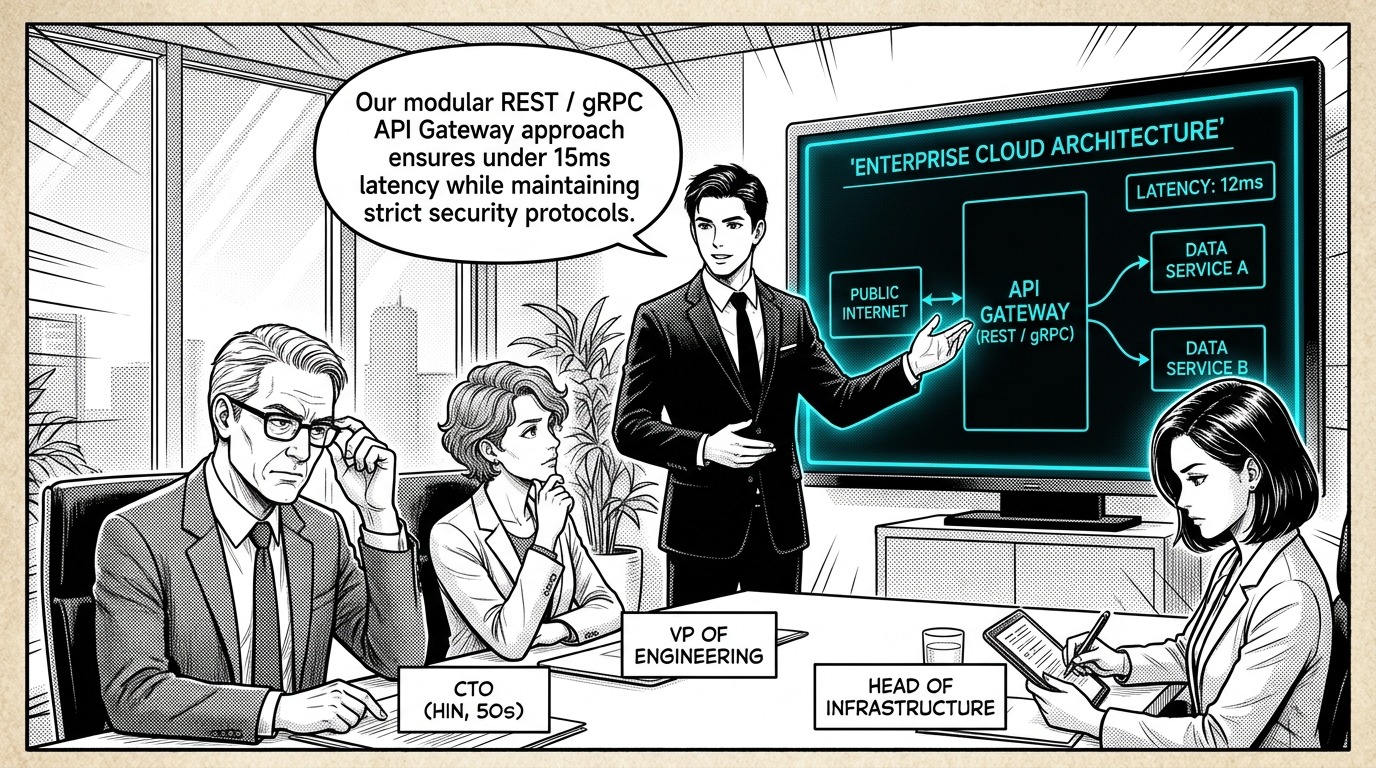
Excelling in this interview demands balancing technical rigor with commercial empathy and executive poise. When facing complex architecture questions where details are intentionally omitted, elite candidates apply first-principles thinking, as detailed in our guide on handling difficult interview questions gracefully.
1. The Core Anatomy of the SE Interview: Discovery vs. Demo
The most common trap in a solutions engineering interview is confusing a demonstration with a feature walkthrough. Candidates often treat the meeting as a software user guide, clicking through tabs and reciting settings. In presales, this is known as the "Harbor Tour"—and it results in immediate disqualification.
A technical demo is an architectural narrative validating a business outcome. Discovery and demonstration form an iterative dialogue:
+--------------------------------------------------------------------------+
|                  THE VALUE-LED DISCOVERY & DEMO ENGINE                    |
+--------------------------------------------------------------------------+
|  Phase 1: Targeted Technical Discovery                                   |
|  [ Current Architecture ] -> [ Latent Bottleneck ] -> [ Cost of Inaction ]|
|                                     │                                    |
|                                     ▼                                    |
|  Phase 2: The Architecture Validation Bridge                             |
|  [ Ingestion Schema ]   -> [ Gateway Resiliency ]  -> [ Security Perimeter]|
|                                     │                                    |
|                                     ▼                                    |
|  Phase 3: The 3-Act Tailored Demo                                        |
|  [ Act I: The Pain ]    -> [ Act II: The Solution ] -> [ Act III: Business ]|
|  (Simulate Dropouts)       (Apply Rate-Limiting)      (Quantify ROI)     |
|                                     │                                    |
|                                     ▼                                    |
|  Phase 4: Objection Containment & Technical Close                        |
|  [ Acknowledge ] -> [ Clarify Context ] -> [ Reframe ] -> [ Confirm Win ]|
+--------------------------------------------------------------------------+
As highlighted in our enterprise sales interview questions analysis, buyers evaluate resilience, security compliance, migration friction, and total cost of ownership. The Solutions Engineer must prove the vendor's platform solves acute pain points faster and more reliably than alternatives.
2. The TEDC Discovery Framework for Solutions Engineers
Before opening terminal screens or writing code, an SE establishes technical command through disciplined discovery. While Account Executives evaluate deals using qualification criteria like MEDDPICC—as explored in our MEDDPICC sales discovery call roleplay guide—Solutions Engineers execute technical qualification using the TEDC Framework: Target, Ecosystem, Defect, and Consequence.
+------------+-----------------------------------+-----------------------------------+
| Component  | Focus Area                        | Enterprise Discovery Prompt       |
+------------+-----------------------------------+-----------------------------------+
| Target     | Desired Technical & Business Goal | "What throughput and latency SLA  |
|            |                                   |  does your Q4 roadmap require?"   |
+------------+-----------------------------------+-----------------------------------+
| Ecosystem  | Infrastructure & Tooling Stack    | "How do your legacy ESBs connect  |
|            |                                   |  with cloud-native microservices?"|
+------------+-----------------------------------+-----------------------------------+
| Defect     | Root Cause Failure Modes          | "Where precisely do packets drop  |
|            |                                   |  when ingress hits 15k req/sec?"  |
+------------+-----------------------------------+-----------------------------------+
| Consequence| Operational & Financial Blast     | "When desync occurs, what is the  |
|            | Radius of Unresolved Defects      |  manual engineering remediation?" |
+------------+-----------------------------------+-----------------------------------+
Deconstructing the TEDC Framework
- Target: Define success in concrete engineering terms. Probe for clear metrics: "What is your p99 latency threshold under 25,000 requests per second, and what is your target RTO during cross-region failover?"
- Ecosystem: Map legacy constraints, cloud providers, and operational tooling. Knowing whether downstream consumers use gRPC, REST, or message brokers shapes the demonstration. When evaluating network protocols, understanding system trade-offs is essential, as detailed in our guide on REST vs gRPC vs GraphQL system design trade-offs.
- Defect: Isolate the exact failure mechanism. Is the root cause network saturation, unindexed queries, or thread contention? Forcing the prospect to define the defect keeps the conversation grounded.
- Consequence: Connect technical failures directly to business impact. Connecting dropped webhook packets to manual database reconciliation and SLA penalties demonstrates executive commercial alignment.
3. Designing the 3-Act Tailored Demo Narrative
Once technical discovery validates architecture constraints, structure the live demonstration into a focused Three-Act Narrative Arc.
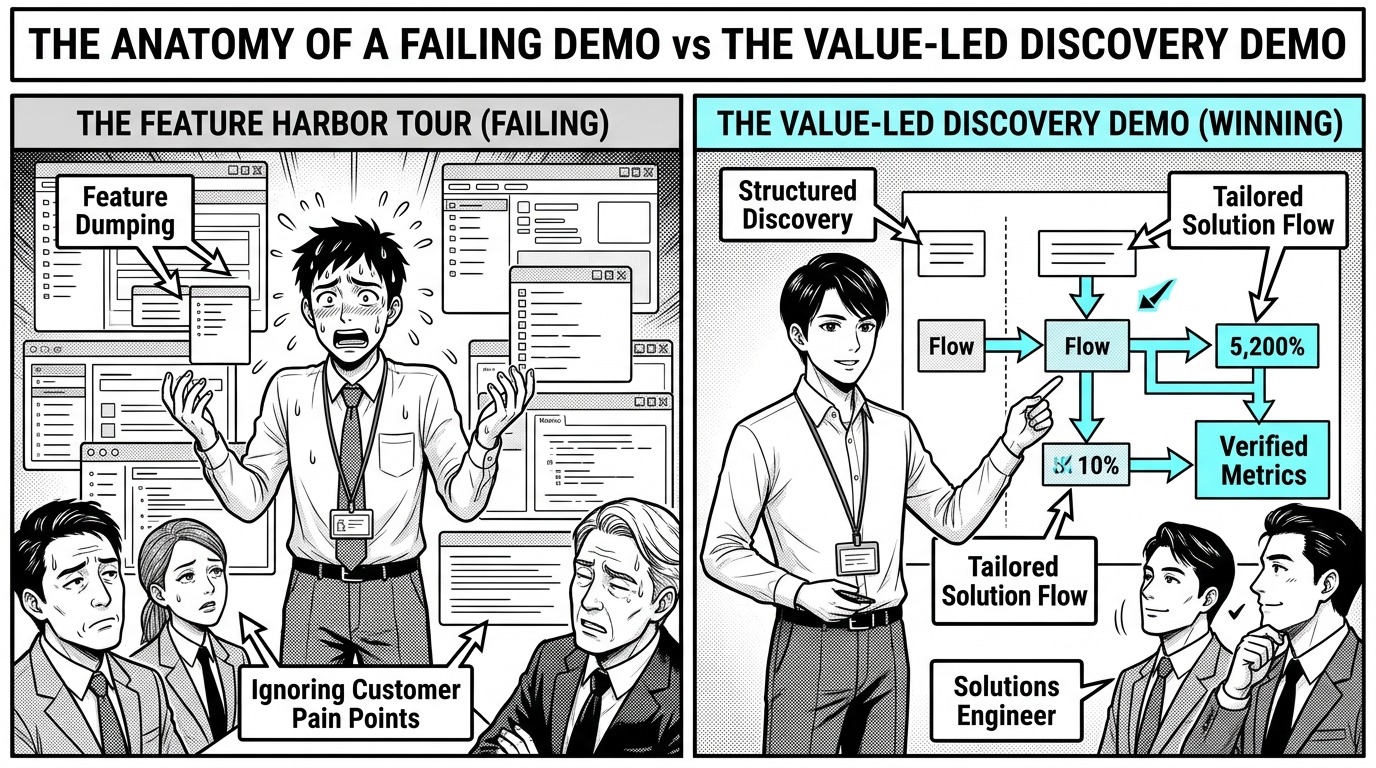
Act I: The Mirror of Pain (Minutes 0–8)
Reproduce the prospect's operational bottleneck inside your demonstration environment. Rather than opening with vendor dashboard settings, show a load-testing script sending 15,000 payloads per second to a mock legacy gateway, demonstrating timeouts, 504 errors, and queue backpressure. This establishes immediate credibility by addressing their real-world problem.
Act II: The Architectural Bridge (Minutes 8–22)
Demonstrate how your platform intercepts ingress traffic, applies rate-limiting, and guarantees zero-loss delivery. For example, show a webhook ingestion bridge that validates signatures and persists events asynchronously:
import hmac
import hashlib
import time
from fastapi import FastAPI, Request, HTTPException, status

app = FastAPI(title="Enterprise Webhook Ingestion Bridge")
WEBHOOK_SECRET = b"production-shared-hmac-key"
MAX_DRIFT_SECONDS = 300

@app.post("/api/v1/webhooks/ingest", status_code=status.HTTP_202_ACCEPTED)
async def ingest_webhook(request: Request):
    timestamp = request.headers.get("X-Signature-Timestamp")
    signature = request.headers.get("X-Signature-256")

    if not timestamp or not signature:
        raise HTTPException(status_code=401, detail="Missing cryptographic headers.")

    # Mitigate replay attacks via timestamp freshness validation
    if abs(int(time.time()) - int(timestamp)) > MAX_DRIFT_SECONDS:
        raise HTTPException(status_code=400, detail="Timestamp outside drift window.")

    raw_payload = await request.body()
    mac = hmac.new(WEBHOOK_SECRET, msg=f"{timestamp}.".encode() + raw_payload, digestmod=hashlib.sha256)

    if not hmac.compare_digest(mac.hexdigest(), signature):
        raise HTTPException(status_code=403, detail="Invalid signature digest.")

    # Asynchronously queue to persistent buffer with zero DB lock contention
    return {"status": "queued", "delivery_guarantee": "at-least-once"}
Presenting clean architectural patterns reassures technical evaluators. For additional strategies on managing traffic surges, see our guide on rate limiting algorithms in system design.
Act III: The Quantified Business Horizon (Minutes 22–30)
Conclude the demonstration by tying technical capabilities directly back to discovery metrics:
- Throughput: Expanded from 3,500 to 45,000 events/sec without dropped requests.
- Latency: P99 response reduced from 840ms to 18ms.
- Operational Efficiency: Eliminates custom queue maintenance, freeing engineers for core product priorities.
4. Live Roleplay Scenarios & Model Transcripts
During the interview, evaluators will deliberately challenge your presentation to gauge your composure. Below are three common interview roleplay scenarios with recommended responses.
Scenario 1: The Build vs. Buy Challenge from a Hostile CTO
CTO Persona: "Your annual licensing fee is $180,000. We have eighty developers. Two platform engineers can spin up an open-source Kafka cluster on Kubernetes in three sprints. Why should we pay for your platform?"
Recommended Response:
"If this were strictly about spinning up a Kafka cluster, building in-house would make economic sense. However, the true cost of event streaming lies in Day-2 distributed operations.
At 120 million daily events, your team would need to build zero-downtime schema evolution registries, maintain cross-region replication clusters, develop SOC2 audit logging pipelines, and handle partition rebalancing during seasonal peaks. Operational benchmarks show maintaining custom streaming infrastructure consumes roughly 2.5 full-time engineers—costing over $400,000 in annual engineering time.
Our platform frees those engineering hours so your developers can focus on core routing algorithms, backed by our 99.99% availability SLA. Would it be helpful to compare our Day-2 TCO model against an internal build roadmap?"
Scenario 2: The Security Ambush from the CISO
CISO Persona: "We handle sensitive freight manifests. In a multi-tenant cloud setup, how do you prevent tenant isolation leaks or memory snooping from exposing our proprietary data?"
Recommended Response:
"We approach tenant isolation across three distinct architectural layers:
First, at storage, we enforce envelope encryption where each tenant uses a dedicated Customer-Managed Key (BYOK) via AES-256-GCM. Without your KMS key, raw storage cannot be decrypted.
Second, at compute, payload processing runs in sandboxed microVMs (AWS Firecracker / gVisor) that terminate upon execution, preventing cross-tenant memory snooping.
Third, we maintain active SOC2 Type II and ISO 27001 certifications. I can provide our SOC2 report and penetration testing audit under mutual NDA today. Would you like to review our automated key rotation process?"
Scenario 3: The Live Demo Environment Failure
Scenario: During minute 15 of your demonstration, an unexpected gateway timeout or 500 error appears on screen.
Recommended Response:
Acknowledge the issue calmly and use it to highlight observability:
"Our staging gateway threw a connection reset. In distributed systems, temporary network disruptions occur—which provides a great opportunity to show how our platform surfaces distributed telemetry.
The gateway emitted trace ID req_trace_982e7. Let us inspect the OpenTelemetry console to review the root cause. While the automated backoff handles the retry, let me pivot to our secondary cluster to show you the consumer experience."
Turning an unexpected glitch into a demonstration of monitoring and recovery reflects true engineering maturity.
5. Solutions Engineer Evaluation Rubric
Enterprise software teams evaluate Solutions Engineer candidates across five core competencies:
| Evaluation Dimension | Junior Candidate (No Hire) | Capable Candidate (Borderline) | Staff Solutions Engineer (Strong Hire) |
|---|---|---|---|
| Technical Depth | Memorizes features; struggles with network and concurrency mechanics. | Explains API schemas; relies on standard slides for edge cases. | Deep systems knowledge; effortlessly navigates protocols, security, and concurrency. |
| Discovery Rigor | Asks surface-level questions; fails to identify cost of inaction. | Identifies technical constraints; misses executive financial impact. | Applies TEDC discovery; engages multi-persona stakeholders; quantifies architectural debt. |
| Demo Architecture | Conducts unstructured feature tours; lacks coherent storyline. | Follows standard product walkthrough; lacks dramatic contrast. | Executes a 3-Act Narrative; mirrors acute pain before demonstrating architectural solutions. |
| Objection Handling | Becomes defensive or dismissive of customer concerns. | Answers objections factually without verifying stakeholder alignment. | Validates stakeholder perspectives; reframes objections into trade-offs; secures agreement. |
| Executive Presence | Overruns time limits; speaks continuously without checking in. | Manages time reasonably well; occasionally confirms audience alignment. | Commands meeting rhythm; listens actively; engages executive buyers as a trusted advisor. |
Aligning your preparation with these evaluation criteria ensures you present a compelling case to the hiring committee. Integrating technical demonstrations with commercial milestones is equally vital in high-velocity teams, as outlined in our guide on revenue operations pipeline stage gates.
6. Mastering the SE Interview with totop.app
Mastering the solutions engineer technical demo discovery interview requires conversational practice under realistic interview conditions. Developing executive presence and spontaneous objection handling requires active speaking repetition.
With totop.app, you can practice roleplay interviews tailored to technical sales roles:
- Interactive AI Roleplay Personas: Practice answering tough objections from skeptical CTOs, CISOs, and architects using voice-enabled AI personas.
- Actionable Diagnostic Scoring: Receive feedback on discovery question depth, technical precision, and talk-to-listen ratios.
- Fast Readiness Checks: Test your spontaneous technical communication with our free 60-Second Job Blitz.
To prepare thoroughly for Solutions Engineer, Sales Engineer, or Solutions Architect interviews, explore our pricing and practice plans and start practicing today.
Practice Full Stack Engineer Questions Live with AI Mock Interviews
Turn any job description across Engineering, DevOps, Data, Marketing, Sales, Finance, or HR into a personalized test and live voice or text AI mock interview on totop.app, or test your speed right now in the 60-Second Full Stack Engineer Blitz.
Play 60s Full Stack Engineer Blitz (Free, No Login) | Start 14-Day Free Trial | Browse All Interview Guides