I Failed 15 Technical Interviews Before Getting This Right
Let me paint a picture for you. It’s a Tuesday afternoon, my inbox pings, and there it is: "Thank you for your time, but we've decided to move forward with other candidates."
That was rejection number 15.
I stared at my screen, feeling a mix of frustration and defeat. I knew how to code. I had built complex side projects. I could talk about system architecture for hours with my friends. Yet, the moment someone handed me a dry-erase marker and said, "Reverse a binary tree," my brain completely short-circuited.
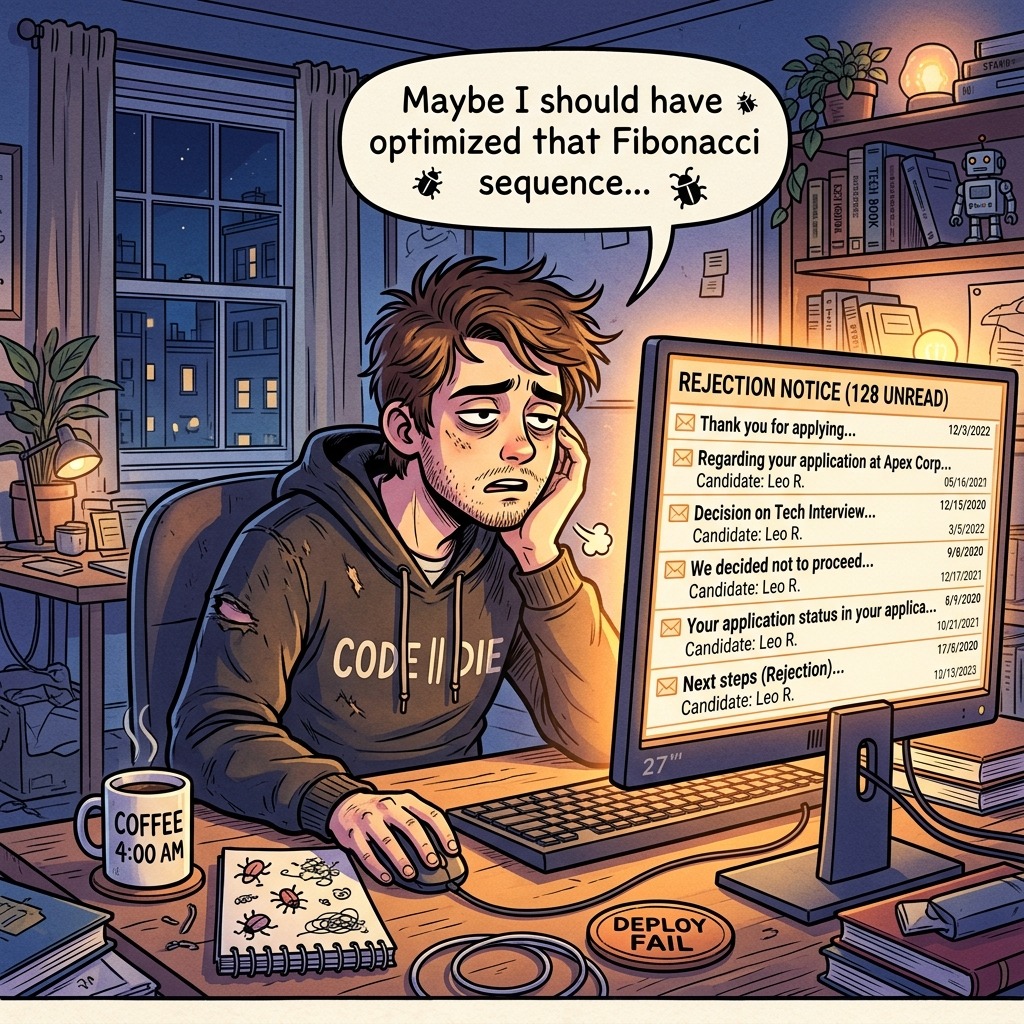
It took me 15 failures to realize a harsh truth: passing a technical interview is a completely different skill than being a good software engineer.
I was studying wrong. I was practicing wrong. I was interviewing wrong.
Once I changed my approach, everything flipped. The rejections turned into on-sites, and the on-sites turned into offers. Here are the hard-learned lessons that finally broke my losing streak.
The "Whiteboard Freeze" is Real (And How to Fix It)
In my early interviews, I treated coding questions like a school exam. The interviewer would give me the prompt, and I would immediately fall dead silent, staring intensely at the whiteboard for 10 minutes while my anxiety spiked.
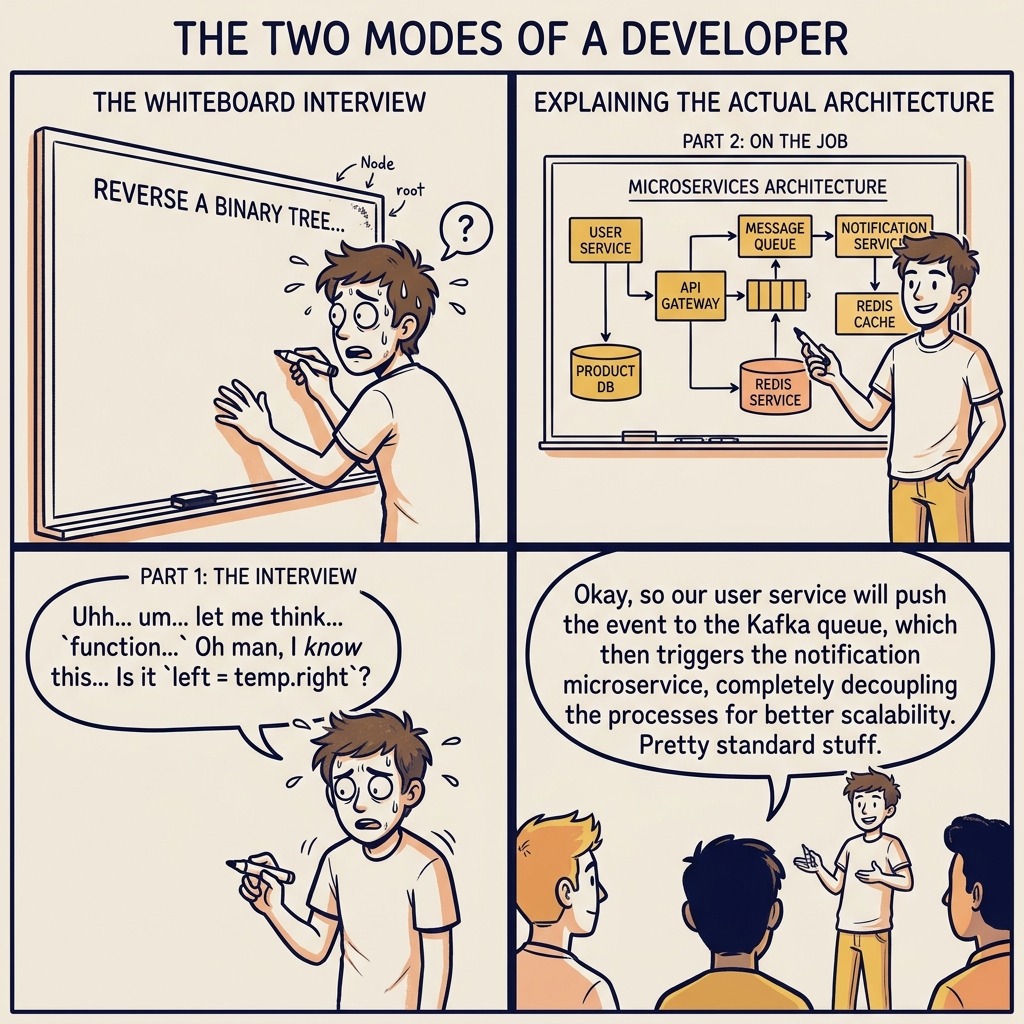
I thought if I didn't instantly know the optimal $O(n)$ solution, I was doomed. This is the biggest trap you can fall into.
The Fix: You need to learn how to think out loud.
Interviewers aren't just looking for a working algorithm; they want to see how you problem-solve. When you go silent, they have no idea if you're close to a brilliant breakthrough or completely lost.
Now, the moment I get a question, I start talking. "Okay, so my first thought is to use a nested loop, which would be $O(n^2)$. That's obviously not ideal, but it gets us a baseline. Let me write that down. If I wanted to optimize this to $O(n)$, I'd probably need to use a Hash Map to trade space for time..."
Suddenly, I wasn't failing; I was collaborating.
Clarify Before You Code
Another major mistake I made in those first 15 interviews was jumping straight into writing code before I fully understood the constraints.
I would spend 20 minutes writing an elaborate solution, only for the interviewer to say, "Ah, but what if the array contains negative numbers?" My entire approach would crumble.
The Fix: Spend the first 5 minutes of the interview purely on clarification and edge cases.
Before writing a single line of code, ask:
- "Are the inputs always sorted?"
- "Will there be duplicate values?"
- "What should I return if the input is empty or null?"
- "Are there memory constraints I should be aware of?"
Writing these constraints on the board shows seniority. It shows you think about edge cases before deploying to production.
The "Brute Force First" Approach
We've all been brainwashed by LeetCode into thinking we need to produce the most elegant, highly optimized solution on our first try.
In my 12th interview, I spent 40 minutes trying to implement a complex dynamic programming approach, got confused by my own state transitions, and ran out of time. I submitted nothing.
The Fix: Get a working, brute-force solution on the board as fast as humanly possible.
A working, slow solution is infinitely better than a broken, "fast" solution. Once you have the brute force code written down, your brain relaxes. The pressure drops. From there, it is much easier to look at your code and say, "Okay, we are doing repeated work here. Let's memoize this," or "We can replace this inner loop with a set."
The Turning Point
It wasn't overnight, but the shift was undeniable. I stopped trying to prove I was a genius and started trying to show I was a good coworker. I communicated, I clarified, and I iterated.
When offer number one finally came through (followed shortly by offer number two), the relief was overwhelming. Those 15 rejections weren't wasted time; they were just a very painful, very necessary training ground.
If you are stuck in that rejection loop right now, take a step back. Stop grinding raw algorithms for a minute and start practicing your communication.
Practicing these soft skills in a realistic environment makes all the difference. If you want to simulate that pressure and get comfortable thinking out loud, you can practice realistic technical rounds on totop.app, where you can refine your delivery before it counts.
Keep pushing. It only takes one "yes" to make the 15 "no's" irrelevant. You've got this.