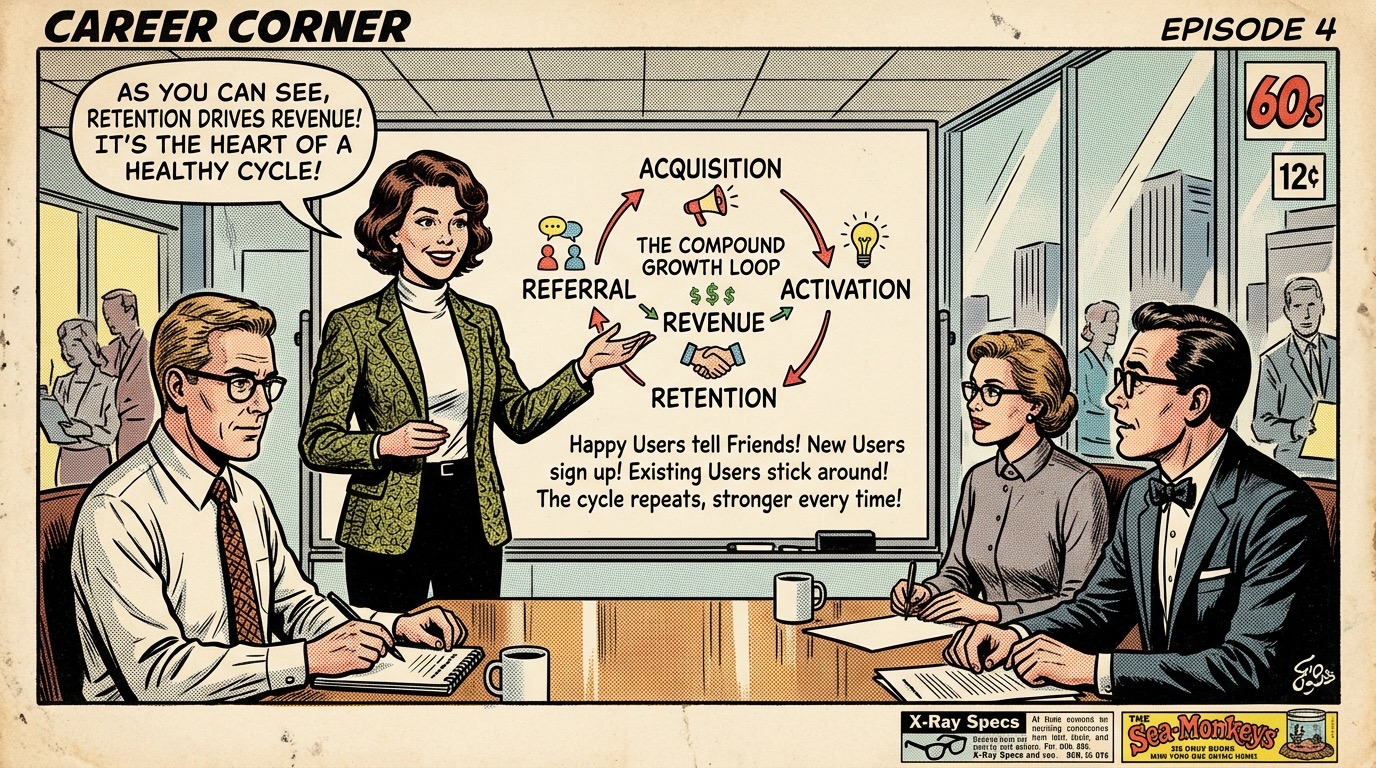
Growth marketing has fundamentally evolved from tactical acquisition tricks into a multidisciplinary, scientific discipline. Early in the tech startup boom, companies relied on fragmented growth hacks—clever email loops, social scraping, or aggressive ad spend—to produce quick spikes in vanity metrics. Today, modern product-led companies operate in a much more demanding landscape characterized by rising customer acquisition costs (CAC), signal degradation in paid advertising, and stringent privacy standards.
When modern hiring teams assess candidates with growth marketing interview questions, they are not asking for a list of ad channels or copywriting slogans. Interviewers want to understand how you conceptualize full-funnel user journeys, establish rigorous experimentation velocity, and build self-sustaining loops where customer acquisition, user activation, retention, and monetization compound over time.
Whether you are interviewing for a Growth Marketing Manager, Head of Growth, or Growth Product Manager position, this guide breaks down the core frameworks, technical analytical depth, and structured answers required to impress interview panels.
What Differentiates Growth Marketing in Modern Interviews?
Before exploring individual questions, it is vital to understand how interviewers differentiate growth marketing from related disciplines:
- Brand Marketing vs. Growth Marketing: Brand marketing builds awareness, sentiment, and long-term positioning. Growth marketing focuses on measurable pipeline, conversion efficiency, and iterative behavioral triggers across the entire lifecycle.
- Performance Marketing vs. Growth Marketing: As highlighted in our analysis of performance marketing interview questions, performance marketers concentrate primarily on paid media efficiency, creative iteration, ROAS, and bidding algorithms. Growth marketers take an end-to-end view, frequently partnering with product and engineering teams to optimize onboarding UX, activation milestones, referral mechanics, and pricing tiers.
- Product Marketing vs. Growth Marketing: While product marketers drive messaging, persona research, and competitive intelligence (as covered in our guide to product marketing manager interview questions), growth marketers focus on testing channels, validating hypotheses rapidly, and optimizing the velocity of the conversion funnel.
In an interview, demonstrating that you respect these boundaries while proactively collaborating across departments marks you as a senior, high-impact operator.
Core Frameworks Every Growth Marketer Must Master
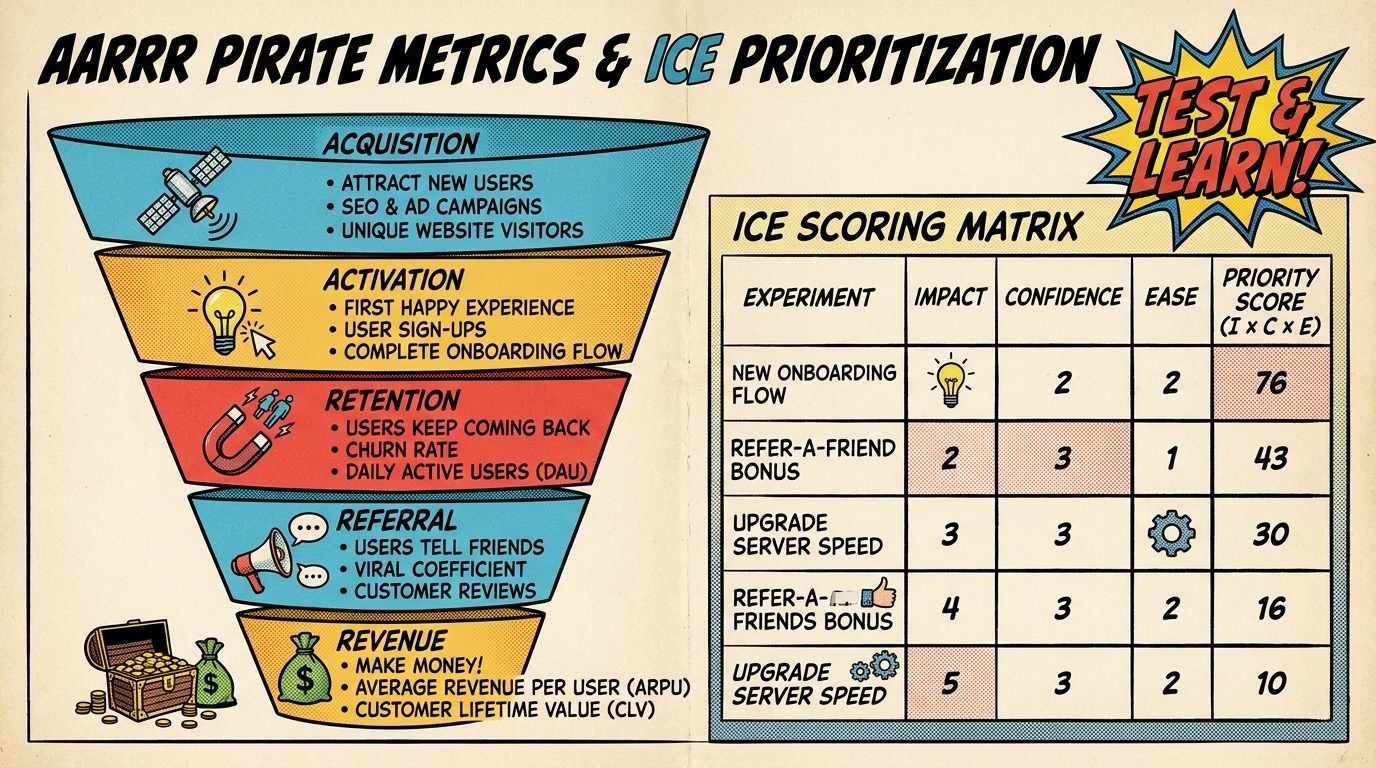
To communicate clearly under pressure, you need structured mental models. Top growth candidates lean heavily on two foundational frameworks: the AARRR Pirate Metrics funnel and the ICE/RICE prioritization scoring models.
1. The AARRR Pirate Funnel & Compounding Growth Loops
The traditional AARRR model (Acquisition, Activation, Retention, Referral, Revenue) remains the standard taxonomy for diagnosing where a business leaks value:
- Acquisition: Which channels bring qualified, high-intent traffic to the front door? (Metrics: Cost per Acquisition, Blended CAC, Channel Click-Through Rate).
- Activation: Do users experience the product's core value proposition ("Aha! moment") within their first session? (Metrics: Onboarding completion rate, Time-to-Value [TTV], Setup Milestone rate).
- Retention: Do cohorts return consistently over daily, weekly, or monthly cycles? (Metrics: N-day retention curves, Net Revenue Retention [NRR], Churn Rate).
- Referral: Do active customers naturally invite peers or generate organic word-of-mouth loops? (Metrics: Viral Coefficient K-factor, Referral Invite Rate, Viral Cycle Time).
- Revenue: How effectively does the platform convert active usage into sustainable cash flow? (Metrics: Average Revenue Per User [ARPU], Customer Lifetime Value [LTV], Payback Period).
In senior interviews, candidates should always emphasize that retention must precede acquisition. Pouring paid traffic into an unactivated or leaky bucket incinerates capital. Compounding loops where retained users generate content or invite colleagues create durable enterprise moats.
2. Experiment Prioritization: ICE vs. RICE
Growth teams rarely fail due to a shortage of ideas; they fail due to disorganized execution. Interviewers expect you to explain how you filter dozens of team suggestions into an actionable sprint backlog:
- Impact (1–10): If this experiment succeeds, how dramatically will it move our primary North Star Metric?
- Confidence (1–10): What objective data, qualitative user research, or past test results back up this hypothesis?
- Ease (1–10): How many engineering, design, and marketing hours will it take to build and deploy?
By averaging or multiplying these scores (Score = (Impact + Confidence + Ease) / 3), you establish a transparent, objective roadmap that keeps stakeholders aligned.
Top Growth Marketing Interview Questions & Strategic Answers
Question 1: "How do you systematically design and validate a growth experiment from hypothesis to rollout?"
What the Interviewer Is Probing:
Do you follow a disciplined scientific method, or do you haphazardly run disconnected tweaks hoping something clicks?
High-Scoring Answer Structure:
- Observation & Data Mining: Identify friction in the customer journey using funnel drop-off analytics, session recordings, or customer survey responses.
- Formulate a Testable Hypothesis: Follow a strict grammatical formula: "Based on [data/observation], we believe that [introducing change X] for [user segment Y] will result in [measurable outcome Z], because [psychological or UX rationale]."
- Define Primary & Guardrail Metrics: Set a single primary success metric (e.g., Day-7 activation rate) and strict guardrail metrics (e.g., unsubscribes, refund rates, or page load latency) to ensure improvements in one area do not destroy another.
- Determine Sample Size & Runtime: Calculate the minimum detectable effect (MDE) and run duration required to hit 95% statistical significance before launching, preventing premature stopping bias.
- Analyze, Document, and Iterate: Whether the experiment wins, loses, or remains flat, document key learnings in a centralized knowledge base and share findings cross-functionally.
Question 2: "Our Customer Acquisition Cost (CAC) jumped 40% quarter-over-quarter while payback periods doubled. How would you diagnose and solve this?"
What the Interviewer Is Probing:
Your root-cause analytical capability, familiarity with unit economics, and ability to remain calm amidst operational fires.
High-Scoring Answer Structure:
- Segment Blended CAC into Component Channels: Begin by disaggregating overall CAC into paid acquisition, organic inbound, referral, and sales-assisted channels. A spike in blended CAC is frequently caused by a channel mix shift (e.g., ramping expensive paid search while organic blog traffic plateaus).
- Evaluate Channel-Specific Ad Mechanics: Inspect auction dynamics, ad creative fatigue, frequency caps, and audience saturation on paid platforms (Meta, Google, LinkedIn).
- Audit Post-Click Conversion Efficiency: Did the landing page conversion rate drop due to tracking broken by browser updates, an untested redesign, or latency regressions?
- Assess Pricing and Cohort Quality: If marketing is driving low-intent traffic that churns within the trial window, the denominator of your payback equation collapses.
- Immediate Remediation Plan: Pause bottom-quartile ad sets, reallocate spend to proven high-intent search campaigns, launch a quick onboarding activation test, and optimize referral incentives to generate zero-CAC customer invites.
Question 3: "How do you identify a product's 'Aha! moment' and optimize onboarding around it?"
What the Interviewer Is Probing:
Your understanding of product-led growth (PLG) and the mathematical relationship between early user milestones and long-term retention.
High-Scoring Answer Structure:
- Correlational vs. Causal Discovery: Explain how you identify early behavioral clusters that correlate with high 90-day retention (classic examples: Slack finding that teams sending 2,000 messages retain at 93%, or Twitter discovering users following 30 accounts stay active).
- Isolating Friction in Onboarding: Use session analytics to strip away unnecessary form fields, redundant confirmations, and passive tutorials that delay the moment of value.
- Guided Time-to-Value (TTV): Introduce personalized onboarding checklists, interactive product walkthroughs, and smart defaults that pre-populate templates or workspace data so the user sees immediate value in their first 5 minutes.
- Experimentation Verification: Run an A/B test where one cohort receives the accelerated path to the target milestone to verify that reaching the action faster causally drives higher cohort retention.
Question 4: "What are the most frequent mistakes growth marketers make in A/B testing, and how do you prevent them?"
What the Interviewer Is Probing:
Statistical literacy, intellectual honesty, and awareness of confirmation bias.
High-Scoring Answer Structure:
- Peeking and Early Stopping: Checking dashboards daily and terminating a test the moment p < 0.05 inflates false positives (Type I errors). I enforce fixed-horizon testing or sequential testing methods.
- Ignoring Statistical Power & Sample Size: Running tests on low-traffic pages where detecting a 3% uplift would require 9 months of traffic. I prioritize high-volume surface areas or test bolder, high-leverage variations.
- Novelty Effects vs. True Lift: Sudden UI changes often generate brief curiosity clicks that regress to baseline within two weeks. I ensure tests run for full weekly business cycles to smooth out weekend and weekday behavioral variance.
- Failure to Monitor Guardrail Metrics: Celebrating a 15% increase in lead captures when downstream sales qualification drops 30% indicates vanity optimization rather than business growth.
Behavioral and Cross-Functional Leadership Scenarios
As you advance from execution-focused roles to strategic leadership positions, interviewers spend significant time evaluating how you handle cross-functional friction. Growth marketers must constantly negotiate with engineers, product managers, data analysts, and executive stakeholders:
Handling Disagreements with Product and Engineering
When marketing proposes an experiment that engineers feel introduces technical debt, or that product designers worry degrades brand aesthetics, how do you respond?
Senior candidates emphasize evidence, bounded risk, and modular scoping. Instead of demanding a permanent product overhaul, propose an isolated, time-boxed pilot for 10% of new traffic. Agree upfront on the exact success criteria and cleanup commitments. Involving engineering leads in early ideation sessions ensures that technical feasibility is built into the hypothesis from day one.
What to Do When an Interviewer Asks a Scenario You Have Never Encountered
In high-stakes interviews, you will inevitably encounter unexpected domain scenarios—such as expanding into an unfamiliar geographic territory or troubleshooting an algorithmic disruption. When caught off guard, never guess blindly. Follow the principles outlined in our guide on when you don't know the answer during an interview: acknowledge the constraint honestly, clarify the core assumptions, and walk the interviewer through your foundational problem-solving methodology step by step.
If you are transitioning into growth from a traditional campaign or marketing management background, review our companion playbook on marketing manager interview questions to connect strategic narrative skills with data-driven experimentation.
Technical Metrics Cheat Sheet for Growth Marketers
Keep these formulas and standard benchmarks top of mind during case studies:
| Metric | Calculation | Target Benchmark |
|---|---|---|
| Customer Acquisition Cost (CAC) | Total Sales & Marketing Spend / New Customers Acquired | Varies by vertical; must be tied to LTV |
| Customer Lifetime Value (LTV) | (ARPU × Gross Margin %) / Churn Rate | Ideal LTV:CAC ratio is ≥ 3:1 |
| CAC Payback Period | CAC / (Monthly ARPU × Gross Margin %) | < 12 months for B2B SaaS; < 6 months for B2C |
| Viral Coefficient (K-Factor) | Invites Sent per User × Conversion Rate of Invites | K > 1 indicates self-sustaining viral growth |
| Net Revenue Retention (NRR) | (Starting ARR + Expansion - Contraction - Churn) / Starting ARR | > 110% indicates healthy compound expansion |
How to Prepare and Stand Out in Your Interview
Acing growth marketing interviews requires converting abstract mathematical concepts into fluent, natural verbal communication under pressure. Reviewing formulas on a page is rarely enough when an executive panel questions your CAC attribution model or asks you to critique their current signup flow.
To build genuine interview confidence:
- Practice Dynamic Case Scenarios: Use totop.app to simulate realistic, interactive mock interviews with intelligent AI interviewers that evaluate your experiment design logic, analytical precision, and communication clarity in real time.
- Deepen Technical Literacy: If your growth role borders product analytics, SQL data pipelines, or technical tracking architecture, review our foundational guide to technical interview preparation to communicate effortlessly with data engineering partners.
- Build a Personal Experiment Portfolio: Prepare 2 to 3 detailed case studies detailing a hypothesis you formed, the quantitative test design you deployed, the obstacles encountered, and the measurable revenue or retention impact achieved.
Growth marketing rewards curiosity, rigorous logic, and resilience in the face of failed experiments. Approach your interview with structured frameworks, speak in the language of unit economics, and demonstrate how your experimentation engine drives sustainable enterprise value.
Practice Growth Marketer Questions Live with AI Mock Interviews
Turn any job description across Engineering, DevOps, Data, Marketing, Sales, Finance, or HR into a personalized test and live voice or text AI mock interview on totop.app, or test your speed right now in the 60-Second Growth Marketer Blitz.
Play 60s Growth Marketer Blitz (Free, No Login) | Start 14-Day Free Trial | Browse All Interview Guides