Performance Marketing Interview Questions & Answers

Walking into a performance marketing interview in 2026 feels remarkably different from pitching ad budgets five years ago. Hiring leaders no longer ask if you know how to toggle Facebook Ads Manager or launch a Google Search campaign. Machine learning automation, Meta Advantage+, and Google Performance Max have democratized basic campaign execution.
Instead, interviewers want to test your mathematical discipline, economic intuition, and analytical rigor. Can you dissect unit economics when signal loss obscures conversion tracking? Do you understand the difference between platform-reported ROAS and true incremental business lift? Can you defend an eight-figure paid media budget in front of a skeptical CFO?
Whether you are interviewing for a Senior Growth Marketer, Paid Media Lead, or Head of Performance Marketing position, this guide breaks down the core performance marketing interview questions, foundational unit economics, diagnostic frameworks, and attribution trade-offs tested by top hiring teams.
What Hiring Teams Look For in Performance Marketers
Modern performance marketing lives at the intersection of quantitative finance, behavioral psychology, and rapid creative iteration. During your interview loop, evaluators evaluate your expertise across three distinct pillars:
- Unit Economics & Financial Acumen: Understanding how paid acquisition integrates with the general ledger. You must speak fluently about Customer Acquisition Cost (CAC), Lifetime Value (LTV), Payback Period, and Profit on Ad Spend (POAS).
- Channel Mastery & Experimentation Rigor: Knowing how to allocate capital efficiently across Google, Meta, TikTok, YouTube, and Programmatic networks, while maintaining a structured hypothesis testing backlog.
- Measurement, Attribution & Incrementality: Navigating privacy shifts, server-side tracking (CAPI), and statistical lift testing to verify that your campaigns drive genuine net-new revenue rather than claiming credit for organic demand.
To ensure your preparation covers both strategic and tactical perspectives, review our companion guides on digital marketing interview questions and strategic marketing manager interview questions and frameworks.
Essential Performance Marketing Metrics & Formulas
Before diving into situational interview scenarios, ensure that you can calculate and explain these core growth marketing metrics under interview pressure.
Core Metrics Summary
| Metric | Formula | Strategic Significance |
|---|---|---|
| Paid CAC | Total Paid Ad Spend / Paid Conversions | Measures channel-specific acquisition efficiency. |
| Blended CAC | (Total Paid Spend + Tooling + Agency Fees) / Total New Customers | Evaluates overall acquisition health including organic halo. |
| ROAS | Gross Revenue Attributed to Ads / Ad Spend | Tactical campaign return; sensitive to platform over-reporting. |
| POAS | Gross Profit Attributed to Ads / Ad Spend | Reflects real contribution margin after cost of goods sold. |
| MER | Total Gross Revenue / Total Marketing Ad Spend | High-level macro efficiency ratio across all channels. |
| LTV:CAC Ratio | Customer Lifetime Value / Customer Acquisition Cost | Benchmark for scalable unit economics (healthy target: 3:1 to 4:1). |
| Payback Period | CAC / (Average Monthly Revenue per User × Gross Margin %) | Measures cash flow velocity and capital recycling rate. |
When asked cac roas interview questions, always highlight the distinction between vanity metrics and cash flow. For instance, a ROAS of 4.0x looks impressive on a slide deck, but if gross margins are 25%, the business is merely breaking even on ad spend before accounting for overhead.
Top Technical & Strategic Performance Marketing Interview Questions
Question 1: "Your blended CAC spikes by 35% week-over-week while ROAS drops. Walk me through your diagnostic workflow."
What the Interviewer Is Really Testing
The interviewer wants to see if you panic and immediately slash budgets, or if you apply a structured, hypothesis-driven forensic methodology to isolate root causes.
How to Structure Your Answer
Frame your response using a top-down diagnostic sequence:
- Verify Tracking & Data Pipeline Integrity:
- Did the tracking pixel, Google Tag Manager container, or Conversions API (CAPI) break?
- Check if an engineer pushed a frontend website deployment that dropped checkout event triggers or caused script errors.
- Deconstruct the Funnel Metrics:
- Break down CAC into its upstream component levers: $\text{CAC} = \frac{\text{CPM}}{\text{CTR} \times \text{CVR} \times \text{AOV}}$
- CPM Spike: Did CPM rise due to auction competition, macro holiday seasonality, audience saturation, or narrow audience targeting?
- CTR Drop: Are creatives experiencing audience fatigue? Has ad frequency climbed above acceptable thresholds?
- CVR Collapse: Did on-page conversion rate plummet? Check website page load speed, mobile responsiveness, checkout gateway errors, or unexpected out-of-stock notices.
- Analyze Channel and Audience Mix Shifts:
- Did budget accidentally shift into unproven experimental campaigns or broad audience tests?
- Is a high-performing evergreen creative suddenly fatigued after weeks of heavy scaling?
- Actionable Remediation Plan:
- Temporarily pause severely bleeding ad sets while protecting stable baseline campaigns.
- Rotate fresh creative hooks and visual angles into testing ad sets.
- Communicate the finding transparently to stakeholders with an estimated recovery timeline.
Question 2: "How do you navigate attribution and measure true incrementality in a post-cookie landscape?"
What the Interviewer Is Really Testing
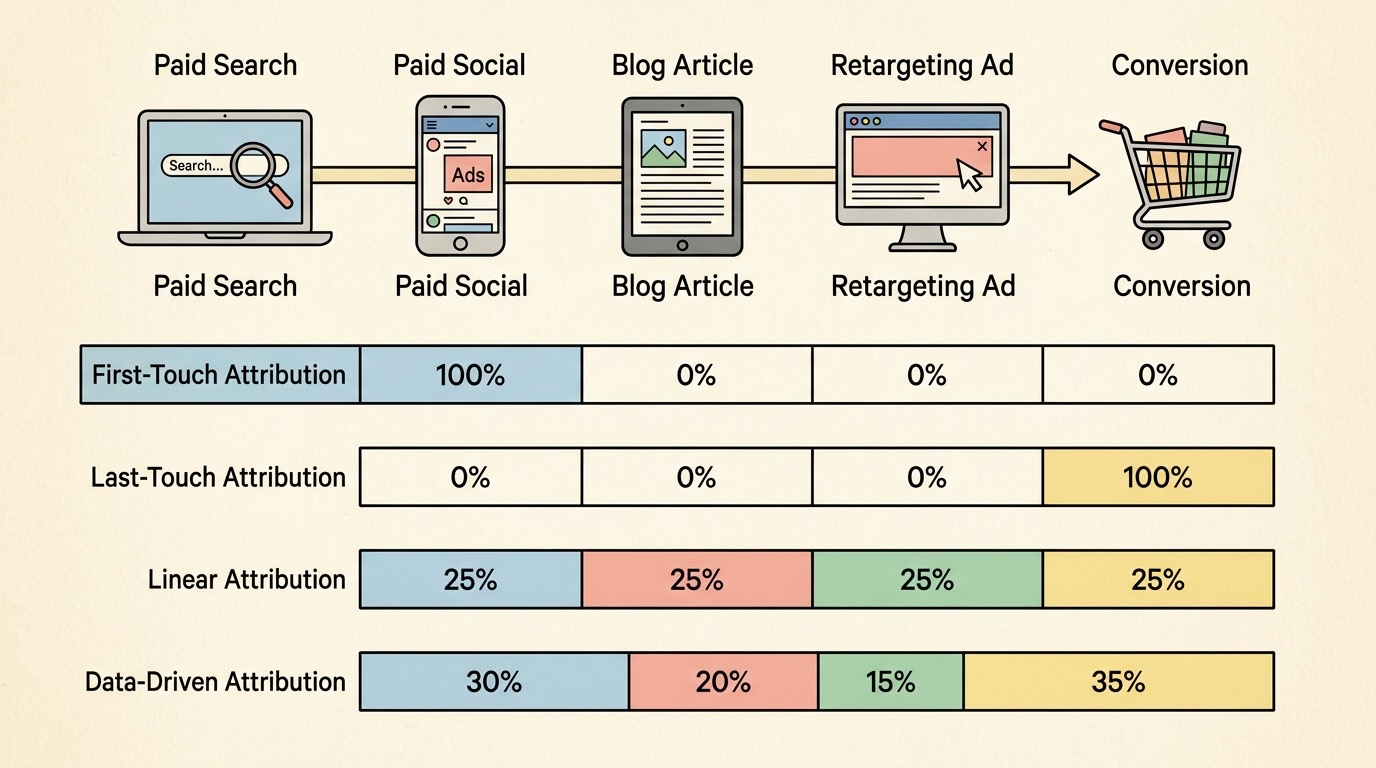
With Apple's App Tracking Transparency (ATT), Chrome third-party cookie phaseouts, and browser tracking prevention, self-reported network dashboards (Meta Ads Manager and Google Ads) frequently double-count the same conversion. Interviewers look for candidates who understand marketing attribution models and modern incrementality testing.
How to Structure Your Answer
Walk the interviewer through the evolution of attribution models:
- Single-Touch Attribution (First-Touch vs. Last-Touch):
- First-Touch credits top-of-funnel discovery channels (e.g., YouTube, TikTok, non-brand search) but ignores nurturing.
- Last-Touch disproportionately favors bottom-of-funnel capture channels (e.g., branded search, retargeting) while starving discovery channels of budget.
- Multi-Touch Attribution (MTA):
- Distributes credit across touchpoints (Linear, Time-Decay, U-Shaped, or algorithmic Data-Driven Attribution). While MTA was popular historically, deterministic MTA has degraded significantly due to cross-device signal loss and cookie blocking.
- Modern Triangulation Framework:
- Modern growth teams do not rely on a single attribution model. Instead, explain that you triangulate truth using three distinct measurement methodologies:
- Platform In-App Telemetry (Tactical Day-to-Day): Used for intra-day optimization, automated bid adjustments, and ad creative iteration.
- Incrementality Lift Testing & Geo-Holdout Experiments (Strategic Validation): Run matched-market tests (e.g., holding out paid search in specific geographic regions while maintaining spend in control regions) to calculate true causal incremental lift (iROAS and iCAC).
- Marketing Mix Modeling (MMM): Statistical regression modeling (such as Meta Robyn or Google LightweightMMM) that analyzes historical spend patterns against top-line revenue without relying on user-level identifiers.
- Modern growth teams do not rely on a single attribution model. Instead, explain that you triangulate truth using three distinct measurement methodologies:
For cross-functional perspectives on positioning product value alongside growth metrics, consult our breakdown of product marketing manager interview questions.
Question 3: "How do you structure capital allocation and creative testing across paid channels?"
What the Interviewer Is Really Testing
Can you systematically scale profitable channels while sustaining an innovation engine that discovers the next growth channel before existing ones reach diminishing marginal returns?
How to Structure Your Answer
Describe your approach to paid media strategy interview scenarios using the 70/20/10 Budget Allocation Framework:
┌──────────────────────────────────────────────────────────┐
│  70% CORE SCALING ENGINE                                 │
│  Proven channels & evergreen winners (Meta, Google PMax) │
├──────────────────────────────────────────────────────────┤
│  20% HYPOTHESIS & SECONDARY CHANNELS                     │
│  Scaling emerging channels (TikTok, YouTube, Pinterest)  │
├──────────────────────────────────────────────────────────┤
│  10% EXPERIMENTAL BETS                                   │
│  High-risk creative concepts, new ad formats, affiliates │
└──────────────────────────────────────────────────────────┘
- 70% Core Scaling Engine: Allocated to validated channels with predictable unit economics (e.g., Meta broad targeting and Google Performance Max with strict cost caps or target ROAS).
- 20% High-Potential Secondary Channels: Dedicated to emerging channels that demonstrate promising traction but require optimization (e.g., scaling YouTube Shorts, LinkedIn sponsored content, or TikTok spark ads).
- 10% R&D and Moonshot Experiments: Uncapped creative concepting, new platform betas, influencer whitelisting, or untested landing page mechanics.
Detail how creative acts as the primary targeting lever in modern algorithmic bidding. Explain how you produce modular creative variations (testing 3 distinct hooks, 2 body narratives, and 2 calls-to-action to yield 12 unique video ad permutations per sprint).
Question 4: "When would you intentionally accept a higher Customer Acquisition Cost?"
What the Interviewer Is Really Testing
Junior marketers believe lower CAC is always better. Senior leaders know that artificially suppressing CAC often starves the top of the funnel and limits overall enterprise enterprise value.
Key Strategic Trade-Offs to Highlight:
- Higher LTV Customer Cohorts: If Enterprise tier customers or high-frequency annual subscribers cost $600 to acquire but produce $4,000 in LTV, paying a higher CAC yields dramatically superior gross profit compared to acquiring $50 monthly users for $30 CAC.
- Capturing Market Share & Brand Defense: In venture-backed or hyper-growth environments, land-grabbing dominant category mindshare before network effects solidify can justify aggressive customer acquisition.
- Seasonal Liquidation or New Product Launches: Launching a flagship product line requires critical mass to drive algorithmic momentum, customer reviews, and viral word-of-mouth loops.
- Expansion of Market Size: When you scale spend, marginal CAC naturally increases as you move from high-intent searchers into broader prospective audiences. As long as marginal contribution margin remains net-positive, expanding total dollar profit is the right economic decision.
Question 5: "How do you communicate a failed marketing campaign to executive leadership?"
What the Interviewer Is Really Testing
Executive presence, transparency, and blameless post-mortem accountability. When an experiment underperforms, leaders want objective data and clear lessons learned rather than excuses.
Recommended Communication Framework:
- Lead with Bottom-Line Business Impact: State the numbers plainly without sugarcoating (e.g., "Our Q3 YouTube video campaign generated a 0.8x ROAS against our 1.5x target, resulting in a